
Updated: September 2026| Reading Time: 19minutes
Quick Answer : Dog ICU Cost Per Day in the USA
Dog ICU care in the U.S. often runs about $500–$2,000 per day, with more intensive cases potentially reaching $3,000 or more depending on the hospital, monitoring, and treatments required. These figures are planning ranges, not a standardized national ICU rate. Some sources report the ICU charge separately, while others bundle hospitalization, monitoring, medications, diagnostics, or treatment into the total depending on treatment intensity, monitoring level, and hospital type. Standard hospitalization (stable patients, periodic monitoring) tends to run $200–$600 per day, while true intensive care — continuous monitoring, oxygen support, IV medications — runs $500–$2,000+ per day, and cases requiring ventilation, transfusions, or advanced life support can push past $3,500 per day. A multi-day ICU stay commonly totals $3,000 to $10,000+.
Read Related Article… Emergency Vet Costs in the USA (2026): What You’ll Really Pay by State
Quick Cost Summary
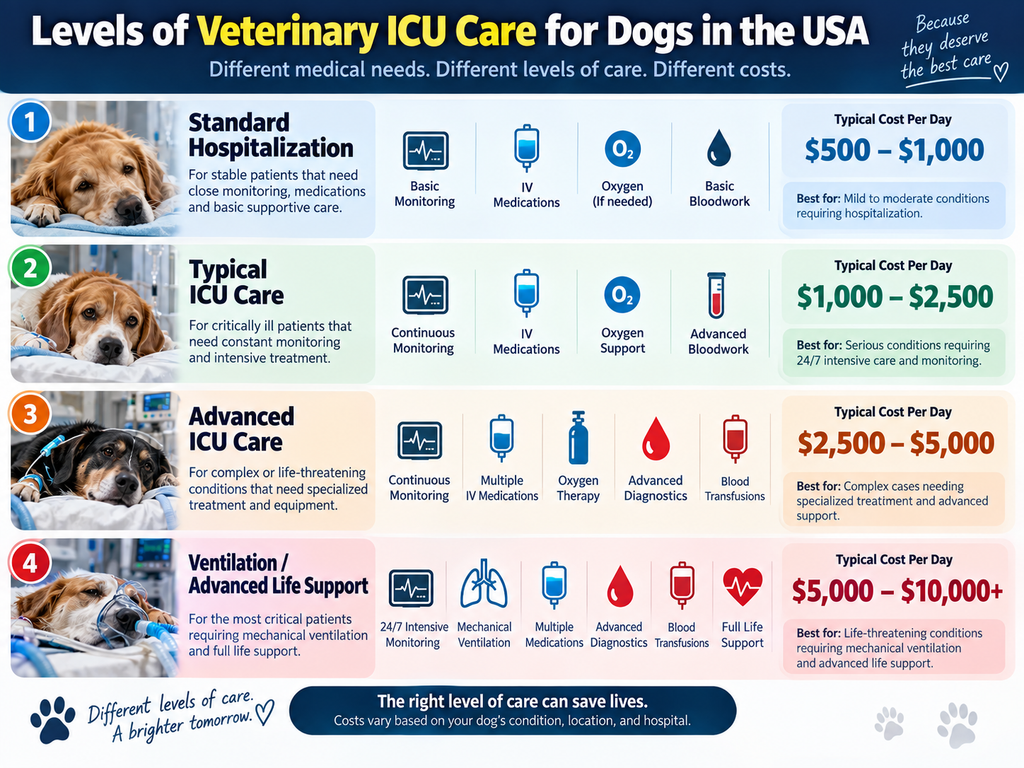
| ICU Situation | Approx. US Cost |
|---|---|
| Standard hospitalization (stable, periodic checks) | $200–$600/day |
| Typical ICU care (continuous monitoring, IV meds) | $500–$2,000/day |
| Advanced ICU (oxygen, frequent bloodwork, specialist involvement) | $1,000–$3,500/day |
| Ventilation, transfusion, or advanced life support | Can exceed $3,500/day |
| Short critical monitoring (1 day or partial day) | $1,500–$3,000+ total |
| Typical 1–3 day ICU stay | $3,000–$7,000+ total |
| Complex/prolonged ICU stay (4+ days) | $7,000–$12,000+ total |
These are planning ranges from multiple industry sources, not guaranteed prices — actual cost depends on your dog’s condition, the hospital, your location, and length of stay.
Table of Contents
- How Much Does Dog ICU Cost Per Day?
- How Much Does a Dog ICU Stay Cost Overall?
- How Much Does Dog ICU Cost for 1, 3, 5, or 7 Days?
- What Does the Daily ICU Fee Include — and What Costs Extra?
- What’s Included in a Dog ICU Bill?
- Why Is My Dog’s ICU Bill So High?
- What Makes ICU Costs Increase?
- Dog ICU vs. Regular Hospitalization
- When Does a Dog Need ICU Care?
- What Makes a Dog ICU Bill Increase?
- How Much Can Oxygen, Blood Transfusions, or Ventilation Add?
- How Long Do Dogs Usually Stay in the ICU?
- When Can a Dog Move From ICU to Regular Hospitalization?
- Does the Hospital Require an Upfront Deposit?
- Can You Ask for a Daily or Itemized ICU Estimate?
- Does Pet Insurance Cover Dog ICU Costs?
- What If You Can’t Afford Your Dog’s ICU Bill?
- Questions to Ask Your Vet Before Agreeing to ICU Care
- FAQ
How Much Does Dog ICU Cost Per Day?
Dog ICU care typically costs $500 to $2,000 per day for standard intensive care, with more advanced cases reaching $1,000 to $3,500+ per day.
There’s no single national daily rate, and sources vary in exactly how they define “per day” — some are quoting ICU-specific charges only, while others blend in hospitalization, monitoring, and treatment as one bundled daily figure. Healthy Paws puts ICU hospitalization at $500–$2,000 per day versus $200–$600 for standard hospitalization. A separate industry cost calculator cites $1,000–$3,500 per day specifically for intensive care, versus $500–$1,500 for standard emergency hospitalization. The gap between these figures usually comes down to what’s bundled in — a quote that only covers the “cage fee” looks very different from one that includes monitoring, medications, and repeat diagnostics.
How Much Does a Dog ICU Stay Cost Overall?
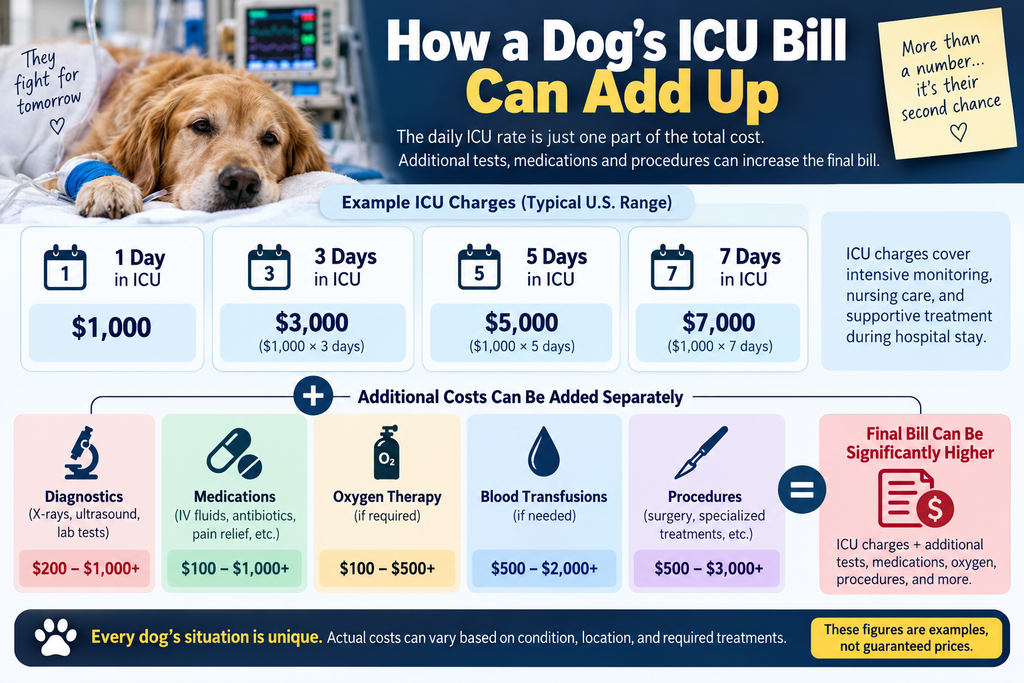
Most ICU stays run $3,000 to $7,000 for a typical 1–3 day admission, while complex or prolonged cases (4 or more days) commonly reach $7,000 to $12,000 or more.
The math is straightforward once you have a daily rate estimate: a $1,000/day ICU stay for three days is $3,000 before diagnostics, medications, or the underlying treatment are even added. This is why a “$3,000 surgery” with a few days of post-op ICU monitoring can easily become a $6,500+ final bill — the surgery and the ICU stay are two separate cost categories that get added together, not one number.
| ICU Stay | Example Daily Rate | ICU Cost |
|---|---|---|
| 24 hours | $1,000 | ~$1,000 |
| 3 days | $1,000 | ~$3,000 |
| 5 days | $1,000 | ~$5,000 |
| 7 days | $1,000 | ~$7,000 |
How Much Does Dog ICU Cost for 1, 3, 5, or 7 Days?
Dog ICU costs can add up quickly because each additional day usually adds another ICU or hospitalization charge, while medications, diagnostics, oxygen, and other treatments may be billed separately. Current U.S. cost data places ICU-level care roughly around $500–$1,500+ per night, although some emergency and specialty hospitals may charge more depending on the level of care.
For example, using a $1,000 daily ICU rate:
| ICU Stay | Approx. ICU Charges* |
|---|---|
| 1 day | ~$1,000 |
| 3 days | ~$3,000 |
| 5 days | ~$5,000 |
| 7 days | ~$7,000 |
A 3-day stay could therefore cost around $3,000 in ICU charges alone, while a week could approach $7,000 before additional diagnostics or intensive treatments are added. Real-world total ICU hospitalization costs can vary substantially; current 2026 sources report total stays ranging from roughly $1,500 to $12,000+ depending on severity, treatment intensity, and length of stay.
The most important question to ask your veterinary hospital is whether its quoted daily ICU rate includes monitoring, nursing care, medications, oxygen, and diagnostics—or whether those appear as separate charges.
What Does the Daily ICU Fee Include — and What Costs Extra?
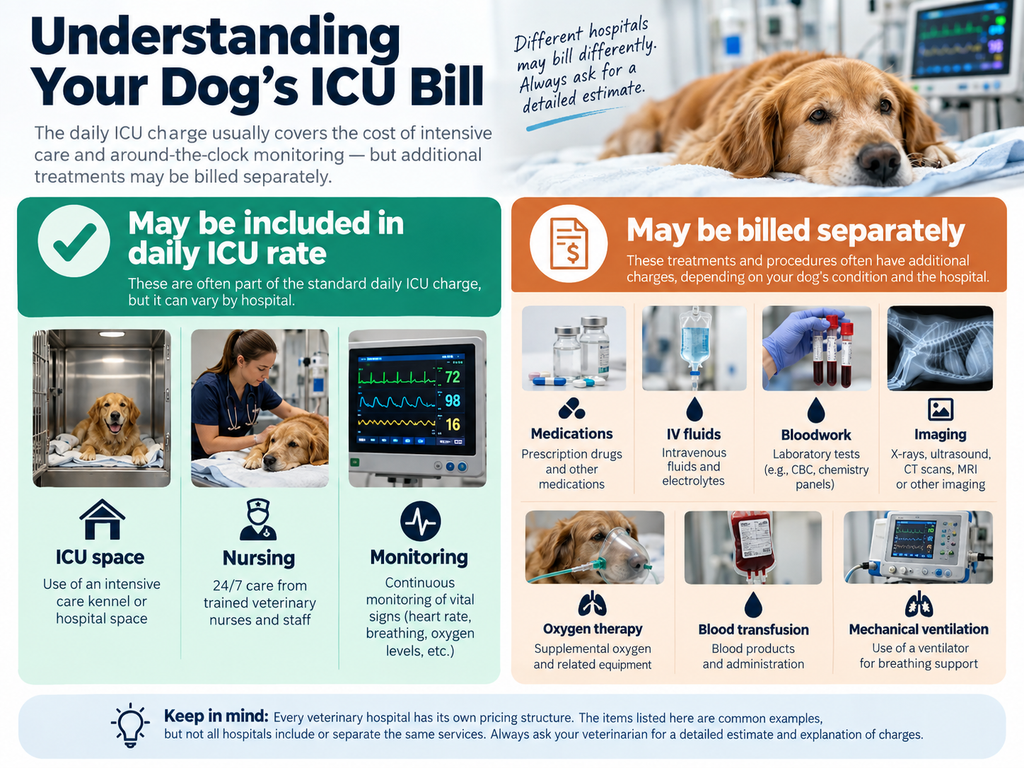
A dog’s daily ICU fee usually covers the hospital space, intensive nursing care, and continuous or frequent monitoring. Depending on the hospital, the daily rate may also include routine vital-sign checks, basic nursing support, and some monitoring equipment. ICU-level care is generally more expensive because staff and equipment must be available around the clock.
However, the ICU fee is not necessarily the entire daily bill. Items that may be charged separately include:
- Emergency or specialist examination fees
- IV catheter placement and IV fluids
- Medications and injectable drugs
- Blood tests and repeat laboratory work
- X-rays, ultrasound, CT, or other imaging
- Oxygen therapy
- Blood transfusions or blood products
- Mechanical ventilation or other advanced support
- Procedures related to the condition causing the ICU admission
For example, recent veterinary cost data shows that IV fluids, medications, doctor assessments, bloodwork, imaging, and oxygen can appear as separate line items in addition to the daily hospitalization or ICU charge.
Read Related Article… Emergency Vet Exam Cost in the USA (2026)
Before agreeing to ICU care, ask the hospital which services are included in its daily ICU rate and which will be billed separately.
What’s Included in a Dog ICU Bill?
An ICU day typically bundles several things into one daily charge, which is part of why it costs meaningfully more than standard hospitalization.
Continuous or near-continuous monitoring — vital signs checked far more frequently than standard hospitalization, sometimes constantly via equipment. More intensive veterinary technician and nursing support, with monitoring performed more frequently than in standard hospitalization. IV fluids and medications, administered and adjusted throughout the day as your dog’s condition changes. Oxygen support, when needed. Repeat bloodwork or diagnostics, used to track whether treatment is working. Specialist involvement, particularly at referral hospitals with board-certified criticalists overseeing care.
Why Is My Dog’s ICU Bill So High?
The honest answer is that ICU care is expensive to provide, not just expensive to buy. Emergency and specialty hospitals staff licensed veterinarians and technicians around the clock, keep advanced equipment like ventilators, oxygen systems, and continuous monitors ready at all times, and often employ board-certified specialists whose expertise commands higher fees than general practice. That infrastructure sits ready whether or not it’s being used at any given moment, and the cost of maintaining it is spread across every patient who needs it.
A useful comparison: The same type of diagnostic test can cost more at an emergency or specialty hospital because you’re paying for a 24/7 facility, emergency staffing, monitoring, and the additional resources required for critical patients.
Bottom Line: ICU pricing reflects the cost of having a full critical-care team and equipment instantly available, every hour of every day — it’s a different operating model from your regular vet, not simply a markup on the same service.
What Makes ICU Costs Increase?
Several specific factors push a daily rate, or a total stay, toward the higher end of the range.
Length of stay is the single biggest multiplier — each additional day adds its own daily rate on top of everything already incurred. Oxygen support and mechanical ventilation are among the most expensive individual interventions, requiring specialized equipment and constant monitoring. Blood transfusions add both the cost of the blood product and the administration/monitoring time. Repeated bloodwork or imaging, used to track a changing condition, adds up over a multi-day stay. IV medications, especially specialized drugs like vasopressors used to support blood pressure in critical patients, carry their own cost. Specialist involvement — a board-certified criticalist overseeing a complex case — typically carries a premium over general ICU staff. Underlying condition severity matters enormously too: sepsis, severe trauma, respiratory failure, and poisoning cases tend to require more intensive, longer intervention than a more contained problem.
Read Related Article… Dog MRI Cost in the USA (2026): Average Cost, Insurance Coverage & Financing
Read Related Article… Dog CT Scan Cost in the USA (2026): Real Numbers, Hidden Charges, and How to Lower the Bill
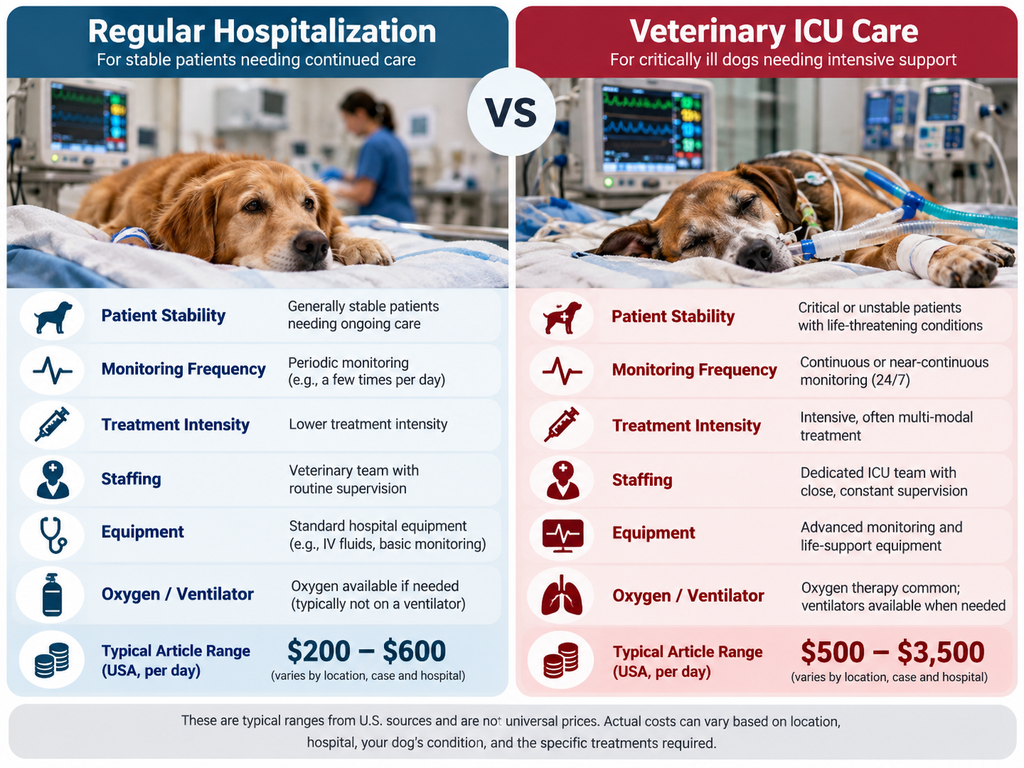
Dog ICU vs. Regular Hospitalization
| Factor | Regular Hospitalization | ICU Care |
|---|---|---|
| Monitoring frequency | Periodic checks | Continuous or near-continuous |
| Patient condition | Generally stable | Critically ill or high-risk |
| Treatment intensity | Lower | Higher — active intervention as needed |
| Typical cost | $200–$600/day | $500–$3,500/day |
| Staffing ratio | Standard | Lower patient-to-staff ratio |
| Equipment | Basic monitoring | Advanced — oxygen, ventilators, continuous monitors on standby |
Not every hospitalized dog needs ICU-level care — your vet determines the appropriate level based on how unstable your dog’s condition is, not simply how serious the diagnosis sounds.
When Does a Dog Need ICU Care?
A dog may need intensive care when its condition is unstable or requires monitoring and treatment that cannot be safely provided in a regular hospital ward. Veterinary ICUs commonly care for dogs with severe respiratory problems, oxygen dependence, unstable heart or blood pressure, severe infections or sepsis, major trauma, serious neurologic complications, severe metabolic problems, or complications after major surgery.
ICU-level care may also be recommended when a dog needs continuous monitoring, oxygen therapy, blood transfusion, IV medications, or mechanical ventilation. For example, dogs that cannot maintain adequate oxygen levels despite supplemental oxygen may require ventilatory support and much closer monitoring.
Read Related Article… Dog Poisoning Treatment Cost: How Much Will You Pay at the Vet?
Common situations that can lead to ICU admission include:
- Severe breathing difficulty or respiratory failure
- Sepsis or severe infection
- Shock or unstable blood pressure
- Major trauma or internal bleeding
- Severe pancreatitis
- Acute heart failure
- Serious poisoning
- Seizures or other neurological emergencies
- Complications following major surgery
Not every seriously ill dog needs ICU care. The veterinary team determines the appropriate level of hospitalization based on how unstable your dog is and how closely your dog needs to be monitored.
Read Related Article… Dog Pancreatitis Treatment Cost: What You’ll Pay in the USA (2026)
What Makes a Dog ICU Bill Increase?
Several factors can push a dog’s ICU bill toward the higher end of the range. Length of stay is one of the biggest drivers because each additional ICU day adds another round of monitoring, nursing care, medications, and treatment.
Your dog’s condition and treatment intensity also matter. Dogs with respiratory failure, sepsis, severe trauma, poisoning, or other unstable conditions may require more frequent monitoring and intervention than a dog needing short-term observation.
Additional costs can come from oxygen therapy, repeated bloodwork, X-rays or ultrasound, IV medications, blood transfusions, specialist consultations, and mechanical ventilation. These services may be billed separately from the daily ICU or hospitalization charge.
The hospital itself and your location can also affect pricing. Specialty and referral hospitals often have 24/7 staffing, advanced equipment, and specialist access, which can increase the overall cost.
How Much Can Oxygen, Blood Transfusions, or Ventilation Add?
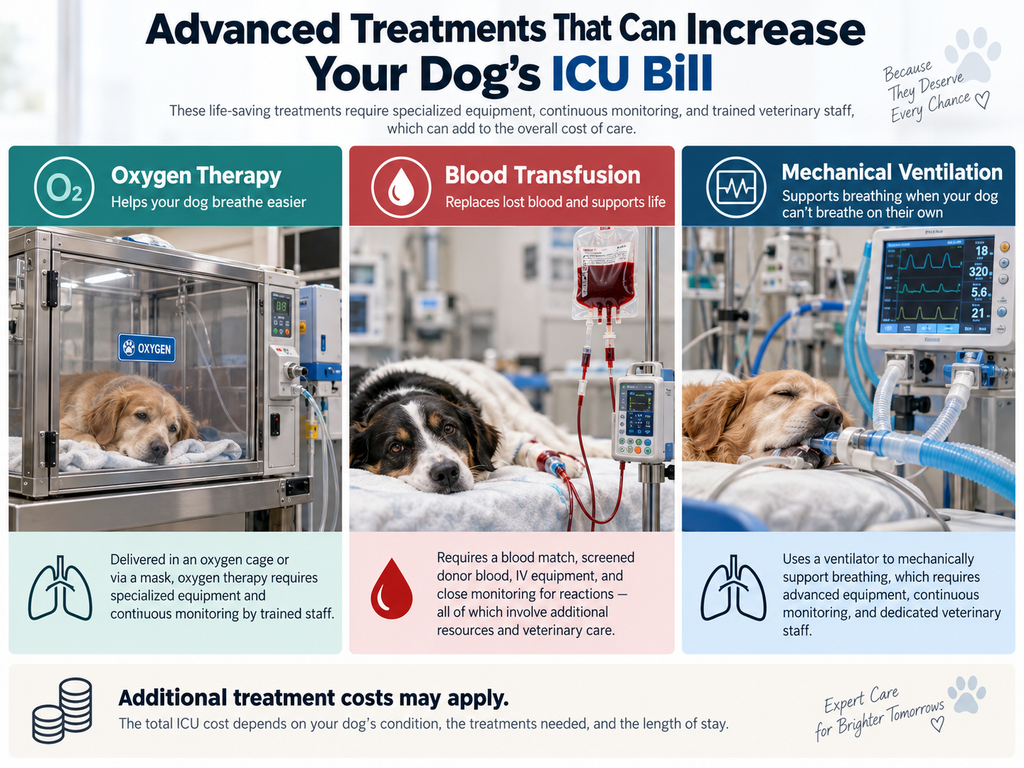
Oxygen, blood transfusions, and mechanical ventilation can increase a dog’s ICU bill substantially because they require specialized equipment, additional monitoring, and intensive nursing care.
Oxygen therapy: Current U.S. cost data puts emergency oxygen therapy around $1,194 for small dogs and $1,861 for large dogs, although the actual charge depends on the method and length of treatment. This is generally added to hospitalization and other treatment costs.
Blood transfusions: A transfusion can add hundreds to several thousand dollars depending on the blood product, number of units, blood typing, monitoring, and the underlying condition. Some current U.S. estimates place a transfusion episode around $500–$3,000.
Mechanical ventilation: This is one of the most expensive forms of respiratory support. Current veterinary cost guidance estimates roughly $1,500–$2,000 for the first day and about $1,500 per additional day, with prolonged ventilator cases potentially exceeding $15,000 overall.
Read Related Article… Dog Blood Transfusion Cost: What You’ll Actually Pay in the USA (2026)
How Long Do Dogs Usually Stay in the ICU?
Stay length depends entirely on the underlying condition and how quickly your dog stabilizes — many critical but treatable cases resolve within 1–3 days, while more severe or complicated conditions (sepsis, major trauma, severe pancreatitis, poisoning with ongoing organ effects) can require 4 or more days.
Your vet typically can’t guarantee an exact discharge date upfront, since it depends on how your dog responds to treatment day by day. This uncertainty is one of the most common sources of bill anxiety, since owners often go in expecting a set number and instead face daily updates.
When Can a Dog Move From ICU to Regular Hospitalization?
A dog can usually move from the ICU to regular hospitalization once their condition is stable enough that they no longer need continuous monitoring or intensive treatments. The exact decision depends on the underlying illness and how your dog responds to treatment.
Your veterinary team may consider moving your dog out of the ICU when:
- Vital signs are stable without constant intervention
- Oxygen support is no longer needed, or the level of support has decreased
- Blood pressure and heart rate are stable
- IV medications or continuous infusions are no longer required
- Frequent blood tests or other intensive monitoring are no longer necessary
- Your dog is responding consistently to treatment
For example, a dog that initially needs oxygen, continuous monitoring, and frequent medication adjustments may move to standard hospitalization after those needs decrease. Veterinary hospitals often have intermediate-care areas specifically for patients who are medically stable but still need inpatient treatment.
The move does not necessarily mean your dog is ready to go home. It usually means the level of monitoring and treatment can be safely reduced while your dog continues recovering in the hospital.
Does the Hospital Require an Upfront Deposit?
Often, yes. Many U.S. emergency and specialty veterinary hospitals require an upfront deposit when a dog is admitted for hospitalization or ICU care. The amount varies by hospital and may be based on the estimated cost of treatment. Some hospitals require a percentage of the estimate, while others may collect the low end of the estimate before admission. For example, NC State Veterinary Hospital requires a minimum deposit equal to the low end of the estimate for hospitalized cases, while the University of Florida requires 75% of the estimated cost for hospital admission.
The deposit is generally applied toward your final bill, rather than being an additional fee. If your dog’s condition changes and treatment costs increase, the hospital may request an additional deposit.
Before agreeing to ICU care, ask for a written estimate and specifically ask how much is required upfront, what the estimate includes, and when you will be contacted if costs are expected to exceed it.
Can You Ask for a Daily or Itemized ICU Estimate?
Yes. If your dog is receiving ICU care, you can ask the veterinary team for a written estimate showing what the current ICU rate includes and which services may be billed separately. Veterinary financial guidance recommends discussing costs early and providing clear written estimates, especially when treatment may change over time.
Ask the hospital:
- What is the estimated cost for the next 24 hours?
- What does the daily ICU charge include?
- Which services are billed separately?
- What treatments could increase the estimate?
- Can you give me a low-to-high estimate?
- When will you update me if the expected cost changes?
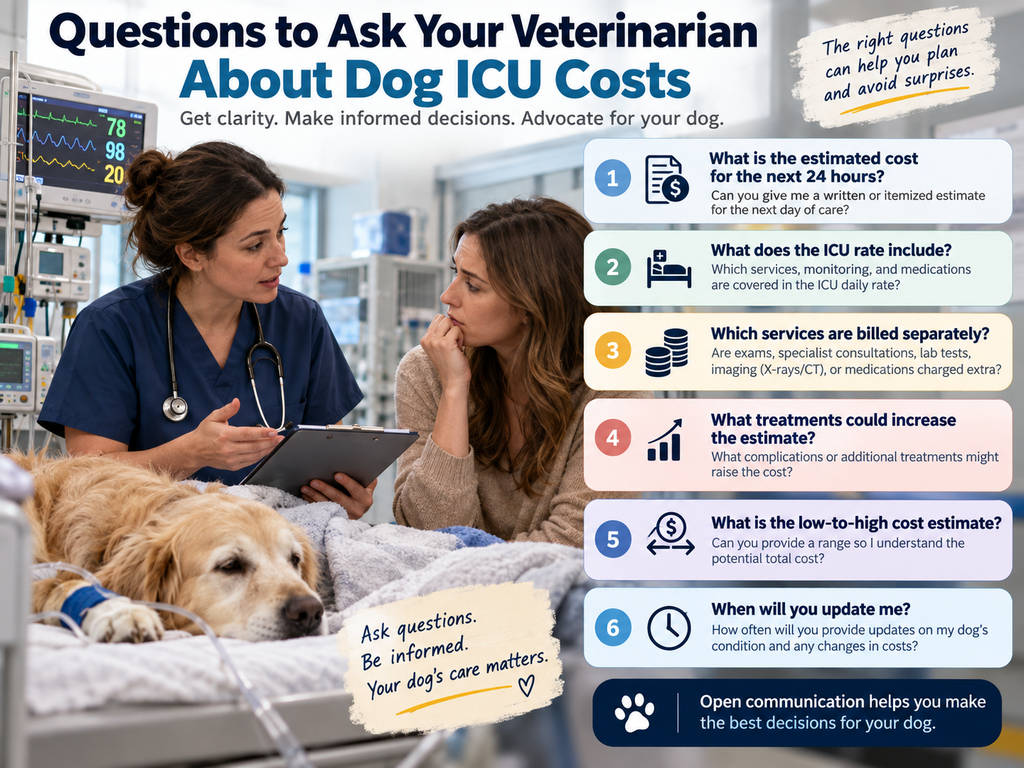
This is particularly important because hospitalization, diagnostics, medications, oxygen therapy and other treatments can add to the emergency bill beyond the initial examination or hospitalization charge.
If your dog is expected to remain hospitalized for several days, ask whether the hospital can provide an updated estimate each day so you understand the expected cost before additional non-emergency expenses are incurred.
Does Pet Insurance Cover Dog ICU Costs?
Many accident-and-illness pet insurance plans cover ICU hospitalization as part of a covered emergency, since intensive care is generally billed alongside whatever accident or illness caused the admission — but coverage depends entirely on your specific policy’s terms.
Reimbursement mechanics follow the usual structure: your deductible applies first, then your reimbursement percentage (commonly 70–90%) applies to the remaining eligible costs, up to your annual limit. It’s worth being direct about one thing: pet insurance generally doesn’t solve a crisis that has already started if the condition is considered pre-existing or falls within your policy’s waiting period — Many accident-and-illness policies may cover eligible ICU hospitalization when the underlying condition is covered, subject to the policy’s deductible, reimbursement rate, limits, exclusions, and waiting periods. If you’re already insured and past your waiting period, most ICU care tied to a covered accident or illness is a legitimate reimbursement claim.
Read Related Article… Does Pet Insurance Cover Emergency Vet Visits? What Most Dog Owners Don’t Know (2026)
What If You Can’t Afford Your Dog’s ICU Bill?
If the ongoing daily cost is more than you can sustain, say so directly to the care team — this is a common conversation in critical care, and veterinary teams increasingly walk owners through treatment options at different cost levels rather than presenting only one path.
Ask for a written, itemized estimate, updated as your dog’s condition changes. Ask specifically what care is essential right now versus what could reasonably be adjusted. Ask whether diagnostics can be staged — running only what’s needed to make the next decision, rather than everything at once. Ask whether step-down care is possible once your dog stabilizes — moving from ICU to standard hospitalization, or to at-home monitoring, as soon as it’s medically appropriate. Ask about Ask whether the hospital accepts financing options such as CareCredit or Scratchpay. Approval, terms, and availability vary. If you’re insured, contact your provider to understand your reimbursement timeline. For the complete breakdown of financing options, grant programs, and questions to ask before agreeing to treatment, see our full guide on what to do if you can’t afford emergency vet surgery.
Read Related Article… Can’t Afford an Emergency Vet Bill? 15 Real Ways Dog Owners Find Help (2026)
A note on how to use this information: these are financial questions to raise alongside your vet’s medical guidance, not substitutes for it — your veterinary team determines what level of care your dog’s condition actually requires.
Read Related Article… Vet Payment Plans: Can You Make Monthly Payments to a Vet? (2026)
Questions to Ask Your Vet Before Agreeing to ICU Care
- What’s included in the daily ICU rate you’re quoting me?
- Is my dog in standard hospitalization or true ICU-level care right now?
- What’s your best estimate for length of stay, and what would change it?
- Which specific treatments (oxygen, transfusion, ventilation) are you anticipating?
- Is step-down care an option once my dog stabilizes?
- Do you accept CareCredit or Scratchpay?
- If I’m insured, is there anything I should document now for my claim?
Frequently Asked Questions
How much does dog ICU care cost per day?
Dog ICU care can cost roughly $500–$2,000 per day, with more complex cases reaching $3,500 or more. Actual pricing depends on the hospital, monitoring, treatments, and what the daily ICU charge includes.
How much does a dog ICU stay cost overall?
A 1–3 day ICU stay can cost several thousand dollars, while prolonged or complex hospitalization can reach $10,000 or more. Diagnostics, medications, oxygen, procedures, and specialist care may be billed separately.
What does a dog ICU daily charge include?
It may include intensive monitoring, nursing care, hospitalization, and some basic supportive treatment. Oxygen, medications, diagnostics, transfusions, procedures, and specialist services may cost extra depending on the hospital.
Does pet insurance cover dog ICU hospitalization?
Many accident-and-illness policies can cover eligible ICU hospitalization, but coverage depends on the policy, deductible, reimbursement rate, annual limit, waiting period, and whether the condition is pre-existing.
How long do dogs usually stay in the ICU?
Some dogs need only 1–3 days of intensive care, while severe cases may require several more days. The length depends on how quickly the dog responds to treatment and becomes stable enough for regular hospitalization.
Can my dog move from ICU to regular hospitalization?
Yes. If your dog becomes stable enough, the veterinary team may move them from ICU-level care to standard hospitalization or another lower level of monitoring. This can reduce the daily cost while continuing necessary treatment.
Can I ask for an itemized dog ICU estimate?
Yes. Ask what the daily ICU charge includes, which services are billed separately, and what the expected cost is for the next 24 hours. You can also ask for an updated written estimate as your dog’s condition changes.
What if I can’t afford my dog’s ICU care?
Tell the veterinary team immediately. Ask about staged diagnostics, step-down care, payment plans, financing options, and an updated estimate so you understand which costs are medically necessary and what may come next.
External Authority Sources
- Healthy Paws Pet Insurance — emergency cost breakdown
- AVMA (American Veterinary Medical Association)
- Industry emergency vet cost data (Pawlicy, (CareCredit)
Disclaimer: This article is for informational and educational purposes only. Cost data reflects 2026 figures from multiple veterinary industry sources and will vary based on your dog’s condition, location, hospital type, and length of stay. PetInsurePrime does not sell pet insurance and receives no compensation from any insurance provider.
PetInsurePrime | Independent • Research-Based | Helping US dog owners understand real vet costs and coverage options — without the sales pressure.