Updated: July 2026 | Reading Time: 22 Minutes
Your vet just said your dog needs a CT scan. You nodded — and then quietly started calculating whether you can afford it.
That calculation is harder than it should be, because the number most owners find online is the scan fee alone. The actual all-in cost — including the anesthesia every dog requires, the pre-scan bloodwork, the contrast dye if it’s needed, and the radiologist’s interpretation fee — often runs $500–$1,000 more than the quoted scan price.
Read Related Article… Dog MRI Cost in the USA (2026): Average Cost, Insurance Coverage & Financing
Here’s what a dog CT scan actually costs in 2026, facility by facility, region by region, and line item by line item — so you can walk into that imaging appointment knowing exactly what to expect.
Quick Answer Dog CT Scan Cost in the USA
A dog CT scan in the USA typically costs $750–$2,500 for most cases, including anesthesia and standard diagnostic fees. More complex scans, multiple body regions, or emergency imaging can increase the total cost to $3,500 or more. The final price depends on your location, the veterinary facility, anesthesia, contrast dye, and whether additional diagnostic services are required.
At a Glance: Dog CT Scan Cost Summary (2026)
| Cost Component | Range |
|---|---|
| CT scan fee (per region) | $350 – $1,200 |
| Anesthesia | $200 – $600 |
| Pre-anesthetic bloodwork | $100 – $250 |
| IV catheter placement | $40 – $75 |
| Contrast dye (if used) | $100 – $300 |
| Radiologist interpretation fee | $100 – $350 |
| All-in: single region, no contrast | $750 – $1,800 |
| All-in: single region, with contrast | $900 – $2,500 |
| All-in: two regions scanned | $1,500 – $3,500+ |
Table of Contents
- What Is a Dog CT Scan and Why Does Your Vet Recommend It?
- The Real Cost Breakdown: What’s Included vs. Billed Separately
- Dog CT Scan Cost by Facility Type
- How Location Affects What You Pay
- What Makes One CT Scan More Expensive Than Another
- CT Scan vs MRI vs X-Ray vs Ultrasound: Cost and Use-Case Comparison
- Does Pet Insurance Cover Dog CT Scans?
- How To Reduce Your Dog’s CT Scan Cost Without Compromising the Diagnosis
- What To Do If You Can’t Afford a CT Scan
- Action Checklist
- FAQ
What Is a Dog CT Scan and Why Does Your Vet Recommend It?
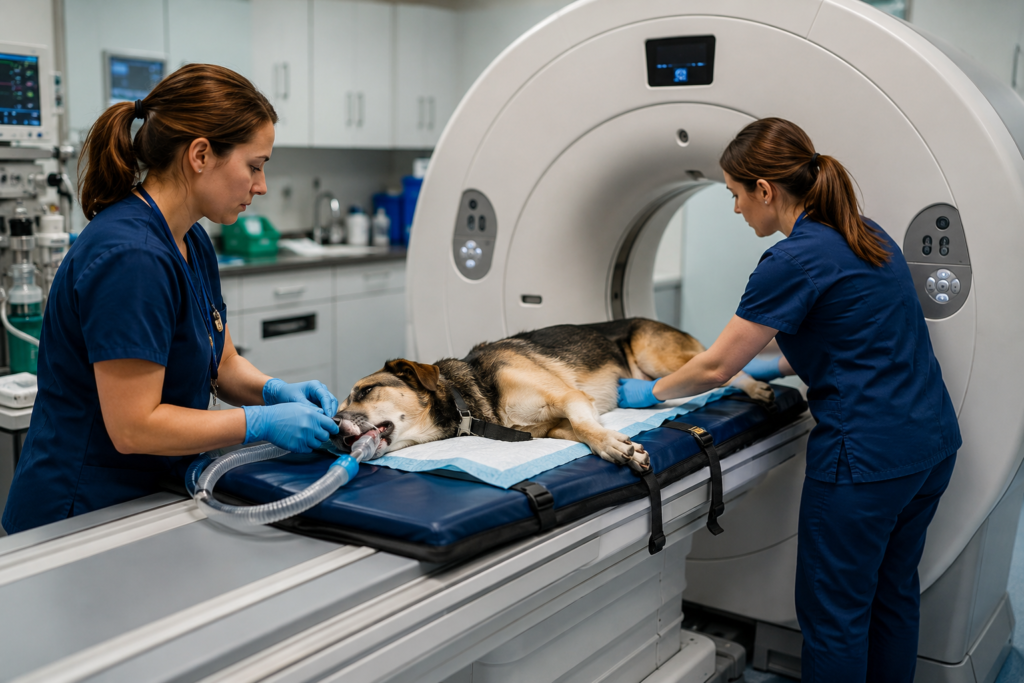
A CT scan — computed tomography, also called a CAT scan — uses a rotating X-ray tube and computer processing to create detailed three-dimensional cross-sectional images of your dog’s internal structures. Unlike a standard X-ray, which produces a flat two-dimensional image, a CT scan provides veterinarians with comprehensive cross-sectional pictures of a dog’s interior, including their bones, blood vessels, and soft tissues.
Your vet might recommend a CT scan if simple imaging techniques like X-rays or ultrasounds aren’t enough to diagnose or treat your dog’s condition, or when your vet plans a complex surgery and needs precise anatomical mapping.
Conditions most commonly diagnosed or managed with dog CT scans:
- Nasal tumors and chronic nasal discharge not explained by X-ray
- Ear canal disease and inner ear problems (otitis media/interna)
- Bone fractures and orthopedic injuries requiring surgical planning
- Lung disease — masses, pneumonia patterns, pulmonary embolism
- Cancer staging — determining whether a tumor has spread to lymph nodes or organs
- Abdominal organ masses and liver or spleen lesions
- Trauma assessment after car accidents or falls
- Skull and jaw abnormalities
- Surgical planning for complex procedures where 3D mapping is required
CT scans are more widely available and cheaper than MRIs — which is why your vet may recommend a CT first even when either modality could theoretically work. The scan takes minutes rather than 45–90 minutes for an MRI, anesthesia time is significantly shorter, and the cost is generally half that of an MRI for equivalent body regions.
One important requirement: Every dog receiving a CT scan requires sedation or general anesthesia. Dogs must remain completely still during the scan, and they cannot do this voluntarily while conscious. This is what separates CT cost from a standard X-ray — the anesthesia requirement is real, unavoidable, and represents a significant portion of the total bill.
The Real Cost Breakdown: What’s Included vs. Billed Separately
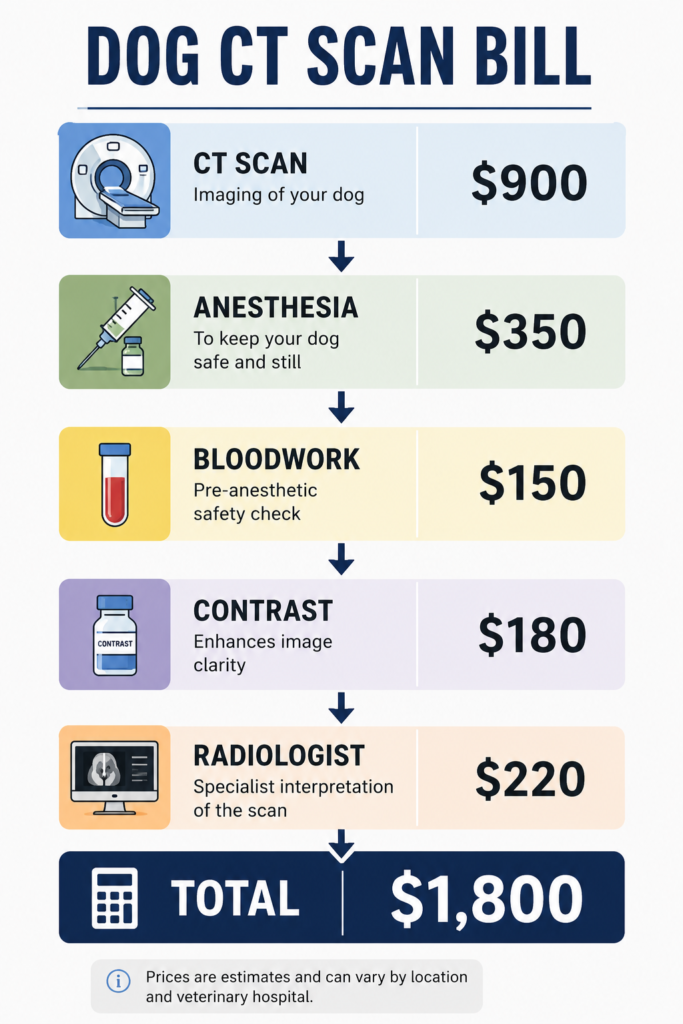
This is the section that prevents the biggest shock at checkout. The scan fee — the number most websites report — is rarely the number on your final invoice.
The scan fee itself runs $350–$1,200 per region scanned, but anesthesia ($200–$600), IV contrast ($100–$300), pre-anesthetic bloodwork ($100–$250), and the radiologist read ($100–$350) stack on top of it.
Full itemized cost breakdown:
| Line Item | Cost Range | Usually Included in Quote? |
|---|---|---|
| CT scan fee (per body region) | $350 – $1,200 | ✅ Yes |
| Anesthesia drugs + administration | $200 – $500 | ⚠️ Sometimes |
| Anesthesia monitoring | $50 – $150 | ⚠️ Sometimes |
| Pre-anesthetic bloodwork | $100 – $250 | ❌ Often separate |
| IV catheter placement | $40 – $75 | ❌ Often separate |
| Contrast dye (gadolinium or iodine) | $100 – $300 | ❌ Usually separate |
| Radiologist interpretation fee | $100 – $350 | ⚠️ Sometimes |
| Recovery monitoring post-anesthesia | $50 – $150 | ⚠️ Sometimes |
The “all-in quote” problem:
Some quotes include anesthesia, contrast, and the radiologist read; others list them separately. Always ask whether a quote is all-in. The single most important question to ask any imaging facility is: “Does this price include anesthesia, pre-operative bloodwork, contrast dye if needed, and the radiologist’s interpretation fee?”
A facility quoting $900 for the scan and $600 all-in for the anesthesia package is more expensive than a facility quoting $1,400 all-in. Without comparing apples to apples, you can’t actually compare costs.
The multiple-region multiplier:
Each additional body region scanned adds $300–$800 to the bill. A single-region chest CT runs $750–$1,800 all-in. Adding the abdomen in the same session — which requires the same anesthesia event — brings the total to $1,200–$2,800. Scanning head and chest together can reach $1,500–$3,500+.
The important nuance: a second region added during the same anesthesia event costs far less than a separate appointment. If your oncologist suspects the cancer may have spread to both the chest and abdomen, scanning both regions in one session is significantly more cost-effective than two separate appointments.
Dog CT Scan Cost by Facility Type
Where you get the CT scan matters enormously — potentially more than any other single factor in the total cost.
| Facility Type | All-In Cost Range | Notes |
|---|---|---|
| General veterinary practice (in-house CT) | $800 – $1,800 | Less common; standard equipment |
| Dedicated veterinary imaging center | $750 – $1,800 | Often cheapest; specialists on staff |
| University / teaching hospital | $800 – $2,000 | 20–40% below private specialty |
| Private specialty hospital | $1,500 – $3,500+ | Highest cost; full specialist team |
General veterinary practice with CT: A growing number of general practices now own CT equipment, though it’s still not common. These clinics offer CT at lower overhead costs than specialty hospitals, though they typically send images to an external radiologist for interpretation — adding a separate read fee.
Dedicated veterinary imaging centers: Dedicated veterinary imaging centers — where your vet sends the case but stays your doctor — often beat full-service specialty hospitals on price. These facilities do nothing but imaging, which means their scanners run at high volume and their per-case overhead is lower. The radiologist on staff interprets the scan and sends a report to your regular vet, who then discusses findings with you.
University veterinary teaching hospitals: Teaching hospitals associated with veterinary schools often offer CT scans with lower fees than private clinics while providing access to veterinary specialists with advanced expertise. UC Davis, Cornell, Colorado State, Texas A&M, the University of Wisconsin, and University of Minnesota all operate advanced imaging services. Typical savings: 20–40% versus a private specialty hospital for the same study. Wait times may be slightly longer for non-emergency cases.
Private specialty and referral hospitals: Specialty veterinary hospitals typically charge between $2,000 and $3,500+ for CT scans. These hospitals are equipped with advanced imaging technology and staffed by board-certified radiologists who provide expert interpretations on-site. The cost premium is real, but so is the access to immediate specialist consultation — which matters for complex cases requiring same-day surgical planning.
How Location Affects What You Pay
Geographic variation in veterinary CT costs follows the same pattern as all veterinary care — urban areas and high-cost-of-living states charge significantly more than rural areas and lower-cost states.
| Region | Cost vs. National Average | Estimated All-In CT Range |
|---|---|---|
| Hawaii | +40% | $1,050 – $3,500+ |
| California (major cities) | +35% | $1,013 – $3,375+ |
| New York / New Jersey | +25–30% | $938 – $3,250+ |
| Massachusetts / Connecticut | +25% | $938 – $3,125+ |
| Texas (Austin, Dallas, Houston) | +10–15% | $825 – $2,875+ |
| Florida | +5–10% | $788 – $2,750+ |
| Midwest (IL, OH, IN, IA) | -5 to 0% | $713 – $2,375+ |
| Southeast (GA, TN, NC) | -5 to -10% | $675 – $2,250+ |
| South (AL, MS, AR) | -18–22% | $615 – $1,950+ |
The same CT study that costs $1,800 all-in in suburban Ohio costs $2,400–$2,700 in San Francisco or Boston. This isn’t quality variation — it’s overhead. Clinic rent, staff wages, and facility costs in major metro areas are embedded in every line item on the invoice.
If your dog doesn’t urgently need a CT scan, you may find that you’re able to save money by traveling a bit farther to a different location to have the test done. For a planned, non-emergency scan, driving 60–90 minutes to a university veterinary hospital or a lower-cost imaging center in a nearby smaller city can save $500–$1,500 on the same procedure.
What Makes One CT Scan More Expensive Than Another
Even within the same city and the same facility type, CT scans vary in cost based on several procedure-specific factors.
Number of body regions scanned: This is the largest within-procedure cost driver. Each additional body region adds $300–$800 to the bill A single chest scan is significantly cheaper than a chest plus abdomen scan. If your vet says “we might want to look at both areas,” ask specifically whether both regions are medically necessary before authorizing the full study.
Contrast dye: Contrast adds $100–$300 to the bill and is used when the vet needs to highlight blood flow — tumor mapping, vascular anomalies, surgical planning. Roughly half of veterinary CT studies use it. Contrast is medically necessary when blood vessel assessment or tumor characterization is the goal, and cannot be skipped in those cases. For bone and structural imaging, non-contrast CT is often sufficient.
Dog size: The amount of general anesthesia needed depends on your dog’s weight, with larger dogs needing more sedation than smaller dogs. A 100-pound Labrador Retriever requires 3–4x more anesthetic drug volume than a 20-pound Beagle, and the weight-based dosing directly affects the anesthesia line item. For large and giant breeds, anesthesia can run toward the upper end of the $200–$600 range.
Emergency vs. planned: A CT scan performed at 2 AM after an emergency traumatic injury — at a 24-hour specialty hospital on full emergency staffing — costs significantly more than the same scan scheduled for a Tuesday morning at a dedicated imaging center. When medically possible, scheduling a CT scan as a planned outpatient procedure rather than an emergency study saves $300–$800 in facility and staffing premiums.
Machine quality: Not all CT scanners are equal. Higher-slice-count scanners (64-slice vs. 16-slice) produce better image quality and can scan faster, reducing anesthesia time. Some facilities charge more for high-quality imaging — a premium that may be worth it for complex surgical planning cases, but less critical for straightforward bone or chest imaging.
CT Scan vs MRI vs X-Ray vs Ultrasound: Cost and Use-Case Comparison
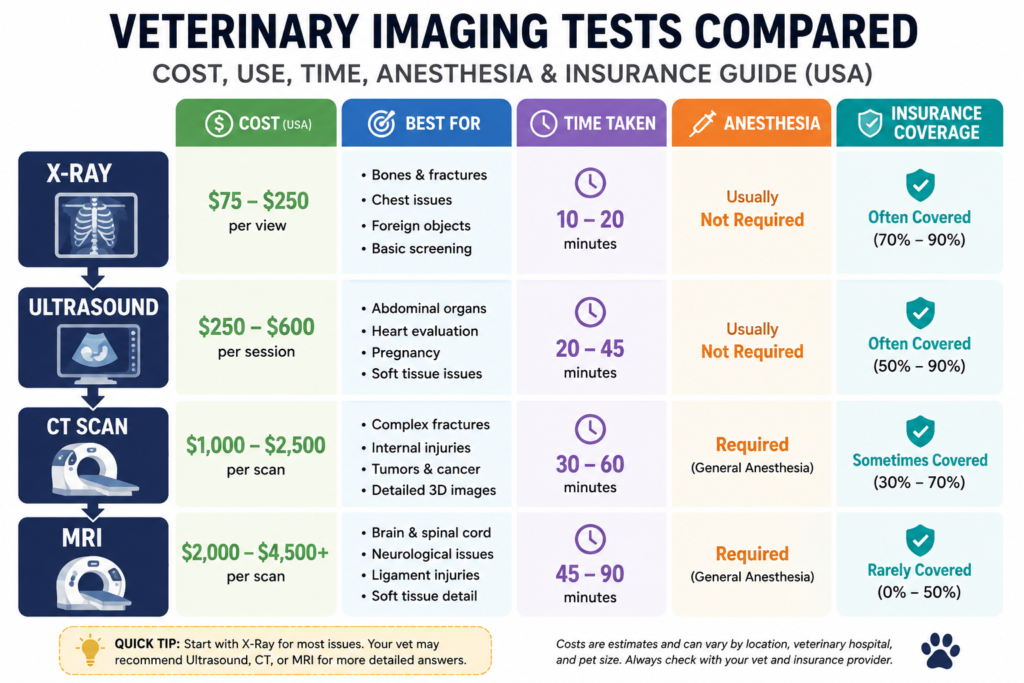
Understanding which imaging test is right for your dog’s condition matters — not just medically, but financially. Sometimes a $150 X-ray answers the question. Sometimes only a CT scan will do.
| Imaging Type | Cost Range | Anesthesia Required? | Best For |
|---|---|---|---|
| X-ray (radiograph) | $100 – $400 per view | ❌ Usually not | Bones, fractures, lung overview, foreign bodies |
| Ultrasound | $250 – $600 | ❌ Usually not | Soft organ detail, pregnancy, real-time organ movement |
| CT scan | $750 – $3,500 all-in | ✅ Yes | Bones, chest, nasal, cancer staging, surgical planning |
| MRI | $1,800 – $5,000 all-in | ✅ Yes | Brain, spinal cord, soft tissue detail, neurological conditions |
When CT is the right choice (and worth the cost): CT scans are ideal for imaging bones, lungs, and complex structures like the nose and sinuses. Your pet might need a CT scan for bone fractures requiring surgical planning, lung disease, nasal tumors, cancer staging, or abdominal organ masses.
When MRI is the better choice: If your pet has a neurological issue affecting the brain, spinal cord, or nerves, MRI is usually the best choice For a dog with unexplained seizures or sudden hind limb paralysis, an MRI provides significantly more diagnostic detail for spinal cord and brain tissue than a CT scan. While CT scans are generally less expensive and faster to perform, they don’t always provide the level of detail needed for certain diagnoses — particularly for soft tissue and neurological conditions where MRI can offer a far clearer, more definitive result.
Read Related Article… Dog MRI Cost in the USA (2026): Average Cost, Insurance Coverage & Financing
When X-ray or ultrasound may be enough: Ask whether your dog’s question can be answered by X-rays ($150–$400) or ultrasound ($300–$600) first — vets often use CT as the second step, and sometimes the first-line imaging settles it.
If your vet has recommended a CT scan and you’re concerned about cost, it’s entirely appropriate to ask: “Is there any chance an X-ray or ultrasound could provide enough information for the diagnosis or surgical plan we need?” A good veterinarian will give you an honest answer about whether the cheaper option is medically adequate.
The CT vs. MRI cost comparison: CT is roughly half the price of MRI: $750–$2,500 versus $1,800–$4,100+ all-in. They answer different questions — CT excels at bone, chest, and surgical planning; MRI at brain and spinal cord detail. When either would work, CT is the more budget-friendly choice and requires significantly less anesthesia time.
Does Pet Insurance Cover Dog CT Scans?
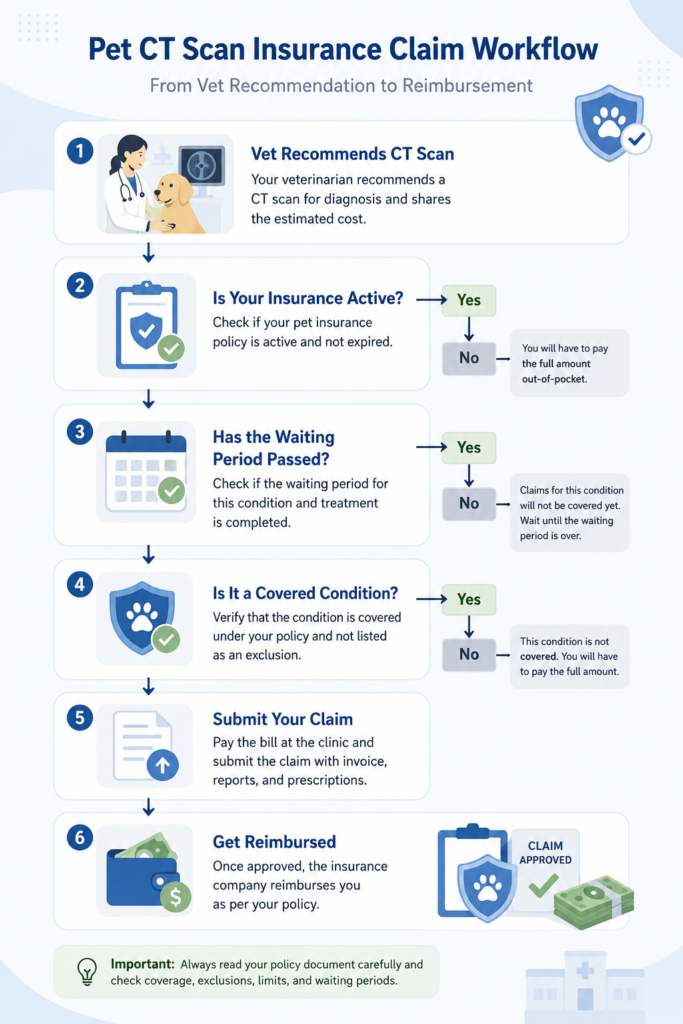
Yes — most comprehensive accident-and-illness pet insurance plans cover CT scans as part of diagnostic imaging coverage, when the scan is medically necessary to diagnose or treat a covered condition.
Read Related Article… Pet Insurance Waiting Period: How Long Before Coverage Starts? (2026 Guide)
Coverage conditions that apply:
- The underlying condition being investigated must not be pre-existing
- The policy must be active and past the waiting period when symptoms first appeared
- The CT scan must be medically necessary — purely preventive or screening CT scans without clinical signs are typically not covered
- You need a comprehensive accident-and-illness plan — accident-only plans cover CT scans only for injury-related diagnostics
What pet insurance typically covers in a CT claim:
- The CT scan fee itself
- Anesthesia and monitoring
- Pre-anesthetic bloodwork (as part of the diagnostic workup)
- Contrast dye if used
- Radiologist interpretation fee
- Follow-up consultation to review results
When medically necessary for a covered condition, CT scans are reimbursed at 70–90% after deductible under comprehensive plans, including the anesthesia and radiologist fees.
Reimbursement math on a real CT bill:
All-in CT scan cost (single region, with contrast): $1,800
- Annual deductible: $250 (already met this year)
- Reimbursement rate: 80%
- Insurer pays: $1,440
- Your out-of-pocket: $360
Without insurance, the full $1,800 is due at the imaging center — typically before or at the time of service.
Read Related Article
Pre-authorization: Some insurers ask for advance notice on imaging over $1,000. Confirm pre-authorization requirements before the scan. This isn’t a denial — it’s a preliminary review that gives you a coverage determination before spending. For a planned, non-emergency CT, calling your insurer before scheduling the appointment takes 10 minutes and eliminates the risk of a surprise claim denial.
If your dog’s condition was documented before enrollment: Any CT scan tied to a condition that existed or showed symptoms before your policy start date will be denied as related to a pre-existing condition. The CT scan itself isn’t what gets evaluated — it’s what the scan is investigating. If that underlying condition is pre-existing, the imaging is excluded.
How To Reduce Your Dog’s CT Scan Cost Without Compromising the Diagnosis
There are legitimate ways to reduce a CT scan bill by $500–$1,500 without changing the quality of the diagnostic result.
1. Get an all-in quote from multiple facilities. Call at least two facilities — your vet’s referred specialty hospital and the nearest dedicated veterinary imaging center or university teaching hospital. Ask each for a total all-in quote covering scan, anesthesia, bloodwork, contrast if needed, and radiologist read. The difference between facilities for the same study frequently runs $500–$1,200.
Read Related Article… Vet Payment Plans: Can You Make Monthly Payments to a Vet? (2026)
2. Ask about university veterinary teaching hospitals. Teaching hospitals associated with veterinary schools often offer CT scans with prices ranging from $1,500 to $2,500 — significantly less than private specialty hospitals while providing access to veterinary specialists and state-of-the-art equipment. For a planned scan, the wait time is usually worth the savings.
3. Schedule multiple regions in one anesthesia event. If multiple regions might need scanning, do them in one anesthesia event — a second region added during the same session costs far less than a separate appointment. This requires knowing before the appointment which areas your vet wants to image. Ask specifically: “Is there any chance we’d want to look at a second region? If so, should we plan for that now?”
4. Ask whether X-ray or ultrasound could answer the question. Before authorizing a CT, confirm with your vet whether less expensive first-line imaging has genuinely been exhausted. For some conditions, an abdominal ultrasound ($250–$600) may provide enough information to avoid a CT scan entirely.
5. Request a written prescription for any post-scan medications. After anesthesia and the scan, your dog may be sent home with medications for pain, nausea, or the underlying condition. Fill these at a human pharmacy using GoodRx rather than the specialty clinic’s dispensary — common savings of $50–$200 per prescription.
6. Contact your insurer about pre-authorization before scheduling. Pre-authorization isn’t just administrative — it confirms coverage before you spend. Discovering a coverage problem after the scan is significantly more stressful than learning about it beforehand, when you still have options.
7. Ask about CareCredit if financing is needed. Most veterinary specialty hospitals and imaging centers accept CareCredit. Applying before your appointment — rather than at the desk under pressure — gives you time to compare terms and ensures availability when the invoice arrives.
What To Do If You Can’t Afford a CT Scan
If your vet has recommended a CT scan and the cost is beyond reach, here are real options — not generic advice.
Ask your vet whether the scan is urgent or deferrable. Some CT scans are time-sensitive — cancer staging before surgery cannot wait long. Others can be scheduled over several weeks, giving you time to arrange financing. Ask directly: “How long can we safely wait on this scan before it affects treatment decisions?”
Apply for CareCredit before your imaging appointment. It’s natural to feel overwhelmed when your vet recommends a CT scan. It’s also okay to question the recommendation and ask if there are lower-cost alternatives. If your vet truly feels the CT scan is necessary, see if you can find a facility that will work with you on payment. CareCredit applications take minutes online and are accepted at most veterinary specialty hospitals and imaging centers.
Read Related Article… 15 Organizations That Help Pay Vet Bills When You Can’t Afford Care (2026)
Consider Scratchpay as an alternative. Scratchpay offers fixed-payment veterinary financing with no deferred interest. For owners who can’t qualify for CareCredit or prefer predictable payments over a promotional period, Scratchpay is accepted at many specialty clinics.
Ask the imaging facility about payment plans directly. Independent specialty hospitals and university teaching hospitals often accommodate payment arrangements for established patients or documented financial hardship. Asking at the time of scheduling is more effective than asking at checkout.
Explore nonprofit financial assistance:
- RedRover Relief (redrover.org) — provides funding for life-threatening conditions, income under $60,000
- The Pet Fund (thepetfund.com) — up to $500 for non-emergency diagnostic care
- Brown Dog Foundation (browndogfoundation.org) — focuses on treatable conditions where finances are the barrier
Read Related Article… Low-Cost Vet Clinics in the USA: How to Find Affordable Emergency Care (2026)
Ask about clinical trial enrollment: If the CT scan is cancer-related, some university veterinary oncology programs offer free imaging as part of clinical research enrollment. Ask the oncology department at the nearest veterinary school whether any active trials are enrolling dogs with your dog’s diagnosis.
Action Checklist
Before the CT scan appointment:
- Ask your vet for a referral to a dedicated imaging center or university teaching hospital — compare their all-in quote against the specialty hospital
- Get an itemized all-in quote: scan + anesthesia + bloodwork + contrast (if needed) + radiologist fee
- Ask whether both body regions should be scanned in one appointment if multiple areas may be involved
- Contact your pet insurer about pre-authorization for any imaging over $1,000
- Confirm your deductible status — how much have you already met this policy year?
- Apply for CareCredit now if a large out-of-pocket cost is possible
- Ask your vet whether X-ray or ultrasound has genuinely been exhausted as a first-line option
At the imaging facility:
- Confirm the all-in quote at check-in — verify it matches what you were quoted over the phone
- Ask whether contrast dye is confirmed as medically necessary or potentially optional
- Request that all diagnoses be documented clearly in the report — “first presentation of symptoms” language supports your insurance claim
After the scan:
- Request all invoices and the radiologist’s written report for your insurance claim
- Submit your insurance claim promptly — most insurers have submission windows
- Fill any post-scan prescriptions at a human pharmacy using GoodRx rather than the imaging facility’s dispensary
Frequently Asked Questions
How much does a dog CT scan cost in the USA?
Most dog CT scans cost $750–$2,500 in total, including anesthesia, bloodwork, and image interpretation. More complex scans or multiple body regions can increase the total to $3,500 or more, depending on your location, the veterinary facility, and whether contrast dye is required.
Does a dog CT scan include anesthesia in the price?
Not always. Some veterinary hospitals provide an all-inclusive quote, while others bill anesthesia, bloodwork, contrast dye, and the radiologist’s interpretation separately. Before scheduling the scan, ask for an itemized estimate so you know the total expected cost.
How long does a dog CT scan take?
The scan itself usually takes only a few minutes, but most appointments last 30–90 minutes because your dog must be prepared for anesthesia, positioned correctly, monitored throughout the procedure, and allowed time to recover before going home.
Does pet insurance cover dog CT scans?
Most accident-and-illness pet insurance plans cover CT scans when they’re medically necessary to diagnose or treat a covered condition. Coverage typically includes anesthesia and diagnostic imaging after your deductible and reimbursement rate are applied. Pre-existing conditions and waiting periods still apply.
Can a dog have a CT scan without anesthesia?
Usually no. Dogs need to remain completely still during the scan to produce clear images, so general anesthesia is required in most cases. Some patients may receive deep sedation instead, but some form of chemical restraint is almost always necessary.
What is the cheapest place to get a dog CT scan?
University veterinary teaching hospitals and dedicated veterinary imaging centers often provide the best value. Comparing all-inclusive quotes from multiple facilities can save several hundred dollars without sacrificing diagnostic quality.
Is a CT scan worth it for dogs?
In many cases, yes. A CT scan can provide detailed images that help veterinarians diagnose fractures, tumors, lung disease, nasal conditions, and other problems that X-rays or ultrasound may miss. Whether it’s worth the cost depends on your dog’s condition, your veterinarian’s recommendation, and whether the results will change treatment decisions.
Does every dog need a CT scan?
No. Many conditions can be diagnosed with X-rays or ultrasound. Veterinarians usually recommend CT scans only when advanced imaging is needed for an accurate diagnosis, surgical planning, or cancer staging.
What You Should Do Next
If your vet has recommended a CT scan and you have pet insurance — call your insurer today. Ask specifically whether the underlying condition is covered, and request pre-authorization information for imaging over $1,000. These two steps take 15 minutes and determine whether you’re looking at a $360 out-of-pocket cost or a $1,800 one.
If you don’t have insurance and the cost is a concern — call the nearest university veterinary teaching hospital for an all-in quote before accepting the specialty hospital referral your vet gave you. The quality of the diagnostic result is equivalent. The savings can be $500–$1,500.
And if your dog is healthy right now — this is the moment to review your pet insurance plan’s annual limit and diagnostic imaging coverage. A CT scan plus whatever treatment follows can easily reach $5,000–$15,000. Knowing your coverage is adequate before you need it is worth far more than figuring it out in a waiting room.
Read Related Article… Dog Surgery Cost in the USA: Real Prices for 2026
External Authority Sources
- PetMD — Dog CT Scan Guide
- Cornell University College of Veterinary Medicine
- Sage Veterinary Imaging — CT vs MRI Guide
- CareCredit Veterinary Cost Guide
- VetReceipt (real invoice data)
- AVMA (American Veterinary Medical Association)
Disclaimer: This article is for informational and educational purposes only. Cost data reflects 2026 national averages from NAPHIA, Insurify, and MetLife Pet Insurance and will vary based on your dog’s age, breed, location, and the specific plan you choose. PetInsurePrime does not sell pet insurance and receives no compensation from any insurance provider. Always compare multiple quotes and read your policy documents carefully before enrolling.
PetInsurePrime | Independent • Research-Based | Helping US dog owners understand real vet costs and coverage options — without the sales pressure.
Pingback: Does Pet Insurance Cover Blood Tests? What to Know
Pingback: Dog Radiation Therapy Cost in the USA | Full Cost Guide
Pingback: Dog Seizure Treatment Cost in the USA: 2026 Price Guide