
Updated: July 2026 | Reading Time: 20 Minutes
It’s 11:30 PM. Your dog is limping badly, vomiting, or something just feels wrong. Your regular veterinarian is closed, so you’re rushing to the nearest emergency animal hospital. On the way, one question keeps running through your mind:
Read related article….. Pet Insurance for Dogs in the USA: How It Works
In most cases, yes. Comprehensive accident-and-illness pet insurance plans usually cover emergency vet visits, including diagnostics, treatment, surgery, and hospitalization for new illnesses or injuries. However, you’ll typically need to pay the bill upfront and file a claim later for reimbursement.
Quick Answer Does Pet Insurance Cover Emergency Vet Visits?
Yes — most comprehensive pet insurance plans cover emergency vet visits, including after-hours visits, emergency exams, diagnostics, treatment, and hospitalization. Coverage applies when the condition is new, not pre-existing, and your policy’s waiting period has passed. The important catch: you still pay the full bill upfront at the clinic, then file a claim and wait for reimbursement. There is one major exception to that rule — and it’s worth knowing before you go.
Read related article… Pet Insurance Waiting Period: How Long Before Coverage Starts? (Full Guide)
Coverage varies by insurer, reimbursement rate, deductible, and policy terms, so always review your individual policy before an emergency happens.
Examples : Most accident-and-illness pet insurance plans reimburse 70–90% of eligible emergency veterinary expenses after your deductible, provided the condition isn’t pre-existing and your waiting period has ended.
Key Takeaways
✓ Emergency visits usually covered
✓ Owner pays first
✓ Claims submitted later
✓ Waiting periods apply
✓ Pre-existing conditions excluded
✓ Direct pay available only with limited insurers
At a Glance: Emergency Coverage Summary
| Emergency Situation | Usually Covered? | Notes |
|---|---|---|
| Emergency exam fee | ✅ Depends on insurer | Some plans exclude exam fees |
| Bloodwork & diagnostics | ✅ Yes | If medically necessary |
| X-rays & ultrasound | ✅ Yes | Covered under eligible claims |
| Emergency surgery | ✅ Yes | After waiting period |
| Hospitalization | ✅ Yes | If medically necessary |
| Prescription medication | ✅ Usually | Sent home after treatment |
| Poison ingestion treatment | ✅ Yes | If not pre-existing |
| Pre-existing condition | ❌ No | Common claim denial |
| During waiting period | ❌ No | Coverage hasn’t started |
| Accident-only plan (illness) | ❌ No | Illnesses excluded |
Table of Contents
- What Does Pet Insurance Actually Cover at the Emergency Vet?
- What Does an Emergency Vet Visit Actually Cost?
- The One Thing Most Dog Owners Don’t Know — You Pay First
- Emergency vs. Urgent Care vs. Regular Vet: Which Bill Does Insurance Cover?
- When Pet Insurance Won’t Cover an Emergency Visit
- The Direct Payment Exception: How Trupanion Works Differently
- What To Do Right Now If You’re Already at the Emergency Vet
- What Happens If Insurance Doesn’t Cover Your Emergency Bill?
- Action Checklist: Before the Next Emergency Happens
- FAQ
What Does Pet Insurance Actually Cover at the Emergency Vet?
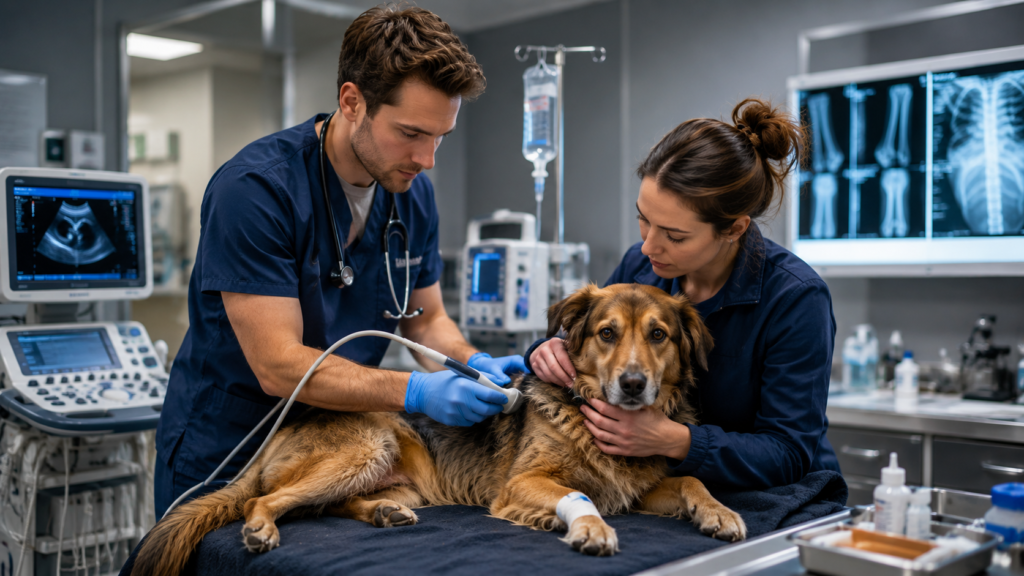
Most comprehensive accident-and-illness plans are designed for exactly this situation — an unexpected emergency with costs your regular budget can’t absorb. Coverage at the emergency vet typically includes everything the clinic does from the moment your dog walks in, as long as the condition qualifies.
What’s generally covered:
- Emergency exam and triage fee — the charge just to be seen. Ranges from $100–$300. Covered by most comprehensive plans, but not all. Some insurers (Healthy Paws, Lemonade) exclude exam fees unless explicitly added.
- Diagnostic testing — bloodwork ($150–$300), X-rays ($150–$400), ultrasound ($300–$600), urinalysis, and other panels ordered to diagnose the condition.
- Emergency treatment — IV fluids, oxygen therapy, wound care, stabilization medications, pain management.
- Emergency surgery — foreign body removal, GDV/bloat repair, fracture stabilization, internal bleeding. Fully covered under most comprehensive plans.
- Overnight hospitalization — $200–$600 per night for standard monitoring, $500–$1,500 per night in the ICU. Covered when medically necessary.
- Specialist consultations — if your dog’s emergency requires a cardiologist or neurologist on staff, those fees are typically included.
- Prescription medications sent home after discharge.
What plan type you have determines a lot:
| Provider | Emergency Visits | Emergency Exam Fee | Direct Vet Payment |
|---|---|---|---|
| Trupanion | ✅ Yes | Usually covered (depends on policy) | ✅ VetDirect Pay at participating hospitals |
| Healthy Paws | ✅ Yes | May not be covered under all policies | ⚠ Direct payment available in some situations |
| Lemonade | ✅ Yes | Optional Vet Visit Fee add-on | ❌ Reimbursement model |
| Fetch | ✅ Yes | ✅ Covered | ❌ Reimbursement model |
Note: Coverage for exam fees, reimbursement, and direct payment varies by policy, state, and provider. Always review your policy documents before relying on coverage for an emergency visit.
Read related article… Does Pet Insurance Cover Surgery? What Dog Owners Need to Know
The differences above mostly relate to exam fees, reimbursement methods, and optional features. Regardless of the provider you choose, always read your policy documents carefully before assuming emergency care is fully covered. Coverage terms, waiting periods, and exclusions vary between insurers.
The Important Part: Comprehensive pet insurance covers the full range of emergency vet costs — exam, diagnostics, treatment, surgery, and hospitalization. Accident-only plans cover ER visits from physical injuries but not sudden illnesses. Check your plan type now, not at 2 AM.
What Does an Emergency Vet Visit Actually Cost?
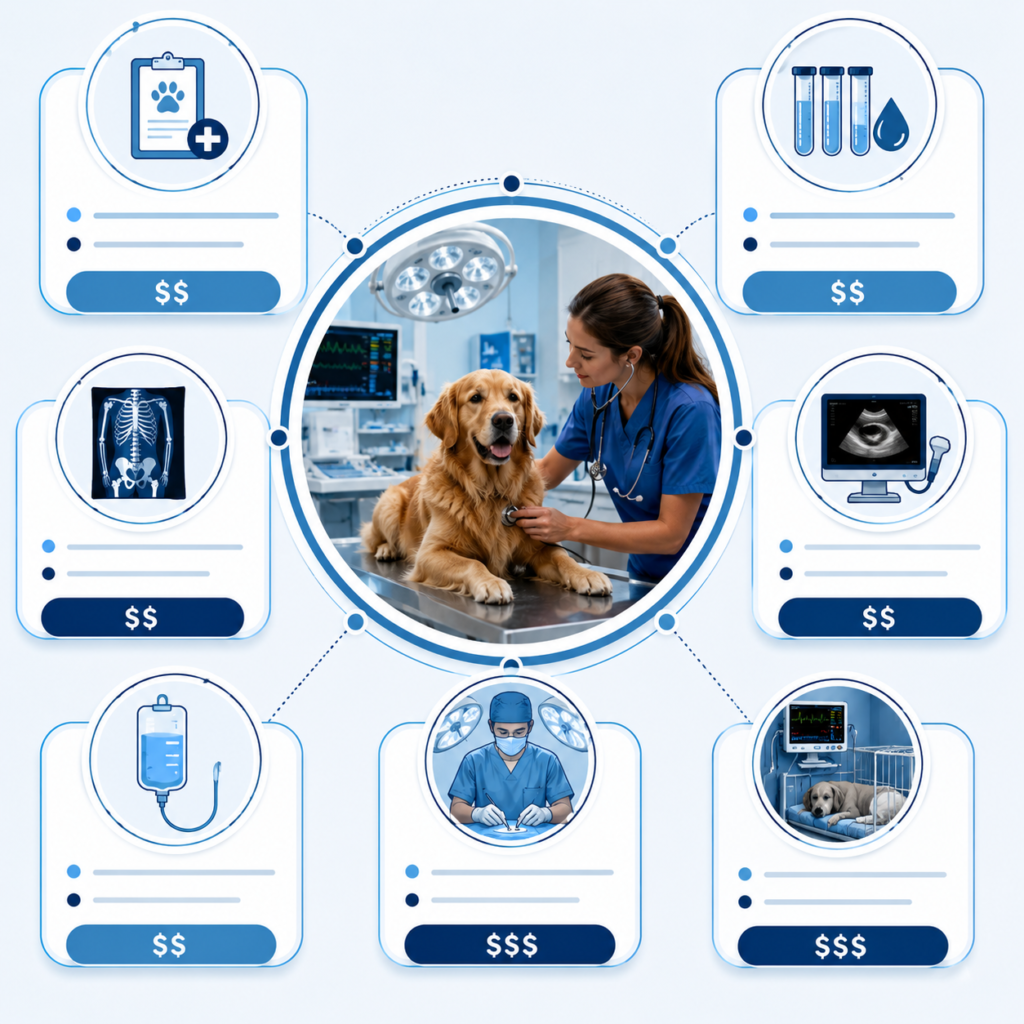
The number most people search for — and the number that most articles understate — is the total all-in cost after your dog has been stabilized, diagnosed, treated, and discharged.
The median emergency vet bill across all conditions is around $800. But that median hides enormous variation based on what’s actually wrong.
Read related article… Emergency Vet Costs in the USA (2026): What You’ll Really Pay by State
2026 emergency vet cost breakdown by line item:
| Service | Cost Range |
|---|---|
| Emergency exam / triage fee | $100 – $300 |
| After-hours surcharge (nights, weekends, holidays) | $50 – $200 |
| Bloodwork panel | $150 – $400 |
| X-rays | $150 – $400 per view |
| Ultrasound | $300 – $600 |
| IV fluid therapy | $50 – $200 |
| Pain medication / injection | $30 – $100 |
| Overnight standard hospitalization | $200 – $600 per night |
| Overnight ICU | $500 – $1,500 per night |
| Emergency surgery (foreign body, GDV, fracture) | $1,500 – $7,000 |
| Specialist surgery (orthopedic, neurological) | $3,000 – $10,000+ |
Real-world scenario ranges:
- Dog ate chocolate, needs monitoring for 4 hours: $300–$600
- Dog with severe vomiting, bloodwork and IV fluids overnight: $800–$1,800
- Dog hit by a car, fracture surgery + 2 nights hospitalization: $4,000–$8,000
- Dog with GDV/bloat, emergency surgery + ICU: $5,000–$10,000
Urban emergency clinics in cities like San Francisco, New York, or Boston charge 30–50% more than the national average due to staffing costs and real estate. After-hours surcharges — nights, weekends, and holidays — add $50–$200 on top of the standard exam fee at most 24-hour facilities. That surcharge is often covered by insurance, but it won’t show up in the initial quote your vet reads you.
Bottom Line Most emergency vet bills land between $800 and $3,000 for moderate cases. Add surgery or multi-night ICU care and the bill can exceed $8,000 before discharge. The after-hours surcharge alone — often $50–$200 — surprises owners who don’t know to ask about it upfront.
The One Thing Most Dog Owners Don’t Know — You Pay First
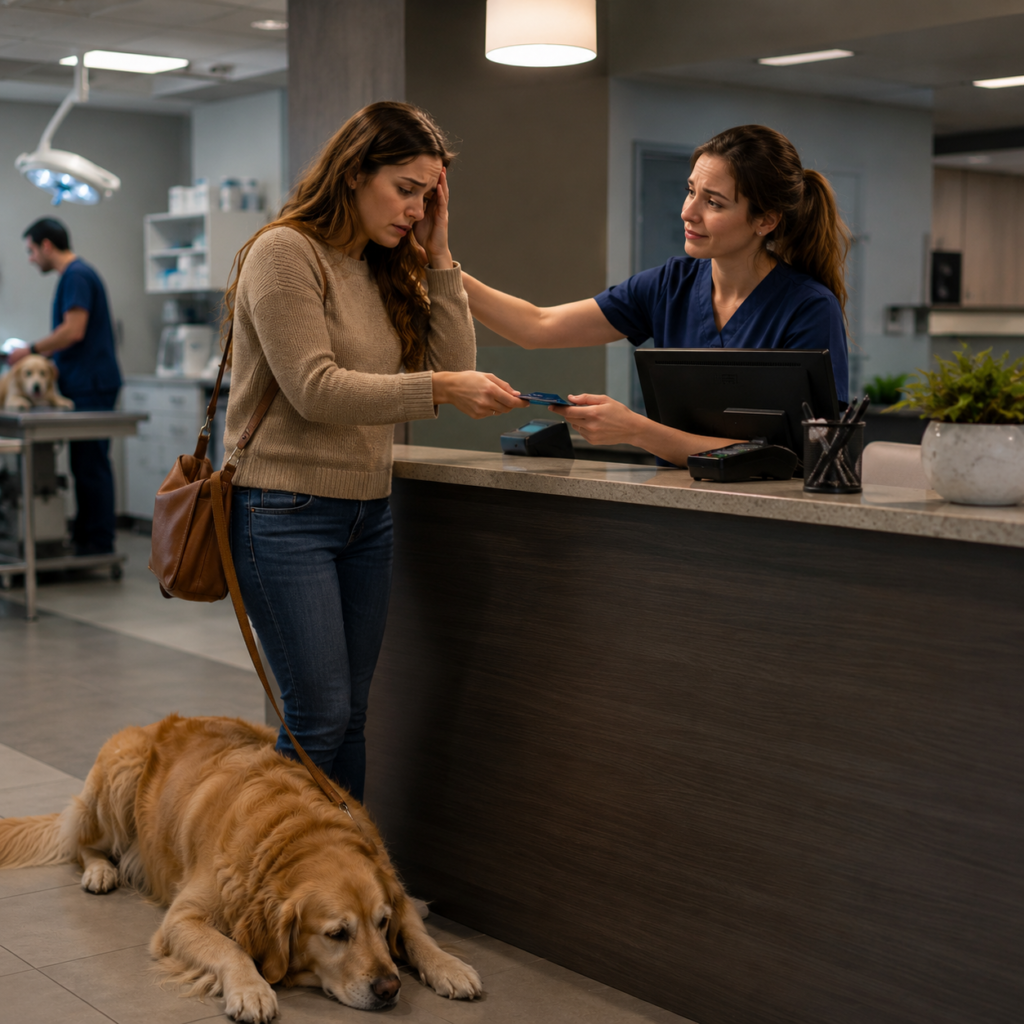
This is the detail that causes the most stress at the worst possible moment.
Pet insurance does not work like human health insurance. The clinic does not bill your insurer. There is no insurance card to hand over at check-in. You pay the entire bill at the emergency vet before you leave — upfront, in full — and then submit a claim to your insurer afterward. Reimbursement typically takes 5–15 business days.
What this means in practice:
Your dog needs emergency surgery. The estimate is $4,200. You pay $4,200 tonight. You submit a claim with your itemized invoice. Your insurer reviews it, approves coverage, and reimburses you $3,110 (after your $250 deductible at 80% reimbursement). That money arrives in your bank account 1–2 weeks later.
The financial gap this creates:
Most 24-hour emergency clinics require a 50% deposit before treatment begins on expensive cases. That means $2,100 due before your dog goes into surgery — regardless of insurance. This is why having a credit card with available capacity, a CareCredit account, or an emergency savings fund matters independently of whether you have pet insurance.
Pet insurance helps enormously — but it helps after the crisis, not during it. The financial pressure happens at midnight at the clinic, not two weeks later when the reimbursement lands.
The one major exception: Trupanion offers direct payment to enrolled veterinary clinics, which means you only pay your deductible amount at checkout and the insurer covers the rest in real time. More on that below.
Quick Recap: You pay the full emergency vet bill at the clinic — upfront, before leaving. Insurance reimburses you after. This means you need to be able to cover $2,000–$5,000+ out of pocket the night of the emergency, even with good coverage. A CareCredit account or emergency fund handles this gap.
Emergency vs. Urgent Care vs. Regular Vet: Which Bill Does Insurance Cover?
Not every situation that feels urgent is a true emergency — and choosing the right facility changes both the cost and your stress level significantly.
Three levels of veterinary care:
Regular vet (daytime, appointment-based) Your dog’s primary care provider for routine issues and scheduled sick visits. Exam fees: $50–$150. Insurance covers illness and accident visits under a comprehensive plan.
Urgent care vet clinic Walk-in clinics that handle non-life-threatening issues that need same-day attention — ear infections, minor cuts, limping without trauma, vomiting without signs of obstruction. Exam fees: $150–$350. Often 30–60% cheaper than a full ER. Covered by insurance the same as a regular vet visit.
24-hour emergency hospital Staffed around the clock with emergency specialists, advanced diagnostics (MRI, CT, ICU), and the ability to perform emergency surgery. Exam fees: $150–$300 plus after-hours surcharge. Bills run 2–5x higher than a daytime urgent care visit. Covered by insurance the same as any other visit — plan type and exclusions still apply.
Read related article… Does Pet Insurance Cover MRI for Dogs? Coverage, Costs & What to Expect (2026)
When to go where:
| Symptom | Right Facility |
|---|---|
| Suspected bloat / GDV (distended abdomen, retching) | 🚨 Emergency hospital immediately |
| Hit by a car | 🚨 Emergency hospital immediately |
| Seizure lasting more than 2 minutes | 🚨 Emergency hospital immediately |
| Difficulty breathing | 🚨 Emergency hospital immediately |
| Profuse bleeding that won’t stop | 🚨 Emergency hospital immediately |
| Sudden paralysis or collapse | 🚨 Emergency hospital immediately |
| Limping, no trauma history, weight-bearing | Urgent care or next-day vet |
| Vomiting once or twice, otherwise alert | Urgent care or next-day vet |
| Ear infection, minor rash, mild diarrhea | Next-day regular vet if possible |
| Ate something potentially toxic — call ASPCA first | ASPCA Poison Control: (888) 426-4435 |
Choosing urgent care over a full ER for a non-critical issue can save $500–$1,500 in exam and facility fees — and the covered amount is the same. Insurance doesn’t require you to go to the most expensive facility available.
What This Means: Pet insurance covers emergency visits, urgent care visits, and regular vet visits under the same policy rules. Going to urgent care instead of a full ER for non-critical issues can save $500–$1,500 on a single visit without affecting your coverage. The right call saves money and stress.
When Pet Insurance Won’t Cover an Emergency Visit
Emergency visit denials happen — and most of them are predictable in advance. Here’s where coverage breaks down.
Pre-existing conditions. The most common denial reason. If your dog has an existing heart condition and goes to the ER with cardiac symptoms, that emergency won’t be covered. If your dog has had recurring ear infections for two years and goes to the ER with a severe infection, expect a denial. Insurance companies review your dog’s vet records during the claims process.
The waiting period. Most policies have a 14-day illness waiting period, after which new illnesses are covered. Accidents have shorter windows — typically 24–48 hours, though some insurers like MetLife have a 0-day accident waiting period. An emergency that occurs during any active waiting period is not covered, and the condition may be flagged as pre-existing going forward.
Accident-only plans covering illness emergencies. If your dog has a bloat episode, a seizure, or a sudden urinary blockage — those are illness-driven emergencies. An accident-only policy won’t cover them. This catches owners off guard when they assumed “emergency” meant all emergencies.
Exam fees on plans that exclude them. Some insurers — notably Healthy Paws and some Lemonade configurations — don’t reimburse the emergency exam fee itself. On a $2,500 bill where the exam fee is $250, that’s a $250 out-of-pocket cost you didn’t expect. Check your plan’s exam fee language before you need the ER.
After the annual limit. If your dog had a major procedure earlier in the policy year and you’ve hit your annual reimbursement cap, an emergency visit won’t receive additional coverage until your policy renews. Track your annual claims total — especially if your dog has had multiple health events in one year.
| Denial Reason | How to Protect Yourself |
|---|---|
| Pre-existing condition | Enroll while your dog is young and healthy |
| Emergency during waiting period | Enroll early — never at the first sign of trouble |
| Illness on accident-only plan | Choose a comprehensive accident & illness plan |
| Exam fees not covered | Verify exam fee coverage before enrolling |
| Annual limit exhausted | Monitor your claims total; choose unlimited annual limit plans |
In Short: Most emergency visit denials trace back to pre-existing conditions or the waiting period — both avoidable with early enrollment. If you have an accident-only plan, confirm now whether a sudden illness would be covered. Finding that out at the ER desk is the worst possible time.
The Direct Payment Exception: How Trupanion Works Differently
Almost every pet insurer follows the same model: you pay the vet, they reimburse you later. Trupanion is the major exception — and at a true emergency, the difference is significant.
Trupanion has enrolled over 9,000 veterinary clinics in the US in its direct payment program. At enrolled locations, the clinic submits your claim in real time at checkout. You pay only your deductible. Trupanion pays the remaining covered amount directly to the vet before you leave.
On a $5,000 emergency surgery with a $500 deductible, that means you pay $500 at checkout instead of $5,000. The other $4,500 goes directly from Trupanion to the clinic.
This matters most when:
- The bill is large and you can’t cover it upfront
- You don’t have a high-limit credit card or CareCredit available
- You’re dealing with multiple high-cost events in one year
The trade-off: Trupanion’s premiums are typically higher than comparable plans, and their deductible structure is per-condition (not annual), which can add up if your dog has multiple separate health issues in one year.
It’s not the right plan for everyone — but for the specific scenario of a large, unexpected emergency vet bill, the direct payment feature eliminates the financial pressure that standard reimbursement models create.
Key Takeaway: Trupanion’s direct pay system means you only pay your deductible at the emergency vet — not the full bill. This is the closest thing to how human health insurance works at the point of care. If covering a large upfront bill would be a genuine hardship, it’s worth comparing Trupanion against reimbursement-based plans.
What To Do Right Now If You’re Already at the Emergency Vet
If you’re reading this in a waiting room right now, here’s what matters:
1. Focus on your dog first. Authorize the care your dog needs. The bill is a problem you can solve — your dog’s health is the priority. Don’t delay treatment while waiting on insurance information.
2. Tell the clinic you have pet insurance. Mention your insurer’s name. If you have Trupanion, ask specifically whether the clinic is enrolled in direct payment — this changes your checkout experience entirely.
3. Ask for an itemized estimate. Not just a total — an itemized list of every charge. You need this for your insurance claim, and it helps you understand what you’re authorizing.
4. Request that all diagnoses be documented in writing. The vet’s written notes about the condition’s onset are your best protection against a claim denial. “First presentation of symptoms” in the medical record is significant.
5. Pay with a card that gives you flexibility. If the bill is larger than your available balance, ask about CareCredit — many emergency clinics accept it, and approval can happen in minutes.
6. Get copies of everything before you leave. All invoices, all discharge instructions, all diagnostic reports. You’ll need these to submit your claim.
7. Submit your claim promptly. Most insurers have claim submission windows — typically 90–180 days after the visit. Submitting quickly means faster reimbursement.
Bottom Line At the emergency vet, care comes first — not paperwork. Tell the clinic you have insurance, get everything in writing, pay with whatever flexibility you have, and submit your claim with complete documentation as soon as possible after discharge.
What Happens If Insurance Doesn’t Cover Your Emergency Bill?
If your claim is denied, or you don’t have insurance at all, the bill is still real — and most emergency clinics expect payment before your dog goes home.
Options when facing an uncovered emergency bill:
CareCredit. A healthcare credit card accepted at most veterinary emergency hospitals. Applications can be completed in minutes at the clinic desk. Offers promotional interest-free periods (typically 6–18 months) for balances paid in full before the period ends. Read the fine print — deferred interest applies if you don’t pay the full balance in time.
Scratchpay. A veterinary financing option that offers simple installment plans without deferred interest. Often available for amounts as low as $200. Apply online or through many clinics directly.
Payment plans directly from the clinic. Some emergency hospitals offer in-house payment arrangements for established clients or severe hardship situations. Not guaranteed — call ahead or ask the financial coordinator at check-in.
RedRover Relief. A nonprofit that provides urgent-care financial grants to pet owners who qualify based on need. Processing takes time, so this works better for planned procedures than genuine emergencies, but worth knowing.
Veterinary school teaching hospitals. For follow-up care after an emergency, university veterinary hospitals offer specialist-level services at reduced rates. They don’t replace true emergency care, but post-stabilization treatment there can reduce ongoing costs significantly.
Appeal a denied claim. If your emergency claim was denied and you believe the denial was incorrect, request the denial reason in writing and appeal with your vet’s documentation showing the condition was new and unrelated to any prior history. A formal appeal supported by medical records succeeds more often than most owners expect.
Bottom Line An uncovered emergency bill has solutions — CareCredit, Scratchpay, and direct clinic payment plans are the fastest ones available at the time of visit. A denied insurance claim is worth appealing with veterinary documentation. RedRover Relief exists for genuine financial hardship situations.
External Authority Sources
- NAPHIA (North American Pet Health Insurance Association)
- ASPCA Animal Poison Control Center — (888) 426-4435
- American College of Veterinary Emergency and Critical Care
- RedRover Relief (emergency vet financial assistance)
- CareCredit Veterinary Financing
Action Checklist: Before the Next Emergency Happens
Don’t wait for an emergency to figure this out. Do this now, while everything is calm.
- Confirm your current pet insurance plan is active and note the policy number
- Know your plan type: accident-only or accident & illness (comprehensive)
- Check whether your plan covers exam fees — some don’t
- Verify your current policy’s waiting period status — has it fully passed?
- Find the nearest 24-hour emergency vet to your home and save the address and phone number
- Find the second-nearest emergency vet (the nearest may be full or temporarily closed)
- Save ASPCA Animal Poison Control in your phone: (888) 426-4435
- Apply for a CareCredit card now, before an emergency — approval takes minutes and the card sits ready
- Know your annual coverage limit and how much you’ve used this policy year
- Set a reminder to enroll your dog in pet insurance if you haven’t yet — before any symptoms develop
Frequently sked Questions
Does pet insurance cover after-hours emergency vet visits?
Yes — after-hours and overnight emergency visits are covered the same as daytime visits under comprehensive accident-and-illness plans. The after-hours surcharge (typically $50–$200) is also covered under most plans that include exam fees. Check your specific policy’s exam fee language.
Do I need to call my insurer before going to the emergency vet?
No. In a genuine emergency, go directly to the nearest emergency clinic. Your dog’s care is the priority. You notify your insurer after the visit when you submit your claim — not before or during.
Does pet insurance cover ER visits for poison ingestion?
Yes — toxin exposure and poison ingestion treatment are covered under most comprehensive accident-and-illness plans. This includes treatment for chocolate, xylitol, rodenticide, certain plants, and other common dog toxins.
How do I file a pet insurance claim after an emergency vet visit?
Collect your itemized invoice and all medical records from the clinic. Log in to your insurer’s app or website and submit the claim with documentation. Most insurers have a mobile app for fast submission. Keep copies of everything you submit.
How long does pet insurance reimbursement take after an emergency claim?
Most insurers process emergency claims within 5–15 business days of receiving complete documentation. Lemonade’s AI system processes many simple claims within minutes to hours. Trupanion’s direct pay model eliminates the wait entirely at enrolled clinics.
Does pet insurance cover emergency vet visits out of state?
Yes — most US pet insurance plans allow you to use any licensed veterinarian in the United States. There are no in-network or out-of-network restrictions in pet insurance the way there are in human health insurance.
What if my dog was injured and I don’t have pet insurance?
Focus on the care first. Ask the clinic about CareCredit financing, Scratchpay, or direct payment plans before assuming you have no options. After your dog is stable, explore whether Trupanion or a comprehensive accident-and-illness plan makes sense going forward — the next emergency will come eventually.
Does the emergency exam fee count toward my deductible?
Yes — if your plan covers exam fees, the emergency exam fee counts toward your annual deductible just like any other eligible expense. Once your deductible is met for the year, subsequent eligible costs are reimbursed at your policy’s full rate.
Can I get pet insurance the same day as an emergency?
You can enroll, but the emergency won’t be covered. Any condition that caused or led to the emergency visit will be classified as pre-existing. Insurance you buy tonight helps with future emergencies — not the current one.
What You Should Do Next
If your dog is at the emergency vet right now — focus on the care. Get the itemized invoice, document everything, and submit your claim within 24–48 hours of discharge while the visit is fresh.
If your dog is fine tonight but you found this article while planning ahead — that’s exactly the right moment. The owners who handle emergency vet bills with the least stress are the ones who set up their insurance, their CareCredit card, and their emergency vet’s phone number before anything happened.
The emergency will come. Every experienced dog owner knows this. What changes is whether you’re scrambling for $4,000 at midnight or handing over a card and waiting for a reimbursement that covers most of it.
Disclaimer
This article is for informational and educational purposes only. Cost data reflects 2026 national averages from NAPHIA, Insurify, and MetLife Pet Insurance and will vary based on your dog’s age, breed, location, and the specific plan you choose. PetInsurePrime does not sell pet insurance and receives no compensation from any insurance provider. Always compare multiple quotes and read your policy documents carefully before enrolling.
PetInsurePrime | Independent • Research-Based | Helping US dog owners understand real vet costs and coverage options — without the sales pressure.