
Updated: August 2026| Reading Time: 19minutes
Your dog just ate something they shouldn’t have, or you’re already sitting in the vet’s waiting room with a bag of chocolate wrappers or an empty pill bottle in your hand. Your dog’s health is the real emergency, but you also need an honest number, right now, so you know what you’re walking into.
Quick Answer : Dog Poisoning Treatment Cost
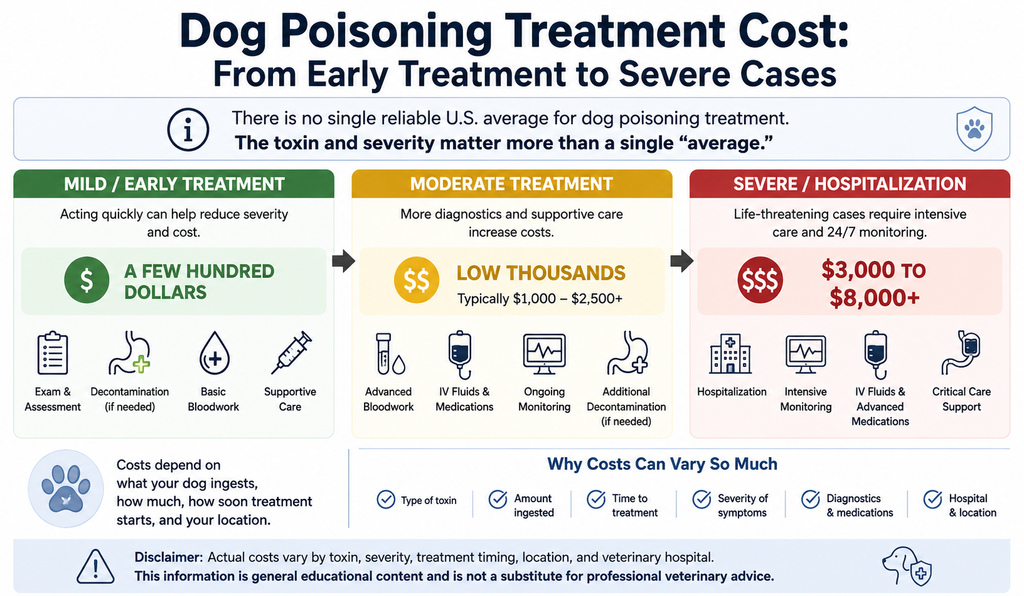
Dog poisoning treatment costs range from a few hundred dollars for early, uncomplicated cases to $3,000–$8,000+ for severe poisonings requiring hospitalization, antidotes, or organ support. There is no single reliable U.S. average for dog poisoning treatment because the bill changes dramatically by toxin, severity, treatment timing, and length of hospitalization. Current cost sources put reported totals anywhere from roughly $65 for limited early intervention to $8,000+ for severe cases, while invoice-based samples and typical emergency-care estimates cluster much lower, though published figures vary — one detailed cost tracker puts the range as wide as $65–$8,000 with an $1,800 average, while a small invoice sample found $550–$2,950. The honest answer is that “average” cost matters less here than which toxin, how fast you got treatment, and how sick your dog became.
Quick Cost Summary
| Service / Cost | Typical or Published Cost | What It Covers |
|---|---|---|
| Pet Poison Helpline | $89 per incident | Veterinary toxicology consultation; follow-up consultations for the same case are included. |
| ASPCA Animal Poison Control | Consultation fee may apply | 24/7 poison-control guidance from veterinary toxicology professionals; ASPCA does not currently publish a fixed fee on its public page. |
| Emergency veterinary exam | Varies by clinic and location | Initial physical examination and assessment of the poisoning risk |
| Decontamination / induced vomiting | Varies by case | May be considered when medically appropriate; the veterinarian determines whether it is safe |
| Activated charcoal | Varies by case | May be used for certain toxin exposures when appropriate |
| Bloodwork | Varies by clinic | Checks for effects on organs, blood clotting, blood sugar, or other toxin-specific concerns |
| IV fluids | Varies by treatment plan | Supportive care and hydration when indicated |
| Hospitalization / monitoring | Varies widely | Observation, repeated testing, medications, and monitoring for delayed effects |
| Antidote / toxin-specific treatment | Varies by toxin | Some poisonings require specific medications or antidotes |
| Total treatment bill | Can range from hundreds to several thousand dollars | Depends heavily on toxin, dose, timing, symptoms, treatment required, hospitalization, and location |
Read Related Article… Emergency Vet Costs in the USA (2026): What You’ll Really Pay by State
These are planning ranges from multiple published sources, not guaranteed prices — actual cost depends on the toxin, your dog’s size, how quickly treatment started, and your location.
Table of Contents
- How Much Does Dog Poisoning Treatment Cost?
- When Is Dog Poisoning an Emergency?
- Does My Dog Need a Vet If They Have No Symptoms Yet?
- What Should You Do If Your Dog Ate Something Poisonous?
- Why the Cost Range Is So Wide
- What Treatment Will a Vet Use for Dog Poisoning?
- What Makes the Bill Add Up?
- Cost by Poison: Why “Dog Poisoning” Isn’t One Scenario
- Cost by Severity: Mild vs. Moderate vs. Severe
- Can a Poisoned Dog Be Treated at Home?
- Does Pet Insurance Cover Dog Poisoning?
- Can You Buy Pet Insurance After Your Dog Is Poisoned?
- What Should You Ask the Emergency Vet About the Estimate?
- What If You Can’t Afford Treatment?
- Action Checklist If Your Dog Ate Something Toxic Right Now
- FAQ
How Much Does Dog Poisoning Treatment Cost?
Dog poisoning treatment typically costs a few hundred dollars for mild, early-treated cases up to $8,000 or more for severe cases requiring hospitalization and intensive care.
Published sources vary noticeably on the “average,” which is worth being upfront about rather than picking one number and presenting it as gospel. One detailed veterinary cost tracker documents a range of $65–$8,000 with a stated average around $1,800. A separate analysis based on real invoices found a tighter $550–$2,950 range. PetPlace cites an average closer to $2,000. The differences come down to what’s being averaged — a same-day induced-vomiting case costs radically less than a rat poison case requiring days of hospitalization, and different data sources weight those scenarios differently.
When Is Dog Poisoning an Emergency?
Dog poisoning should be treated as an emergency when your dog shows signs of serious or rapidly worsening illness after a possible toxin exposure. Seizures, trouble breathing, loss of consciousness, severe weakness or collapse, significant bleeding, or difficulty responding normally are reasons to go directly to the nearest emergency veterinary hospital.
However, you should not wait for severe symptoms before seeking advice. Some toxins can cause delayed effects, and a dog may initially appear completely normal after ingestion. Contact your veterinarian, a local emergency veterinary hospital, or a veterinary poison-control service as soon as you suspect a toxic exposure so they can assess the substance, amount, timing, and your dog’s condition.
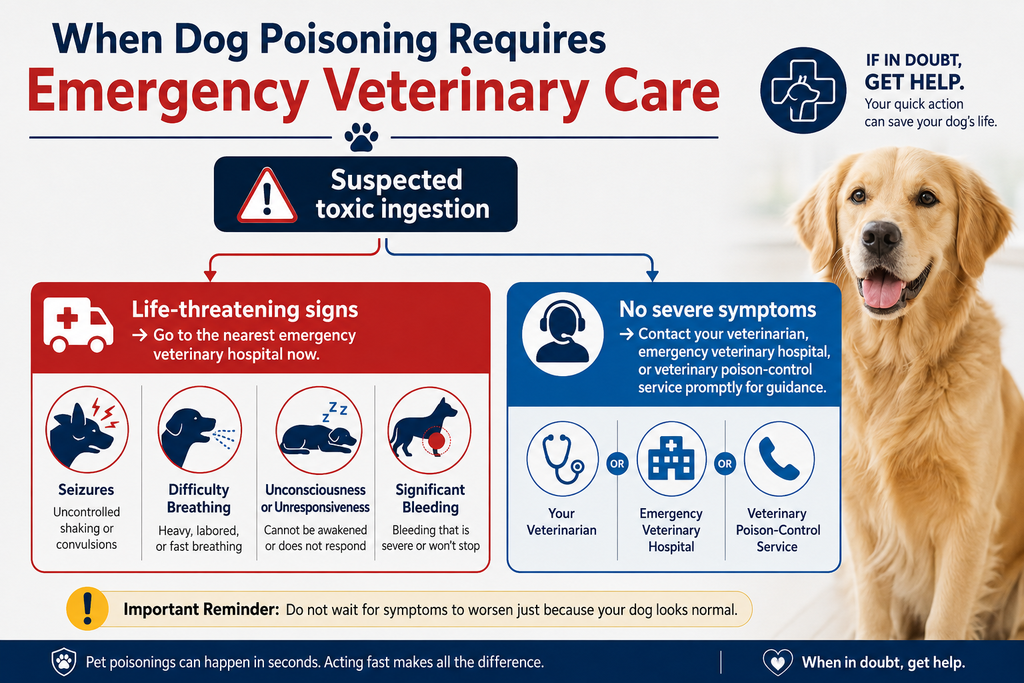
If you go to the vet, bring the product packaging, medication bottle, label, or any other information that can help identify what your dog consumed. Do not induce vomiting or give home remedies unless a veterinary professional specifically tells you to do so.
Does My Dog Need a Vet If They Have No Symptoms Yet?
Yes—you should still contact a veterinarian or veterinary poison-control service if you believe your dog has eaten something potentially toxic, even if they appear completely normal. Some poisons can have delayed effects, and treatment may become more difficult once symptoms develop.
That does not mean every dog will automatically need an emergency-hospital visit. A veterinarian or veterinary toxicology professional can assess the substance, amount ingested, your dog’s weight, health history, and how long ago the exposure occurred, then determine whether your dog needs immediate treatment or can be monitored at home.
If your dog is already showing seizures, trouble breathing, unconsciousness, severe weakness, or bleeding, go directly to an emergency veterinary hospital rather than waiting for symptoms to progress.
Do not induce vomiting or give home remedies unless a veterinarian or poison-control professional specifically tells you to do so.
What Should You Do If Your Dog Ate Something Poisonous?
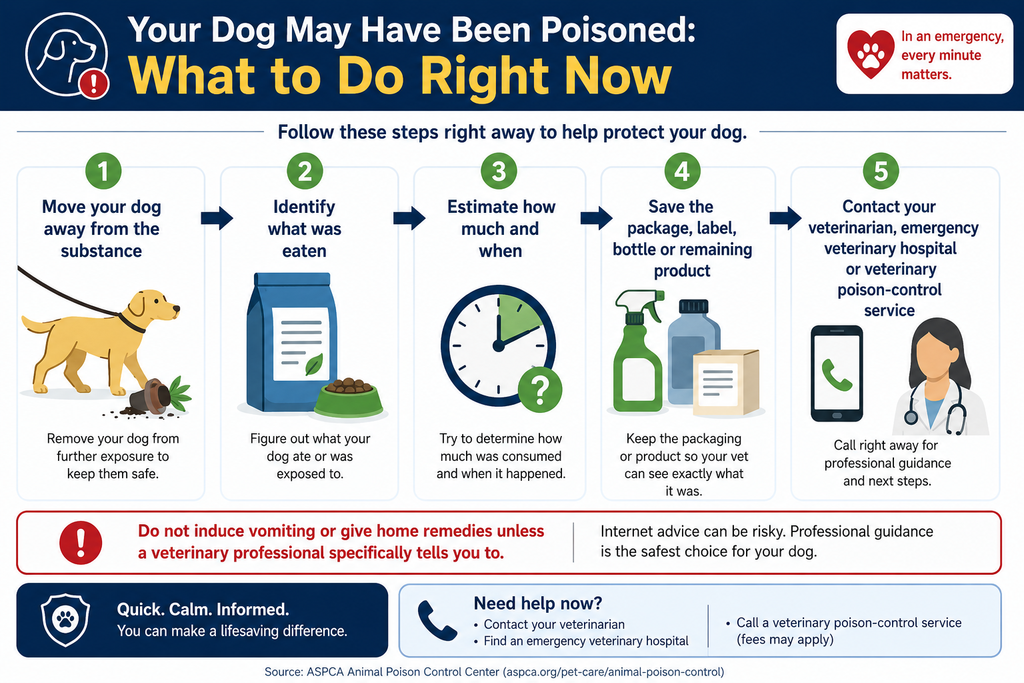
If you think your dog has eaten something potentially toxic, don’t wait for symptoms to appear. First, move your dog away from the substance and prevent any further exposure. Note what your dog may have eaten, approximately how much, and when it happened. Keep the original package, label, medication bottle, or any remaining substance available for the veterinarian or poison-control team.
Contact your veterinarian, a local emergency veterinary hospital, or a pet poison-control service as soon as possible. Even if your dog seems completely normal, some toxins can cause delayed symptoms, and early guidance can affect both treatment and cost.
Do not give home remedies or try to induce vomiting unless a veterinarian or veterinary poison-control professional specifically tells you to do so. Some substances can cause additional injury when vomited.
If your dog is having seizures, trouble breathing, is unconscious or unresponsive, or is bleeding, go directly to the nearest emergency veterinary hospital.
Why the Cost Range Is So Wide
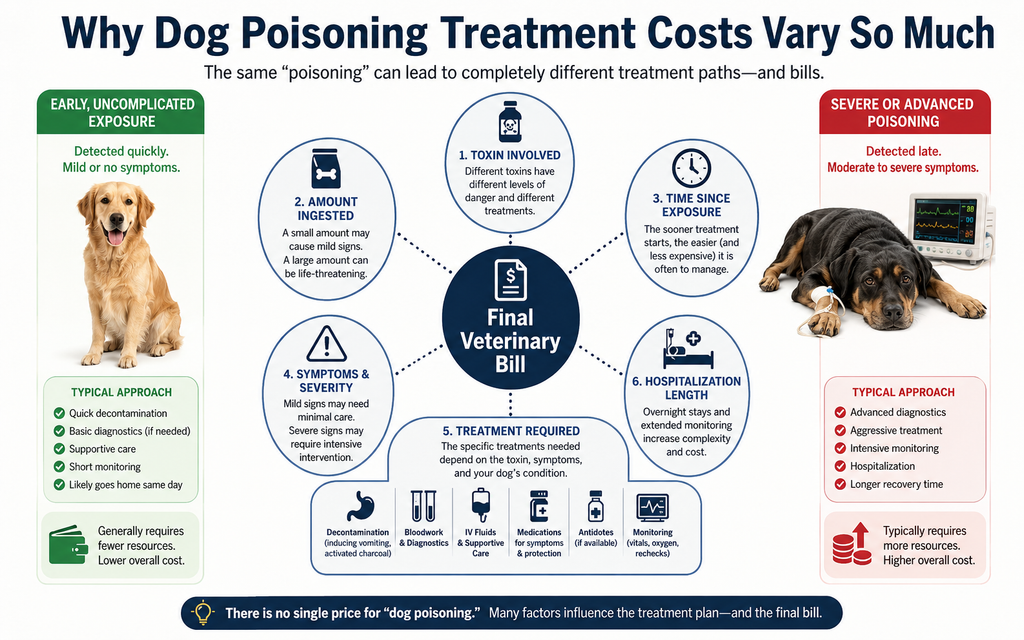
The gap between a $250 bill and an $8,000 bill comes down almost entirely to two things: how fast treatment started, and which toxin was involved.
Timing is the single biggest lever. In some poisoning cases, vets may consider inducing vomiting when the exposure was recent and the procedure is medically appropriate. The useful window varies by toxin and circumstance, so don’t wait to see symptoms before contacting a veterinarian or poison-control service after that window closes, the toxin has moved past the stomach and vomiting is no longer effective, sometimes even harmful. Missing that window means moving to more involved treatment: activated charcoal, IV fluids, bloodwork, and monitoring, which costs substantially more than a same-day induced-vomiting visit.
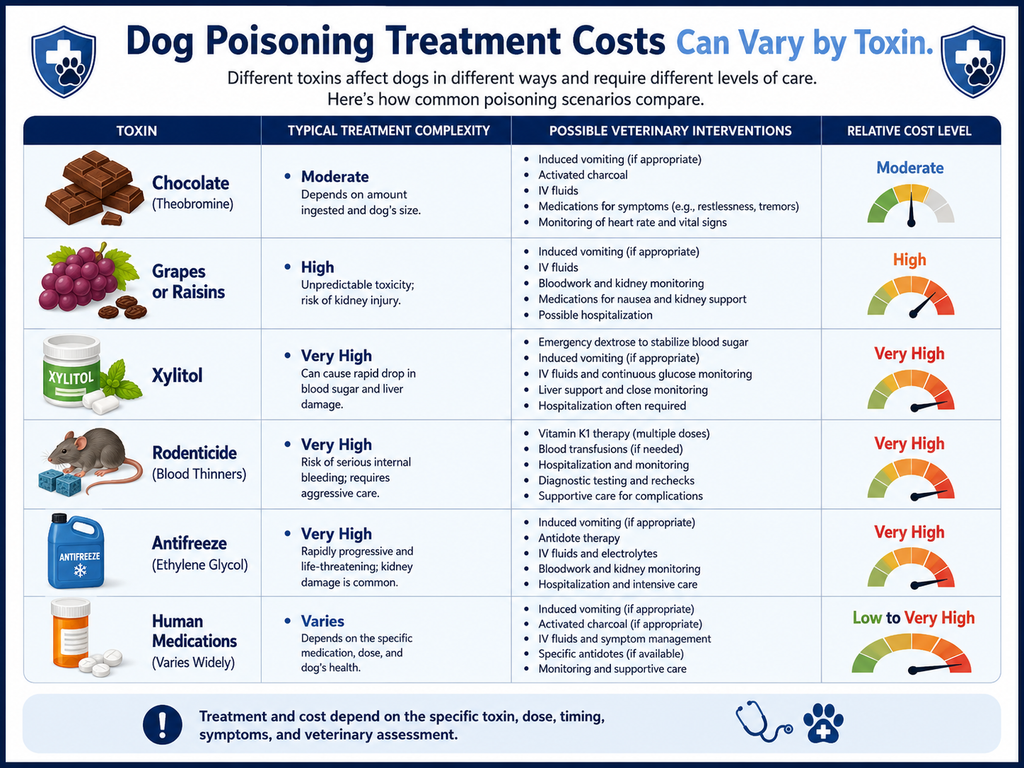
Toxin type matters just as much. Chocolate, grapes/raisins, xylitol, rodenticides and medications can require very different treatment plans, so the toxin and dose matter more than the label ‘poisoning. Rat poison, xylitol, or antifreeze can require days of hospitalization, specific antidotes, or organ support — completely different cost categories from the same starting point of “my dog ate something.”
What Treatment Will a Vet Use for Dog Poisoning?
Treatment depends on what your dog ingested, how much was consumed, when the exposure happened, and whether your dog is already showing symptoms. A veterinarian may first try to prevent further absorption of the toxin through appropriate decontamination. In some recent ingestions, this can include professionally induced vomiting or activated charcoal, but these treatments are not appropriate for every poison or every dog.
If the toxin has already been absorbed or your dog is sick, treatment may focus on supportive care such as IV fluids, controlling vomiting or seizures, maintaining breathing and blood pressure, correcting electrolyte problems, and monitoring organ function. Some poisons also have specific antidotes—for example, certain rodenticides or antifreeze exposures may require toxin-specific treatment.
Because treatment varies significantly by toxin, don’t induce vomiting or give home remedies unless a veterinarian or veterinary poison-control professional specifically tells you to do so.
What Makes the Bill Add Up?
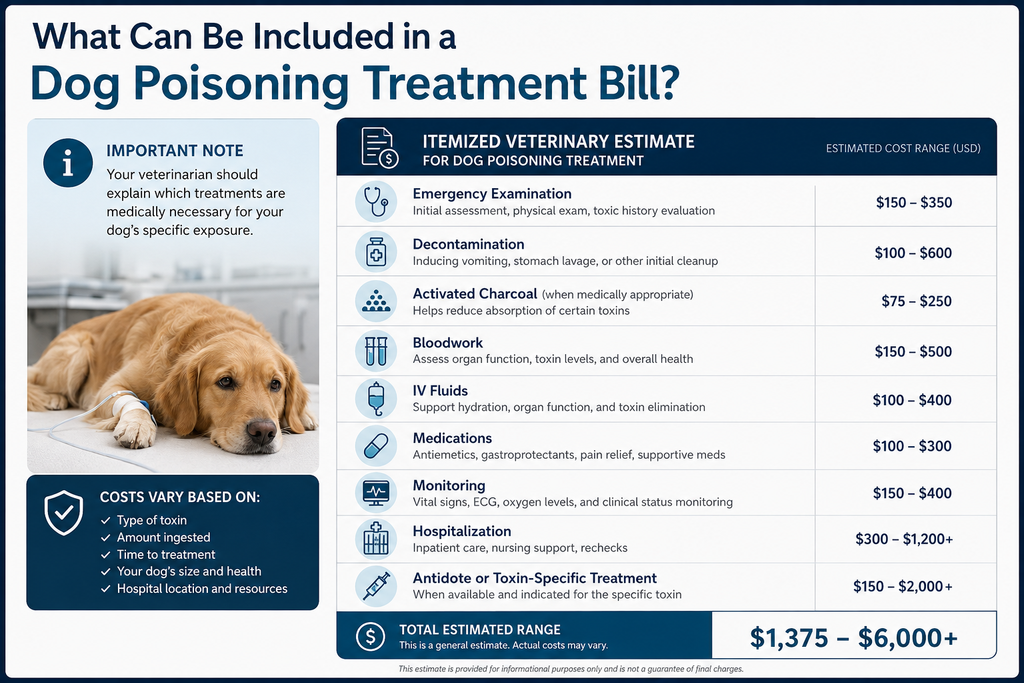
A poisoning treatment bill is built from several distinct pieces, layered on as needed based on the toxin and how your dog responds.
The emergency exam is the starting point, typically $100–$250 during regular hours or $150–$300+ at an emergency clinic. A poison-control consultation — ASPCA Animal Poison Control Center or Pet Poison Helpline — costs $89–$95 per incident and is often recommended by vets to confirm toxic dose and treatment protocol for the specific substance. Induced vomiting, when it’s still an option, runs $250–$400 during regular hours or $400–$800 at an emergency clinic, with the apomorphine medication itself only $50–$150 — the exam fee accounts for most of the difference. Activated charcoal, used when the vomiting window has passed or for toxins vomiting won’t fully clear, is typically bundled with IV fluids at $800–$2,000+, since most poisoning cases need fluid support regardless. Bloodwork checks organ function and toxin impact, commonly $150–$400. IV fluid therapy runs $150–$400 for catheter placement and initial fluids, then $200–$600 per 24 hours of ongoing therapy. Hospitalization and ICU monitoring, needed for severe cases, adds $500–$1,500 per day. Specific antidotes — vitamin K for certain rodenticides, for example — carry their own cost depending on the toxin and treatment duration.
Read Related Article… Emergency Vet Exam Cost in the USA (2026)
Cost by Poison: Why “Dog Poisoning” Isn’t One Scenario
| Toxin | Typical Treatment Path | Approximate Cost Range |
|---|---|---|
| Chocolate (caught early) | Induced vomiting, monitoring | $250–$800 |
| Grapes/raisins | Induced vomiting, IV fluids, kidney monitoring (bloodwork) | $500–$1,500+ |
| Xylitol (sugar-free gum) | Immediate hospitalization, blood sugar monitoring, liver support | $800–$3,000+ |
| Rat poison (rodenticide) | Bloodwork, vitamin K antidote (often multi-week course), hospitalization | $500–$3,500+ |
| Antifreeze | Emergency hospitalization, specific antidote, aggressive IV fluids | $1,500–$5,000+ |
| Human medications (varies widely) | Depends heavily on the drug — induced vomiting to full hospitalization | $300–$4,000+ |
A practical example: a dog that eats a small piece of chocolate and is brought in within an hour might leave with a $400 bill after induced vomiting and a few hours of observation. A dog that gets into rat poison, where symptoms may not appear for 3–5 days with anticoagulant types, often needs bloodwork, a multi-week vitamin K course, and possible hospitalization if bleeding has already started — a bill that can climb past $2,500 even without severe complications.
Cost by Severity: Mild vs. Moderate vs. Severe
Mild cases — caught within the induced-vomiting window, with a toxin that clears quickly — typically involve an exam, vomiting induction, and a short observation period, landing in the $250–$800 range.
Moderate cases — either past the vomiting window or involving a toxin that needs more active management — typically add activated charcoal, bloodwork, and IV fluids, landing in the $800–$2,500 range, often with same-day discharge.
Read Related Article… Dog Blood Test Cost in the USA (2026): Real Prices, What Each Panel Tests, and How to Pay Less
Severe cases — significant organ involvement, a toxin requiring extended treatment (like rodenticide’s multi-week antidote course), or a dog presenting already symptomatic — typically require hospitalization, ICU-level monitoring, and possibly advanced organ support, landing in the $3,000–$8,000+ range.
Can a Poisoned Dog Be Treated at Home?
Some dog poisoning cases can be monitored or treated at home, but that decision should come from a veterinarian or veterinary poison-control professional—not from symptoms alone. The appropriate response depends on the substance, amount ingested, your dog’s size and health, when the exposure occurred, and whether any symptoms are present. ASPCA Poison Control says some cases can be managed at home after a professional risk assessment, while others require immediate veterinary care.
If your dog is having seizures, trouble breathing, severe bleeding, is unconscious, or is not responding normally, go directly to an emergency veterinary hospital.
Even if your dog looks completely normal, don’t simply wait for symptoms. Some toxins can cause delayed effects. Call your veterinarian, emergency vet, or a pet poison-control service for guidance.
Most importantly, don’t give home antidotes or try to induce vomiting unless a veterinary professional specifically tells you to do so. Some substances can make vomiting dangerous.
Does Pet Insurance Cover Dog Poisoning?
Pet poisoning is commonly treated as an accident under accident-and-illness and accident-only policies, but coverage depends on the insurer, policy terms, waiting period, deductible, reimbursement percentage, annual limit, and any applicable exclusions as a listed accident, since accidental toxin ingestion is a textbook example of the coverage category these policies are built for.
Read Related Article… Does Pet Insurance Cover Emergency Vet Visits? What Most Dog Owners Don’t Know (2026)
Actual reimbursement depends on your specific policy: your deductible applies first, then your reimbursement percentage (commonly 70–90%) applies to the remaining eligible costs, up to your annual limit. Coverage generally requires that the poisoning happened after your policy’s waiting period ended — most accident waiting periods are shorter than illness waiting periods, sometimes as little as a few days, but this varies by insurer and is worth confirming directly. Pre-existing conditions don’t typically apply to a new, one-time poisoning event the way they might to a chronic illness, but always verify your specific policy’s language rather than assuming.
Can You Buy Pet Insurance After Your Dog Is Poisoned?
You can usually buy a pet insurance policy after your dog has been poisoned, but the poisoning incident that already happened generally will not be covered. Pet insurers typically treat an injury, illness, or symptoms that existed before coverage began or during the policy’s waiting period as pre-existing. For example, Embrace specifically lists poisoning as a covered accident when the poisoning occurs after the applicable waiting period, while conditions that occurred before coverage or during the waiting period can be excluded.
That means buying insurance after your dog has already ingested a toxin is not a way to make the current emergency bill reimbursable. Waiting periods also vary by insurer and location; for example, Embrace currently lists a two-day accident waiting period in one policy form, while Trupanion lists five days for injuries.
If your dog has already been poisoned, focus first on getting veterinary or poison-control guidance. You can still consider insurance for future, unrelated accidents and illnesses, subject to the policy’s terms and exclusions.
What Should You Ask the Emergency Vet About the Estimate?
Before approving treatment, ask the emergency vet to walk you through the estimate in plain language. Start with: “What does my dog medically need right now, and which parts of this estimate are essential?” Then ask whether hospitalization is necessary, what each major treatment or test is for, and whether there are medically appropriate outpatient or monitoring options.
It is also reasonable to ask: “What could happen if we delay or decline this treatment?” and “Are there additional costs that could be added later?” This can help you understand both the immediate bill and the possible financial range.
Read Related Article… Can a Vet Refuse Emergency Treatment If You Can’t Pay? (2026)
If cost is a concern, say so directly. Ask whether the clinic offers payment plans, financing, or other payment arrangements, and whether there is a lower-cost treatment approach that is still medically appropriate for your dog’s situation. ASPCA recommends discussing next steps and treatment needs with the veterinary team before the additional treatment estimate is generated.
Read Related Article… Vet Payment Plans: Can You Make Monthly Payments to a Vet? (2026)
Don’t be embarrassed to ask about cost. A clear conversation can help you make a more informed decision while your dog is being treated.
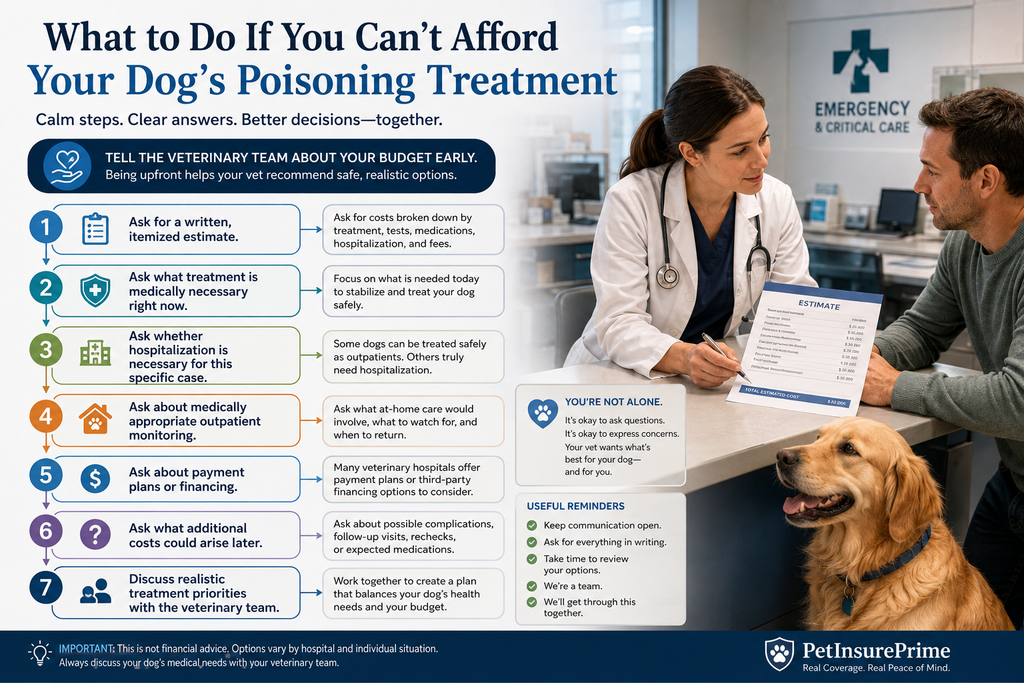
What If You Can’t Afford Treatment?
If the estimate is more than you can cover right now, say so directly to the vet team immediately — poisoning cases often have real time pressure, so speed matters here more than in almost any other emergency conversation.
Read Related Article… Can’t Afford an Emergency Vet Bill? 15 Real Ways Dog Owners Find Help (2026)
Ask for a written, itemized estimate so you understand exactly what’s being recommended. Ask specifically what treatment is medically necessary right now versus what could reasonably wait or be monitored instead. Ask whether hospitalization is truly necessary for your dog’s specific case, or whether outpatient treatment with close monitoring at home is a reasonable option given the toxin involved. Ask about CareCredit or Scratchpay, both of which can often be approved within minutes and pay the clinic directly. Ask whether the clinic offers any payment plan or accepts a partial deposit to begin treatment while you arrange the rest. For the complete breakdown of financing options, grant programs, and questions to ask before agreeing to treatment, see our full guide on what to do if you can’t afford emergency vet surgery.
Action Checklist If Your Dog Ate Something Toxic Right Now
- Note exactly what your dog ingested, how much, and when
- Call your vet or a poison control hotline (ASPCA APCC or Pet Poison Helpline) immediately
- Do not induce vomiting at home without professional guidance — some substances make this dangerous
- Bring any packaging or remaining product to the vet visit
- Ask for a written estimate before agreeing to treatment
- Ask directly whether hospitalization is necessary for this specific toxin
- Call your pet insurer to confirm coverage and expected reimbursement
Frequently Asked Questions
How much does it cost to treat a poisoned dog?
Dog poisoning treatment can cost a few hundred dollars for an early, uncomplicated case and $3,000–$8,000+ for severe cases requiring hospitalization or intensive treatment. The actual bill depends heavily on the toxin, amount ingested, treatment needed, location, and how sick the dog becomes.
Why is dog poisoning treatment so expensive?
Poisoning can require very different treatments depending on the toxin. Costs may include the emergency exam, decontamination, bloodwork, IV fluids, medications, monitoring, antidotes, and hospitalization. Severe cases can require substantially more care than early-treated exposures.
Does pet insurance cover dog poisoning treatment?
Often, poisoning is treated as an accident under eligible accident or accident-and-illness policies. For example, Embrace’s current policy language specifically includes poisoning among covered accidents when the condition starts after the applicable waiting period.
How much does it cost to induce vomiting at the vet?
The total cost depends on the clinic, exam fee, medication, and whether your dog needs additional monitoring or treatment. Don’t choose whether to induce vomiting based only on cost. Never induce vomiting at home unless a veterinarian or veterinary poison-control professional specifically tells you to do so.
How quickly should I contact a vet if my dog ate something poisonous?
Immediately. Don’t wait for symptoms to appear. Some toxins can cause delayed effects, and treatment may become more difficult once symptoms develop. Contact your veterinarian, an emergency veterinary hospital, or a poison-control service for guidance.
Does my dog need a vet if they seem completely normal?
Not necessarily a hospital visit in every case, but you should still get professional guidance promptly after a potentially toxic ingestion. A veterinarian or poison-control expert can determine whether home monitoring is appropriate or whether your dog needs treatment.
Is rat poison treatment more expensive than other poisonings?
It can be, but costs vary significantly by the type of rodenticide and the dog’s condition. Some rodenticides require prolonged monitoring or specific treatment, while others can cause serious neurologic or other complications. The earlier a veterinarian evaluates the exposure, the better they can determine the appropriate treatment.
Can you buy pet insurance after your dog is poisoned?
You can generally purchase a policy afterward, but the poisoning that already happened would generally not be covered. Pet insurance typically covers eligible accidents or illnesses that begin after the policy’s waiting period and excludes pre-existing conditions.
What information should I give the vet or poison-control service?
Have your dog’s weight, age, breed, the product or substance involved, ingredients or concentration, estimated amount eaten, and approximate time of exposure ready. Bring the product packaging if possible. These details help determine the appropriate treatment.
What if I can’t afford my dog’s poisoning treatment?
Tell the veterinary team immediately and ask for a written, itemized estimate. Ask which treatment is medically necessary now, whether hospitalization is required, and what payment or financing options the clinic accepts. Don’t delay emergency care while trying to solve the financial side alone. ASPCA notes that an estimate is typically discussed once the veterinarian determines what additional treatment may be needed.
External Authority Sources
- ASPCA Animal Poison Control Center
- PetMD — Rat Poisoning in Dogs
- AVMA (American Veterinary Medical Association)
- NAPHIA
- Embrace
- PetPlace industry cost data
Disclaimer: This article is for informational and educational purposes only and is not a substitute for veterinary or poison control guidance. If you suspect your dog has ingested something toxic, contact your veterinarian or a poison control hotline immediately. Cost data reflects 2026 figures from multiple veterinary industry sources and will vary based on your dog’s size, the toxin involved, location, and treatment timing. PetInsurePrime does not sell pet insurance and receives no compensation from any insurance provider.
PetInsurePrime | Independent • Research-Based | Helping US dog owners understand real vet costs and coverage options — without the sales pressure.