
Updated: August 2026| Reading Time: 28minutes
Your dog was just diagnosed with cancer. The oncologist has recommended chemotherapy. And right now, sitting in that consultation room or driving home afterward, the most urgent financial question is one you need answered immediately:
The short answer is yes — if your policy was active when the symptoms first appeared and the cancer wasn’t documented before enrollment. But there are specific conditions attached to that yes, and the details determine whether you’re looking at $2,000 out-of-pocket on a $9,000 protocol or $9,000.
Read Related Article… Pet Insurance for Dogs in the USA: How It Works (2026)
Here’s the complete answer.
Quick Answer : Does Pet Insurance Cover Chemotherapy
Yes, many pet insurance policies cover chemotherapy as part of their treatment options for pets diagnosed with cancer. Most policies cover new cancer diagnoses — not pre-existing or experimental treatments. Coverage applies when: you have a comprehensive accident-and-illness plan (not accident-only), the cancer was diagnosed after your policy’s illness waiting period ended, and the cancer showed no documented symptoms before enrollment. Chemotherapy for pets usually costs $150 to $600 per dose, but insurance can cover 70% to 90% of the bill.
Read Related Article… Dog Chemotherapy Cost in the USA (2026): Real Numbers by Cancer Type, Protocol & Situation
Read Related Article… Dog Cancer Treatment Cost in the USA (2026): Surgery, Chemo & Total Costs
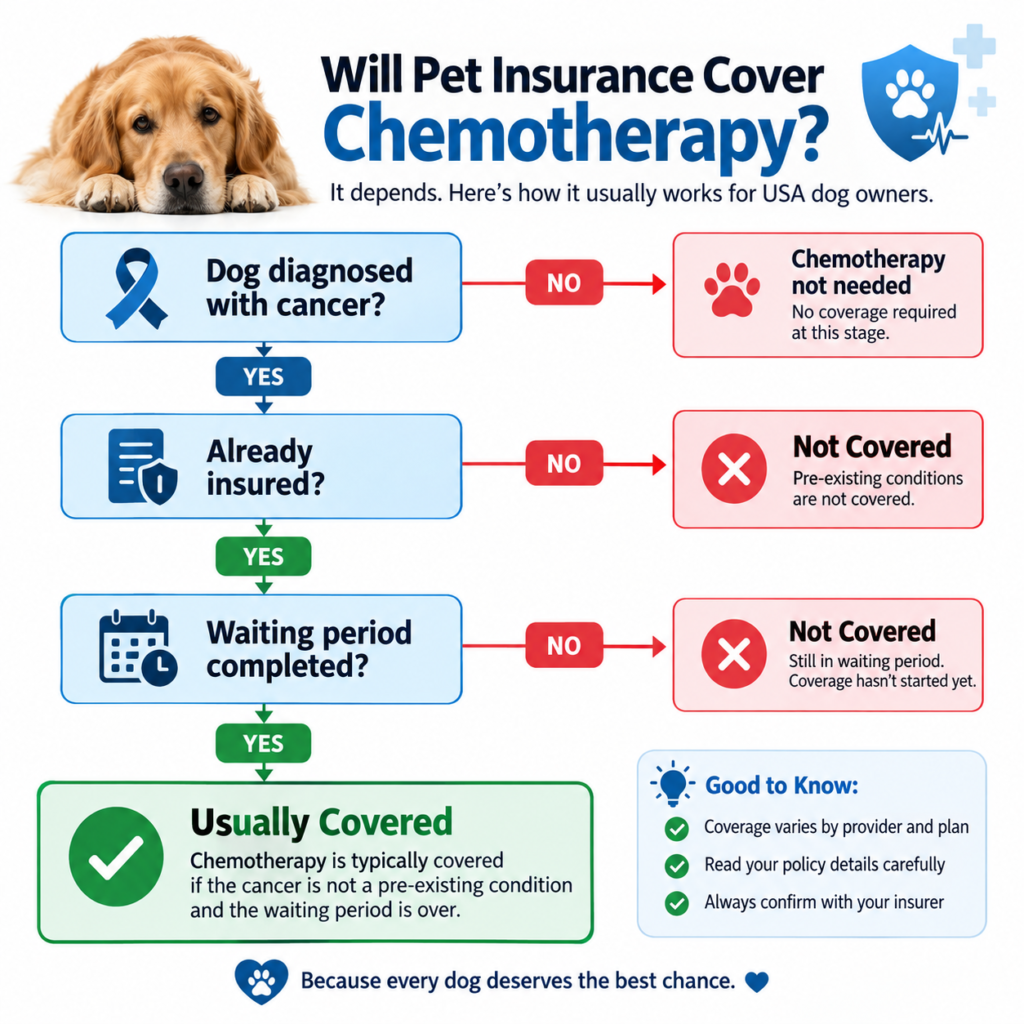
At a Glance: Chemotherapy Coverage Summary
| Situation | Covered? |
|---|---|
| New cancer diagnosis, comprehensive A&I plan, past waiting period | ✅ Yes — 70–90% after deductible |
| Cancer diagnosed during waiting period | ❌ No — waiting period exclusion |
| Cancer symptoms documented before enrollment | ❌ No — pre-existing condition |
| Cancer diagnosed before enrollment | ❌ No — pre-existing condition |
| Accident-only plan, any cancer | ❌ No — illness not covered |
| Pre-session CBC blood work | ✅ Yes — part of covered treatment |
| Anti-nausea medications at each visit | ✅ Yes — covered as treatment |
| Oncologist consultation fees | ✅ Varies by insurer |
| Staging diagnostics (CT, biopsy, bloodwork) | ✅ Most comprehensive plans |
| Experimental immunotherapy | ⚠️ Often excluded |
| Palladia / toceranib (FDA-approved for MCT) | ✅ Covered by most plans |
| Tanovea / rabacfosadine | ⚠️ Newer drug — check your plan |
| Pre-existing cancer, future unrelated condition | ✅ Yes — other conditions covered |
| Second cancer (unrelated to first) | ✅ Yes — if new and not pre-existing |
Table of Contents
- Which Pet Insurance Plans Cover Chemotherapy?
- What Pet Insurance Actually Covers in a Chemo Claim
- The Pre-Existing Condition Rule — The Most Common Reason Claims Are Denied
- The Waiting Period Problem for Cancer and Chemotherapy
- Insurer-by-Insurer Chemotherapy Coverage Comparison (2026)
- The Annual Limit Problem: Why Your Plan’s Cap Matters More Than the Premium
- Real Reimbursement Math: What Insurance Pays on a $9,000 CHOP Protocol
- What Happens If Your Dog’s Cancer Relapses in Year 2
- Experimental Treatments: What’s Covered and What Isn’t
- My Dog Already Has Cancer — Can I Still Get Insurance?
- How to Pre-Authorize Chemotherapy with Your Insurer
- How to File a Chemotherapy Claim — Week by Week
- Action Checklist
- FAQ
Which Pet Insurance Plans Cover Chemotherapy?
If you have comprehensive pet insurance coverage and your dog or cat develops cancer, your policy should help you pay for treatment. There are typically three ways that dogs and cats with cancer are treated: surgery to remove the tumor, targeted radiation to reduce its size, or chemotherapy to destroy the tumor.
Read Related Article… What Doesn’t Pet Insurance Cover? 13 Common Exclusions Every Pet Owner Should Know (2026)
The plan type is the first and most important filter:
Comprehensive accident-and-illness plans: ✅ Cover chemotherapy — this is the plan type you need. Both surgical and non-surgical cancer treatments, including all chemotherapy protocols, are included when coverage conditions are met.
Accident-only plans: If you have an accident-only pet insurance plan, it will only cover accidental injuries, so it won’t cover the costs of cancer treatment. Cancer is classified as an illness. Accident-only plans do not cover it — not the diagnosis, not the chemotherapy, not a single session.
Wellness add-ons: Do not cover chemotherapy. Wellness add-ons cover preventive and routine care only. They are not relevant to cancer treatment coverage.
Read Related Article… Pet Insurance Waiting Period: How Long Before Coverage Starts? (2026 Guide)
What varies: Not all comprehensive plans are equal for cancer coverage. The variables that matter most:
- Annual coverage limit ($5,000 vs $10,000 vs unlimited)
- Whether exam fees are included (varies by insurer)
- Whether hereditary conditions are covered (relevant for breed-specific cancers)
- Whether alternative/complementary treatments alongside chemo are covered
- The illness waiting period length (14 days is standard; orthopedic waiting periods don’t apply to cancer)
What Pet Insurance Actually Covers in a Chemo Claim
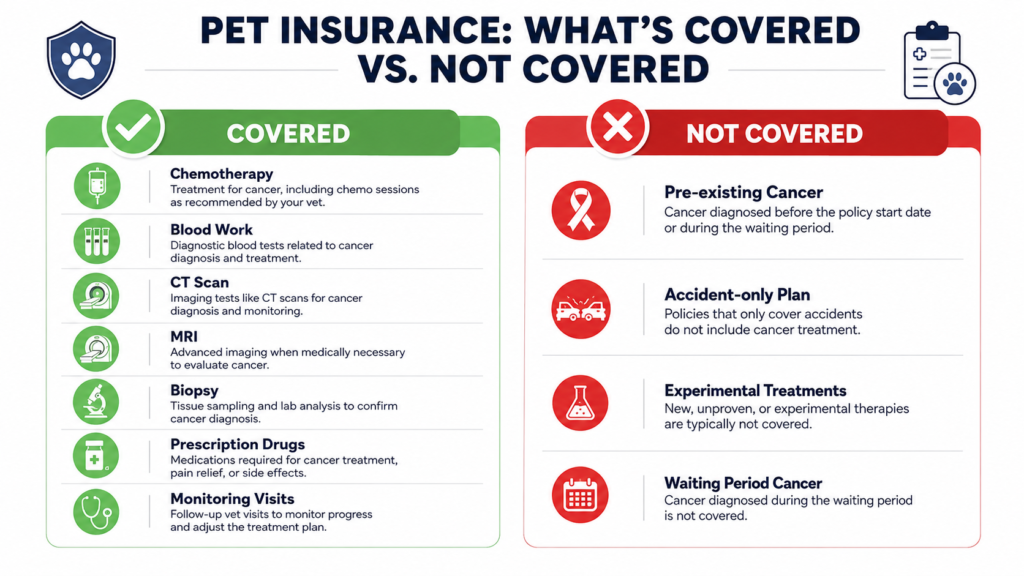
Understanding exactly what falls within a chemotherapy claim prevents the surprise of uncovered line items appearing at checkout.
Read Related Article… Dog MRI Cost in the USA (2026): Average Cost, Insurance Coverage & Financing
Typically covered as part of a chemo treatment claim:
Not all plans cover diagnostics related to chemotherapy, so check if imaging and lab work are included.
- Chemotherapy drugs and administration — the core treatment cost, covered at your reimbursement rate after deductible
- Pre-session CBC blood work — the mandatory blood count check before every session is part of the treatment, not a separate diagnostic event
- Anti-nausea medications (Cerenia, ondansetron) at each visit — administered as part of the treatment protocol
- IV catheter placement and IV fluid flush — required for IV drug administration
- Oncologist visit / monitoring fee — the per-session supervision charge
- Staging diagnostics that led to the cancer diagnosis — CT scans, biopsies, bloodwork ordered to diagnose and stage the cancer are covered as part of the same condition
- Post-treatment monitoring — recheck imaging and oncology exams during and after the protocol
- Prescription medications sent home — anti-nausea, steroids, pain management prescribed as part of the cancer treatment
Read Related Article… Dog CT Scan Cost in the USA (2026): Real Numbers, Hidden Charges, and How to Lower the Bill
What varies by insurer:
- Exam fees — MetLife, Embrace, ASPCA, and Spot include exam fees; Healthy Paws and Trupanion do not
- Holistic/complementary treatments — MetLife explicitly covers vet-prescribed supplements and holistic treatments as part of cancer care; most other plans do not
- Rehabilitation after cancer surgery — Embrace covers rehabilitation; most plans do not
- Prescription food — if prescribed specifically for cancer management, some plans cover it
Read Related Article… Dog Biopsy Cost in the USA (2026): Real Prices by Type, Hidden Lab Fees & What the Results Mean
What is almost never covered:
- Experimental or unproven treatments (specific drugs discussed in section 9)
- Over-the-counter supplements not prescribed by a vet
- Cancer that was pre-existing before enrollment
- Treatment during the waiting period
Read Related Article… Does Pet Insurance Cover Blood Tests? The Complete Answer for Dog Owners (2026)
The Pre-Existing Condition Rule — The Most Common Reason Claims Are Denied
This is the most important section for owners who received a cancer diagnosis and now need to understand whether it’s covered.
If your pet already has cancer, your insurance policy will not cover it. Pet insurance may cover the costs of future ailments that aren’t related to the cancer treatment, but it won’t cover any costs related to the cancer including surgery, radiation, and chemotherapy.
The pre-existing condition exclusion applies when:
1. The cancer was diagnosed before enrollment. If your dog has a documented cancer diagnosis from before your policy start date, all treatment for that cancer — including every chemotherapy session — is excluded. Permanently. On any policy.
2. Cancer symptoms appeared before enrollment. This is the trap that catches the most owners off guard. The insurer doesn’t require a formal cancer diagnosis to exclude coverage — they require evidence that symptoms existed before enrollment.
A vet note from a routine exam 6 months before you enrolled saying “monitoring a palpable lump on right flank” — that lump is now pre-existing on any new policy. If that lump turns out to be a mast cell tumor requiring chemotherapy, the claim is denied.
Common documentation that creates pre-existing status:
- Any vet record noting an unexplained lump being “monitored”
- Prior bloodwork showing elevated calcium (can indicate cancer)
- Weight loss recorded across multiple visits without explanation
- Documented enlarged lymph nodes, even if cancer wasn’t confirmed
- Prior diagnostic imaging showing a mass
3. Symptoms appeared during the waiting period. Even with a new policy, if cancer symptoms developed during the illness waiting period (typically the first 14 days), the condition is treated as pre-existing on that policy.
The “curable condition” exception: AKC Pet Insurance offers coverage for pre-existing conditions, including incurable ones, after 365 consecutive days of continuous enrollment. A dog managing lymphoma, where a single diagnosis can cost between $900 and $4,500, may qualify for coverage on that condition after a year.
This is a meaningful and rare exception. Most insurers permanently exclude pre-existing conditions. AKC’s 365-day continuous enrollment rule means a dog with a documented prior condition — even an ongoing one like lymphoma — could theoretically qualify for coverage on that condition after maintaining uninterrupted coverage for one year. This exception doesn’t apply at any other major insurer.
Read Related Article… Does Pet Insurance Cover Pre-Existing Conditions? The Truth Most Pet Owners Learn Too Late (2026)
The gray area — borderline prior records:
If your dog has borderline prior records (one mention of a lump, subsequently unmentioned) and is denied coverage, the appeal process involves:
- Requesting the specific exclusion reason in writing
- Getting a letter from your vet documenting that the prior lump was benign and unrelated to the current cancer
- Appealing with pathology reports showing the current tumor is a new, separate occurrence
Appeals with veterinary documentation succeed more often than owners expect when the prior record is genuinely ambiguous.
The Waiting Period Problem for Cancer and Chemotherapy
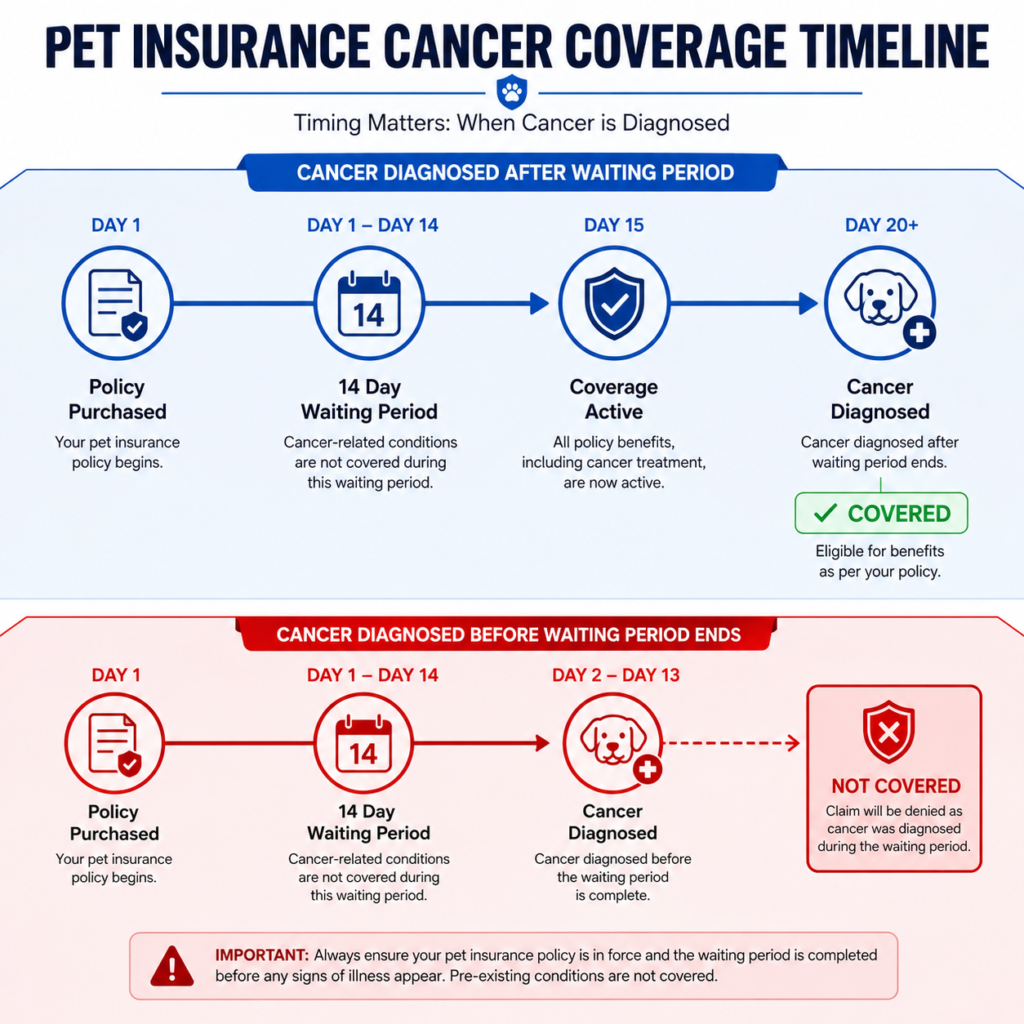
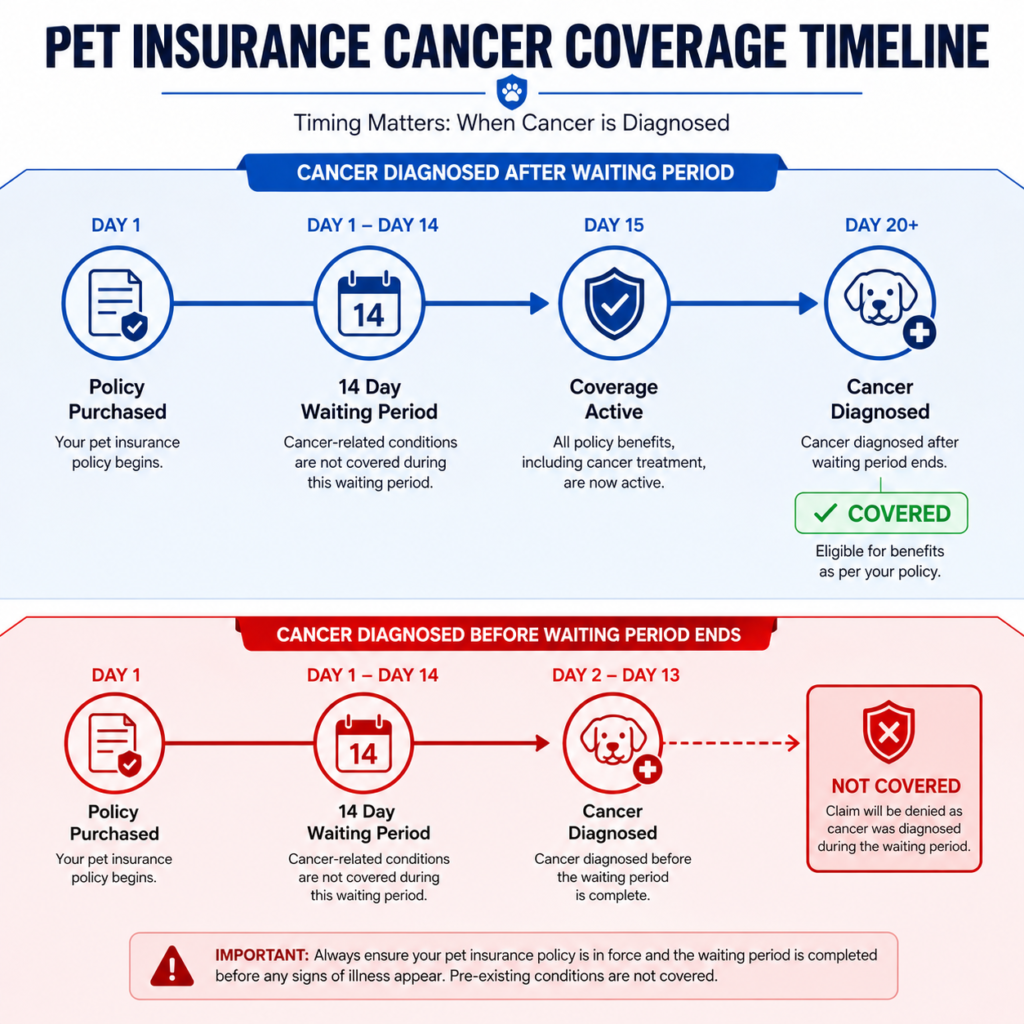
Pet insurance waiting periods mean coverage doesn’t activate immediately upon enrollment. For chemotherapy, the relevant waiting period is the illness waiting period.
Standard illness waiting periods:
| Insurer | Illness Waiting Period | Orthopedic Waiting Period |
|---|---|---|
| ASPCA Pet Health Insurance | 14 days | 14 days |
| MetLife Pet | 14 days | 14 days |
| Embrace | 14 days | 6 months |
| Spot | 14 days | 14 days |
| Fetch | 15 days | 6 months |
| Lemonade | 14 days | 14 days |
| Nationwide | 14 days | 14 days |
| Healthy Paws | 15 days | 12 months |
| Trupanion | 5 days | 30 days |
Cancer is classified as an illness — not an accident and not an orthopedic condition. This means the illness waiting period (14–15 days for most insurers) is the relevant one. Orthopedic waiting periods (6–12 months) do not apply to cancer.
Read Related Article… Pet Insurance Waiting Period: How Long Before Coverage Starts? (2026 Guide)
What the waiting period means for chemotherapy:
If your dog is enrolled on June 1 and develops lymphoma symptoms on June 10 — that’s within the 14-day illness waiting period. The lymphoma is excluded from coverage. Chemotherapy for that lymphoma is excluded. All treatment related to that specific cancer diagnosis is permanently excluded under that policy.
If the same dog develops lymphoma symptoms on June 20 — past the 14-day waiting period — the condition is covered, and chemotherapy claims will be processed.
The “accelerated waiting period waiver”: Some insurers waive the waiting period if a veterinarian certifies the dog has received a wellness exam and shows no signs of the condition within the past 30 days. Trupanion’s 5-day waiting period for illness (with wellness exam) is one of the shortest in the industry. This matters for owners who want faster coverage activation.
Insurer-by-Insurer Chemotherapy Coverage Comparison (2026)
Not all comprehensive plans handle cancer and chemotherapy identically. These are the meaningful differences between major insurers for chemotherapy coverage specifically.
| Insurer | Chemo Covered? | Annual Limit | Exam Fees | Hereditary Conditions | Experimental Rx | Pre-existing Exception |
|---|---|---|---|---|---|---|
| ASPCA Pet Health Insurance | ✅ Yes | Up to $10K (unlimited option) | ✅ Included | ✅ Covered | ❌ Usually not | ❌ Standard exclusion |
| MetLife Pet | ✅ Yes | Up to unlimited | ✅ Included | ✅ Covered | ⚠️ Some coverage | ❌ Standard exclusion |
| Embrace | ✅ Yes | Up to $30K | ✅ Included | ✅ Covered | ❌ Not typically | ❌ Curable conditions only |
| Spot | ✅ Yes | Up to unlimited | ✅ Included | ✅ Covered | ❌ Not typically | ❌ Standard exclusion |
| Fetch | ✅ Yes | Up to unlimited | ✅ Included | ✅ Covered | ❌ Not typically | ❌ Standard exclusion |
| Healthy Paws | ✅ Yes | Unlimited | ❌ Excluded | ✅ Covered | ❌ Not typically | ❌ Standard exclusion |
| Trupanion | ✅ Yes | Unlimited (90%) | ❌ Excluded | ✅ Covered | ❌ Not typically | ❌ Standard exclusion |
| Nationwide | ✅ Yes | Up to unlimited | ✅ Included | ✅ Covered | ⚠️ Some | ❌ Standard exclusion |
| AKC Pet Insurance | ✅ Yes | Unlimited | ✅ Included | ✅ Covered | ❌ Not typically | ✅ 365-day rule |
| Lemonade | ✅ Yes | Up to $100K | ❌ Standard plan | ✅ Covered | ❌ Not typically | ❌ Standard exclusion |
Key distinctions for chemotherapy coverage:
Exam fee inclusion: On a 19-session CHOP protocol, the exam fee at each visit represents $75–$200 per appointment. Across the full protocol, exam fee inclusion or exclusion represents $1,425–$3,800 in reimbursement difference. Healthy Paws and Trupanion exclude exam fees — factor this into your actual net reimbursement calculation.
Annual limit for cancer: Because chemotherapy services can repeat across multiple treatment cycles in a single policy year, an unlimited annual limit is the coverage structure that best reflects what cancer treatment costs over time. A $5,000 annual limit doesn’t cover one full CHOP protocol. Even a $10,000 limit may fall short of the all-in cost including diagnostics, monitoring, and supportive medications.
Trupanion’s direct payment advantage: Trupanion’s direct payment program at enrolled oncology clinics pays the clinic immediately at checkout. You pay only your per-condition deductible. On a $700 chemo session with a $200 per-condition deductible, you pay $200 and Trupanion pays $500 directly to the clinic. For owners managing 19 weekly appointments, not needing to front $700 and wait for reimbursement each visit is a meaningful cash-flow advantage.
The Trupanion deductible structure: Trupanion uses a per-condition deductible (you set it at enrollment, typically $0–$1,000) rather than an annual deductible. For a dog with lymphoma, you pay the per-condition deductible once — and every subsequent chemo session, monitoring visit, and supportive medication for that lymphoma diagnosis is covered at 90% with no additional deductible. For a long cancer treatment journey, this structure is financially favorable versus an annual deductible that resets every year.
The Annual Limit Problem: Why Your Plan’s Cap Matters More Than the Premium
This is the detail that most pet insurance marketing obscures — and the one that determines whether your insurance meaningfully helps with chemotherapy or provides token coverage.
A full CHOP protocol all-in (19 sessions + anesthesia + blood work + monitoring + diagnostics) runs $8,000–$15,000 in year one. If your policy has a $5,000 annual limit — it’s exhausted before the protocol is complete.
Annual limit impact on a $14,000 cancer year:
| Annual Limit | Insurance Pays (80% rate, $250 deductible) | Your Out-of-Pocket |
|---|---|---|
| $5,000 | $5,000 | $9,000 |
| $10,000 | $9,800 | $4,200 |
| $15,000 | $11,000 | $3,000 |
| Unlimited | $11,000 | $3,000 |
Note: At $15,000+ limit, the calculation reaches the same result as unlimited on a $14,000 bill.
The multi-year compounding problem:
Cancer treatment often spans more than one policy year. A dog that starts CHOP in October completes the protocol in January — straddling two policy years. The deductible resets at the policy renewal. Year 1 hits the limit. Year 2 starts a fresh deductible and a fresh limit counter.
If the dog relapses in Year 2 and begins a rescue protocol — the Year 2 annual limit starts from zero again. With an unlimited plan, this is not a problem. With a $5,000 or $10,000 annual limit, the owner may hit the ceiling in both years.
Read Related Article… Does Pet Insurance Cover Cancer Treatment? What Most Pet Owners Don’t Know (2026)
The premium difference for unlimited coverage:
Moving from a $5,000 annual limit to an unlimited plan at comparable reimbursement rates typically costs $15–$40 more per month — $180–$480 more per year. On a cancer treatment year costing $14,000, that premium difference returns $4,800–$6,800 more in reimbursement. The math strongly favors unlimited for any breed with elevated cancer risk.
Real Reimbursement Math: What Insurance Pays on a $9,000 CHOP Protocol
Let’s run the actual numbers across a complete CHOP protocol for a medium-sized dog at a mid-range specialty clinic.
Read Related Article… Dog Cancer Treatment Cost in the USA (2026): Surgery, Chemo & Total Costs
Total protocol cost: $9,200 (19 sessions including blood work, anti-nausea, oncologist fees)
Scenario 1 — Comprehensive plan, 80% reimbursement, $250 annual deductible (already met), unlimited limit:
- Total eligible: $9,200
- Deductible remaining: $0
- At 80% reimbursement: $7,360 back
- Your out-of-pocket: $1,840
- Effective cost of the full CHOP protocol with insurance
Scenario 2 — Comprehensive plan, 80% reimbursement, $500 annual deductible (first claim of the year), $10,000 limit:
- Total eligible: $9,200
- Minus deductible: $500
- Eligible after deductible: $8,700
- At 80% reimbursement: $6,960 back
- Your out-of-pocket: $2,240
Scenario 3 — Comprehensive plan, 80% reimbursement, $250 deductible met, $5,000 annual limit:
- Total eligible: $9,200
- Deductible: $0
- At 80% up to $5,000 limit: $5,000 back
- Your out-of-pocket: $4,200
The $5,000 limit plan returns $2,360 less than the unlimited plan — on a single protocol, in a single year.
Scenario 4 — Trupanion direct pay, 90% reimbursement, $0 per-condition deductible:
- At 90% reimbursement: $8,280 back
- Your out-of-pocket: $920
- Paid directly to the clinic at each session — no upfront cash required
Trupanion’s 90% rate with a $0 deductible on a $9,200 protocol returns the most of any scenario — but the monthly premium for this tier is also the highest.
The cash-flow reality:
Even with excellent insurance, most plans require you to pay the clinic at each session and wait for reimbursement. On a weekly $600 chemo visit:
- Pay $600 at checkout
- Submit claim that evening
- Receive $480 reimbursement in 5–15 business days
- Net weekly cash flow requirement: $120 ongoing
Over a 19-week protocol, having $600–$1,000 available each week is the practical financial requirement — even with 80% reimbursement. CareCredit applied before the first appointment eliminates this week-to-week pressure.
What Happens If Your Dog’s Cancer Relapses in Year 2
Because chemotherapy services can repeat across multiple treatment cycles in a single policy year, its unlimited annual limit is the coverage structure that best reflects what cancer treatment costs over time.
Lymphoma relapse is expected — 95% of dogs eventually relapse after achieving remission with CHOP. When relapse occurs, the financial and insurance picture changes.
Year 2 insurance dynamics:
If your dog completed CHOP in Year 1 and relapses in Year 2:
- The annual deductible resets at policy renewal
- The annual limit counter resets
- The cancer itself is not newly diagnosed — it’s the same pre-existing condition on the new policy year
The good news: The cancer was already a covered condition on your policy. Relapse is not a new pre-existing condition — it’s a continuation of the covered illness. Your insurer cannot reclassify an ongoing covered condition as pre-existing simply because the policy year renewed.
The bad news: Your deductible resets. If you have a $500 annual deductible and the policy renews in January, your first rescue protocol session in February is subject to the fresh $500 deductible before reimbursement begins.
Coverage for rescue protocols: Most insurers cover rescue chemotherapy protocols (MOPP, actinomycin-D, rabacfosadine/Tanovea) as continuation of cancer treatment for the same covered condition. However, newer drugs like Tanovea are sometimes classified as experimental — check your specific policy’s experimental treatment exclusion language before beginning a rescue protocol.
Switching insurers after cancer diagnosis: If your pet already has cancer, you won’t find a policy that will cover it since it’s a pre-existing condition. If you switch insurers after your dog’s lymphoma diagnosis — even during remission — the lymphoma is a pre-existing condition on the new policy. Every new insurer will exclude it. Do not switch insurers during cancer treatment. Maintain your current policy regardless of premium increases.
Experimental Treatments: What’s Covered and What Isn’t
Most plans do, but only for new cancer diagnoses — not pre-existing or experimental treatments.
The “experimental treatment” exclusion is one of the least-explained clauses in pet insurance policies — and it’s particularly relevant for cancer, where new drugs and approaches are continuously emerging.
Treatments that are FDA-approved and generally covered:
- Palladia (toceranib phosphate) — FDA-approved targeted therapy for canine mast cell tumors. Covered by most comprehensive plans because it’s an established, approved medication.
- Oncept (melanoma vaccine) — USDA-licensed for canine melanoma. Most plans cover it as a licensed treatment.
- Standard CHOP drugs — cyclophosphamide, doxorubicin, vincristine, prednisone — all established medications, universally covered.
Treatments that are often classified as experimental:
- Tanovea (rabacfosadine) — conditionally approved by FDA, increasingly used for canine lymphoma rescue protocols. Some insurers cover it; others classify it as experimental. Check your specific policy before starting.
- Immunotherapy protocols — checkpoint inhibitors, adoptive cell therapy, and other emerging immunotherapy approaches are often excluded as experimental even when recommended by board-certified oncologists.
- Low-dose metronomic chemotherapy as a standalone protocol — some plans cover it as a recognized alternative protocol; others classify it as off-label use.
- Specific combination protocols not in standard formularies — custom protocols built for individual cases may face classification challenges.
How to determine coverage before starting:
Ask your insurer two specific questions:
- “Is [specific drug name] classified as an approved or experimental treatment under my policy?”
- “Is [specific protocol name] listed in your covered treatment formulary?”
Get the answer in writing — not just verbally over the phone. If a treatment is approved today but the policy language changes at renewal, having written confirmation protects your claim for that treatment cycle.
My Dog Already Has Cancer — Can I Still Get Insurance?
If your pet already has cancer, your insurance policy will not cover it. You’ll still be able to obtain pet insurance for your dog or cat, but your policy will exclude any ongoing pre-existing conditions (including cancer) from coverage.
This is the most painful situation to be in — and deserves a direct, complete answer.
You can still enroll. The cancer will be excluded.
A new policy will exclude all treatment related to the current cancer diagnosis. Every chemotherapy session, every oncology visit, every medication prescribed for the cancer — excluded on any new policy purchased after diagnosis.
What a new policy WILL cover:
All conditions unrelated to the cancer. A dog in active cancer treatment can still develop:
- A broken leg from an accident
- A urinary tract infection
- A foreign body obstruction from swallowing something
- Dental disease
- Skin infections
- Allergies
- Any other new, unrelated condition
These are covered normally on a new policy — because they’re not the cancer.
Is it worth enrolling after a cancer diagnosis?
Calculate it based on your dog’s realistic prognosis and other health risks:
- If your dog has a meaningful expected lifespan after cancer treatment, new coverage makes sense for protecting against non-cancer emergencies
- If your dog is elderly with multiple health issues, the premium cost versus expected benefit requires honest evaluation
- If you have high-risk breed factors for multiple conditions, coverage for non-cancer conditions is meaningful
The AKC exception revisited: AKC Pet Insurance offers coverage for pre-existing conditions, including incurable ones, after 365 consecutive days of continuous enrollment. This is the only major insurer with a pathway to eventual coverage of a pre-existing condition. For a dog currently in cancer treatment, enrolling with AKC now — knowing coverage for the existing cancer may become available after 365 days of continuous enrollment — is a specific, deliberate strategy worth discussing with your financial advisor.
What to do right now:
- Contact your current insurer if you already have a policy — confirm the cancer diagnosis is covered and request pre-authorization
- If you have no current coverage, enrolling now protects against non-cancer emergencies
- Apply for CareCredit for the current cancer treatment financing
- Contact Live Like Roo and The National Canine Cancer Foundation for cancer-specific financial assistance
How to Pre-Authorize Chemotherapy with Your Insurer
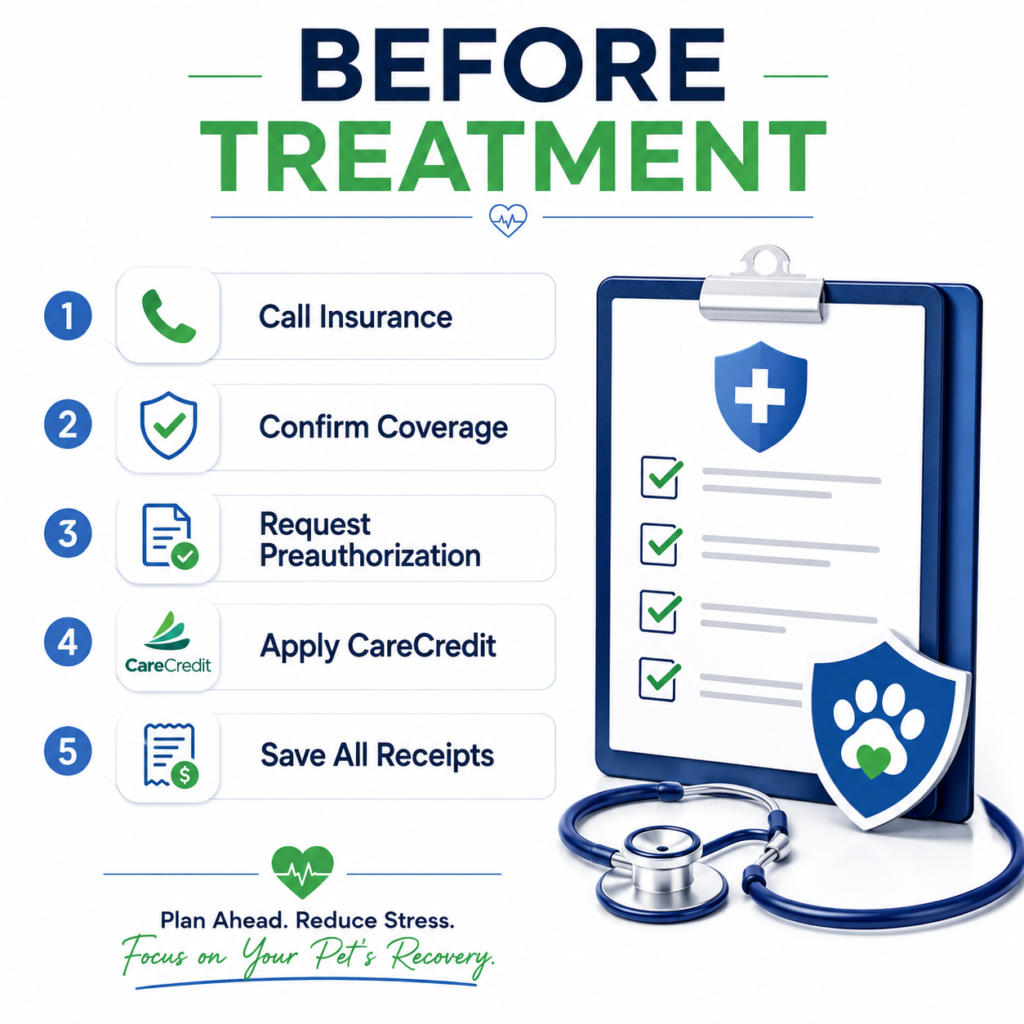
Pre-authorization is not available at all insurers — but for those that offer it, the process confirms coverage before any money is spent. For a $9,000+ protocol, spending 20 minutes pre-authorizing is the most valuable financial step you can take.
Step-by-step pre-authorization process:
Step 1: Gather your documents before calling. Collect: your policy number, the oncologist’s written treatment recommendation (including drug names and number of sessions), the staging diagnostic reports, and the pathology report confirming the cancer diagnosis.
Step 2: Call your insurer’s claims department — not the general line. The claims team handles coverage determinations. Ask specifically: “I need to request pre-authorization for a chemotherapy protocol for my dog. Who should I speak with?”
Step 3: State the clinical information clearly. Tell them:
- The cancer diagnosis (exact type, confirmed by biopsy)
- The date of diagnosis (to confirm it’s past the waiting period)
- The protocol recommended (CHOP, carboplatin, etc.)
- The drugs involved by name
- The expected number of sessions and cost
Step 4: Ask three specific questions.
- “Is this cancer diagnosis covered under my policy?”
- “Is [protocol name] an approved treatment under my policy or classified as experimental?”
- “Are all components of the treatment — drugs, blood work, oncologist fees, anti-nausea medications — covered?”
Step 5: Get confirmation in writing. Ask for a written coverage determination — not just a verbal confirmation. Request it by email or ask them to mail it. The reference number from the phone call is useful but not as protective as written confirmation.
Insurers that offer formal pre-authorization: Some insurers — including MetLife, Embrace, and Nationwide — have formal pre-authorization processes for expensive planned treatments. Healthy Paws and Trupanion typically process claims after the fact rather than in advance. Ask specifically when you call.
How to File a Chemotherapy Claim — Week by Week
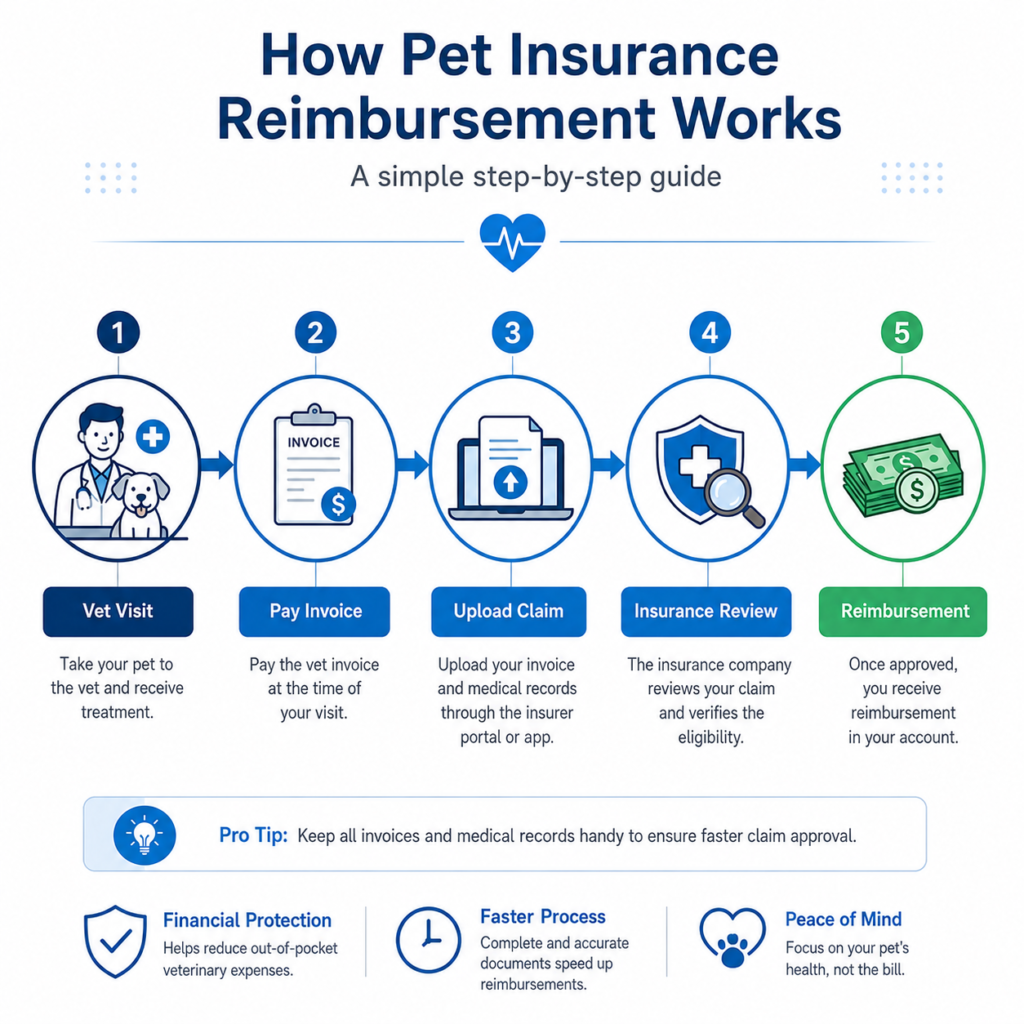
Unlike a single surgery claim, chemotherapy generates a new invoice every week for 15–19 weeks. Understanding the claim submission process for ongoing treatment prevents delays and maximizes reimbursement timing.
Two approaches to claim submission during CHOP:
Option A — Submit after every visit: After each weekly appointment, submit the invoice that evening with the itemized receipt. Most insurers process chemotherapy claims in 5–15 business days. This approach maximizes cash flow — you receive the reimbursement for visit 1 before visit 3, creating an ongoing reimbursement cycle that offsets weekly payments.
Option B — Submit in batches: Accumulate 3–4 weeks of invoices and submit together. Fewer submissions but longer gaps between reimbursements and larger front-loaded cash requirements.
For most owners managing weekly $600–$900 appointments, Option A is the better cash flow approach.
What to include with each claim submission:
- Itemized invoice from the oncology clinic (not just a total)
- The medical record / SOAP note for that visit (confirms the cancer diagnosis and visit reason)
- The pathology report confirming diagnosis (attach to first claim; subsequent claims reference the diagnosis)
Using insurer apps for faster processing: Most major insurers (Lemonade, MetLife, Fetch, Healthy Paws) have mobile apps with photo-based claim submission. For ongoing chemo claims, photograph the invoice with your phone and submit via app immediately after each appointment — the fastest possible reimbursement pathway.
Tracking claims across the protocol: Keep a running log:
| Session | Date | Cost | Submitted | Reimbursed | Your Share |
|---|---|---|---|---|---|
| 1 | Week 1 | $720 | ✅ | $576 | $144 |
| 2 | Week 2 | $580 | ✅ | $464 | $116 |
This log makes it easy to monitor your progress toward the annual limit and identify any sessions where claims were delayed or partially denied.
Action Checklist
If your dog was just diagnosed and you have pet insurance:
- [ ] Call your insurer today and confirm the cancer diagnosis is covered (not pre-existing)
- [ ] Request pre-authorization for the recommended protocol and drug list
- [ ] Confirm your annual coverage limit — compare it to the oncologist’s all-in estimate
- [ ] Confirm whether exam fees are included in your plan’s coverage
- [ ] Confirm whether the specific drugs in your protocol are approved or classified as experimental
- [ ] Get all coverage confirmations in writing
- [ ] Apply for CareCredit before the first oncology appointment for cash-flow management
- [ ] Submit claims after every session — not in batches
If your dog was just diagnosed and you do NOT have pet insurance:
- [ ] Apply for CareCredit immediately — approval is fast
- [ ] Contact Live Like Roo (wearethecure.org) for cancer-specific financial grants
- [ ] Research the nearest university veterinary teaching hospital for reduced-cost chemotherapy
- [ ] Ask your oncologist about generic drug alternatives for oral chemotherapy components
- [ ] Consider enrolling in a new policy now for protection against non-cancer emergencies going forward
If your dog is healthy right now:
- [ ] Enroll in a comprehensive plan with unlimited or $15,000+ annual limit before any symptoms develop
- [ ] Choose a plan that includes exam fees if your breed has elevated cancer risk
- [ ] Confirm that the plan covers hereditary conditions if you own a breed with known cancer predisposition
Frequently Asked Question
Does Pet Insurance Cover Chemotherapy for Dogs?
Yes, most comprehensive accident-and-illness pet insurance plans cover chemotherapy for dogs diagnosed with cancer after the policy starts and the waiting period ends. Coverage usually includes chemotherapy drugs, oncology visits, blood work, and related cancer treatments. However, chemotherapy for pre-existing cancer or conditions that appeared during the waiting period is generally excluded. Always review your policy’s coverage limits, reimbursement rate, and exclusions before treatment begins.
How Much Does Pet Insurance Pay for Chemotherapy?
Most pet insurance plans reimburse 70% to 90% of eligible chemotherapy costs after your deductible. Chemotherapy typically costs $150–$600 per session, and a full treatment protocol can exceed $9,000. Your reimbursement depends on your policy’s annual limit, deductible, reimbursement percentage, and whether all treatment costs qualify for coverage.
Which Pet Insurance Covers Chemotherapy With No Annual Limit?
Several insurers offer plans with unlimited annual coverage for eligible cancer treatments, including chemotherapy. Unlimited coverage is often recommended because cancer treatment can easily exceed $10,000 in a single year. However, coverage details, reimbursement rates, waiting periods, and exclusions vary by provider, so compare policies carefully before enrolling.
Does Pet Insurance Cover Pre-Existing Cancer?
Usually, no. Most pet insurance companies do not cover cancer diagnosed before your policy became active or when symptoms appeared before coverage or during the waiting period. Some insurers may offer limited exceptions for certain curable pre-existing conditions, depending on their policy rules, but cancer is generally excluded once considered pre-existing.
Does Pet Insurance Cover Blood Work During Chemotherapy?
In many comprehensive accident-and-illness plans, yes. Blood tests such as a CBC performed before each chemotherapy session are typically considered part of the covered cancer treatment rather than routine wellness care. Coverage can vary by insurer, so confirm that laboratory tests related to chemotherapy are included in your policy.
If My Dog’s Cancer Returns, Will Insurance Cover Another Round of Chemotherapy?
If the original cancer was covered under your policy, relapse treatment is generally handled as a continuation of the same covered condition rather than a new illness. However, your annual deductible and annual coverage limit may reset at renewal, which can increase your out-of-pocket costs depending on your plan. Always confirm relapse coverage with your insurer before starting treatment.
Should I Switch Pet Insurance After My Dog Is Diagnosed With Cancer?
In most cases, no. Switching insurers after a cancer diagnosis usually means the cancer becomes a pre-existing condition under the new policy and won’t be covered. If your current insurer already covers the diagnosis, keeping your existing policy is typically the better financial choice unless you’ve confirmed better coverage elsewhere.
Is Chemotherapy Covered During the Waiting Period?
No. If cancer develops or symptoms first appear during your policy’s illness waiting period, insurers generally classify it as a pre-existing condition. As a result, chemotherapy and other cancer-related treatment for that condition are usually excluded from coverage. Buying pet insurance before any symptoms appear provides the best chance of future coverage.
What You Should Do Next
If you’re reading this because your dog was just diagnosed — call your insurer today, not tomorrow. Ask directly: “Is this cancer diagnosis covered under my policy?” Get the answer. Get it in writing. Then ask about pre-authorization for the recommended protocol.
If coverage is confirmed — apply for CareCredit before the first session. The cash-flow management of weekly $600–$900 appointments is significantly easier when CareCredit’s credit line is in place before the first invoice arrives.
If your insurance won’t cover it — contact Live Like Roo immediately, ask your oncologist about university hospital pricing and generic drug options, and apply for CareCredit for the primary financing.
And if your dog is healthy right now — this is the moment that matters. One blood panel showing elevated calcium, one vet note mentioning a palpable lump, one documented bout of unexplained weight loss — any of these closes the pre-existing condition window. Enroll now, choose unlimited annual coverage, and make sure exam fees are included. The owners who handle cancer treatment with the least financial stress are the ones who made that decision before they ever needed it.
External Authority Sources
- ConsumerAffairs — Does Pet Insurance Cover Chemotherapy
- MoneyGeek — Best Pet Insurance That Covers Cancer
- MetLife Pet Insurance — Cancer Coverage
- Progressive — Does Pet Insurance Cover Cancer
- Embrace Pet Insurance — Cancer Coverage
- NAPHIA (North American Pet Health Insurance Association)
Disclaimer: This article is for informational and educational purposes only. Cost data reflects 2026 national averages from NAPHIA, Insurify, and MetLife Pet Insurance and will vary based on your dog’s age, breed, location, and the specific plan you choose. PetInsurePrime does not sell pet insurance and receives no compensation from any insurance provider. Always compare multiple quotes and read your policy documents carefully before enrolling.
PetInsurePrime | Independent • Research-Based | Helping US dog owners understand real vet costs and coverage options — without the sales pressure.