
Updated: July 2026 | Reading Time: 26minutes
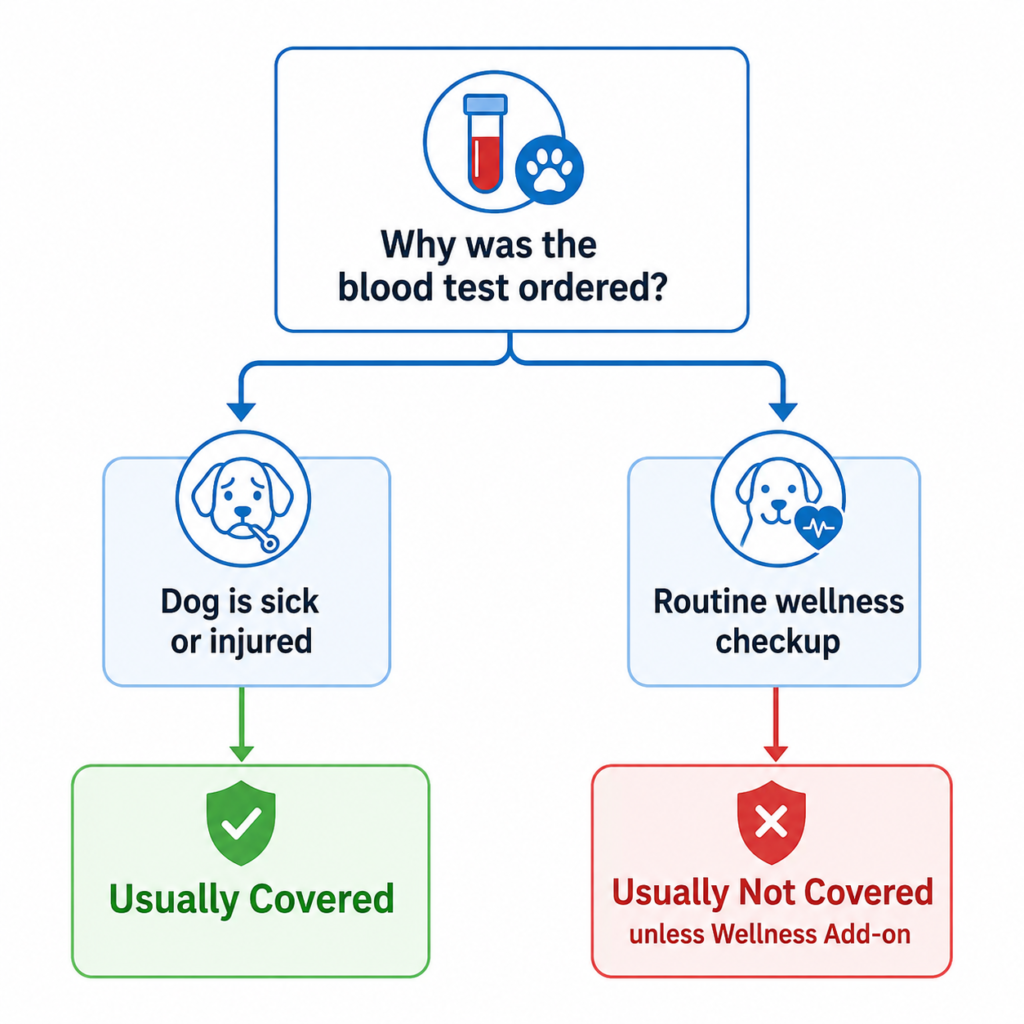
Your dog just had blood work done — or your vet is recommending it — and you’re trying to figure out whether your pet insurance will cover it. The answer sounds simple until you realize it depends on a question your insurer never explains clearly upfront: why was this test ordered?
That single question — not the test itself, not the cost, not which insurer you have — determines whether your blood work claim is approved or denied. Here’s how to answer it for your specific situation. Typical blood work costs between $80–$300, depending on the tests ordered and your location.
Read Related Article… Pet Insurance for Dogs in the USA: How It Works (2026)
Quick Answer : Does Pet Insurance Cover Blood Tests
Pet insurance can help cover blood work when it is used to diagnose or monitor a covered accident or illness. Routine annual wellness blood work — ordered at a checkup when your dog has no symptoms — is not covered under standard accident-and-illness plans. It requires a wellness add-on. Pre-anesthetic blood work for elective procedures (spay, neuter, dental cleaning) also typically requires a wellness add-on. The same CBC and chemistry panel can be covered or not covered depending entirely on why your vet ordered it.
Read Related Article… Dog Blood Test Cost in the USA (2026): Real Prices, What Each Panel Tests, and How to Pay Less
At a Glance: Blood Test Coverage Summary
| Situation | Covered? | Plan Required |
|---|---|---|
| Blood work to diagnose a new illness (vomiting, lethargy, etc.) | ✅ Yes | Accident & Illness |
| Blood work to diagnose an accident-related injury | ✅ Yes | Accident-Only or A&I |
| Emergency blood panels (toxin ingestion, collapse, trauma) | ✅ Yes | Accident & Illness |
| Pre-anesthetic blood work before emergency surgery | ✅ Yes | Accident & Illness |
| Blood work to monitor a covered ongoing condition | ✅ Yes | Accident & Illness |
| Routine annual wellness blood work (healthy dog, checkup) | ❌ No | Wellness add-on needed |
| Pre-anesthetic blood work for elective procedures (spay, dental) | ❌ Usually not | Wellness add-on needed |
| Blood work for a pre-existing condition | ❌ No | Not coverable |
| Blood work ordered during the waiting period | ❌ No | Must be past waiting period |
| Routine senior panel at annual wellness exam | ❌ No (standard plan) | Wellness add-on needed |
| Cancer blood screening (Nu.Q, CADET) — no clinical signs | ❌ No | Not covered by either |
| At-home DNA health test | ❌ No | Not covered by any plan |
Table of Contents
- The One Question That Determines Coverage: Why Was This Test Ordered?
- What Diagnostic Blood Tests Pet Insurance Covers
- What Blood Tests Pet Insurance Does NOT Cover
- The Pre-Existing Condition Problem for Blood Work
- Does Pet Insurance Cover Routine Annual Blood Work?
- Wellness Add-Ons: What They Actually Cover and What They Pay
- Does Pet Insurance Cover Pre-Anesthetic Blood Work?
- Insurer-by-Insurer Blood Test Coverage Comparison
- Real Reimbursement Math: What You Actually Get Back
- The Split Visit Problem: When One Bill Has Both Covered and Uncovered Tests
- How to File a Blood Work Claim Successfully
- Action Checklist
- FAQ
The One Question That Determines Coverage: Why Was This Test Ordered?
Before anything else — before looking at which insurer you have, before calculating your deductible, before checking your plan tier — the coverage answer hinges on one thing:
Was this blood test ordered because your dog is sick or hurt, or because it’s time for a routine checkup?
Pet insurance plans are built around one central question: why was this test ordered?
This is why two dogs can have identical CBC and chemistry panels on the same day at the same clinic and get completely different coverage outcomes:
- Dog A is brought in because she’s been lethargic and vomiting for three days. Blood work is ordered to find out what’s wrong. → Covered under accident-and-illness plan.
- Dog B comes in for his annual wellness exam and feels completely fine. Blood work is ordered as preventive screening. → Not covered without a wellness add-on.
The test is identical. The cost is identical. The coverage outcome is completely different.
Diagnostic blood work must be directly related to a condition covered by your accident and illness policy. Routine wellness blood tests — those performed during annual checkups when your pet is seemingly healthy — are not covered under standard accident and illness policies.
The insurer’s claims team looks at the visit reason on your vet’s invoice. “Annual wellness exam” → wellness claim. “Vomiting and lethargy — rule out GI disease, organ dysfunction” → diagnostic claim. The vet’s documentation of why the test was ordered is what the insurer evaluates — not the test result.
What Diagnostic Blood Tests Pet Insurance Covers
Under a standard comprehensive accident-and-illness plan, blood tests are covered when they’re medically necessary to investigate or monitor a covered condition.
Pet insurance will typically cover blood work that’s used to diagnose a new illness, monitor an ongoing covered condition, identify the cause of an emergency, or determine appropriate treatment.
Read Related Article… Dog CT Scan Cost in the USA (2026): Real Numbers, Hidden Charges, and How to Lower the Bill
Specifically covered scenarios:
Sick visit diagnostics: Your dog comes in with unexplained vomiting, diarrhea, lethargy, loss of appetite, or any symptom that prompted the vet visit. Blood work ordered to investigate those symptoms is covered. The CBC identifies infection, anemia, or immune issues. The chemistry panel evaluates organ function. Both are fully eligible.
Read Related Article… Dog Ultrasound Cost in the USA (2026): Real Prices, Hidden Charges & What Happens After
Emergency blood panels: Blood tests can be used as a diagnostic tool when an emergency situation has arisen.</cite> Any blood work ordered as part of an emergency visit — toxin ingestion, collapse, trauma, suspected internal bleeding — is covered as part of the emergency workup under both accident-only and accident-and-illness plans.
Read Related Article… Dog Blood Test Cost in the USA (2026): Real Prices, What Each Panel Tests, and How to Pay Less
Monitoring a covered chronic condition: If your dog is diagnosed with diabetes, kidney disease, Addison’s disease, or another condition after your policy is active and past the waiting period — the follow-up monitoring blood work is covered as part of managing that condition. Quarterly creatinine panels for kidney disease. Monthly glucose curves for a diabetic dog. These are covered because the underlying condition is covered.
Read Related Article… Dog MRI Cost in the USA (2026): Average Cost, Insurance Coverage & Financing
Pre-surgical blood work for covered procedures: When a covered surgery is planned — emergency surgery for a foreign body, tumor removal after a new cancer diagnosis, fracture repair — the pre-anesthetic blood work ordered before that surgery is covered as part of the same claim. It’s medically necessary for the covered procedure.
Cancer-related blood monitoring: Blood tests ordered to diagnose or monitor cancer are covered when the cancer itself is a covered condition. CBC panels before each chemotherapy session are eligible. Blood work to investigate suspected lymphoma in a dog with new symptoms is eligible.
Specialist-ordered panels: Blood work ordered by a veterinary specialist — internal medicine, oncologist, cardiologist, neurologist — in the course of diagnosing or treating a covered condition is covered at the same rate as any other eligible diagnostic test.
What Blood Tests Pet Insurance Does NOT Cover
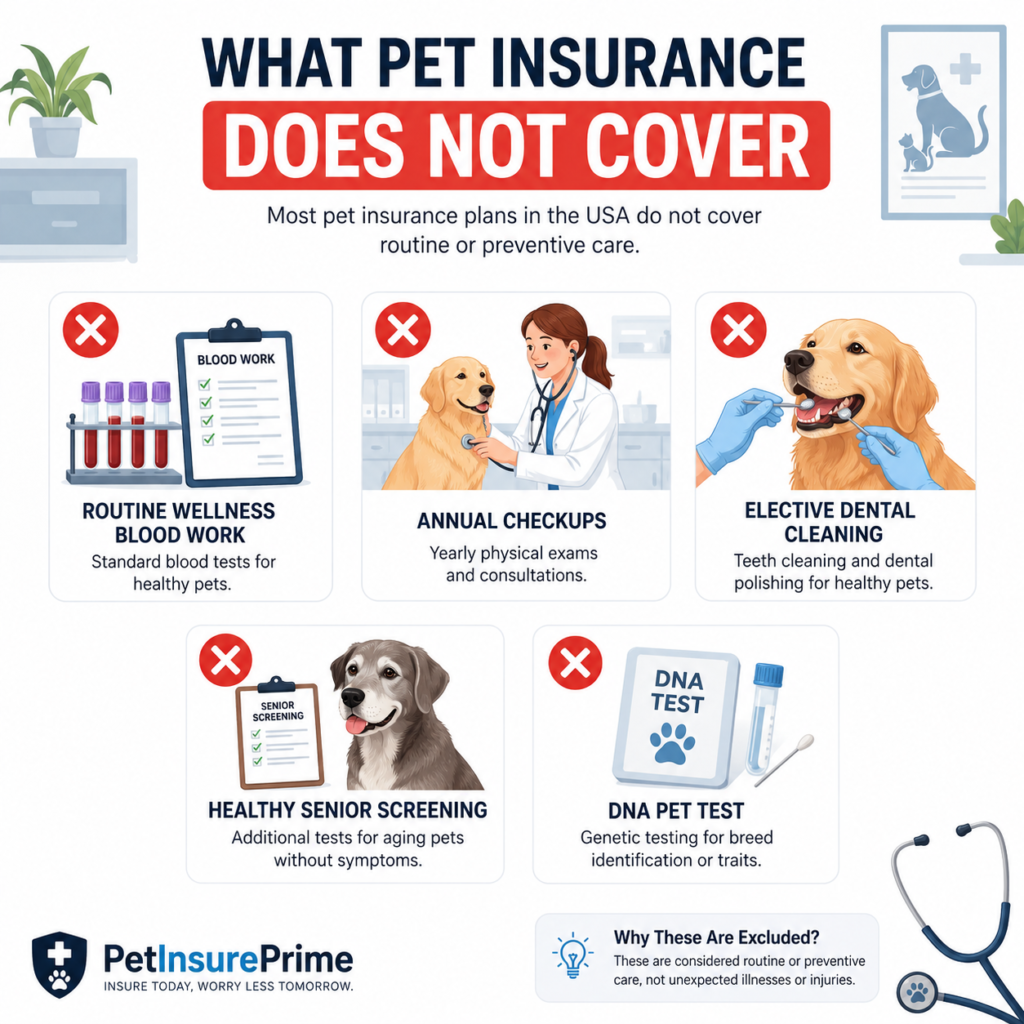
Most standard pet insurance plans don’t cover routine wellness care.</cite> Several specific blood test scenarios fall outside accident-and-illness coverage regardless of how comprehensive your plan is.
Routine annual wellness blood work: The annual CBC and chemistry panel ordered at your dog’s yearly checkup when she appears healthy is a wellness expense. No standard accident-and-illness plan covers it. This is the most common coverage misconception — owners assume that because blood work sounds medical, it’s automatically covered. The reason for ordering determines this, and “annual wellness screening” is not a covered reason.
Pre-anesthetic blood work for elective procedures: Pre-anesthesia bloodwork for elective procedures — spay, neuter, dental cleaning — is preventive or elective, so the pre-op bloodwork requires a wellness rider. Dental cleanings and spay/neuter procedures are elective, not emergencies. The blood work required before these procedures follows the same coverage classification as the procedure itself.
Monitoring a pre-existing condition: If your pet has a chronic condition requiring ongoing monitoring that was pre-existing — diagnosed or showing symptoms before enrollment — your insurer won’t cover the monitoring blood work. A dog enrolled with kidney disease that was already diagnosed: the quarterly creatinine and phosphorus rechecks are excluded as related to a pre-existing condition.
If your dog was already diagnosed with CKD before enrollment, the quarterly creatinine and SDMA rechecks are likely excluded as pre-existing.
Blood work ordered during the waiting period: Any blood test ordered to investigate a condition that developed during your policy’s waiting period is excluded. The condition itself is excluded (it falls within the waiting window), and the diagnostic tests tied to it are excluded for the same reason.
Preventive cancer screening with no clinical signs: Pre-emptive senior panels for thyroid, kidney function, and urinalysis when your pet has no symptoms are wellness territory. Cancer screening blood tests (Nu.Q Vet, CADET) ordered proactively without specific clinical signs are not covered under accident-and-illness plans — they’re preventive, not diagnostic.
At-home DNA health tests: At-home DNA health panels are not veterinary diagnostic tests and are universally excluded. These are consumer products, not clinic-administered diagnostics — no pet insurance plan covers them.
| Blood Test Situation | Covered? | Why |
|---|---|---|
| Sick visit — active symptoms | ✅ Yes | Diagnostic for covered condition |
| Emergency panel | ✅ Yes | Part of emergency workup |
| Cancer monitoring (covered cancer) | ✅ Yes | Managing covered condition |
| Pre-anesthetic for emergency surgery | ✅ Yes | Supports covered procedure |
| Annual wellness panel (healthy dog) | ❌ No | Routine/preventive |
| Pre-anesthetic for dental cleaning | ❌ No | Elective procedure |
| Pre-existing condition monitoring | ❌ No | Pre-existing exclusion |
| During waiting period | ❌ No | Waiting period exclusion |
| Cancer screening — no symptoms | ❌ No | Preventive, not diagnostic |
| DNA health test | ❌ No | Not a clinical diagnostic |
The Pre-Existing Condition Problem for Blood Work
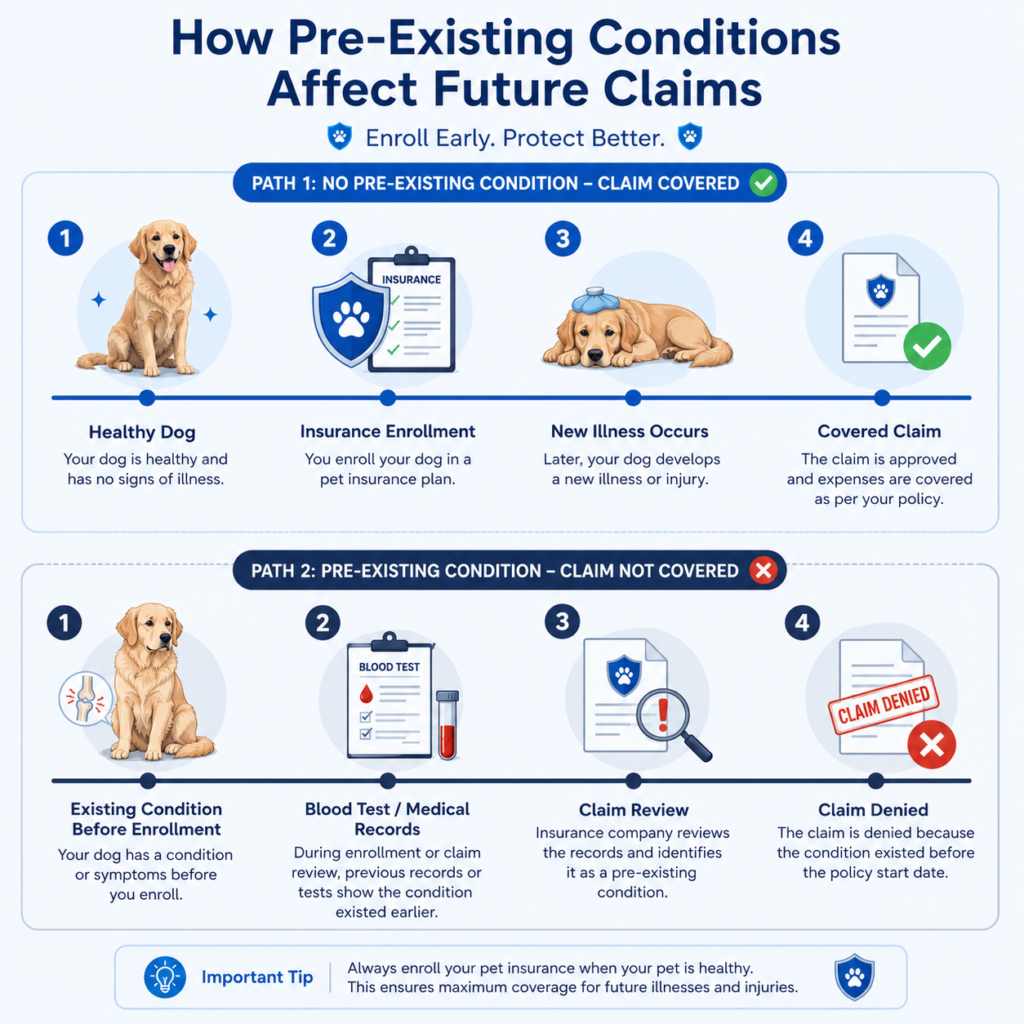
This is the coverage gap that surprises the most owners — and it’s worth understanding in detail before it becomes relevant.
The pre-existing condition exclusion doesn’t just apply to the condition itself. It applies to every diagnostic test ordered to investigate, diagnose, or monitor that condition.
Read Related Article… Does Pet Insurance Cover Pre-Existing Conditions? The Truth Most Pet Owners Learn Too Late (2026)
Three scenarios that play out differently:
Scenario 1 — Enrolled healthy, kidney disease develops later: Dog enrolled at age 3 with no kidney issues. At age 5, bloodwork shows elevated creatinine for the first time. Vet diagnoses early kidney disease. All monitoring blood work going forward — creatinine, BUN, phosphorus, SDMA — is covered because the condition developed after enrollment.
Scenario 2 — Prior vet records show kidney abnormality before enrollment: Dog enrolled at age 5. Prior vet records from age 4 show slightly elevated creatinine that was being “monitored.” Insurer reviews medical history during claims. The kidney condition is classified as pre-existing. All monitoring blood work — not covered.
Scenario 3 — New insurer, pre-existing kidney disease: Dog switches to a new insurer at age 6 with documented kidney disease. On the new policy, kidney disease is a pre-existing condition. All kidney-related blood work is not covered on the new policy, even if it was covered on the prior policy.
The “curable condition” exception: Some insurers — notably Embrace — cover conditions that were pre-existing but have been cured and symptom-free for 12 months before enrollment. A dog that had a urinary tract infection 2 years ago that fully resolved: UTI-related blood work would typically be covered because the condition is considered resolved.
Why this matters for blood work specifically: Blood work panels often check multiple organ systems simultaneously. A chemistry panel showing liver enzyme elevation in a dog with no prior liver history is fully covered. The same panel in a dog where prior records mention “mildly elevated ALT, monitoring” creates a pre-existing condition dispute. The insurer may deny the liver-related components of the panel while covering others.
Does Pet Insurance Cover Routine Annual Blood Work?
This is the most searched version of this question — and the honest answer is no, not without a wellness add-on.
Routine wellness blood work requires a preventive care add-on.
The National Association of Insurance Commissioners defines accident and illness coverage as covering “diagnosis, care, and treatment for sickness or injury, excluding routine care or wellness services unless specifically included.” Policies that bundle both types of coverage must clearly distinguish between them.
Read Related Article… Pet Insurance for Dogs in the USA: How It Works (2026)
What this means practically: every major insurer separates accident-and-illness coverage from wellness/preventive coverage. The base accident-and-illness plan covers emergencies and illness diagnostics. Routine blood work — the annual panel ordered when your dog is healthy — falls under wellness/preventive care by definition.
Read Related Article… Pet Insurance Waiting Period: How Long Before Coverage Starts? (2026 Guide)
The “is my dog sick or healthy” gray area:
What about a dog who comes in for her annual exam and the vet notices she’s losing weight? The vet orders blood work to investigate the weight loss alongside the routine exam.
This is where most bloodwork coverage disputes happen.
If the vet documents the blood work as: “Annual wellness screening” → wellness claim. If the vet documents it as: “Investigating unexplained weight loss over past 3 months” → diagnostic claim, potentially covered.
The clinical reason documented matters. If your dog has an active symptom at the wellness appointment, ask your vet whether the blood work is being ordered for the annual wellness component or to investigate the symptom. The distinction determines coverage.
Wellness Add-Ons: What They Actually Cover and What They Pay
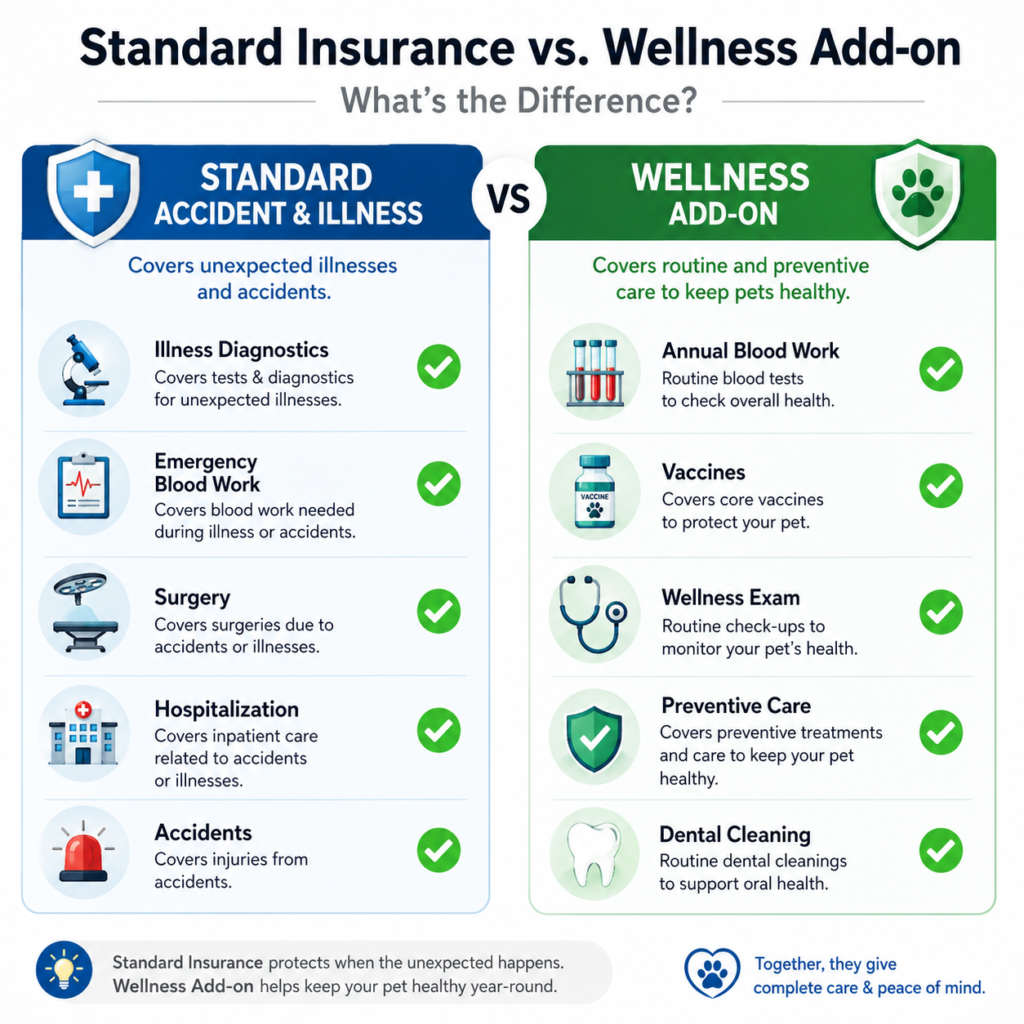
A wellness add-on (also called a preventive care rider) is the solution for routine blood work coverage. But the coverage isn’t unlimited — and the dollar limits often don’t match what annual blood work actually costs.
How wellness add-ons work:
Wellness plans work more like a membership than traditional insurance. You pay a monthly fee, and in return your pet gets access to a set dollar amount for each covered service.
Most wellness add-ons reimburse up to a specific dollar amount per service per year — not per percentage like accident-and-illness coverage. If your plan allows $50 for blood work and your panel costs $200, you receive $50 — not 80% of $200.
Wellness add-on blood work reimbursement by insurer:
| Insurer | Wellness Add-On Name | Blood Work Allowance | Annual Add-On Cost |
|---|---|---|---|
| MetLife Pet | Preventive Care | Up to plan limit ($50–$100) | $9–$24/month |
| Embrace | Wellness Rewards | Up to $200 annually (pooled) | $18–$25/month |
| ASPCA Pet Health Insurance | Preventive Care | Up to $50 per benefit period | $9–$16/month |
| AKC Pet Insurance | Defender / DefenderPlus | Included in wellness bundle | $14–$20/month |
| Spot Pet Insurance | Preventive Care | $75–$100 | $9–$20/month |
| Trupanion | N/A — no wellness add-on | ❌ Not offered | — |
| Healthy Paws | N/A — no wellness add-on | ❌ Not offered | — |
| Nationwide | Whole Pet / Wellness | Up to schedule amount | $25–$60/month |
The wellness add-on math:
Annual CBC + chemistry panel + heartworm/4Dx test: $215 average cost. Wellness add-on blood work allowance: $75. Annual add-on premium: $120–$240/year.
You pay $120–$240 extra per year to recover $75 on blood work. The net math doesn’t favor the wellness add-on for blood work alone — it makes sense when multiple wellness services (vaccines, fecal exam, heartworm test, dental exam) are bundled together.
When wellness add-ons make financial sense:
- Your dog consistently uses multiple covered wellness services each year
- Annual blood work, dental exam, vaccines, heartworm test, and flea/tick prevention are all used
- The combined annual wellness spending exceeds the add-on premium cost
When wellness add-ons don’t make financial sense:
- You only want blood work coverage
- You use very few of the covered wellness services
- The annual add-on premium exceeds your typical wellness spending
Does Pet Insurance Cover Pre-Anesthetic Blood Work?
This depends entirely on the procedure the blood work precedes — not the blood work itself.
Pre-anesthetic blood work before a covered procedure:
Emergency surgery for a foreign body: ✅ Covered — the procedure is covered, so the required pre-anesthetic screening is part of the same claim.
Cancer surgery after a new diagnosis: ✅ Covered — medically necessary procedure, blood work is part of the workup.
Orthopedic surgery for a covered injury: ✅ Covered.
Pre-anesthetic blood work before an elective procedure:
Spay, neuter, dental cleaning — these are preventive or elective, so the pre-op bloodwork requires a wellness rider.
Dental cleaning: ❌ Not covered under standard plan. Wellness add-on required. Spay or neuter: ❌ Not covered. Wellness add-on required (if the add-on covers spay/neuter, the blood work may follow).
The logic is consistent: the blood work’s coverage follows the procedure’s coverage. If the procedure is covered, the required pre-anesthetic blood work is covered. If the procedure requires a wellness add-on, the blood work does too.
The senior dog wellness exam blood work question:
Many owners enroll senior dogs in comprehensive plans and wonder why the “comprehensive” plan doesn’t cover annual senior panels. Pre-emptive senior panels — thyroid, kidney function, urinalysis — when your pet has no symptoms are wellness territory.
A senior dog’s T4 ordered because the vet suspects hypothyroidism based on clinical signs (weight gain, hair loss, lethargy): ✅ Covered — diagnostic for an active symptom.
The same T4 ordered as part of the annual senior wellness screen with no clinical signs: ❌ Not covered without wellness add-on.
Insurer-by-Insurer Blood Test Coverage Comparison
Not all insurers handle blood work coverage identically. These are the meaningful differences between major plans:
| Insurer | Diagnostic Blood Work | Routine Blood Work | Exam Fees | Wellness Add-On Available |
|---|---|---|---|---|
| MetLife Pet | ✅ Up to 90% | ❌ Standard plan | ✅ Covered | ✅ Yes |
| Embrace | ✅ Yes | ❌ Standard plan | ✅ Covered | ✅ Yes (Wellness Rewards) |
| ASPCA Pet Health Insurance | ✅ Yes | ❌ Standard plan | ✅ Covered | ✅ Yes |
| Spot Pet Insurance | ✅ Yes | ❌ Standard plan | ✅ Covered | ✅ Yes |
| Fetch | ✅ Yes | ❌ Standard plan | ✅ Covered | ❌ No |
| Healthy Paws | ✅ Yes | ❌ Standard plan | ❌ Excluded | ❌ No |
| Trupanion | ✅ Yes | ❌ Standard plan | ❌ Excluded | ❌ No |
| Nationwide Whole Pet | ✅ Yes | ✅ Yes (benefit schedule) | ✅ Yes | ✅ Included |
| AKC Pet Insurance | ✅ Yes | ❌ Standard plan | ✅ Yes | ✅ Yes (Defender) |
| Lemonade | ✅ Yes | ❌ Standard plan | ❌ Excluded | ✅ Yes |
Key differences that matter for blood work specifically:
Exam fee coverage: MetLife, Embrace, ASPCA, and Spot cover the exam fee associated with the blood work visit. Healthy Paws and Trupanion do not. This matters because the exam fee ($50–$150) appears on the same invoice as the blood work and represents 25–50% of a moderate blood work bill.
Reimbursement rate: MetLife advertises up to 90% reimbursement for diagnostic blood work. Most other plans offer 70%, 80%, or 90% depending on the tier you choose. Higher reimbursement rates come with higher premiums.
Nationwide Whole Pet: The most comprehensive routine care coverage — the Whole Pet plan includes benefit schedule coverage for many routine services including blood work without a separate add-on. The trade-off: Nationwide’s Whole Pet plan uses a benefit schedule (fixed amounts per procedure) rather than percentage-based reimbursement, which can mean lower payouts on expensive diagnostics.
Real Reimbursement Math: What You Actually Get Back
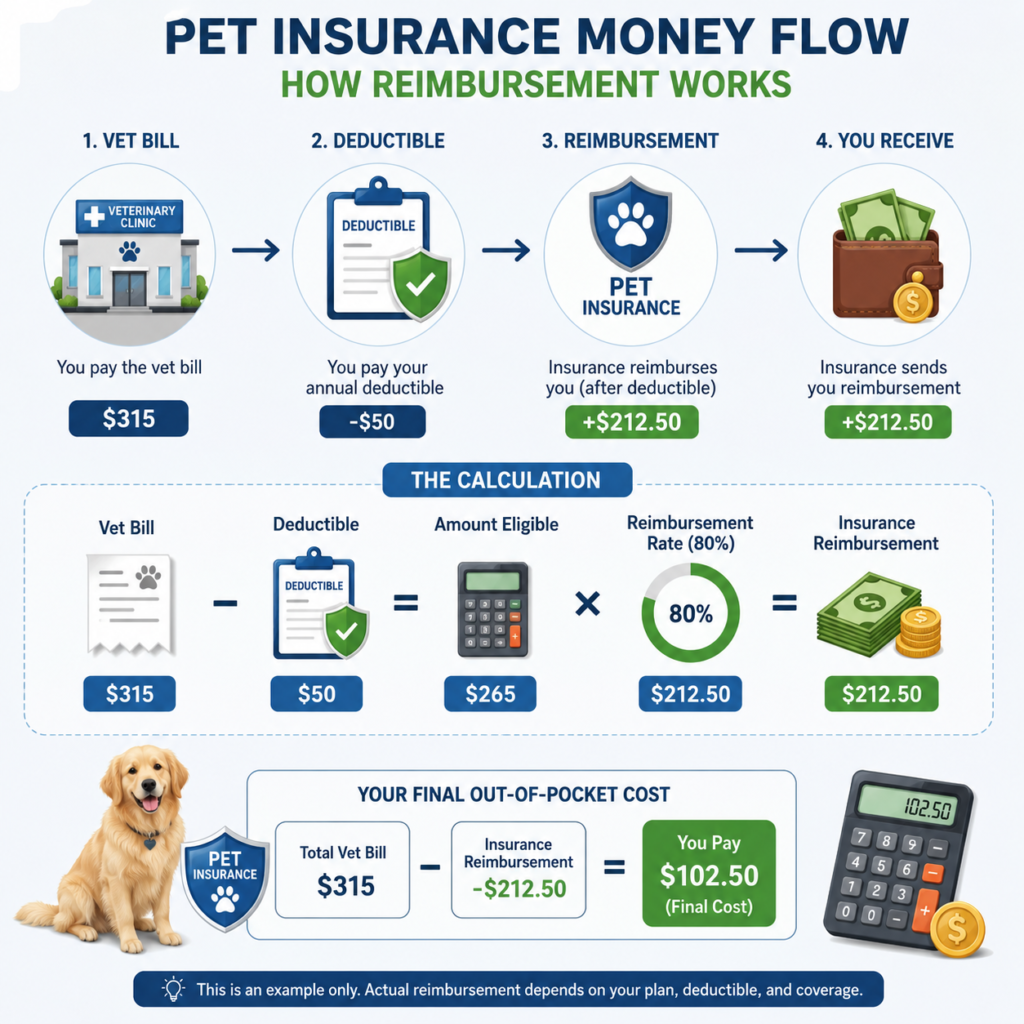
Understanding the actual dollar return on a blood work claim — not just the percentage — helps calibrate expectations.
Scenario 1 — Sick visit blood work, deductible NOT yet met:
Dog brought in for vomiting. Exam fee ($75) + CBC + chemistry panel ($185) + heartworm/4Dx ($55) = $315 total. Annual deductible: $250.
- Eligible costs: $315
- Applied to deductible: $250
- Remaining eligible after deductible: $65
- At 80% reimbursement: $52 back
- Your out-of-pocket: $263
Scenario 2 — Same visit, deductible ALREADY MET:
Same bill: $315. Deductible already satisfied from a prior claim this policy year.
- Eligible costs: $315
- Deductible remaining: $0
- At 80% reimbursement: $252 back
- Your out-of-pocket: $63
Scenario 3 — Senior blood panel, specialist visit, deductible met:
Specialist internal medicine consultation ($200) + comprehensive chemistry panel + T4 + urinalysis ($350) + CBC ($85) = $635 total. Deductible met.
- At 80% reimbursement: $508 back
- Your out-of-pocket: $127
Scenario 4 — Wellness add-on for routine annual panel:
Annual wellness blood work: CBC + chemistry + heartworm = $215. Wellness add-on blood work allowance: $75.
- Reimbursement: $75 flat
- Your out-of-pocket: $140
What these examples show:
The deductible is the critical variable for moderate blood work bills. A $315 blood work bill processed before the deductible is met returns only $52. The same bill after the deductible is met returns $252. Owners who file their first claim of the year for a small blood work bill and receive almost nothing in reimbursement often conclude “insurance doesn’t cover blood work” — when the actual issue is the deductible timing.
If your dog has multiple vet visits in a year, the blood work claim becomes most valuable when it’s not the first claim.
The Split Visit Problem: When One Bill Has Both Covered and Uncovered Tests
This is the scenario most insurers don’t explain proactively — and it creates real confusion when the claim comes back partially approved.
Your dog comes in for her annual wellness exam. The vet notices she’s been drinking more water than usual over the past few weeks. The vet orders a comprehensive blood panel and urinalysis — partly for the annual wellness screen and partly to investigate the polydipsia (excessive thirst) that could indicate diabetes or Cushing’s disease.
Your bill: Annual exam ($75) + blood panel ($210) + urinalysis ($65) = $350.
What gets covered:
- The portion of blood work ordered to investigate excessive thirst (diagnostic): ✅ Potentially covered
- The annual exam fee: ✅ Covered by insurers that include exam fees
- The “routine wellness” component of the panel: ❌ Not covered without wellness add-on
- The annual exam itself as a wellness service: ❌ Not covered without wellness add-on
This is where most bloodwork coverage disputes happen.
How to protect yourself in this situation:
Ask your vet to write two separate invoices or at minimum clearly document the reason for each component of the blood work in the visit notes. “Blood panel ordered to investigate polydipsia and rule out diabetes and hyperadrenocorticism” covers differently than “Annual senior wellness blood panel.”
Many insurers will split a claim — covering the diagnostic components while excluding the routine wellness components on the same visit. But they can only do this if your vet’s documentation distinguishes between the two reasons.
How to File a Blood Work Claim Successfully
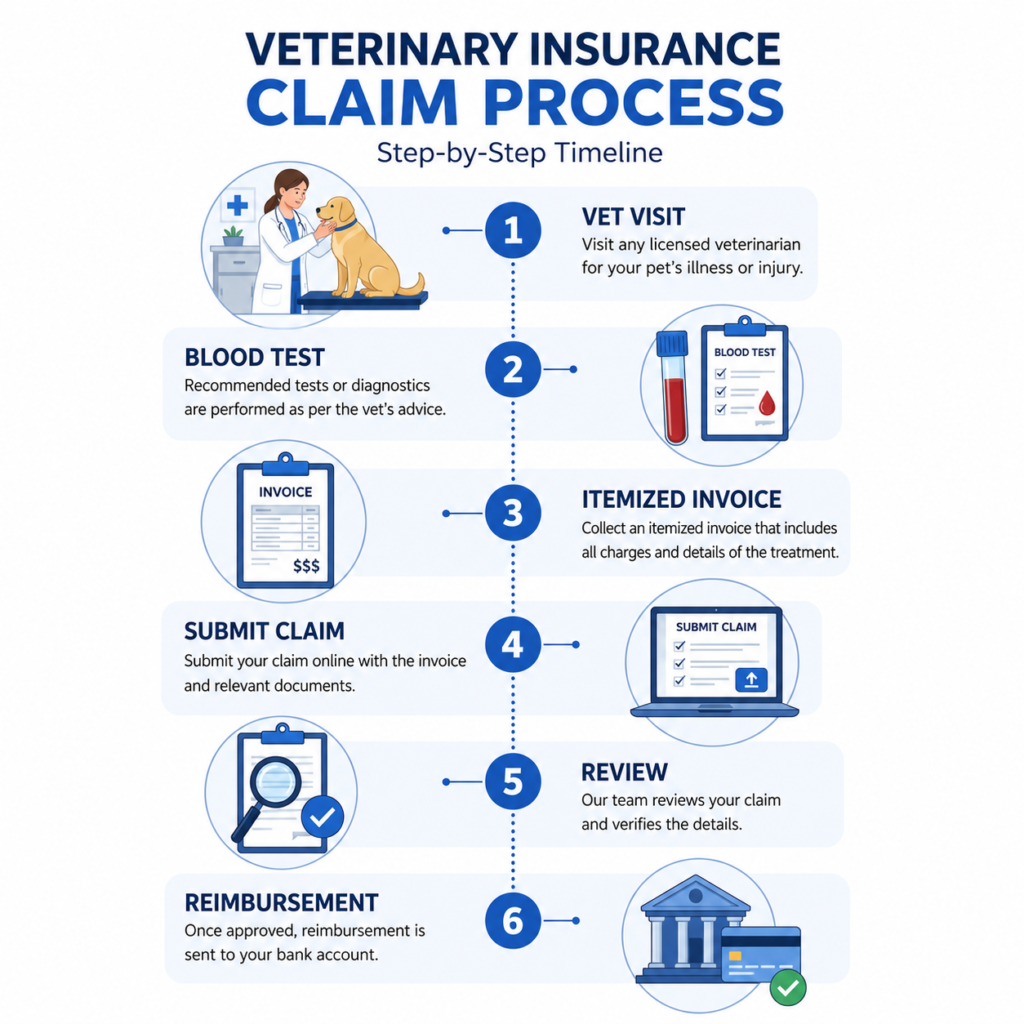
Step 1: Confirm coverage eligibility before the visit when possible. For planned blood work visits — particularly comprehensive senior panels or specialist referrals — a quick call to your insurer confirming the condition being investigated is covered takes 5 minutes and prevents surprises.
Step 2: Ask your vet to document the clinical reason clearly. The visit notes and invoice reason matter more than anything else in the claims process. “CBC and chemistry ordered to investigate acute vomiting and lethargy onset 3 days ago” is a covered reason. “Annual wellness blood work” is not. Ask your vet to specify the symptom or concern in the documentation.
Step 3: Get an itemized invoice. A single line item that says “Blood work — $215” is harder to process than an itemized invoice showing CBC ($85), chemistry panel ($130). Itemized invoices let the claims team confirm exactly what was tested and why.
Step 4: Submit the complete visit record, not just the invoice. Most insurers require both the invoice and the medical records (SOAP notes) for diagnostic blood work claims. The medical record contains your vet’s documented reason for ordering the tests — which is what determines coverage.
Step 5: Submit promptly. Most insurers have claim submission windows of 90–180 days from the date of service. Submitting within 5–7 days of the visit is ideal — the visit is fresh, documentation is easy to gather, and reimbursement arrives sooner.
Step 6: Know how to appeal. If a blood work claim is denied and you believe it should be covered, request the specific denial reason in writing. If the denial cites “routine wellness” for blood work that was genuinely diagnostic, ask your vet to provide a letter clarifying the clinical indication. Appeals supported by veterinary documentation succeed more often than owners expect.
Action Checklist
Before any blood work visit:
- [ ] Identify whether this is diagnostic (investigating a symptom) or routine wellness (annual checkup with no symptoms)
- [ ] If diagnostic: confirm your insurer covers the condition being investigated
- [ ] If routine wellness: check whether your plan has a wellness add-on and what the blood work allowance is
- [ ] Ask your vet to document the specific clinical reason for the blood work in the visit notes
- [ ] Check your deductible status — have you met your annual deductible this policy year?
At the vet:
- [ ] Request an itemized invoice showing each test individually
- [ ] Confirm the visit notes state the symptom or clinical concern being investigated
- [ ] If the visit mixes routine wellness and active symptom investigation, ask for separate documentation of each component
After the visit:
- [ ] Gather both the itemized invoice and the visit records (SOAP notes) before submitting
- [ ] Submit your claim within 5–7 days of the visit
- [ ] If partially denied, request the denial reason in writing and consider an appeal with supporting documentation from your vet
For future planning:
- [ ] If you rely on annual wellness blood work, run the math on whether a wellness add-on saves money versus your typical annual cost
- [ ] Enroll in pet insurance while your dog is young and healthy — before any blood work results show abnormalities that could become pre-existing conditions
- [ ] Keep copies of all blood work results — a clean history before enrollment is your best protection against pre-existing disputes later
Frequently Asked Question
Does pet insurance cover blood tests for dogs? <cite index=”12-1″>Pet insurance can help cover blood work when it is used to diagnose or monitor a covered accident or illness.</cite> Routine annual wellness blood work ordered at a healthy dog’s checkup is not covered under standard plans without a wellness add-on. The reason the test is ordered determines coverage — not the test itself.
Does pet insurance cover routine annual blood work? <cite index=”12-1″>Routine wellness blood work requires a preventive care add-on.</cite> Standard accident-and-illness plans do not cover annual wellness blood panels. A wellness add-on reimburses a fixed dollar amount (typically $50–$200 per year) for routine blood work.
Does pet insurance cover CBC and chemistry panels? Yes — when ordered to diagnose or monitor a covered condition. <cite index=”18-1″>MetLife Pet’s standard insurance policy can reimburse you up to 90% of the cost of blood work used as a diagnostic test when your dog is sick or hurt.</cite> The same CBC and chemistry panel ordered as annual routine screening is not covered without a wellness add-on.
Does pet insurance cover pre-anesthetic blood work? <cite index=”19-1″>Pre-anesthetic bloodwork for elective procedures — spay, neuter, dental cleaning — requires a wellness rider.</cite> Pre-anesthetic blood work before a covered emergency or illness-related surgery is covered as part of the same claim as the covered procedure.
What if blood work finds a pre-existing condition? <cite index=”16-1″>If your pet has a chronic condition requiring ongoing monitoring that was pre-existing — diagnosed or showing symptoms before enrollment — your insurer won’t cover the monitoring blood work.</cite> The pre-existing condition exclusion applies to all diagnostic tests tied to that condition, not just the treatment.
Does pet insurance cover blood work for senior dogs? Standard accident-and-illness plans cover blood work that investigates active symptoms in senior dogs. <cite index=”19-1″>Pre-emptive senior panels ordered for thyroid, kidney function, and urinalysis when your pet has no symptoms are wellness territory</cite> — requiring a wellness add-on. A wellness add-on is particularly valuable for senior dogs who need comprehensive annual screening.
How much does pet insurance reimburse for blood tests? Under accident-and-illness plans, reimbursement is 70%–90% of eligible costs after your annual deductible. On a $315 blood work bill with deductible already met, 80% reimbursement returns $252. On the same bill with a $250 deductible not yet met, you receive only $52 back. Deductible timing is the most important variable for moderate blood work bills.
Is a wellness add-on worth it just for blood work coverage? Usually not. Most wellness add-ons reimburse $50–$200 for blood work while costing $120–$300/year in additional premium. The add-on makes financial sense when your dog uses multiple covered wellness services (vaccines, dental exam, heartworm test, fecal exam) and the combined reimbursements exceed the add-on premium cost.
What You Should Do Next
If you just received a blood work bill and you have pet insurance — check two things before filing: the visit reason documented on the invoice (diagnostic vs. routine wellness) and whether your annual deductible has already been met this year. Both answers determine what you’ll actually receive in reimbursement.
If you’re choosing a pet insurance plan and routine blood work matters to you — compare wellness add-on allowances specifically. Ask each insurer: “How much do you reimburse for annual blood work under the wellness add-on, and what is the monthly add-on premium?” Divide the reimbursement by the annual add-on cost to see whether it pencils out for your dog’s typical wellness spending.
And if your dog is healthy right now — enroll while every blood test result is normal. A single blood panel showing borderline elevated values that the vet documents as “monitoring” can create a pre-existing condition classification on any future policy. The window between “currently healthy” and “values being monitored” closes without warning — and once it closes, the related blood work monitoring is excluded on any new plan.
Before you submit your claim, check whether your blood work was ordered because your dog was sick or simply for routine wellness. That one detail often determines whether your insurer pays.
External Authority Sources
- MetLife Pet Insurance — Blood Tests Coverage
- Spot Pet Insurance — What Does Pet Insurance Cover
- Embrace Pet Insurance — Blood Work Coverage
- NAIC Pet Insurance Model Law
- PetPlace — Does Pet Insurance Cover Blood Work
- VetLens — Does Pet Insurance Cover Bloodwork
Disclaimer: This article is for informational and educational purposes only. Cost data reflects 2026 national averages from NAPHIA, Insurify, and MetLife Pet Insurance and will vary based on your dog’s age, breed, location, and the specific plan you choose. PetInsurePrime does not sell pet insurance and receives no compensation from any insurance provider. Always compare multiple quotes and read your policy documents carefully before enrolling.
PetInsurePrime | Independent • Research-Based | Helping US dog owners understand real vet costs and coverage options — without the sales pressure.