
Updated: June 2026 | Reading Time: 19 Minutes
You just signed up for pet insurance and feel relieved — until you realize your dog isn’t actually covered yet. That’s the waiting period, and it’s one of the most commonly misunderstood parts of any policy.
Most new pet owners assume coverage begins the day they pay their first premium. It doesn’t. And for some conditions — like torn ligaments or hip dysplasia — coverage might not start for six months or more.
Read more…Pet Insurance for Dogs in the USA: How It Works (2026)
Knowing how waiting periods work before your pet gets sick can save you thousands of dollars in unexpected veterinary bills. In this guide, you’ll learn how long waiting periods last, which insurers offer the shortest waits, what happens if your pet becomes ill during the waiting period, and how to avoid common claim mistakes.
Quick Answer Pet Insurance Waiting Period
Most policies have a 2–14 day waiting period for accidents and a 14-day waiting period for illnesses. Orthopedic conditions like cruciate ligament injuries typically have a much longer wait: 6 to 12 months, depending on the insurer. No condition that develops during the waiting period will be covered — it may be permanently classified as a pre-existing condition.
Quick Summary: Pet Insurance Waiting Periods at a Glance
| Coverage Type | Typical Waiting Period |
|---|---|
| Accidents | 0–14 days (some plans start Day 1) |
| Illnesses | 14 days (standard across most U.S. carriers) |
| Orthopedic conditions | 14 days to 12 months (varies widely) |
| Cruciate ligament injuries | 6–12 months at most carriers |
| Wellness / preventive care | Usually immediate |
Waiting periods vary by insurer, policy type, state regulations, and your pet’s medical history. Always verify the exact terms in your policy documents before enrolling.
Table of Contents
- What Is a Pet Insurance Waiting Period?
- Why Do Waiting Periods Exist?
- How Long Are the Different Waiting Periods?
- Orthopedic and Cruciate Ligament Waiting Periods
- What Happens If Your Pet Gets Sick During the Waiting Period?
- Do Waiting Periods Vary by Insurance Company?
- States With Shorter Waiting Period Rules
- How to Reduce or Waive a Waiting Period
- Should You Wait to Enroll?
- Action Checklist Before Your Policy Starts
- FAQ
What Is a Pet Insurance Waiting Period?
A pet insurance waiting period is the gap of time between when your policy becomes active and when you can actually file a claim. You’re paying your monthly premium during this window — your dog just isn’t covered for new conditions yet.
Think of it this way: if your dog breaks a leg on Day 3 of a 14-day accident waiting period, you’ll owe the full vet bill out of pocket. The policy exists. The premium is paid. The coverage hasn’t started.
The waiting period begins on your policy’s effective date — typically the day you purchase the plan or the day after enrollment is confirmed. Every insurer handles the timing slightly differently, so always check your policy documents rather than assuming.
Wellness and preventive care add-ons are the exception. Those almost always begin immediately, since they cover scheduled services rather than unexpected illness or injury.
Most waiting periods apply only once when you first enroll. As long as you keep your policy active without a lapse, they generally do not restart at renewal.
Read more…Does Pet Insurance Cover Pre-Existing Conditions?
Key Takeaway: A waiting period is not a defect in your policy — it’s a standard industry requirement. Coverage doesn’t start on Day 1 for most conditions. The practical fix is simple: enroll as early as possible, ideally before your dog shows any health symptoms.
Why Do Waiting Periods Exist?
It can feel frustrating to pay your first premium and still have to cover an unexpected vet bill yourself. However, waiting periods exist because pet insurance is designed to protect against future illnesses and injuries—not conditions that may already be developing when you enroll. They also help reduce fraud and keep premiums more affordable for all policyholders.
Insurance is designed to protect against future unknowns — not to cover events that are already happening or visibly developing. The waiting period enforces that boundary.
Read more…What Doesn’t Pet Insurance Cover?
There’s also a secondary reason for orthopedic-specific waits: many joint problems in dogs are genetic or progressive, meaning early signs can be subtle and easy to miss. A six-month window gives insurers confidence that a dog showing no orthopedic symptoms at enrollment is genuinely healthy at that time.
This logic mirrors how other forms of insurance work. You can’t buy car insurance after an accident and expect the claim to be paid. Pet insurance operates on the same principle.
Key Takeaway: Waiting periods exist to keep premiums affordable and prevent fraud — not to trap policyholders. They’re a feature of the system, not fine-print trickery. The best response is simply enrolling early.
How Long Are the Different Waiting Periods?
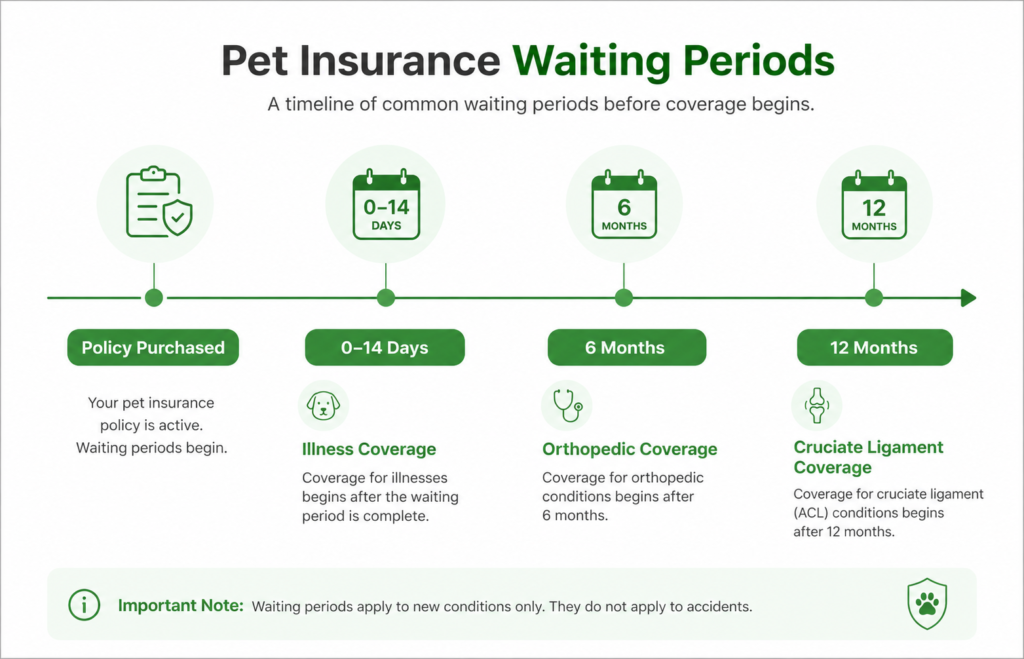
There are three main waiting period categories in almost every U.S. pet insurance policy. Each one covers a different type of condition and runs for a different length of time.
Accident Waiting Periods
Accident coverage has the shortest wait — and with some insurers, no wait at all. The standard range is 0 to 14 days. Several major carriers, including MetLife and Embrace, now offer zero-day accident coverage, meaning protection begins at midnight after enrollment.
Read more… How to Appeal a Denied Pet Insurance Claim: Step-by-Step Guide to Improve Your Chances
Accidents include things like broken bones, lacerations, swallowed foreign objects, and trauma from car accidents. Because these are random and unpredictable by nature, insurers can offer faster coverage.
Read more…Dog MRI Cost in the USA (2026): Average Cost, Insurance Coverage & Financing
Illness Waiting Periods
The 14-day illness waiting period is the U.S. industry standard. Almost every major carrier — including ASPCA, Lemonade, Pets Best, Spot, Pumpkin, and Fetch — uses exactly 14 days. Trupanion is the notable outlier with a 30-day illness wait.
Illnesses covered include infections, digestive problems, cancer diagnoses, urinary issues, and chronic conditions. The longer wait exists because illness symptoms can be gradual and easy to miss at enrollment.
Read more… Why Was My Pet Insurance Claim Denied?
Waiting Period Summary by Type
| Coverage Type | Shortest Available | Industry Standard | Longest Seen |
|---|---|---|---|
| Accidents | 0 days (MetLife, Lemonade, Embrace) | 2–14 days | 15 days |
| Illness | 14 days | 14 days | 30 days (Trupanion) |
| Orthopedic conditions | 14 days (ASPCA, Pumpkin) | 6 months | 12 months |
| Cruciate ligament | 14 days (select carriers) | 6 months | 12 months (Nationwide, Healthy Paws) |
| Wellness / preventive | 0 days (most carriers) | Immediate | Immediate |
Key Takeaway: For accident and illness coverage, the waiting period is measured in days — usually 14 or fewer. For orthopedic and joint conditions, the timeline jumps dramatically. If your dog is a large or high-risk breed, the orthopedic waiting period matters much more than the accident wait.
Orthopedic and Cruciate Ligament Waiting Periods
[Mid-Article Image 1 placement — large breed dog at vet]
This is the section most dog owners don’t read carefully enough — and it’s the one that causes the most expensive surprises.
Orthopedic conditions, especially cruciate ligament (CCL/ACL) tears, are among the most common and costly injuries in dogs. Surgery for a single knee routinely runs $3,000 to $6,000. Because large-breed dogs are genetically predisposed to these injuries, insurers apply much longer waiting periods to protect against adverse selection — pet owners enrolling specifically because they already suspect a problem.
Read more… Dog Surgery Cost in the USA: Real Prices
How Long Is the Orthopedic Waiting Period?
The range is dramatic — from 14 days at a handful of carriers to 12 months at others.
| Insurer | Orthopedic Waiting Period | Cruciate Ligament Wait |
|---|---|---|
| ASPCA | 14 days | 14 days |
| Pumpkin | 14 days | 14 days |
| Lemonade | 30 days | 6 months |
| Pets Best | 14 days (illness period) | 6 months |
| Embrace | 6 months (waivable with exam) | 6 months |
| Fetch | 6 months | 6 months |
| MetLife | No extended wait | 6 months |
| Healthy Paws | 12 months | 12 months |
| Nationwide | 12 months | 12 months |
Source: Published insurer policy documents and U.S. News, 2026. Waiting periods vary by state.
Key Takeaway: If you own a Labrador Retriever, German Shepherd, Golden Retriever, Rottweiler, or other large breed, compare orthopedic waiting periods before comparing premiums. Saving $10 per month isn’t worth waiting 12 months for cruciate ligament coverage.
Why This Matters for Large-Breed Dogs
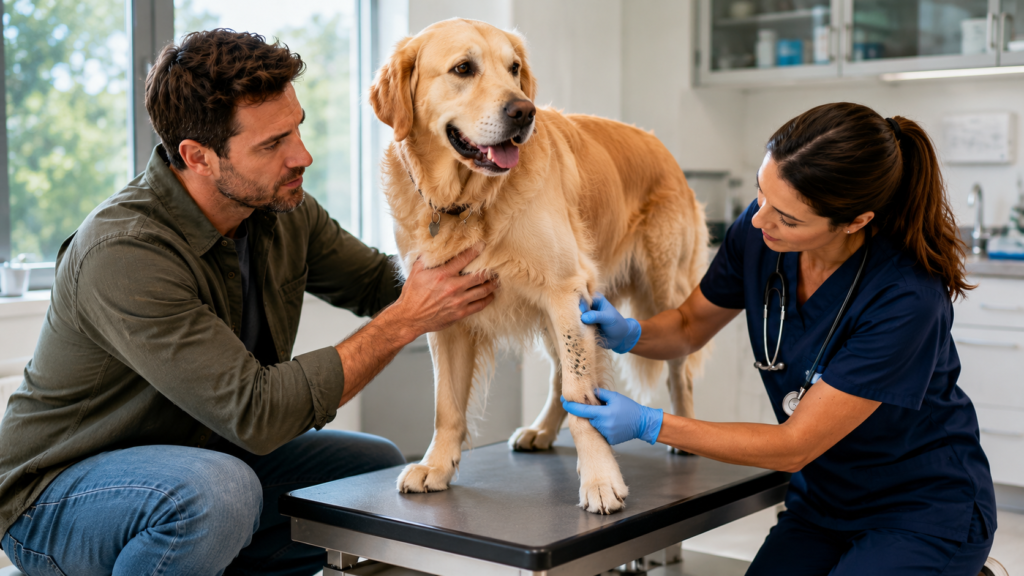
German Shepherds, Labrador Retrievers, Golden Retrievers, and Rottweilers have elevated risk for both hip dysplasia and cruciate injuries. If you enroll with a carrier that has a 12-month orthopedic wait, you’re paying premiums for a full year before joint coverage starts.
For large-breed puppies especially, enrolling early — before any limping, stiffness, or mobility changes appear — is the strongest move. Once a symptom is documented in your dog’s medical records, that joint issue can become a permanent pre-existing condition exclusion regardless of when you enrolled.
Can the Orthopedic Wait Be Waived?
At some carriers, yes. Embrace, Figo, and a few others allow you to reduce or eliminate the orthopedic waiting period by scheduling a veterinary orthopedic exam shortly after enrollment. If the vet documents that your dog’s joints are healthy, the wait can shrink to the standard 14-day illness period.
A $75–$150 wellness visit can unlock months of earlier coverage for conditions that cost thousands to treat.
Key Takeaway: Orthopedic waiting periods are the biggest financial blind spot in most pet insurance policies. If you have a large-breed dog, choose a carrier with a short orthopedic wait — or schedule an exam to waive it. Waiting until your dog starts limping to buy insurance will result in permanent exclusion of that condition.
What Happens If Your Pet Gets Sick During the Waiting Period?

[Mid-Article Image 2 placement — dog owner at vet, calm conversation]
This situation comes up more often than most new policyholders expect. A puppy develops an ear infection on Day 8 of a 14-day illness wait. A dog shows subtle limping on Day 20 of a 6-month orthopedic wait. What happens next matters a lot.
The condition becomes a pre-existing condition.
Many pet owners mistakenly believe avoiding the veterinarian protects future claims. It doesn’t. Insurers evaluate when symptoms first appeared—not simply when they were officially diagnosed.
Any illness, injury, or symptom that appears during the waiting period is treated as though it existed before your policy started. It will not be covered — and in most cases, that condition will be permanently excluded from coverage going forward.
This is not a loophole or a technicality. It’s written into nearly every U.S. pet insurance policy as standard language.
What This Means Practically
- The vet bill for that condition is 100% your responsibility
- Future claims related to that condition will be denied
- Bilateral conditions (both knees, both hips) may both be excluded if one side shows symptoms during the wait
- Switching to a different insurer won’t fix this — the new policy will see the documented medical history
Should You Still Take Your Dog to the Vet During the Waiting Period?
Yes. Always.
A common misconception is that avoiding the vet during the waiting period protects coverage. It doesn’t. The exclusion applies to when a condition first developed — not when it was first documented. Delaying care causes suffering and doesn’t change your coverage status.
Go to the vet. Get treatment. Accept that this specific condition will be excluded. Then protect your dog’s remaining health with the coverage that does apply once waiting periods end.
Key Takeaway: Getting sick during the waiting period is genuinely costly. But it’s not a reason to delay veterinary care — and it’s not something that can be avoided by skipping the vet. The right response is enrolling early, before any symptoms develop.
Do Waiting Periods Vary by Insurance Company?
Yes, significantly — especially for orthopedic conditions.
For accident and illness coverage, the variation is relatively small. Most major U.S. carriers land within a day or two of each other for accidents, and almost all use 14 days for illness. The real differences emerge at the orthopedic level, where the range stretches from 14 days to 12 months.
Company Comparison: Accident and Illness Waiting Periods
| Insurer | Accident Wait | Illness Wait |
|---|---|---|
| MetLife | 0 days | 14 days |
| Lemonade | 0 days (most states) | 14 days |
| Embrace | 0 days | 14 days |
| Pets Best | 3 days | 14 days |
| ASPCA | 14 days (waivable in some states) | 14 days |
| Pumpkin | 14 days | 14 days |
| Spot | 14 days (next-day in select states) | 14 days |
| Trupanion | 5 days | 30 days |
| Fetch | 15 days | 15 days |
Source: Published policy documents and U.S. News, 2026. Always verify directly with your insurer.
Key Takeaway: If minimizing the accident waiting period is your priority, MetLife, Lemonade, and Embrace currently offer the fastest path to accident coverage. For illness coverage, the gap between carriers is minimal — nearly everyone uses 14 days.
States With Shorter Waiting Period Rules
Your state of residence can directly affect how long your waiting period lasts — sometimes dramatically.
Several states have adopted the National Association of Insurance Commissioners (NAIC) Pet Insurance Model Act, which limits how long orthopedic waiting periods can be and, in some cases, eliminates accident waiting periods entirely.
States including California, Delaware, Louisiana, Maine, Maryland, Mississippi, Nebraska, New Hampshire, Ohio, Pennsylvania, Vermont, and Washington have adopted provisions that restrict extended orthopedic waiting periods — in some cases capping them at 30 days.
What this means in practice: a cruciate ligament injury that would trigger a 6-month wait in Texas might only require a 30-day wait in California under the same insurance company’s policy.
Before enrolling:
- Ask the insurer for the state-specific waiting period schedule
- Request a sample policy for your state
- Don’t assume the general marketing page waiting period applies to your location
Key Takeaway: State regulations can change over time, and insurers may apply different waiting periods depending on where you live. Before buying a policy, ask for the state-specific sample policy and verify whether your state has adopted rules limiting accident or orthopedic waiting periods.
How to Reduce or Waive a Waiting Period
You can’t eliminate waiting periods entirely in most cases — but several legitimate strategies can shorten them significantly.
1. Schedule a Veterinary Exam at Enrollment
Some insurers (Embrace, Figo, and others) will reduce the orthopedic waiting period from 6 months to 14 days if your dog receives a clean orthopedic exam shortly after enrollment. The vet completes a form — sometimes called an Orthopedic Report Card — documenting that no joint issues were present.
This option is state-dependent and not available from all carriers, but it’s worth asking about directly.
2. Transfer From a Previous Policy Without a Gap
If you’re switching carriers, some companies recognize prior continuous coverage and waive or shorten waiting periods. Keeping your current policy active until the new one starts is critical — even a brief lapse can mean starting from zero.
3. Check Your State’s Regulations
Certain states restrict how long waiting periods can be. Research whether your state has adopted NAIC Pet Insurance Model Act provisions before comparing quotes.
4. Time Your Enrollment Strategically
Waiting periods are a one-time event. Once cleared, you have continuous coverage as long as you maintain your policy — there are no annual resets upon renewal. Enrolling during a healthy stretch gives you the best chance of clearing the window without incident.
Key Takeaway: The most effective combination: a vet exam at enrollment plus gap-free continuous coverage. These two steps can dramatically shorten orthopedic waits and protect against pre-existing condition exclusions that would otherwise follow your dog for life.
Should You Wait to Enroll?
Decision Framework
| Situation | What Makes Sense |
|---|---|
| Puppy or newly adopted healthy dog | Enroll immediately. Every day you wait risks a diagnosis that becomes a permanent exclusion. |
| Adult dog, no current symptoms | Enroll now. Waiting increases the chance something develops before coverage starts. |
| Dog already showing symptoms | Enroll anyway for future conditions — but accept the current issue will be excluded. |
| Switching from another insurer | Don’t cancel the old policy until the new one is active. |
| Large-breed dog with joint risk | Choose a carrier with the shortest orthopedic wait, or one that offers a waiver with a clean vet exam. |
When Waiting Doesn’t Make Sense
There’s no strategically good time to delay enrollment if your dog is healthy. The waiting period runs regardless — you just push back when coverage eventually starts.
Read more… Emergency Vet Costs in the USA (2026): What You’ll Really Pay by State
The only reasonable reason to delay is financial: if the monthly premium genuinely isn’t affordable right now. In that case, an accident-only plan at a lower cost can bridge the gap while you’re getting your budget in order.
Key Takeaway: Waiting to enroll is almost never strategically beneficial. The waiting period passes whether you enroll today or in three months — you just reach coverage three months later. The risk of something developing in the meantime is real and, in most cases, non-recoverable from a coverage standpoint.
✅ Action Checklist Before Your Policy Starts
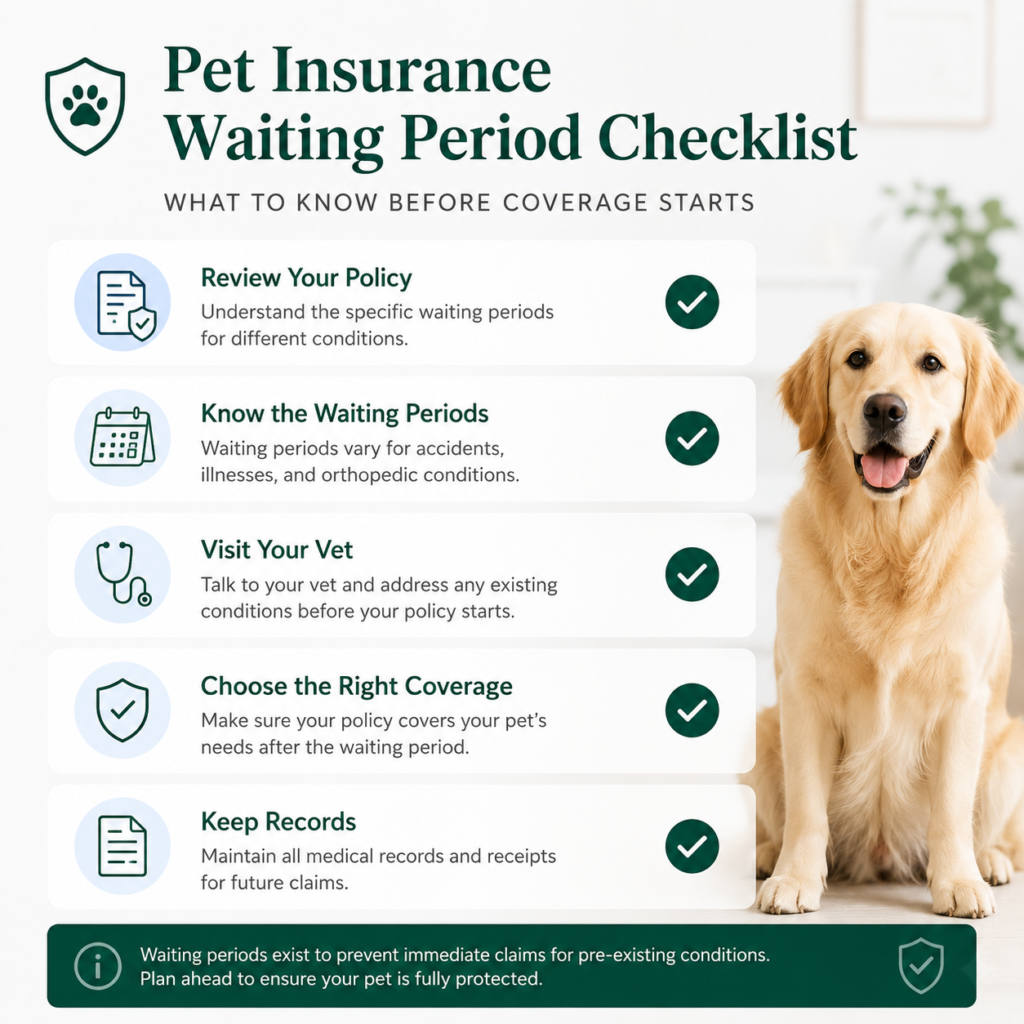
Use this before or immediately after enrolling:
- Confirm your policy’s exact effective date in writing
- Write down the specific end date of your accident, illness, and orthopedic waiting periods
- Schedule a wellness vet visit within 30 days of enrollment (to document baseline health and potentially waive orthopedic wait)
- Ask your insurer if an orthopedic waiver exam is available in your state
- Keep your dog on-leash and away from high-risk environments during the accident waiting period
- Do not delay veterinary care if symptoms appear during the wait — seek treatment even if coverage doesn’t apply
- Request your state-specific waiting period schedule from your insurer
- If switching carriers, confirm your new policy is active before canceling the old one
- Check whether your state has adopted NAIC Pet Insurance Model Act provisions
- Set a calendar reminder for when each waiting period ends
Key Takeaway: Save a digital copy of your policy documents so you can quickly verify waiting periods and coverage rules if your pet needs emergency care.
What You Should Do Next
The best time to buy pet insurance is while your pet is healthy—not after symptoms appear. Understanding waiting periods before you enroll helps you avoid denied claims, unexpected vet bills, and costly coverage gaps. Compare at least three insurers, review the state-specific policy wording, and choose a plan that fits both your budget and your pet’s long-term health risks.
External Sources Referenced:
- NAIC Pet Insurance Model Act
- ASPCA Pet Health Insurance policy documents
- Embrace Pet Insurance Help Center — Orthopedic Waiting Period documentation
- Lemonade Pet Insurance — Waiting Period Guide
- U.S. News — How Do Pet Insurance Waiting Periods Work
- MoneyGeek — Pet Insurance Waiting Periods 2026
- Pawlicy Advisor — Waiting Period Comparison Chart
- Bankrate — Pet Insurance Waiting Period Guide
Frequently Asked Questions
Can I use pet insurance right after buying it?
Usually, no. Most pet insurance policies have waiting periods before coverage begins. Accident coverage may start within 0–14 days, while illness coverage typically starts after 14 days. Orthopedic conditions often have much longer waiting periods, depending on the insurer and your state.
What counts as a pre-existing condition?
A pre-existing condition is any illness, injury, or symptom that appears before your coverage starts or during the waiting period. These conditions are generally excluded from future reimbursement, although your pet can still receive coverage for unrelated future illnesses or injuries.
Is there pet insurance with no waiting period?
Not for comprehensive illness coverage. Some insurers offer immediate or next-day accident coverage, but illness and orthopedic conditions almost always have a waiting period before claims become eligible.
Does the waiting period reset every year?
No. Waiting periods normally apply only when you first enroll. As long as you renew your policy without a lapse in coverage, you generally won’t need to complete another waiting period.
What happens if my dog gets sick during the waiting period?
If your dog develops symptoms before the waiting period ends, that condition is usually treated as pre-existing and won’t be covered. However, your policy can still cover unrelated illnesses and injuries that occur after coverage begins.
Can the orthopedic waiting period be waived?
Sometimes. Certain insurers allow you to shorten or waive the orthopedic waiting period after a veterinarian confirms your pet has no existing joint or ligament problems. Availability depends on the insurer and your state.
Does the waiting period apply to wellness plans?
Usually not. Most wellness or preventive care add-ons begin immediately or shortly after enrollment, covering routine services such as vaccinations, wellness exams, and parasite prevention.
Should I take my dog to the vet during the waiting period?
Yes. Never delay veterinary care because of insurance. Waiting to see a veterinarian won’t change when a condition first developed, and delaying treatment could make your dog’s health worse.
Are waiting periods the same in every state?
No. Waiting period rules can vary by state because insurance regulations differ. Always review your state’s policy wording or ask the insurer for the waiting periods that apply where you live.
When is the best time to buy pet insurance for a puppy?
The best time is while your puppy is healthy, typically as soon as the insurer’s minimum enrollment age allows. Buying early helps ensure waiting periods end before unexpected illnesses or injuries occur.
Disclaimer
This article is for informational and educational purposes only. Cost data reflects 2026 national averages from NAPHIA, Insurify, and MetLife Pet Insurance and will vary based on your dog’s age, breed, location, and the specific plan you choose. PetInsurePrime does not sell pet insurance and receives no compensation from any insurance provider. Always compare multiple quotes and read your policy documents carefully before enrolling.
PetInsurePrime | Independent • Research-Based | Helping US dog owners understand real vet costs and coverage options — without the sales pressure.