
Updated: August 2026| Reading Time: 16minutes
You found a lump while petting your dog, or your vet felt one during a checkup, and now the word “aspiration” is on the table. Before you can even process what that means for your dog’s health, your brain jumps straight to the next question: what is this actually going to cost? That’s a fair question, and the honest answer is that it depends more than most owners expect.
Quick Answer: How Much Does a Fine Needle Aspiration Cost ?
A dog fine needle aspiration (FNA) generally costs about $50–$200 for the procedure itself, although your total veterinary bill can be higher once the exam, cytology, sedation, ultrasound guidance, or outside laboratory fees are included. More complex cases can reach several hundred dollars.
The final number depends on where the lump is, how many samples are needed, whether your dog needs sedation, and whether the sample is read in-house or sent to a specialist pathologist. There’s no single fixed national price, and two clinics in the same city can reasonably quote very different numbers for what sounds like the same test.
Dog Fine Needle Aspiration Cost at a Glance
| Scenario | Typical Cost | Notes |
|---|---|---|
| Simple exam + sample collection only | $50–$200 | No sedation, no outside lab, in-house slide review |
| Total diagnostic cost incl. exam + cytology | $150–$300 | Most common realistic total for one accessible lump |
| Sample sent to outside/reference lab | +$50–$150 | Adds pathologist interpretation fee |
| With mild sedation (anxious or painful dog) | +$75–$200 | Common for lumps near the face, paws, or genitals |
| Ultrasound-guided FNA (internal organ/mass) | $300–$700+ | Requires imaging equipment and more vet time |
| Multiple lumps sampled same visit | +$30–$75 per additional site | Some clinics bundle, others charge per site |
Read Related Article… Dog Ultrasound Cost in the USA (2026): Real Prices, Hidden Charges & What Happens After
These are planning ranges, not guaranteed prices. Actual cost depends on your location, clinic, and your dog’s specific case.
Table of Contents
- Quick Answer: How Much Does a Fine Needle Aspiration Cost for a Dog?
- Dog Fine Needle Aspiration Cost at a Glance
- What Is a Fine Needle Aspiration (FNA) for Dogs?
- What Is Included in the FNA Cost?
- Why Can Dog FNA Costs Reach $300–$700+?
- Dog FNA Cost by Situation
- Does a Dog Need Sedation for FNA?
- How Much Does FNA Cytology Cost?
- What Can a Dog FNA Tell You?
- What an FNA Cannot Always Tell You
- FNA vs. Biopsy for Dogs: Which Costs More?
- Can FNA Tell If a Dog Has Cancer?
- What Happens If the FNA Is Inconclusive?
- How Long Do Dog FNA Results Take?
- Does Pet Insurance Cover Fine Needle Aspiration?
- What If You Can’t Afford Your Dog’s FNA?
- Questions to Ask Your Vet Before Paying for an FNA
- FAQ
What Is a Fine Needle Aspiration (FNA) for Dogs?
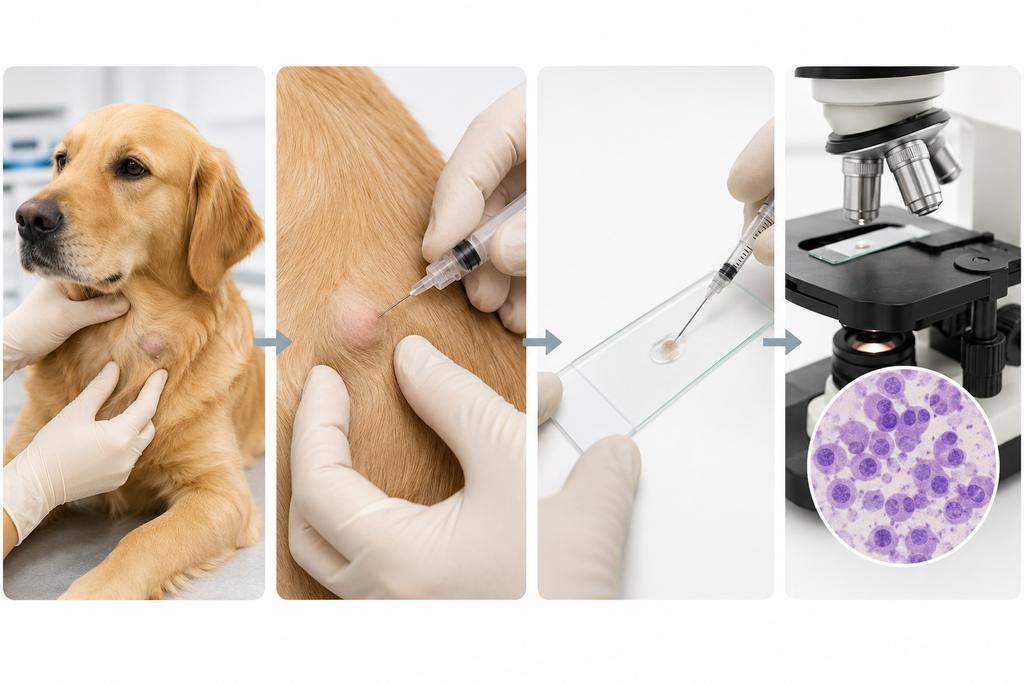
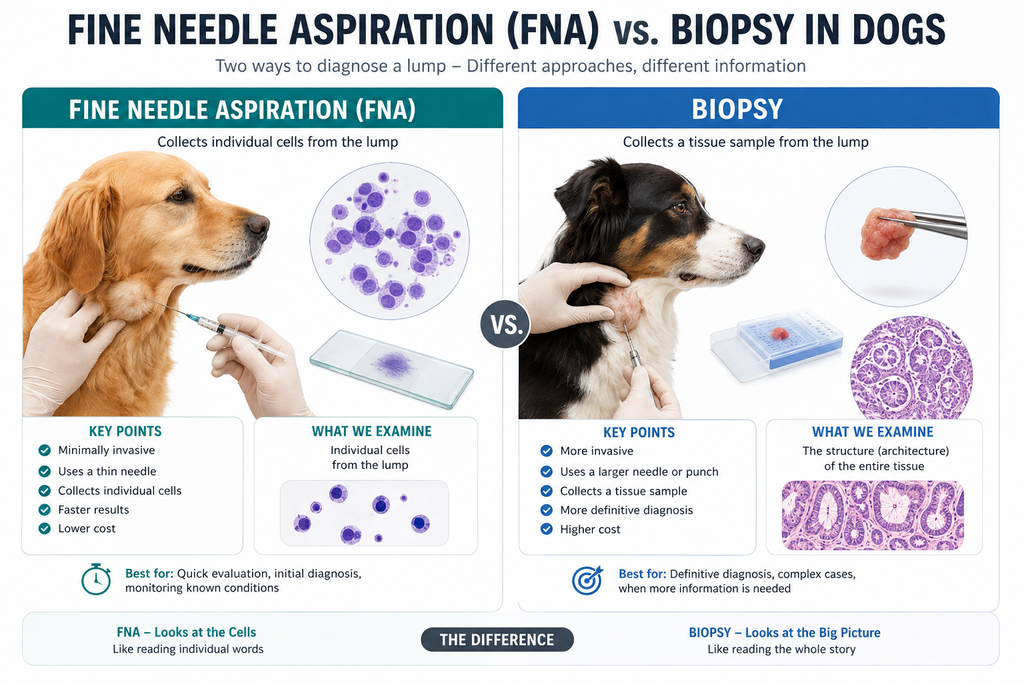
A fine needle aspiration is a simple diagnostic test where your vet inserts a thin needle into a lump or mass and draws out a small sample of cells to look at under a microscope.
Vets reach for FNA as a first step for almost any new lump, bump, or enlarged lymph node, because it’s fast, minimally invasive, and usually doesn’t require sedation. The goal isn’t always a definitive diagnosis — sometimes it’s simply to figure out whether a lump looks concerning enough to investigate further, or benign enough to just monitor.
What Is Included in the FNA Cost?
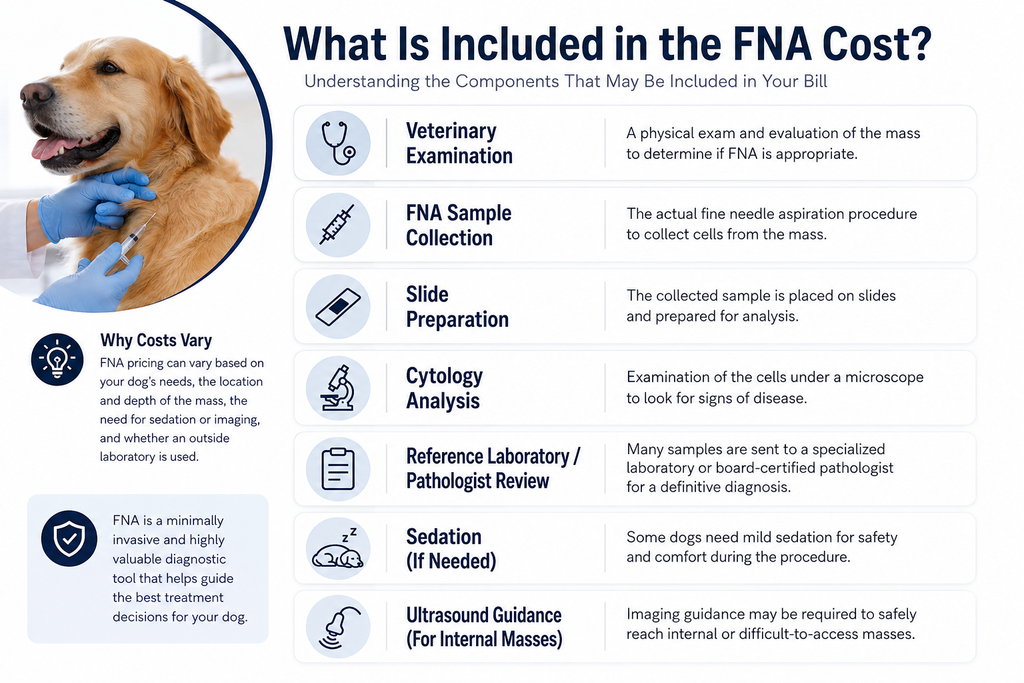
The quoted price for an FNA usually bundles several separate pieces, and knowing what’s included helps explain why one clinic’s number looks different from another’s.
The veterinary exam — checking the lump’s size, location, and feel — is often billed separately from the procedure itself, especially if it’s a new appointment rather than a recheck. Sample collection is the needle procedure itself, usually just a few minutes. Slide preparation covers spreading the collected cells onto a glass slide and staining them for viewing. In-house cytology means your own vet examines the slide under their microscope — this is the fastest and usually cheapest path to a result. Outside/reference laboratory fees apply when the sample is sent to a board-certified veterinary pathologist for a more authoritative read, which adds cost but also adds diagnostic confidence. Sedation, when needed, is billed as its own line item. Imaging, such as ultrasound guidance for an internal mass, adds both equipment time and often a radiologist’s involvement.
Why Can Dog FNA Costs Reach $300–$700+?
The jump from a $150 FNA to a $500+ one almost always comes down to a small set of specific factors, not random pricing differences between clinics.
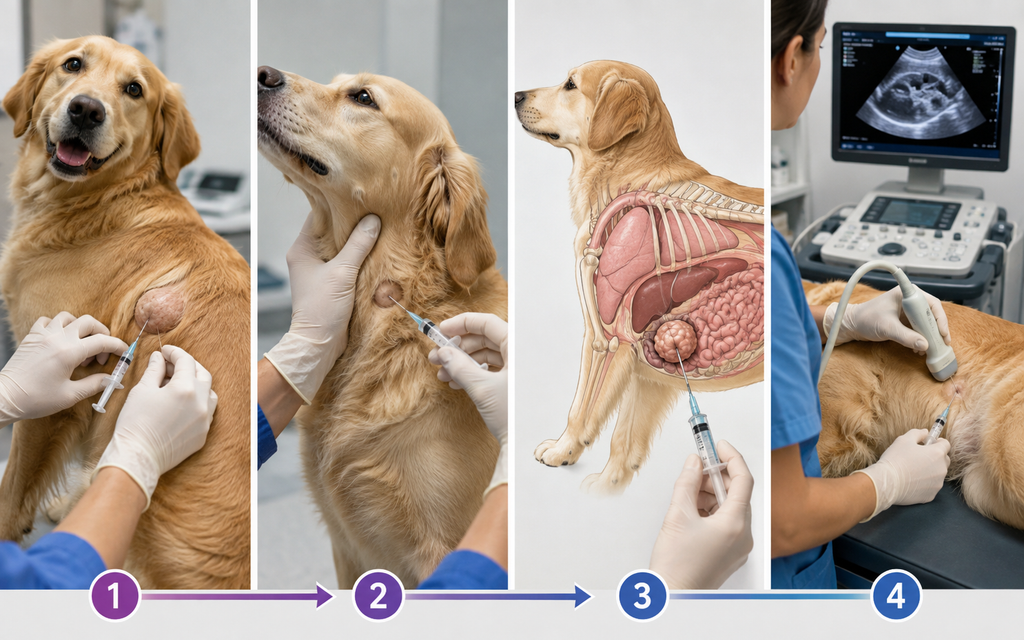
Sedation is the most common driver — a lump near the eyes, ears, mouth, paws, or genitals, or a particularly anxious or painful dog, often needs light sedation to sample safely, adding $75–$200. Internal or deep masses — in the liver, spleen, lungs, or abdominal lymph nodes — can’t be reached with a simple palpation-guided needle stick, so they require ultrasound guidance, which brings in imaging equipment and more vet time. Multiple masses sampled in the same visit add per-site charges, since each lump requires its own needle, slide, and interpretation. Specialist or referral hospitals — oncology practices or 24-hour emergency centers — typically carry higher facility fees than a general daytime practice. Outside laboratory and pathologist fees apply whenever the sample needs a board-certified expert’s read rather than your own vet’s in-house assessment, which is common for masses where the diagnosis isn’t visually obvious.
Dog FNA Cost by Situation
| Situation | Typical Cost | Why |
|---|---|---|
| Simple, accessible skin lump | $50–$150 | No sedation, in-house read, single site |
| Multiple skin lumps, same visit | $150–$300 | Per-site charges add up even without sedation |
| Enlarged lymph node | $100–$250 | Often needs outside lab confirmation |
| Anxious or painful dog needing sedation | $200–$400 | Sedation drugs, monitoring, recovery time |
| Internal mass (organ, abdominal) | $300–$700+ | Requires ultrasound guidance and imaging time |
| Ultrasound-guided FNA at specialty hospital | $400–$700+ | Combines imaging fees with referral-level pricing |
Does a Dog Need Sedation for FNA?
Many accessible skin and subcutaneous lumps can be sampled without any sedation at all — most dogs tolerate the brief needle stick with little more reaction than a vaccine.
Sedation becomes more likely when the lump is in a sensitive or hard-to-hold-still location (near the eyes, ears, mouth, or genitals), when the dog is in pain or unusually anxious, or when the mass is internal and requires the dog to stay completely still for ultrasound guidance. Your vet will typically make this call based on temperament and location, not automatically for every case.
How Much Does FNA Cytology Cost?
“FNA cost” and “cytology cost” often get lumped together in a quote, but they’re technically two different steps with different price drivers.
Collecting the sample is the physical needle procedure — quick, low-cost, and part of the base exam/procedure fee. Examining the cells (cytology) is where the real diagnostic value comes from, and this splits into two paths: your own vet reviewing the slide in-house, which is faster and usually included in the base price, or sending the slide to an outside laboratory for a board-certified veterinary pathologist’s interpretation, which typically adds $50–$150 but often provides a more reliable read — especially for masses where the diagnosis isn’t obvious under a general practice microscope.
What Can a Dog FNA Tell You?
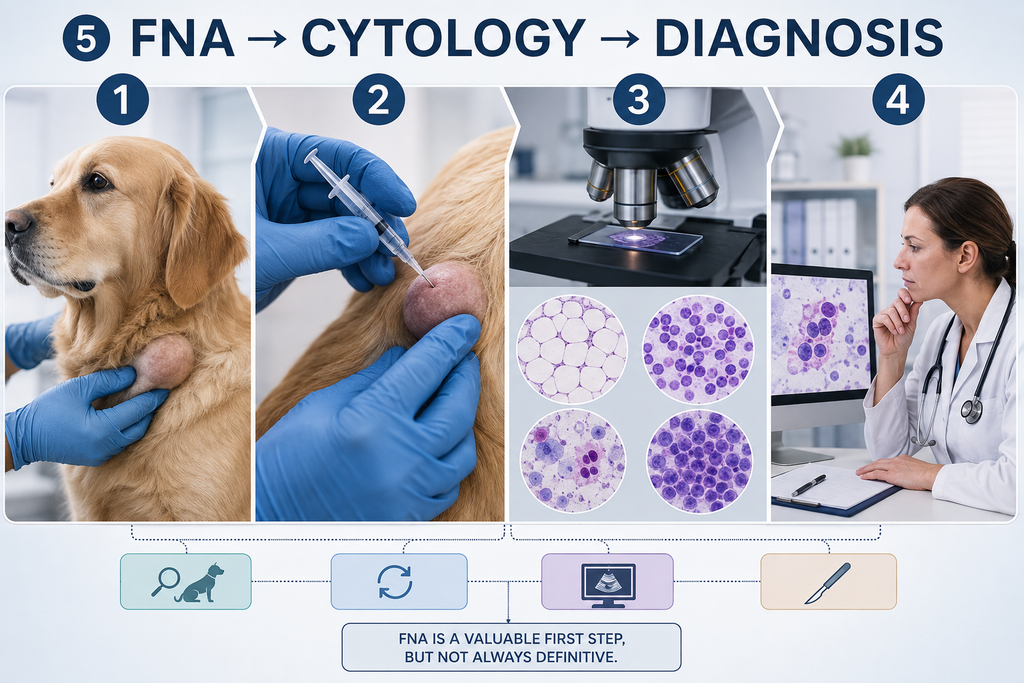
A fine needle aspiration can give your veterinarian an important first look at what is happening inside a lump, bump, enlarged lymph node, or other abnormal mass. Instead of examining the entire lump, FNA collects a small sample of cells that can then be examined under a microscope. The goal is to identify what types of cells are present and whether the findings point toward inflammation, infection, abnormal growth, or another process.
Depending on the mass and the quality of the sample, an FNA may help identify:
- Fat cells: These may be consistent with a fatty mass such as a lipoma, although the appearance of a lump alone does not establish a diagnosis.
- Inflammatory cells: Different inflammatory cells can suggest that the lump is associated with inflammation or an immune response.
- Infectious material or organisms: Cytology may reveal bacteria, fungi, parasites, or other findings that help explain an infection.
- Benign-appearing cells: The sample may contain cells that look consistent with a non-cancerous process.
- Neoplastic or cancerous cells: FNA can sometimes identify abnormal cells and may allow a veterinarian or veterinary pathologist to determine the likely type of tumor.
What an FNA Cannot Always Tell You
An FNA is a cell sample, not a complete piece of tissue. That distinction matters.
A lump can contain different types of tissue, and a needle may not collect the cells that best represent the entire mass. Some tumors also do not release enough cells for a useful sample. As a result, an FNA can sometimes be inconclusive even when a lump is clearly present.
In some cases, cytology can identify a tumor and provide enough information to guide treatment. In others, it may suggest that a mass is suspicious without being able to determine exactly what it is or whether it is definitively benign or malignant. VCA notes that some tumors can appear benign on cytology even when the underlying tumor is malignant, which is one reason biopsy and histopathology may be recommended when the FNA does not provide a clear answer.
This is particularly important because a reassuring FNA result does not automatically mean a lump can be ignored. Your veterinarian will interpret the cytology alongside the lump’s location, size, appearance, growth pattern, your dog’s age, symptoms, and other test results.
If the FNA is non-diagnostic or does not match what your veterinarian suspects clinically, the next step may be another FNA, imaging, or a biopsy for histopathology. Histopathology examines the structure of the tissue itself and can provide information that individual cells from an FNA cannot.
FNA vs. Biopsy for Dogs: Which Costs More?
Read Related Article… Dog Biopsy Cost in the USA (2026): Real Prices by Type, Hidden Lab Fees & What the Results Mean
| Factor | Fine Needle Aspiration (FNA) | Biopsy |
|---|---|---|
| Invasiveness | Minimal — thin needle, usually no sedation | More invasive — tissue sample, often requires sedation/anesthesia |
| Typical cost direction | Lower ($50–$300 typical) | Higher (often several hundred to $1,000+) |
| Speed | Fast — often results in 1–3 days | Slower — full tissue processing takes longer |
| Tissue obtained | Cells only, small sample | Larger tissue sample, preserves structure |
| Diagnostic limitations | Can be inconclusive; doesn’t always distinguish exact tumor type | More definitive; better for confirming cancer type and margins |
| When it’s typically recommended | First-step screening for most new lumps | When FNA is inconclusive, or the mass looks suspicious enough to need a definitive answer upfront |
Can FNA Tell If a Dog Has Cancer?
Sometimes, but not always — it depends heavily on the type of mass.
Some tumor types have a very distinctive cellular appearance that’s easy to identify on a standard FNA slide, giving a confident answer quickly. Others look ambiguous under cytology and require a biopsy to get a definitive diagnosis. FNA is genuinely one of the most valuable early screening tools in veterinary oncology, but it’s a screening tool first — not a guaranteed final answer for every mass.
What Happens If the FNA Is Inconclusive?
Inconclusive results are common with FNA and don’t necessarily mean something is seriously wrong — they simply mean the sample didn’t provide enough clear information to make a call either way.
Read Related Article… Dog Blood Test Cost in the USA (2026): Real Prices, What Each Panel Tests, and How to Pay Less
Typical next steps your vet may discuss include repeating the aspiration (sometimes a second attempt gets a better sample), moving to a full biopsy for a more definitive tissue-level answer, or recommending additional diagnostics like bloodwork or imaging depending on the mass’s location and your dog’s overall symptoms. Which path makes sense depends entirely on your dog’s individual case, and that decision should be made with your vet directly.
How Long Do Dog FNA Results Take?
In-house cytology, where your own vet reads the slide, often provides results the same day or within 24 hours. Samples sent to an outside reference laboratory for a board-certified pathologist’s interpretation typically take longer — commonly one to a few business days, depending on the lab’s turnaround time and how the sample is shipped.
Does Pet Insurance Cover Fine Needle Aspiration?
Pet insurance may cover a veterinarian-recommended FNA when it is medically necessary and the underlying condition is eligible for coverage. However, coverage depends on the policy, waiting periods, deductible, reimbursement percentage, and whether the condition or lump is considered pre-existing as a medically necessary diagnostic test under an accident-and-illness plan, as long as the lump wasn’t present or diagnosed before your policy’s effective date and waiting period.
Read Related Article… Does Pet Insurance Cover Pre-Existing Conditions? The Truth Most Pet Owners Learn Too Late (2026)
Coverage in practice depends on several policy specifics: your deductible (which must typically be met before reimbursement kicks in), your reimbursement percentage (commonly 70–90%), and whether the condition is considered pre-existing — a lump your vet noted before you enrolled, or during the waiting period, is typically excluded regardless of when the FNA itself is performed. Wellness-only plans generally don’t cover diagnostic testing like this at all.
Read Related Article… Does Pet Insurance Cover Cancer Treatment? What Most Pet Owners Don’t Know (2026)
What If You Can’t Afford Your Dog’s FNA?
If the quoted price is more than you’re comfortable with right now, there are practical questions worth asking your vet before assuming you have no options.
Read Related Article… Dog Cancer Treatment Cost in the USA (2026): Surgery, Chemo & Total Costs
Ask whether the quoted price is all-inclusive or whether cytology, sedation, or outside lab fees are separate add-ons. Ask specifically whether sedation is actually necessary for your dog’s lump, or whether it can be attempted without it first. Ask whether an outside lab is required, or whether in-house cytology would be sufficient as a starting point. Confirm whether the test can be performed at your regular general practice vet rather than a specialty or emergency hospital, which often costs less.
Read Related Article… Vet Payment Plans: Can You Make Monthly Payments to a Vet? (2026)
Ask about payment plans or financing options like CareCredit or Scratchpay. If your dog isn’t showing urgent symptoms, ask whether diagnostics can be staged — starting with the simplest, cheapest option before committing to more advanced testing. Finally, ask whether a local nonprofit or low-cost veterinary clinic in your area offers reduced-cost diagnostic services.
Read Related Article… Can’t Pay a Vet Bill in the USA? Here’s What Actually Happens (2026)
Questions to Ask Your Vet Before Paying for an FNA
- Is this quote all-inclusive, or are cytology and lab fees separate?
- Does my dog need sedation for this specific lump?
- Will the sample be read in-house or sent to an outside lab?
- How long will results take either way?
- Is ultrasound guidance necessary, or is this an accessible external lump?
- What happens next if the results come back inconclusive?
- Are payment plans or financing options available here?
Frequently Asked Question
How much does an FNA cost for a dog?
A dog fine needle aspiration (FNA) generally costs $50–$200 for the procedure itself. The total bill can be higher if your dog needs sedation, ultrasound guidance for an internal mass, or laboratory interpretation by a veterinary pathologist.
Is FNA painful for dogs?
FNA involves inserting a needle into the tissue, so some dogs may experience brief discomfort. Many dogs tolerate an FNA well, especially when sampling an accessible skin or subcutaneous lump. Sedation may be recommended for anxious dogs or when sampling certain internal organs.
Does FNA require anesthesia?
Usually not for an accessible lump. Most external masses can be sampled without sedation or anesthesia. Internal masses, including those involving organs such as the liver or spleen, may require sedation and ultrasound guidance to help keep the procedure safe.
What can a dog FNA tell you?
FNA can help identify the types of cells present in a lump and may reveal inflammation, infection, fat cells, or abnormal/neoplastic cells. In some cases, it can provide a diagnosis without requiring a surgical biopsy. However, FNA is not always definitive because the sample may be too small or may not represent the entire mass.
Is FNA cheaper than a biopsy?
Yes, FNA is generally less invasive and less expensive than a surgical biopsy. A biopsy provides a larger tissue sample and can give information about tissue structure that FNA cannot. It is often recommended when cytology is inconclusive or a more definitive diagnosis is needed.
Can an FNA diagnose cancer in dogs?
Sometimes. Certain tumors have recognizable cell patterns that can be identified through cytology. However, FNA cannot definitively diagnose every type of cancer, and some masses require a biopsy and histopathology for a more complete diagnosis.
How long do dog FNA results take?
If your veterinarian examines the sample in-house, you may receive results the same day. If the sample is sent to a veterinary pathologist or reference laboratory, results can take several days to more than a week, depending on the laboratory and case.
Does pet insurance pay for FNA?
Pet insurance may cover an FNA when it is medically necessary and the underlying condition is eligible for coverage. Coverage depends on your policy, including waiting periods, deductible, reimbursement terms, and whether the condition or lump is considered pre-existing. Check your policy or contact your insurer before the procedure if possible.
What if the FNA is inconclusive?
An inconclusive FNA does not necessarily mean that something is wrong; it means the sample did not provide enough information for a reliable diagnosis. Your veterinarian may recommend repeating the FNA, performing additional imaging, or proceeding to a biopsy and histopathology depending on the mass and your dog’s situation.
What should I ask my vet before an FNA?
Ask whether the quoted price includes the veterinary exam, sample collection, cytology, and any laboratory fees. You can also ask whether sedation is necessary, whether the sample will be reviewed in-house or by a veterinary pathologist, how long results are expected to take, and what the next step would be if the FNA is inconclusive.
External Authority Sources
- PetMD — Fine Needle Aspiration for Dogs
- VCA Animal Hospitals — Cytology/FNA overview
- AVMA (American Veterinary Medical Association)
- NAPHIA / pet insurance claims data
Disclaimer: This article is for informational and educational purposes only. Cost data reflects 2026 national averages and will vary based on your dog’s age, breed, location, and the specific clinic or plan you choose. PetInsurePrime does not sell pet insurance and receives no compensation from any insurance provider. Always compare multiple quotes and consult your veterinarian directly about your dog’s individual case.
PetInsurePrime | Independent • Research-Based | Helping US dog owners understand real vet costs and coverage options — without the sales pressure.