
If your vet recommends a cytology test for your dog, the first question is usually simple: how much will it cost? The honest answer has two parts. The lab fee for reading the cells is often modest. Your total bill is almost always higher, because several other charges travel with it.
Quick Answer : Dog Cytology Test Cost
Dog cytology testing often costs roughly $50 to $300 for the straightforward version: an exam, cell collection, and cytology interpretation for one accessible lump. Cases involving sedation, an internal mass needing ultrasound guidance, multiple sites, or outside laboratory review commonly run $300 to $700 or more. These are planning ranges, not a national average, and your vet’s written estimate is the number that matters.
Quick Cost Summary : Dog Cytology Test Cost
| Cytology-Related Cost | Typical Range | What It May Include |
|---|---|---|
| Lab cytology fee (published lab example) | Tens of dollars per site | Microscopic examination at a diagnostic lab |
| Sample collection / FNA | $50–$200 | Collecting the cells |
| Exam + collection + cytology (one accessible lump) | $150–$300 | Most common owner-facing total |
| Outside/reference lab review | +$50–$150 | Pathologist interpretation fee |
| Sedation | +$75–$200 | If location or temperament requires it |
| Additional sites | +$30–$75 each | Each lump is sampled and read separately |
| Ultrasound-guided collection (internal mass) | $300–$700+ | Imaging plus collection plus cytology |
These are planning ranges. Actual prices vary by clinic, location, sedation, lab, and number of samples.
Table of Contents
- Quick Answer : Dog Cytology Test Cost
- Quick Cost Summary : Dog Cytology Test Cost
- How Much Does Cytology Cost for a Dog?
- Why Your Vet’s Quote Can Be Higher Than the Lab Fee
- What Is a Cytology Test for Dogs?
- What Types of Samples Can Be Tested With Cytology?
- Is a Fine-Needle Aspiration (FNA) the Same as Cytology?
- Why Would a Vet Recommend Cytology for a Dog?
- When Should a Dog Lump Be Checked With Cytology?
- What Is Included in a Dog Cytology Test Cost?
- What Can Make Cytology More Expensive?
- How Much Does a Dog Cytology Test Cost by Sample Type?
- How Long Does Dog Cytology Take?
- What Do Dog Cytology Results Mean?
- What Can Cytology Tell You About Your Dog?
- How Accurate Is Cytology for Dogs?
- What If Your Dog’s Cytology Is Inconclusive?
- Cytology vs. Biopsy
- Does Pet Insurance Cover Dog Cytology?
- What Could Your Total Bill Look Like?
- Cost by Location in the USA
- Questions to Ask Your Vet Before Paying
- Can You Save Money on Cytology?
- FAQ
How Much Does Cytology Cost for a Dog?
For one accessible lump, the typical owner-facing total, covering the exam, cell collection, and cytology, lands around $150 to $300. The cytology component alone, meaning the lab reading the cells, is a much smaller piece of that.
| Component | Typical Range |
|---|---|
| Cytology interpretation (lab fee) | Often tens of dollars per site |
| FNA/sample collection | $50–$200 |
| Collection + cytology bundled | $150–$300 |
| Sedation, if needed | $75–$200 extra |
| Outside lab review | $50–$150 extra |
| Additional stains or tests | Varies by case |
Published laboratory fee schedules show why this gap exists. North Carolina’s state veterinary diagnostic laboratory, for example, lists cytology at $40 per site, with a $10 rush surcharge, and notes turnaround of up to eight days. That’s a real, published laboratory price. It is not what you’ll see on your dog’s invoice, because the invoice also covers the exam, the collection procedure, the clinic’s own handling, and often sedation or imaging.
Why Your Vet’s Quote Can Be Higher Than the Lab Fee
This is the question behind most “why is my quote so high” searches, and it comes down to what gets bundled.
A lab fee covers one thing: a pathologist or technician examining a prepared slide. Your clinic’s quote usually layers on the veterinary exam (often billed separately from the procedure), the collection procedure itself, slide preparation and handling, the shipping or courier if the sample goes out, and sometimes sedation or imaging. None of these show up in a lab’s published price list, which is why the invoice total can be several times the lab fee while still being entirely reasonable.
What Is a Cytology Test for Dogs?
Cytology is the microscopic examination of individual cells. A vet or pathologist looks at cells collected from a lump, skin lesion, swollen lymph node, or body fluid to see what kind of cells are present and whether they look normal, inflamed, infected, or abnormal. University veterinary labs describe cytology services as covering aspirates and impression smears from masses, lesions, and organs, as well as body fluids.
It’s a screening and sorting tool. It often gives useful early information quickly, but it doesn’t always produce a final diagnosis on its own.
What Types of Samples Can Be Tested With Cytology?
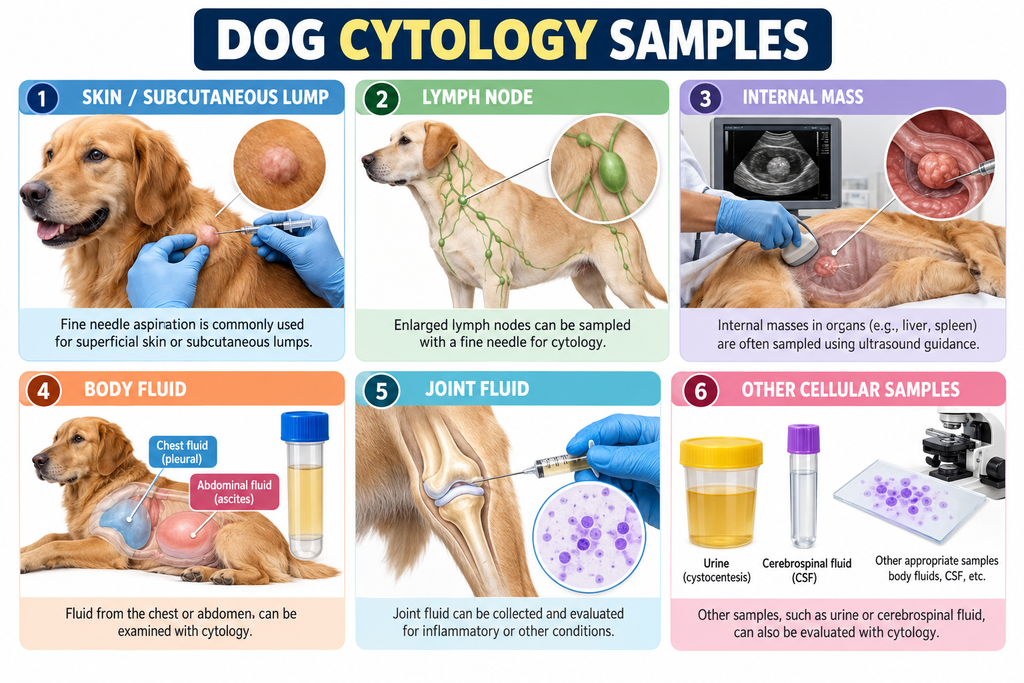
Cytology can examine cells collected from several parts of a dog’s body. The most common samples come from skin or under-the-skin lumps, masses, and enlarged lymph nodes, often collected using a fine-needle aspiration (FNA). Veterinary cytology can also evaluate samples from internal organs such as the liver, kidneys, or lungs when your veterinarian needs more information about an abnormal area.
Cytology can also be performed on certain body fluids, including fluid from the chest or abdomen, joint fluid, urine, and cerebrospinal fluid. These samples can help veterinarians look for inflammation, infection, abnormal cells, or other changes.
For a dog with a new lump, however, an FNA-based cytology test is one of the most common starting points because it can collect cells with relatively little tissue disruption.
The type of sample your veterinarian chooses depends on where the problem is located, what they suspect, and what information they need from the test.
Is a Fine-Needle Aspiration (FNA) the Same as Cytology?
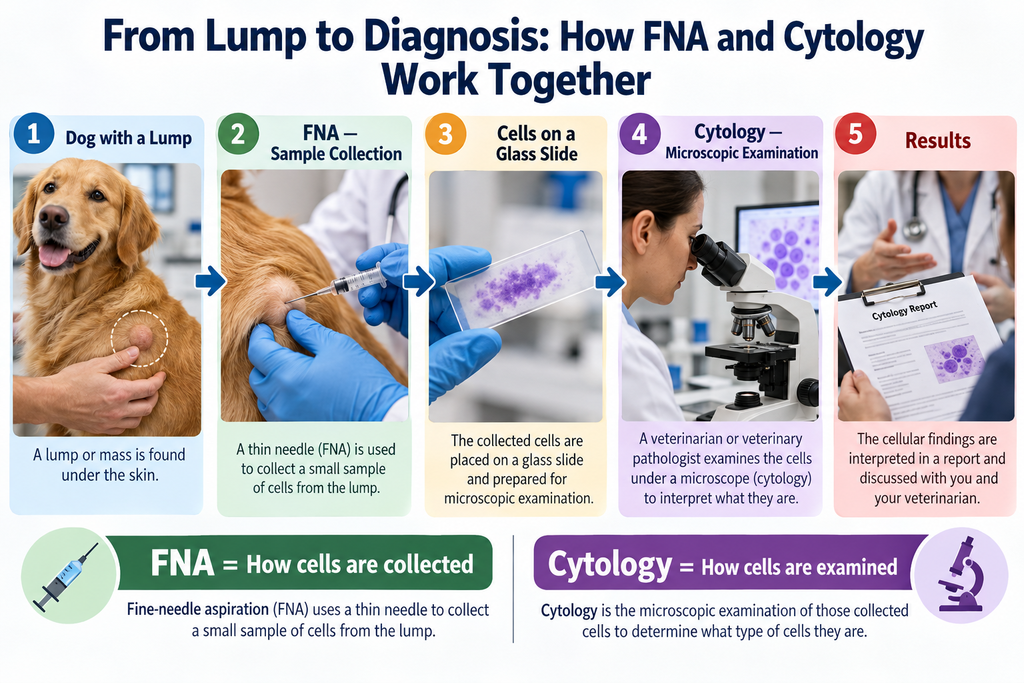
No, they’re two steps in one process. FNA is how the cells are collected. Cytology is how those cells are examined.
Lump → FNA → Cells collected → Cytology → Results
That’s why a quote might say “FNA with cytology” as one line or list them as two. Veterinary sources commonly describe FNA as one of the most common ways to collect cells for cytology, though cytology can also come from impression smears or fluid samples. For collection-side pricing, including sedation decisions and ultrasound-guided sampling.
Read Related Article… Dog Fine Needle Aspiration Cost in the USA (2026): What You’ll Actually Pay
Why Would a Vet Recommend Cytology for a Dog?
Vets commonly recommend cytology for a new skin lump or mass, a swollen lymph node, an abnormal skin lesion, fluid accumulation somewhere unexpected, or a suspected infection or inflammation. It’s also a standard early step when a tumor is possible, because it’s quick and minimally invasive. Cornell’s veterinary oncology resources note that FNA can collect cells from accessible masses and sometimes provides a rapid diagnosis for certain tumor types.
Finding a lump does not automatically mean your dog has cancer. Many lumps turn out to be benign growths, fatty tumors, cysts, or inflammation, and cytology is often how vets sort the likely-harmless from the worth-investigating.
When Should a Dog Lump Be Checked With Cytology?
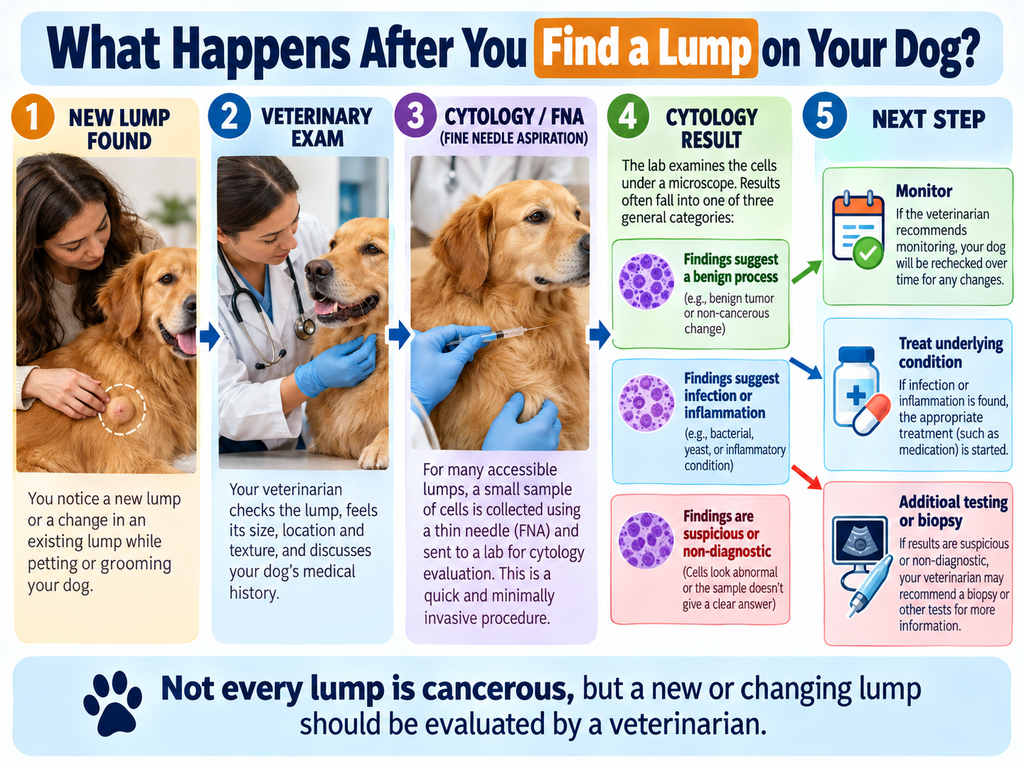
A dog lump should be checked by a veterinarian when it is new, growing, changing in appearance, unusually firm or fixed, or does not go away. Swollen lymph nodes, recurring skin growths, or a lump accompanied by other changes in your dog’s health also deserve veterinary evaluation. Not every lump is cancerous, but you cannot reliably determine what a mass is just by feeling or looking at it.
Your veterinarian may recommend cytology when a lump needs a closer look. A fine-needle sample can collect cells from many accessible masses with relatively little invasiveness, helping the veterinarian determine whether the cells appear benign, inflammatory, infectious, or suspicious for cancer.
Cytology is often an early diagnostic step rather than an automatic sign that your dog has cancer. Some masses can be identified through cytology, while others may require a biopsy or additional testing if the sample does not provide enough information.
What Is Included in a Dog Cytology Test Cost?
A complete quote can include up to seven separate pieces:
- Veterinary examination. Often billed separately, especially for a new visit.
- Sample collection / FNA. The needle procedure and collecting the cells.
- Slide preparation. Spreading and staining the cells so they can be read.
- Cytology interpretation. The microscopic examination by your vet or a veterinary pathologist.
- Sedation. Only if location, pain, or temperament calls for it.
- Imaging. If an internal mass needs ultrasound guidance.
- Additional stains or testing. Some cases need extra investigation.
This list answers the question behind most billing confusion: why a clinic’s quote is higher than the cytology price someone found online. The online number usually reflects item 4 only.
Read Related Article… Dog Blood Test Cost in the USA (2026): Real Prices, What Each Panel Tests, and How to Pay Less
What Can Make Cytology More Expensive?
| Cost Factor | Why It Increases the Bill |
|---|---|
| Location of the mass | Internal masses may need imaging guidance |
| Number of samples | Each site is sampled and read separately |
| Sedation | Adds medication and monitoring costs |
| Outside lab / pathologist review | Adds an interpretation fee |
| Special stains | Additional diagnostic work |
| Emergency or specialty hospital | Higher facility fees |
| Geographic location | Veterinary pricing varies by area |
Published laboratory schedules charge per site, which illustrates why there’s no single “cytology price.” Two lumps means two samples and two reads, and the bill reflects that.
How Much Does a Dog Cytology Test Cost by Sample Type?
The cost of dog cytology can vary depending on where the sample comes from and how it needs to be collected. A simple skin or subcutaneous lump is usually easier to sample than an internal mass, which may require imaging guidance. Multiple lumps can also increase the cost because each site may need a separate sample and interpretation.
For an accessible lump, a veterinary visit that includes examination, fine-needle aspiration (FNA), and cytology may commonly fall around $150–$300. If the sample comes from an internal mass, the total may be higher because ultrasound guidance, sedation, or additional diagnostic services may be needed.
Cytology can also be performed on other samples, including lymph nodes and certain body fluids such as abdominal, chest, joint, or cerebrospinal fluid.
The laboratory’s cytology fee is only one part of the bill. Your final veterinary cost depends on the sample location, collection method, number of sites, imaging, sedation, and whether the sample is reviewed by an outside laboratory.
Read Related Article… Dog Ultrasound Cost in the USA (2026): Real Prices, Hidden Charges & What Happens After
How Long Does Dog Cytology Take?
It depends on where the slide is read. In-house cytology, where your own vet examines the slide at the clinic, can provide results the same day or within a day. Reference laboratory review takes longer: state diagnostic labs list turnaround of several days up to about a week or more, and rush or priority handling typically costs extra (North Carolina’s lab, for example, adds $10 for rush processing). Some university and commercial labs offer same-day results for samples received before a daily cutoff.
What Do Dog Cytology Results Mean?
Dog cytology results describe what the veterinarian or veterinary pathologist sees in the cells collected from your dog’s lump, lesion, lymph node, or other sample. The result may suggest inflammation, infection, a benign growth, or cancerous cells.
A result described as benign generally means the cells do not appear cancerous. Malignant means the cells have features consistent with cancer. You may also see terms such as inflammatory, infectious, suspicious, or non-diagnostic, depending on what was found in the sample.
A non-diagnostic or inconclusive result does not necessarily mean something is wrong with the test. Sometimes the sample contains too few cells or does not capture the most representative part of the mass. In those cases, your veterinarian may recommend another sample, additional testing, or a biopsy.
Cytology can provide a useful answer quickly, but it cannot give a definitive diagnosis for every type of mass. The meaning of your dog’s result should always be interpreted together with the physical exam, imaging, and other findings.
What Can Cytology Tell You About Your Dog?
Cytology can help identify inflammatory cells, signs of infection, benign-appearing cells, suspicious or abnormal cells, and certain types of tumors. For some masses, the cell appearance is distinctive enough to give a confident answer quickly.
It does not always give a definitive diagnosis. Some tumors shed few cells when sampled, and veterinary oncology guidance notes that certain soft-tissue sarcomas can be difficult to diagnose by FNA for exactly that reason. A clear cytology result is valuable. A non-answer doesn’t mean something was missed or that the test was wasted.
How Accurate Is Cytology for Dogs?
Cytology can be very useful for identifying what is happening in a dog’s lump or mass, but its accuracy depends on the type and location of the mass and whether the sample contains enough representative cells. For some lesions, cytology can provide a clear diagnosis without the need for a more invasive biopsy. It can also help identify inflammation, infection, benign growths, and certain types of cancer.
However, cytology does not always give a definitive answer. Some tumors do not release enough cells into an FNA sample, or the collected cells may not show the full structure of the tissue. In those situations, your veterinarian may recommend another sample, imaging, or a biopsy for histopathology.
So, a non-diagnostic cytology result does not necessarily mean the test failed. It may simply mean that a different type of sample is needed to understand the mass more accurately.
What If Your Dog’s Cytology Is Inconclusive?
An inconclusive result usually means the sample didn’t contain enough clear information for a definitive call. The typical path looks like this:
Cytology → inconclusive → vet may recommend biopsy → histopathology
Does that mean you paid for nothing? No. The cytology still narrowed the possibilities, helped your vet decide the next step, and may have ruled out an infection or an obviously inflammatory process. The next step depends on the suspected condition and the mass’s location, and your vet may recommend repeating the sample, a biopsy, imaging, or simply monitoring.
Read Related Article… Dog Oncology Consultation Cost in the USA (2026): What You Pay, What Happens, and What Comes Next
Cytology vs. Biopsy
| Cytology / FNA | Biopsy | |
|---|---|---|
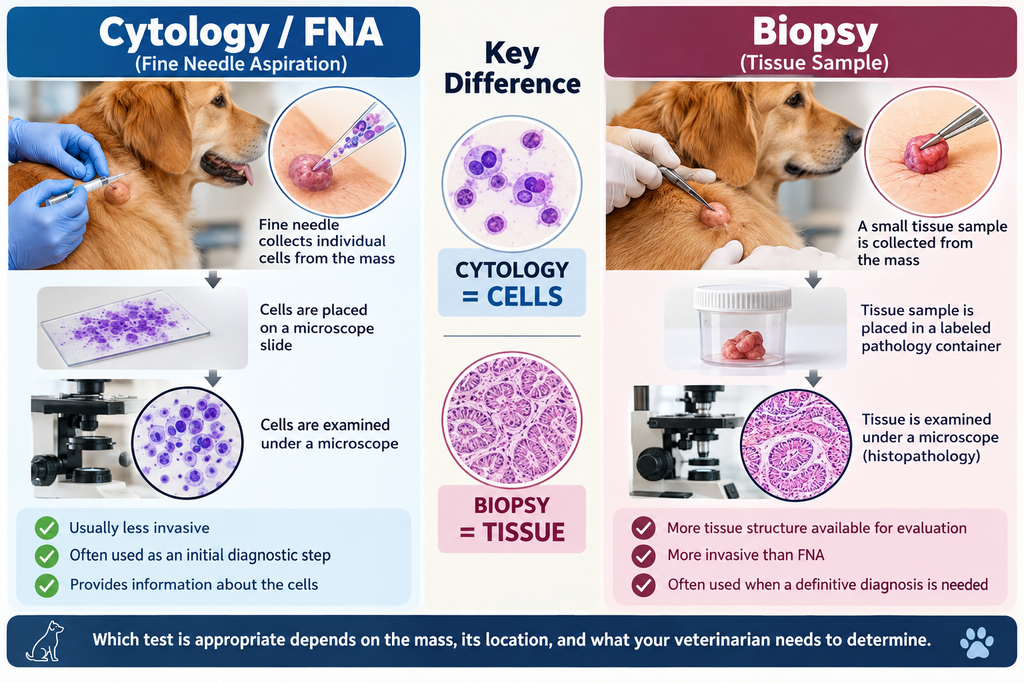
| Sample | Individual cells | Tissue |
| Invasiveness | Usually lower | Usually higher |
| Sedation | Sometimes | More commonly needed |
| Typical cost | Usually lower | Usually higher |
| Main purpose | Initial cell-level assessment | Tissue structure and more definitive diagnosis |
| Can be inconclusive? | Yes | Yes, though it provides more tissue |
A biopsy isn’t automatically definitive in every case, and cytology isn’t automatically inferior. Which one fits depends on the mass, its location, and what your vet is trying to learn. For the collection-side comparison.
Read Related Article… Dog Biopsy Cost in the USA (2026): Real Prices by Type, Hidden Lab Fees & What the Results Mean
Does Pet Insurance Cover Dog Cytology?
It often can, depending on your policy. Veterinarian-recommended diagnostic testing for a new, covered condition is commonly eligible under accident-and-illness plans, and veterinary sources note that many plans may cover FNA when the condition isn’t pre-existing. Coverage is never automatic.
Read Related Article… Pet Insurance Waiting Period: How Long Before Coverage Starts? (2026 Guide)
What decides it:
- Pre-existing conditions. A lump your vet noted before you enrolled, or during the waiting period, is typically excluded.
- Waiting periods. Illness coverage often starts later than accident coverage.
- Deductible and reimbursement percentage. Even a covered claim rarely means 100% of the bill is paid.
- Policy exclusions and annual limits. These vary by insurer.
Read Related Article… Does Pet Insurance Cover Pre-Existing Conditions? The Truth Most Pet Owners Learn Too Late (2026)
What Could Your Total Bill Look Like?
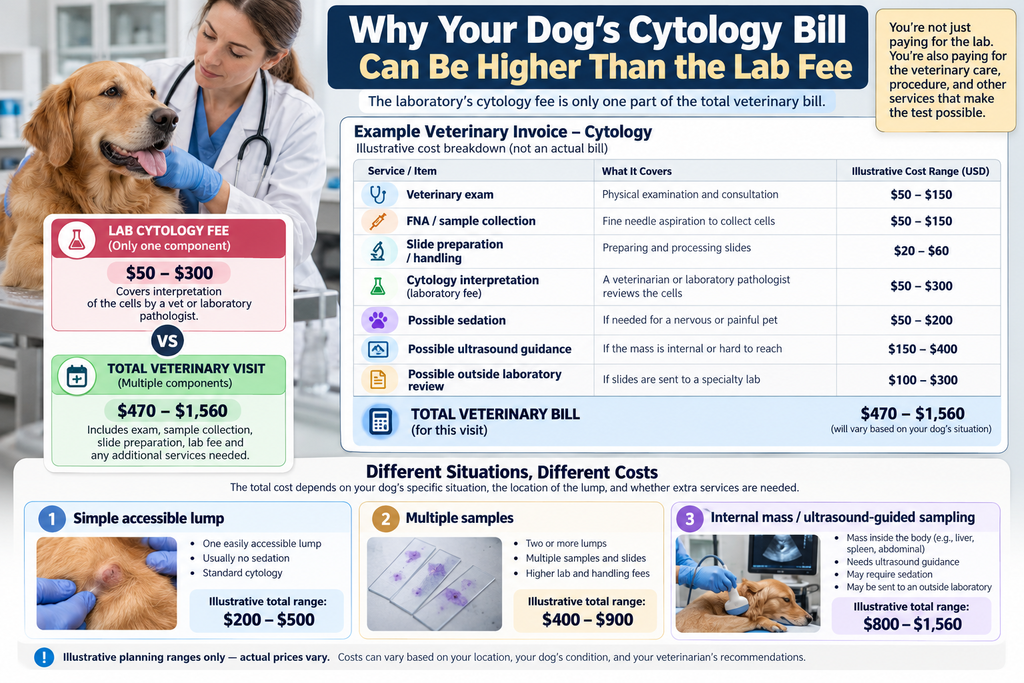
These are illustrative examples built from the ranges above, not guaranteed prices.
Example 1: Simple skin lump. Exam, one FNA sample, in-house cytology. Illustrative total: roughly $150–$300.
Example 2: Multiple lumps. Exam, several samples taken in one visit, cytology on each site. Illustrative total: roughly $200–$450, since each added site adds a collection and read.
Example 3: Internal mass. Exam, ultrasound-guided sampling, possible sedation, cytology sent to a reference lab. Illustrative total: roughly $400–$800 or more.
Cost by Location in the USA
There isn’t reliable published data to responsibly list 50 state prices, so none are listed here. What does shift the number is consistent and worth knowing: metropolitan versus rural areas, general practice versus specialty hospital, university teaching hospital versus private clinic, and routine versus emergency appointments. Urban and high-cost-of-living areas generally run toward the top of any range in this article.
Questions to Ask Your Vet Before Paying
- Is the cytology fee separate from the FNA?
- Is the veterinary exam included?
- Is sedation necessary for this lump?
- Is the sample read in-house or sent to a lab?
- How many samples are being tested?
- When should I expect results?
- Could additional stains or testing be needed?
- If the result is inconclusive, what’s the next step?
- How much would a biopsy cost if needed?
- Can you give me the estimate in writing?
Can You Save Money on a Dog Cytology Test?
Without cutting corners on care, a few things help. Ask for an itemized estimate so nothing is a surprise. Ask whether FNA and cytology are bundled into one price. Ask whether sedation is truly necessary for your dog’s lump or can be attempted without it. Ask whether in-house versus reference-lab reading changes cost or timing. Ask whether multiple samples can be handled in one submission. Compare estimates between clinics when your dog’s situation safely allows it.
Don’t delay medically recommended diagnostics just to save money. Early answers are often the cheaper path overall.
Frequently Asked Question
How much does a cytology test cost for a dog?
A dog cytology test can cost about $150–$300 for a straightforward case, while more complex cases can reach $300–$700 or more when sedation, imaging, multiple samples, or outside laboratory review are involved.
Is cytology expensive for dogs?
Cytology is generally less expensive than many more invasive diagnostic tests, but your total bill depends on the exam, sample collection, laboratory review, sedation, and other services required.
Is FNA the same as cytology?
No. FNA is the method used to collect cells, while cytology is the microscopic examination of those cells. FNA is one of the most common ways veterinarians obtain samples for cytology.
Does dog cytology require sedation?
Not always. Many accessible lumps can be sampled without sedation, but your veterinarian may recommend it if the area is difficult to reach, painful, or your dog cannot remain still.
How long does dog cytology take?
In-house cytology may provide results quickly, sometimes the same day. Samples sent to an outside veterinary laboratory can take several business days, depending on the laboratory and type of testing.
Can cytology detect cancer in dogs?
Yes, cytology can identify cancerous or suspicious cells in some cases. However, it cannot definitively diagnose every type of tumor, so your veterinarian may recommend a biopsy when the cytology result is unclear.
What happens if dog cytology is inconclusive?
Your veterinarian may recommend another sample, additional testing, or a biopsy. The next step depends on the type and location of the mass and how much information the initial cytology provides.
Does pet insurance cover cytology?
Pet insurance may cover cytology when it is medically necessary for a new, covered condition, but coverage depends on your policy. Waiting periods, pre-existing-condition exclusions, deductibles, and reimbursement limits can affect what you receive.
External Authority Sources
- Cornell University — Sprecher Institute, diagnosis and staging
- UC Davis School of Veterinary Medicine — clinical laboratory cytology services
- PetMD — Fine Needle Aspiration for Dogs
- AVMA (American Veterinary Medical Association)
Disclaimer: This article is for informational and educational purposes only and is not a substitute for veterinary advice. Cost ranges reflect 2026 planning estimates and published laboratory fee schedules, and will vary by clinic, location, laboratory, sedation, and your dog’s individual case. PetInsurePrime does not sell pet insurance and receives no compensation from any insurance provider or veterinary practice. Always discuss your dog’s results and next steps with your veterinarian.
PetInsurePrime | Independent • Research-Based | Helping US dog owners understand real vet costs and coverage options — without the sales pressure.