
Updated: July 2026 | Reading Time: 26minutes
The vet just handed you a bill — or an estimate — that’s more than you have available right now. Your dog needs care. You need time to pay for it. And you’re trying to figure out whether that’s actually possible.
It is. More options exist for paying vet bills in installments than most owners realize — including options that don’t require good credit, some that don’t require a credit check at all, and some that can be set up at the desk before your dog is discharged.
Here’s every realistic option, what each requires, and exactly what to say to get started.
Read Related Article… Can’t Pay a Vet Bill in the USA? Here’s What Actually Happens (2026)
Quick Answer : Can You Pay Vet Bills in Installments
Yes — vet bills can be paid in installments through several pathways: third-party financing (CareCredit, Scratchpay), no-credit-check plans (VetBilling, Varidi), in-house clinic payment plans, Buy Now Pay Later services, personal loans, and nonprofit assistance. A 2025 peer-reviewed study found that 35.8% of pet families said they would have been very likely to lose their pet without the no-credit-check payment option offered at the clinic. Payment options exist at nearly every budget level and credit situation — the key is knowing which to ask for.
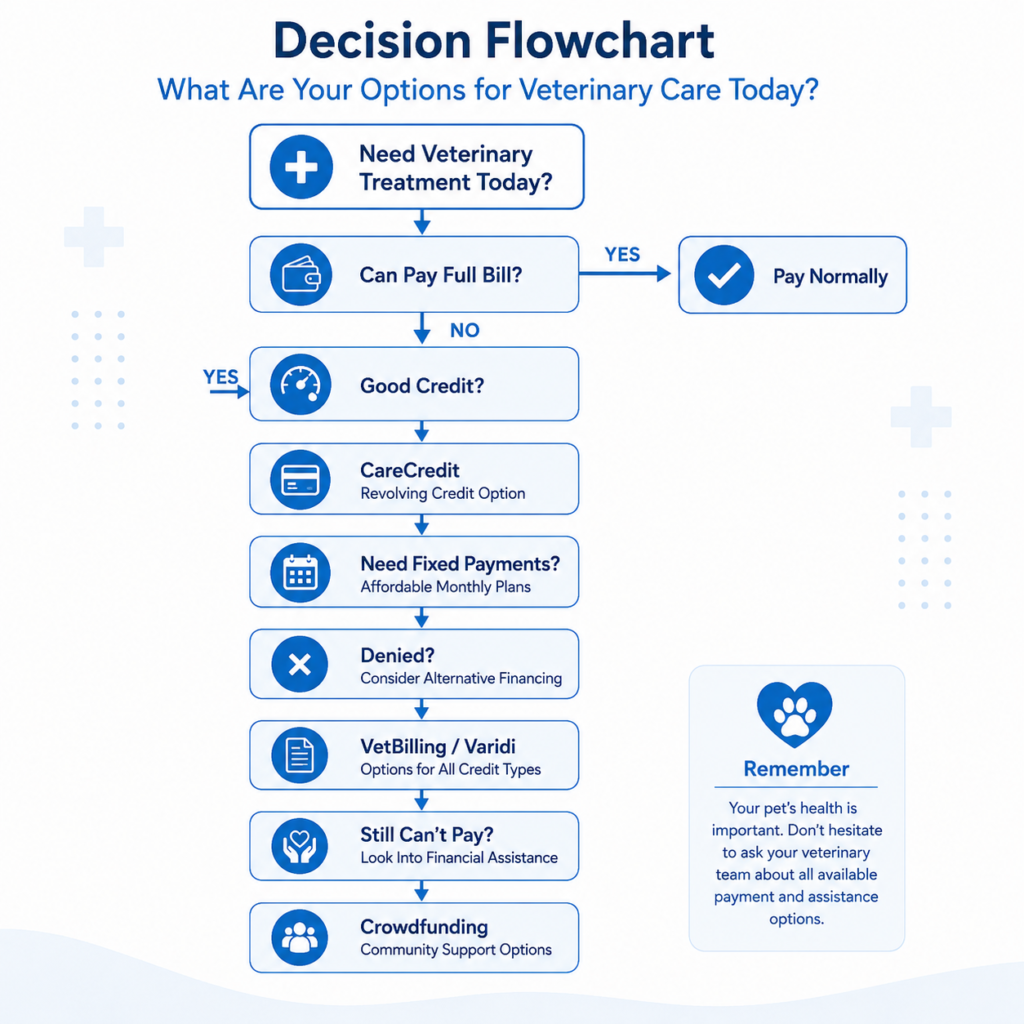
At a Glance: Vet Bill Installment Options (2026)
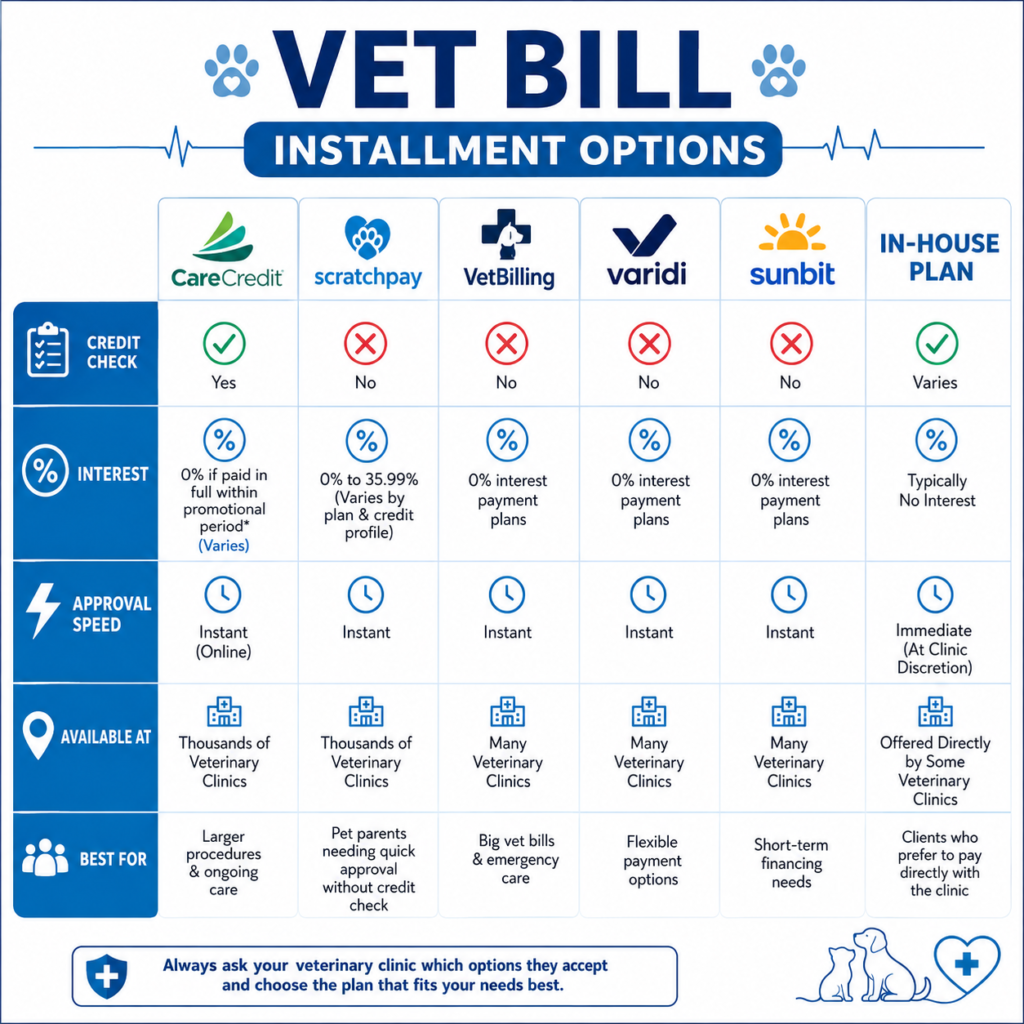
| Option | Credit Check? | Interest? | Where Available | Best For |
|---|---|---|---|---|
| CareCredit | ✅ Hard pull | 0% promo / deferred interest | Most clinics | Bills $200–$25,000+ |
| Scratchpay | ✅ Soft pull | Fixed rate (no deferred interest) | ~17,000 clinics | Predictable payments |
| Sunbit | ✅ Soft pull | Fixed rate | Select clinics | Quick approval |
| Cherr | ✅ Soft pull | Fixed rate | Select clinics | Flexible terms |
| VetBilling | ❌ No credit check | None — clinic-managed | Enrolled clinics | Poor/no credit |
| Varidi | ❌ No credit check | None | Enrolled clinics | Any credit level |
| In-house clinic plan | ❌ Usually none | Usually none | Independent clinics | Established clients |
| Personal loan | ✅ Hard pull | Varies | Banks / online lenders | Large bills |
| Afterpay / BNPL | ✅ Soft pull | None (4 payments) | Select clinics | Bills under $1,500 |
| Nonprofit grant | ❌ Income-based | N/A | Application required | Financial hardship |
| Pet insurance | N/A | N/A | Any licensed vet | Covered conditions |
Table of Contents
- In-House Vet Payment Plans — How to Ask and What to Expect
- CareCredit: The Most Widely Accepted Vet Financing Option
- Scratchpay: The Alternative With No Deferred Interest Risk
- No-Credit-Check Options: VetBilling, Varidi, and Sunbit
- Buy Now Pay Later at the Vet: Afterpay and Others
- Personal Loans for Vet Bills
- Corporate Chain Clinics vs. Independent Practices — Which Offer Plans
- Emergency Vet Payment Plans: How the Deposit System Actually Works
- What To Say Word-for-Word When Asking for Installments
- If You Can’t Pay at All: Nonprofit Financial Assistance
- What Happens If You Miss Payments or Don’t Pay
- How Pet Insurance Fits Into the Installment Picture
- Action Checklist
- FAQ
In-House Vet Payment Plans — How to Ask and What to Expect
In-house payment plans — where the clinic itself manages the installments rather than a financing company — are the most flexible option when they’re available. They typically charge no interest, require no credit check, and can be arranged in minutes.
The challenge: veterinarians aren’t bankers or lenders, and setting up these payment plans can put their businesses at risk, so you may struggle to find a vet who offers them.
Read Related Article… Can You Negotiate Vet Bills in the USA? What Every Pet Owner Should Know (2026)
When in-house plans are most available:
- Independent private practices (not corporate chains)
- Long-term clients with a payment history at the clinic
- Planned procedures rather than emergency treatments
- Bills under $1,500 — larger balances are harder for clinics to absorb
What in-house plans typically look like: Some veterinary clinics offer internal installment plans allowing clients to pay in set monthly amounts directly to the clinic. These arrangements work best when supported by clear, written contracts that outline payment schedules, limits, and consequences for missed payments.
A typical arrangement: 25–50% deposit at checkout, remaining balance paid over 2–4 months. No interest. No third-party involvement. Just a written agreement between you and the clinic.
Why many clinics say no: When a clinic extends a payment plan, it’s essentially extending an unsecured loan. If the client doesn’t pay, the clinic has limited recourse. Clinics that have been burned by non-payment often switch to third-party financing exclusively — because CareCredit and Scratchpay pay the clinic immediately and collect repayment from the client.
How to increase your chances of getting one:
- Be an established client — new patients are almost never offered in-house plans
- Make a significant deposit upfront — the larger your deposit, the lower the clinic’s risk
- Ask before treatment, not after — it signals financial transparency and willingness to pay
- Have a specific repayment proposal ready — “I can pay $400 today and $200 on the 1st of each month” works better than “I can’t pay right now”
CareCredit: The Most Widely Accepted Vet Financing Option
CareCredit is a healthcare credit card accepted at more veterinary clinics than any other financing option — including most emergency hospitals, specialty centers, and corporate chains.
Read Related Article… Best Vet Payment Plans in the USA (2026): CareCredit vs Scratchpay
CareCredit is a healthcare financing credit card designed to cover veterinary expenses, allowing you to break payments into manageable monthly installments rather than paying the full balance upfront. You can check your eligibility online without affecting your credit score, and approval decisions are typically fast.
How it works:
- Apply online at carecredit.com or at the clinic desk
- Approval decisions typically take minutes
- If approved, a credit limit is assigned (often $1,000–$25,000+ depending on creditworthiness)
- The clinic is paid in full immediately
- You repay CareCredit in monthly installments
Promotional financing terms: CareCredit’s main advantage is promotional 0% interest periods. For qualifying purchases over $200, promotional periods typically run 6, 12, 18, or 24 months. If you pay the full balance before the promotional period ends — you pay zero interest.
The deferred interest trap — read this carefully: If you don’t pay the full balance before the promotional period ends, CareCredit charges all the interest that would have accrued from the original purchase date — not just the remaining balance. On a $3,000 balance with a 26.99% APR over 18 months, that retroactive interest can be $600–$700 charged at once.
This is the most important thing to understand before using CareCredit. It’s not a risk that disappears — it’s a defined financial penalty for not paying on time.
Who CareCredit works best for:
- People confident they can pay the balance within the promotional period
- Bills requiring a large credit limit that Scratchpay’s ceiling doesn’t reach
- Situations where the clinic accepts CareCredit but not Scratchpay
Credit requirement: Generally requires a credit score of approximately 620+ for approval. Pre-qualification (soft pull, doesn’t affect score) is available before formal application.
Where accepted: CareCredit covers more than 260,000 healthcare providers including the majority of veterinary clinics, emergency hospitals, and specialty centers in the USA.
Scratchpay: The Alternative With No Deferred Interest Risk
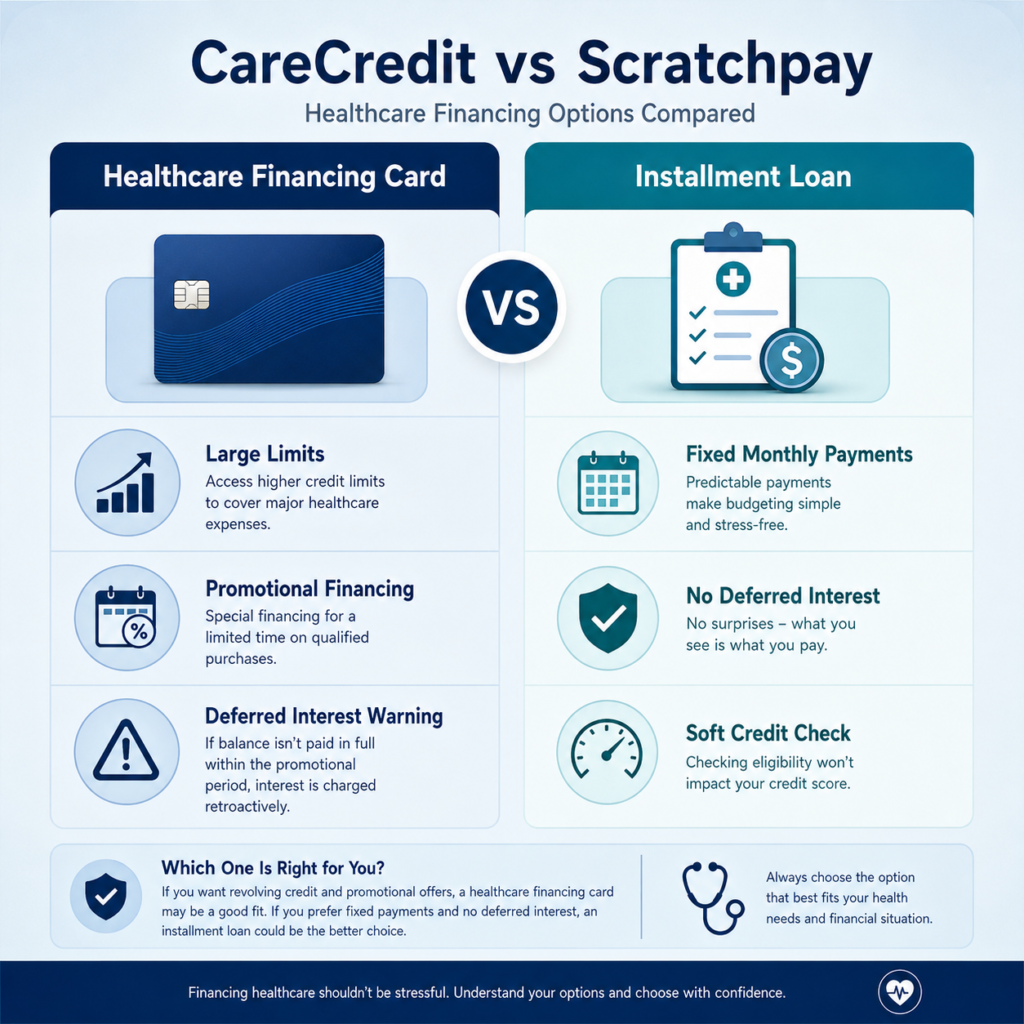
Scratchpay is a veterinary-specific financing company — not a credit card — that offers fixed installment loans for vet bills. Its key advantage over CareCredit is structural: there is no deferred interest.
Scratchpay is not a credit card. It’s a single-purpose installment loan tied to one specific vet bill. You apply, get approved for that amount, make fixed monthly payments, and the loan closes when it’s paid off. Scratchpay offers 12–24 month plans for amounts between $200–$10,000, with no hidden fees.
How it works:
- Apply at scratchpay.com or through the clinic
- Soft credit check that doesn’t affect your score during initial review
- Fixed monthly payments from day one — no surprise charges if you miss the payoff
- Approved amount goes directly to the clinic
- Loan closes when paid off
Cost comparison — Scratchpay vs. CareCredit for a $2,500 bill:
| Scenario | CareCredit (paid on time) | CareCredit (missed deadline) | Scratchpay |
|---|---|---|---|
| Promotional period | 18 months, 0% | 18 months | N/A |
| Monthly payment | ~$139 | ~$139 | ~$125 (24 months) |
| Total paid if on time | $2,500 | $2,500 + ~$675 interest | ~$3,000 total |
| Risk | Deferred interest if late | High | None |
Scratchpay may be more appropriate when you want fixed predictable monthly payments with a clear end date, want to avoid the risk of deferred interest charges, or your credit profile makes traditional credit card approval uncertain.
Where accepted: Scratchpay covers roughly 17,000 locations — significantly smaller than CareCredit’s network. Check the Scratchpay website before your appointment to confirm the clinic is enrolled.
No-Credit-Check Options: VetBilling, Varidi, and Sunbit
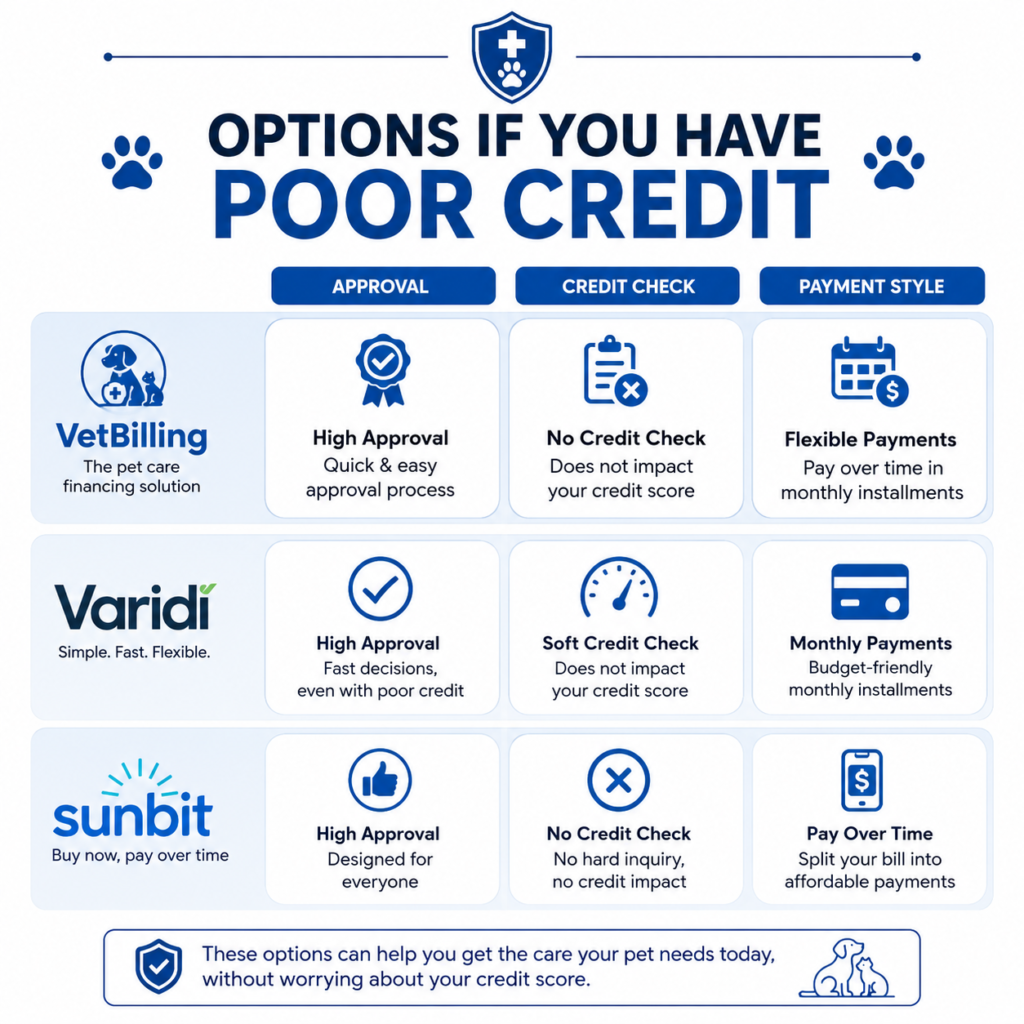
This is the section most vet financing articles leave out entirely — and it’s the one that matters most for owners with poor credit, limited credit history, or no credit at all.
A 2025 peer-reviewed study found that 35.8% of pet families said they would have been very likely to lose their pet without the no-credit-check payment option offered at the clinic. That is more than one in three families.
VetBilling: VetBilling offers clinic-managed installment plans without conventional financing. Unlike conventional financing with limited approvals, VetBilling payment plans give more pet owners an affordable and stress-free way to finance needed veterinary care without delay.
VetBilling is a payment management service that clinics enroll in. The clinic still extends the credit — but VetBilling manages all the billing, reminders, and collections. No credit check required. The clinic decides the terms and approval.
VetBilling also offers a “pay ahead” option: clients can make installment payments in advance for planned non-emergency procedures (dental cleanings, spay/neuter, mass removal) — essentially a layaway system for upcoming vet care.
Varidi: Varidi offers no-credit-check payment plans for veterinary care. Like VetBilling, it works as a managed installment system between the clinic and the client, without requiring the client to qualify through a third-party lender. Available at enrolled clinics only — check the Varidi website to find participating locations.
Sunbit: Sunbit offers payment plans with only a soft credit check. Sunbit uses alternative data (employment, income indicators) in addition to credit history, resulting in higher approval rates than traditional credit cards. Available at select veterinary practices.
Cherr: Cherr offers soft-credit-check installment plans with veterinary-specific terms. Similar to Sunbit in approach — higher approval rates than hard-pull financing, with fixed payments and no deferred interest.
How to find out if these are available: Start by asking your veterinarian if they offer expanded payment plans, such as ones without a credit check at all (such as Varidi or VetBilling) or with only a soft credit check (such as Scratchpay, Cherr, or Sunbit). Call ahead to confirm what is available.
Buy Now Pay Later at the Vet: Afterpay and Others
Buy Now Pay Later (BNPL) services — which split purchases into 4 equal installments paid every two weeks — are beginning to appear at some veterinary clinics.
Some clinics may accept Afterpay, which allows you to pay your bill in installments. However, this option is not universally available. Check with your vet to see if they partner with any Buy Now, Pay Later services.
How Afterpay works for vet bills:
- Bill is split into 4 equal payments
- First payment due at checkout
- Remaining 3 payments automatically charged every 2 weeks
- 0% interest if all payments made on time
- Late fee applies for missed payments
Limitations: Afterpay typically has a maximum purchase limit of $1,000–$2,000. For larger emergency vet bills, this ceiling makes it inadequate as a standalone solution but useful for moderate bills or as a supplement to partial payment.
Kasheesh — splitting a vet bill across multiple cards: Consider a service like Kasheesh to split the vet bill payment across multiple credit cards and debit cards. If you have multiple cards with small available balances, Kasheesh allows you to split one transaction across several payment methods — effectively using all available credit across multiple cards for a single large bill.
Personal Loans for Vet Bills
A personal loan is a lump sum borrowed from a bank, credit union, or online lender and repaid in fixed monthly installments over 12–60 months. For large vet bills that exceed what CareCredit or Scratchpay cover, personal loans are a legitimate option.
Whether your pet needs an expensive emergency treatment or you want to consolidate several vet bills into one manageable monthly payment, a personal loan can help handle expenses.
How it works:
- Apply at your bank, credit union, or through online lenders (LightStream, SoFi, Discover)
- Hard credit check required — affects credit score
- Funds deposited to your bank account, typically within 1–3 business days
- You pay the vet directly; repay the lender in fixed monthly payments
Best personal loan rates for vet bills:
- LightStream: 7.99–25.99% APR, $5,000–$100,000, no fees
- SoFi: 8.99–29.99% APR, $5,000–$100,000
- Discover: 7.99–24.99% APR, $2,500–$40,000
When a personal loan makes sense:
- Bill exceeds CareCredit’s or Scratchpay’s maximum limits
- You want one fixed payment instead of managing multiple accounts
- Your credit score qualifies for a competitive interest rate (680+)
- The emergency happened before financing was in place and you need to consolidate multiple clinic invoices
When it doesn’t:
- Your credit score is too low to qualify for a reasonable rate
- You need funds today — loan funding takes 1–3 days, meaning it doesn’t help for same-day emergencies
- The bill is under $2,000 — CareCredit or Scratchpay are faster and sometimes cheaper
Corporate Chain Clinics vs. Independent Practices — Which Offer Plans
Where you’re getting care directly affects which payment options are available.
Corporate-owned chains (Banfield, BluePearl, VCA, Thrive, National Veterinary Associates): These clinics operate under standardized billing systems. Individual staff cannot offer in-house payment plans — all decisions are made at the corporate level. Your payment options at corporate chains are almost exclusively third-party financing: CareCredit, Scratchpay, or whatever specific lenders that chain has partnered with.
However, Banfield specifically offers the Optimum Wellness Plan — a monthly wellness plan that bundles routine care at a predictable cost. It’s not a payment plan for emergency bills, but it does reduce ongoing routine care costs significantly.
Independent private practices: In-house clinic plans are most available at independent private practices for established clients. Independent owners set their own policies. Many have genuine discretion to offer payment arrangements, defer charges, or work with clients in hardship situations.
How to tell which you’re at: Ask directly: “Is this clinic independently owned, or part of a larger group?” Alternatively, search the clinic name alongside Banfield, VCA, BluePearl, NVA, or Thrive. If it’s independent, you have more options for direct negotiation.
| Clinic Type | In-House Plan Available? | Best Alternative |
|---|---|---|
| Banfield | ❌ No direct plans | Wellness Plan for routine; CareCredit for emergencies |
| BluePearl / VCA | ❌ No direct plans | CareCredit, Scratchpay |
| Independent practice | ✅ Possible | Ask directly + bring deposit |
| University teaching hospital | ⚠️ Sometimes | CareCredit accepted; financial hardship options exist |
| 24-hour emergency chain | ❌ No direct plans | CareCredit, Scratchpay, deposit + balance |
Emergency Vet Payment Plans: How the Deposit System Actually Works
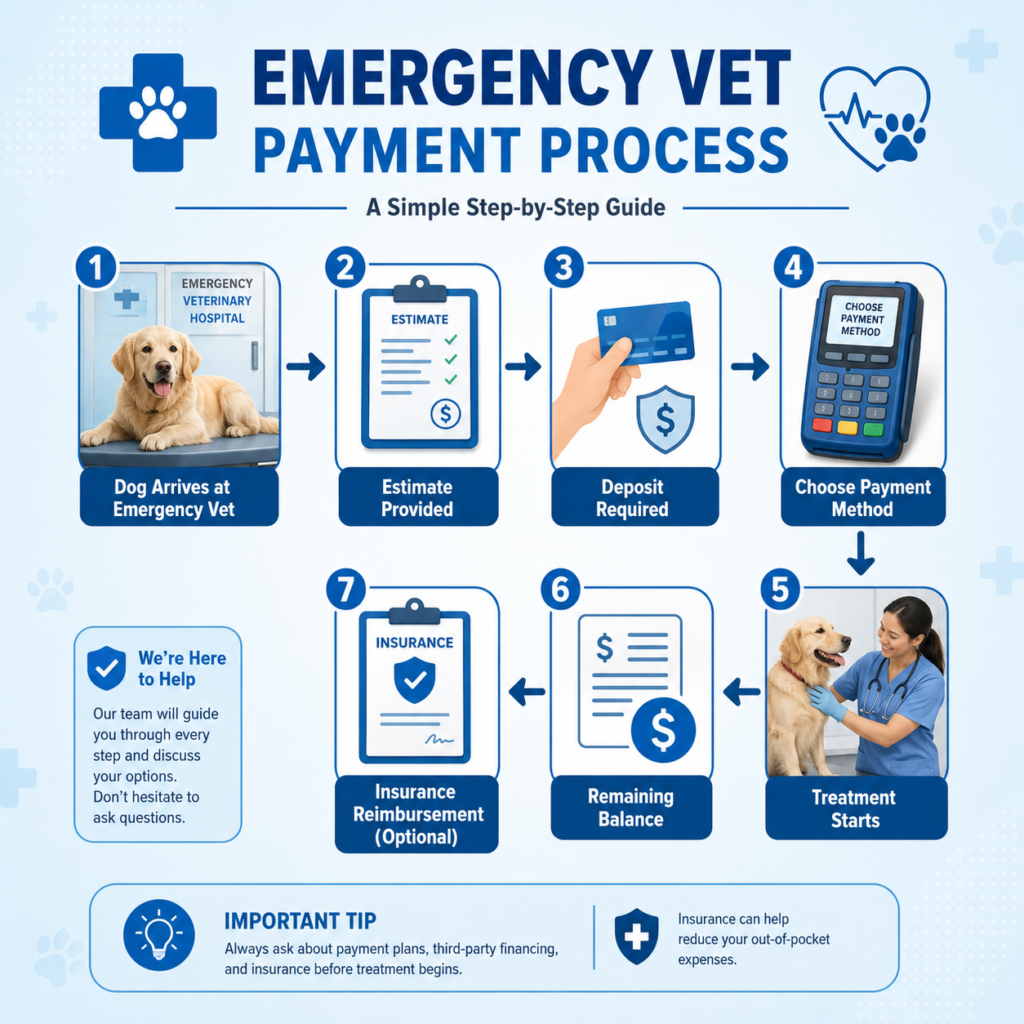
Emergency vets handle the payment conversation differently from regular clinics — and understanding the system before you arrive eliminates the shock.
Most 24-hour emergency hospitals operate on a deposit + discharge balance model:
Read Related Article… Emergency Vet Costs in the USA (2026): What You’ll Really Pay by State
Step 1 — Estimate at intake: Before treatment begins on anything beyond basic triage, the clinic presents you with an estimate. This is a range — for example, $1,800–$3,200 — representing the projected cost of the care being recommended.
Step 2 — Deposit required: Many vets will take a deposit with the expectation that you’ll pay the bill when your pet is discharged. This can help provide you with the time you need to gather the necessary funds. Most emergency hospitals require 50–100% of the low estimate before treatment begins on expensive cases.
Step 3 — Balance at discharge: When your dog is discharged, the final invoice is calculated. You pay the remaining balance — or the full balance if no deposit was taken. CareCredit and Scratchpay applications happen at this point if they weren’t done at intake.
What to say at intake if the deposit is more than you have:
“I want to proceed with care. I can put $[X] down right now. Can I apply for CareCredit for the remaining deposit while we talk through the estimate?”
Most emergency hospitals have a tablet or kiosk at the front desk for CareCredit applications. Having this conversation before saying you can’t proceed gives the clinic an opportunity to find a solution — rather than creating an impasse.
What emergency clinics typically cannot do:
- Start treatment on expensive cases without any payment
- Offer in-house payment plans for new clients
- Defer charges entirely until a later date
What they can sometimes do:
- Accept CareCredit or Scratchpay as the full deposit
- Split the deposit between a credit card and financing
- Reduce the scope of initial treatment to a lower-cost stabilization plan if the full estimate isn’t manageable
What To Say Word-for-Word When Asking for Installments
The framing of this conversation matters as much as what you’re asking for. These phrases work because they signal intention to pay — not intention to avoid paying.
At intake (before treatment): “I want to make sure my dog gets the care she needs. I can put $[X] down today — can we discuss payment options for the remaining balance? Do you work with CareCredit or Scratchpay?”
When asking a regular vet for an in-house plan: “I want to pay this — I just can’t do the full amount today. I’ve been a client here for [X years]. Would it be possible to put $[X] down now and pay the rest over [2–3 months]? I’m happy to sign whatever agreement you need.”
When asking about no-credit-check options: “I’ve had credit challenges in the past. Do you work with any payment plans that don’t require a credit check — like VetBilling or Varidi?”
When CareCredit is denied at the desk: “CareCredit didn’t approve me. Do you have any other financing options — Scratchpay, Sunbit, or a payment plan through the clinic itself?”
When the bill is already finalized and you can’t pay it: “I understand I owe this full amount and I intend to pay it. I genuinely can’t pay it all today. Would it be possible to make a payment of $[X] now and set up a plan for the balance? I’d like to avoid this going to collections for both our sakes.”
What not to say:
- “I don’t have any money” — sounds like avoidance, not a plan
- “This is too expensive” — without a counter-proposal, this goes nowhere
- “I’ll pay you when I can” — too vague to be taken seriously
If You Can’t Pay at All: Nonprofit Financial Assistance
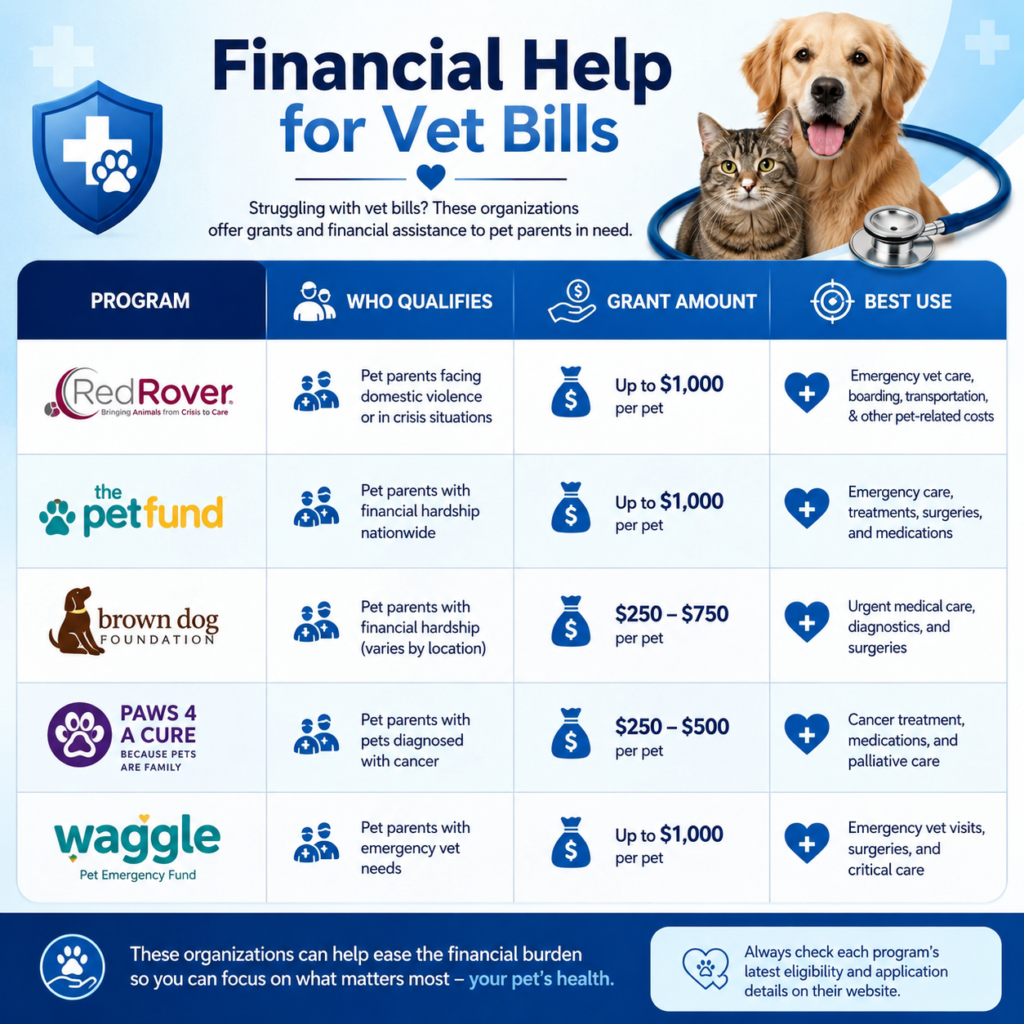
When financing isn’t an option and the in-house plan conversation has been exhausted, these programs exist specifically for this situation.
RedRover Relief (redrover.org) As of early 2026, PetHelpFinder lists more than 7,000 resources for pet financial assistance across the USA. RedRover Relief is among the most accessible — providing urgent care grants for life-threatening situations. Income threshold: under $60,000 household income. Average grant: ~$250. Apply at redrover.org.
Read Related Article… 15 Organizations That Help Pay Vet Bills When You Can’t Afford Care (2026)
The Pet Fund (thepetfund.com) Up to $500 for non-emergency specialist care. Waitlist exists — apply early. Best for planned procedures rather than same-day emergencies.
Brown Dog Foundation (browndogfoundation.org) Specifically for pets with treatable conditions where the owner’s financial situation is the barrier to care. Works directly with veterinarians. Application online at browndogfoundation.org.
Paws 4 A Cure (paws4acure.org) Maximum one-time grant of $500. All illnesses and injuries, all breeds. Funding limited — apply as early as possible.
Live Like Roo (wearethecure.org) Grants of $500–$1,500 specifically for dogs with confirmed cancer diagnoses. Requires medical records.
Waggle (waggle.org) A pet-specific crowdfunding platform. Create a campaign, share on social media. Works well for owners with active networks or compelling stories. No application gatekeeping — the community decides what to fund.
Local humane societies: Call your nearest humane society and ask: “Do you know of any local funds that help with vet bills for owned pets?” Many maintain small emergency funds or can refer you to local organizations that do.
Breed-specific rescues: Many breed clubs — particularly for Golden Retrievers, Bulldogs, Boxers, and other breeds with organized communities — maintain emergency medical funds for breed members. Search “[breed name] rescue health fund” to find breed-specific resources.
| Program | Max Grant | Who Qualifies | Response Time |
|---|---|---|---|
| RedRover Relief | ~$250 | Income under $60K, life-threatening | Days |
| The Pet Fund | $500 | All pets, non-emergency specialist care | Weeks (waitlist) |
| Brown Dog Foundation | Varies | Treatable condition, financial barrier | Days to weeks |
| Paws 4 A Cure | $500 | All illnesses, all breeds | Days to weeks |
| Live Like Roo | $500 – $1,500 | Cancer-diagnosed dogs | Days to weeks |
| Waggle | Crowdfunded | Any pet owner | Hours to days |
What Happens If You Miss Payments or Don’t Pay
If you’ve established a good relationship with your vet and are in good financial standing with them, ask about setting up a payment plan that allows you to pay your bill in monthly installments.
But what happens when payments can’t be made — whether on a clinic plan, CareCredit, or Scratchpay?
Missing CareCredit payments: Missed payments trigger a late fee ($40 typically) and may void the promotional interest rate — activating deferred interest retroactively. Continued non-payment results in the account being treated as a standard credit card default: credit score damage, collection activity, and eventual charge-off.
Missing Scratchpay payments: Late fees apply. Unlike CareCredit, there’s no deferred interest trap — but continued non-payment results in the loan being referred to collections, with standard credit score impact.
Not paying the clinic directly: The clinic can refer the balance to a collections agency, which damages your credit. They may deny future services until the balance is resolved. They may withhold your dog’s medical records. They can pursue the balance in small claims court for amounts under your state’s limit. They cannot, under any circumstances, take your dog or have them euthanized as repayment.
The most important thing to do if you’re struggling: Call before you miss. A clinic that hears from you — “I’m having trouble making the payment this month, can we adjust the schedule?” — responds very differently than one that receives silence. Most independent practices would rather work out a modified arrangement than send a bill to collections and lose both the money and the relationship.
How Pet Insurance Fits Into the Installment Picture
Pet insurance doesn’t replace the need for upfront payment — but it changes the installment math significantly.
If you’ve invested in a good pet insurance plan, you may be surprised by what it covers. The critical reality: you still pay the vet upfront. Insurance reimburses you after. This means you need financing to bridge the gap between checkout tonight and the reimbursement check arriving in 5–15 business days.
Read Related Article… Pet Insurance for Dogs in the USA: How It Works (2026)
How insurance and installments work together:
Best-case scenario for a $4,000 emergency surgery:
- Pay $4,000 at checkout using CareCredit (18-month promotional period)
- Submit insurance claim next morning with complete documentation
- Receive $3,200 reimbursement (80% after $250 deductible already met) within 10 days
- Pay $3,200 off CareCredit immediately
- Remaining CareCredit balance: $800 — manageable over several months
Read Related Article… Does Pet Insurance Cover Pre-Existing Conditions? The Truth Most Pet Owners Learn Too Late (2026)
Without insurance, that $4,000 CareCredit balance sits for the full promotional period — requiring $222/month to pay off in 18 months.
Read Related Article… Pet Insurance Waiting Period: How Long Before Coverage Starts? (2026 Guide)
The exception — Trupanion direct pay: Trupanion’s direct payment program at enrolled clinics pays the vet directly at checkout. You pay only your per-condition deductible. This is the only pet insurance model where you don’t need financing to bridge the reimbursement gap.
Read Related Article… Does Pet Insurance Cover Surgery? What Dog Owners Need to Know
The forward-looking decision: If you don’t have insurance yet, consider looking into policies to prevent financial strain for future vet emergencies. Pet insurance for a healthy young dog runs $40–$70/month — roughly the cost of a CareCredit payment on a moderate emergency bill. One emergency that insurance covers typically pays for several years of premiums.
Read Related Article… Does Pet Insurance Cover Emergency Vet Visits? What Most Dog Owners Don’t Know (2026)
Action Checklist
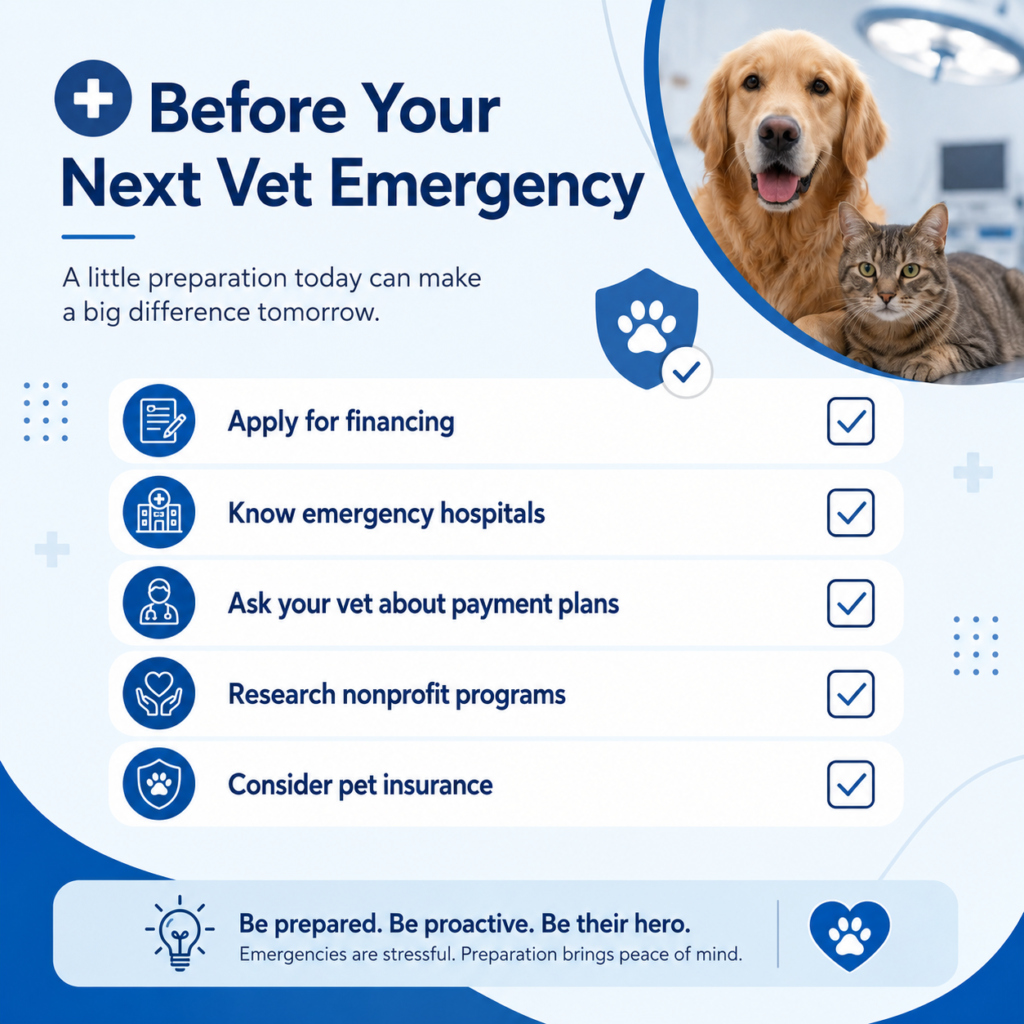
Do this now, before any emergency:
- [ ] Apply for a CareCredit account online — apply before you need it, not at the desk under pressure
- [ ] Download the Scratchpay app and create an account — check if your regular vet is enrolled
- [ ] Call your regular vet and ask: “If I ever had a large bill I couldn’t pay all at once, do you offer any payment plans?”
- [ ] Check whether your vet works with VetBilling or Varidi by calling their front desk
- [ ] Research the nearest 24-hour emergency hospital and confirm which financing options they accept
- [ ] Enroll in pet insurance while your dog is healthy — the installment math changes dramatically with reimbursement
If you’re facing a bill right now:
- [ ] Ask the clinic specifically: CareCredit, Scratchpay, VetBilling, Varidi — which do they accept?
- [ ] Apply for CareCredit at the desk if not already approved
- [ ] Offer a specific deposit amount and a specific repayment proposal for any in-house plan conversation
- [ ] Apply to RedRover Relief, Paws 4 A Cure, and The Pet Fund simultaneously — don’t wait for one to respond before applying to another
- [ ] If the bill is already past due, call the clinic before missing a payment — not after
FAQ
Can you pay vet bills in installments? Yes — through multiple pathways. <cite index=”18-1″>Some hospitals allow a billing and statement system that you pay in monthly installments.</cite> Third-party options include CareCredit (most widely accepted), Scratchpay (no deferred interest), VetBilling and Varidi (no credit check), Sunbit and Cherr (soft credit check). In-house clinic plans are available at independent practices for established clients.
What do you do if you can’t afford a vet bill? <cite index=”24-1″>It doesn’t hurt to ask the vet if it’s possible to set up a payment plan where you pay your bill in separate installments over time. Some emergency vets may take payment plans, but it depends on each practice.</cite> Beyond that: apply for CareCredit or Scratchpay, ask about VetBilling or Varidi, apply to nonprofit programs (RedRover Relief, The Pet Fund), and create a Waggle crowdfunding campaign.
Does CareCredit work for vet bills? Yes. <cite index=”23-1″>CareCredit is a healthcare financing credit card designed to cover veterinary expenses, allowing you to break payments into manageable monthly installments. You can check your eligibility online without affecting your credit score, and approval decisions are typically fast.</cite> The critical detail: deferred interest applies if you don’t pay the full balance before the promotional period ends.
Can you get a vet payment plan with no credit check? Yes. <cite index=”19-1″>Payment plans without a credit check at all include Varidi and VetBilling. Plans with only a soft credit check include Scratchpay, Cherr, and Sunbit.</cite> These are available at enrolled clinics — call ahead to confirm availability.
Do emergency vets offer payment plans? Emergency vets typically don’t offer in-house payment plans for new clients, but most accept CareCredit and Scratchpay. The standard model: a deposit of 50–100% of the low estimate is required before treatment. CareCredit or Scratchpay can be used for the deposit at most 24-hour emergency hospitals.
What if CareCredit is denied? Ask the clinic about Scratchpay, Sunbit, Cherr, VetBilling, or Varidi. Also ask directly whether the clinic offers any in-house payment arrangement. If all financing options fail, apply to RedRover Relief and The Pet Fund, and consider whether Waggle crowdfunding could raise funds quickly.
Is Scratchpay better than CareCredit for vet bills? <cite index=”21-1″>Scratchpay may be more appropriate when you want fixed predictable monthly payments with a clear end date, want to avoid the risk of deferred interest charges, or your credit profile makes traditional credit card approval uncertain.</cite> CareCredit is better when you’re confident you can pay the balance before the promotional period ends and need access to a larger credit limit.
Can a vet send a bill to collections? Yes — an unpaid vet bill can be referred to a collections agency, which damages credit and results in calls and letters. A vet cannot take your pet or deny emergency care, but they can withhold medical records and deny future non-emergency services until the balance is resolved.
What You Should Do Next
If you’re reading this because a bill is in front of you right now — ask three questions at the desk before anything else: “Do you accept CareCredit? What about Scratchpay? Do you work with VetBilling?” Those three questions cover most of the installment landscape in 30 seconds.
If you’re reading this while your dog is healthy — apply for a CareCredit card today. It takes five minutes online, doesn’t affect your credit score during pre-qualification, and means the next time you’re standing at an emergency vet desk at midnight, you already have a card in your wallet that can cover whatever the deposit requires.
The financial stress of a vet emergency is real. But it’s mostly solvable — especially when you know what to ask for before you need it.
External Authority Sources
- CareCredit — How to Pay a Vet Bill
- Scratchpay
- VetBilling
- Humane World — Vet Payment Options
- RedRover Relief
- PetHelpFinder
- AVMA — Financial Assistance for Veterinary Care
Disclaimer: This article is for informational and educational purposes only. Cost data reflects 2026 national averages from NAPHIA, Insurify, and MetLife Pet Insurance and will vary based on your dog’s age, breed, location, and the specific plan you choose. PetInsurePrime does not sell pet insurance and receives no compensation from any insurance provider. Always compare multiple quotes and read your policy documents carefully before enrolling.
PetInsurePrime | Independent • Research-Based | Helping US dog owners understand real vet costs and coverage options — without the sales pressure.