
Updated: August 2026| Reading Time: 14minutes
Your Dog Just Had a Seizure. Here’s What It’s Actually Going to Cost.
Watching your dog seize is one of the more frightening things a pet owner can go through. Your mind jumps to two questions almost at once: is my dog going to be okay, and what is this about to cost me.
Both are fair. Both deserve real numbers, not vague reassurance.
Quick Answer: Dog Seizure Treatment Cost in the USA
Dog seizure treatment cost in the US typically runs $150 to $1,500 for a single emergency vet visit with basic bloodwork, and $2,000 to $5,000+ if your vet refers you to a neurologist for an MRI to find the cause. Long-term epilepsy management with daily anti-seizure medication usually runs $15 to $300+ per month, plus periodic bloodwork to monitor liver function. Some dogs with epilepsy need long-term or lifelong anti-seizure medication, while others may not need medication immediately. Your veterinarian will base the decision on your dog’s seizure pattern, risk factors, and underlying cause.
Quick Cost Summary
| Service | Typical US Cost Range |
|---|---|
| Emergency vet visit (single seizure, stable dog) | $150 – $800 |
| Emergency visit with cluster seizures or hospitalization | $1,000 – $3,000+ |
| Veterinary neurologist consult | $150 – $250 |
| MRI (to rule out tumor or structural cause) | $1,800 – $5,000+ |
| CT scan | $1,500 – $3,500 |
| Cerebrospinal fluid (CSF) analysis | $200 – $600 |
| Basic bloodwork / liver panel | $80 – $200 |
| Phenobarbital (monthly) | $30 – $150 |
| Potassium bromide (monthly) | $15 – $150 |
| Levetiracetam / Keppra (monthly) | $100 – $200+ |
| Zonisamide (monthly) | $100 – $250+ |
Cost estimates as of 2026. Actual pricing varies by region, clinic, and your dog’s size.
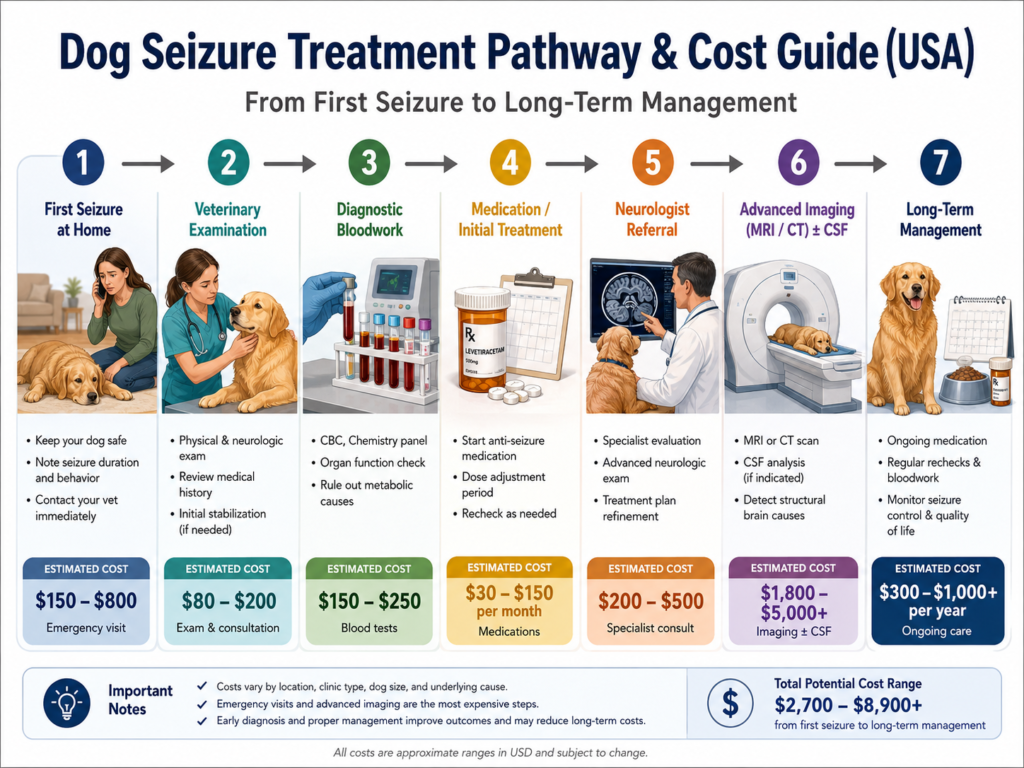
Table of Contents
- What Determines Dog Seizure Treatment Cost
- Emergency Vet Visit Cost for a First Seizure
- Diagnostic Costs: MRI, CT, and Bloodwork
- Long-Term Epilepsy Management Costs
- Does Pet Insurance Cover Dog Seizures?
- Should You Get an MRI or Start With Medication First?
- Common Mistakes That Drive Up the Bill
- What To Do If You Can’t Afford the Vet Bill Right Now
- Action Checklist
- FAQ
What Determines Dog Seizure Treatment Cost
Direct Answer: The total cost depends mainly on your dog’s age and seizure pattern, since that’s what tells your vet whether this looks like idiopathic epilepsy or something that needs a full neurological workup.
Idiopathic epilepsy is more likely when seizure onset occurs between about 6 months and 6 years of age, the neurological examination is normal between seizures, and metabolic causes have been excluded. Seizures beginning outside that range may prompt a more extensive search for an underlying cause.
A first seizure after age 5, or one under age 1, gets treated more cautiously, since the range of possible causes widens to include brain tumors, liver shunts, infection, or organ disease. That caution means more diagnostics, and more diagnostics means a higher bill.
Real-world example: A 2-year-old Labrador has one 30-second seizure, recovers immediately, and acts normal within the hour. The vet runs bloodwork, finds nothing abnormal, and sends the dog home to monitor. Total cost: roughly $200–$350.
A 9-year-old Beagle has a seizure, seems disoriented for hours afterward, and has a second seizure two days later. The vet refers to a neurologist for an MRI to check for a brain mass. Total cost before any treatment even starts: $2,000–$4,500.
Emergency Vet Visit Cost for a First Seizure
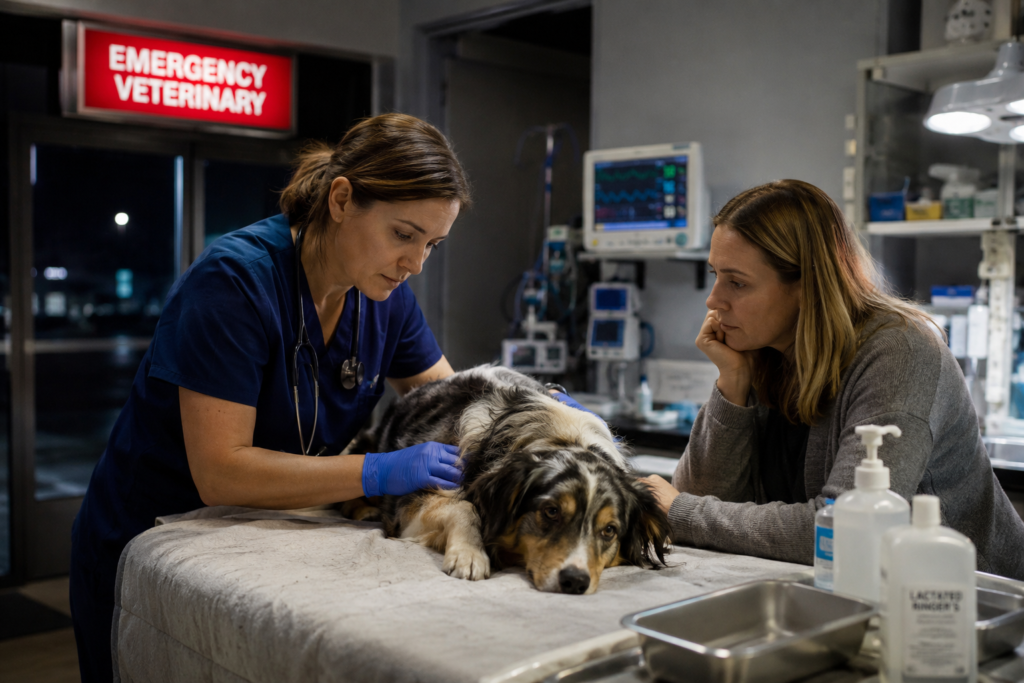
Direct Answer: A standard emergency visit for a dog seizure runs $150 to $800 for the exam, monitoring, and basic labs, but climbs past $1,000 if your dog needs hospitalization or IV medication to stop ongoing seizures.
Most of that first bill is the exam fee, a neurological check, and bloodwork to look for causes like hypoglycemia, kidney or liver failure, or toxin exposure. If your dog is still seizing on arrival, or has back-to-back cluster seizures, the vet will likely give IV anti-seizure medication and keep your dog for observation, which is where costs move into the $1,000–$3,000+ range.
Real-world example: A 2-year-old dog with one brief seizure and a normal examination may initially need an examination and basic diagnostic testing, while an older dog with recurrent seizures may need referral and advanced imaging.
When it’s genuinely an emergency versus when it can wait:A seizure lasting more than five minutes, repeated seizures without full recovery, or other signs of serious illness requires immediate veterinary attention. Even a short first seizure should be discussed with your veterinarian because the cause can range from epilepsy to metabolic disease, toxin exposure, or structural brain disease with your dog acting normal again within an hour, is often safe to evaluate the next day with your regular vet at a lower cost. A seizure lasting over 5 minutes, back-to-back seizures without full recovery, or any seizure in a dog under 6 months old is a genuine emergency that shouldn’t wait.
Diagnostic Costs: MRI, CT, and Bloodwork
Direct Answer: A neurologist consult runs $150–$250, an MRI runs $1,800–$5,000+, a CT scan runs $1,500–$3,500, and spinal fluid analysis runs $200–$600 — and Depending on your dog’s history and examination, a neurologist may recommend additional tests alongside advanced imaging, such as bloodwork, MRI, CT or cerebrospinal fluid analysis.
Read Related Article… Dog Blood Test Cost in the USA (2026): Real Prices, What Each Panel Tests, and How to Pay Less
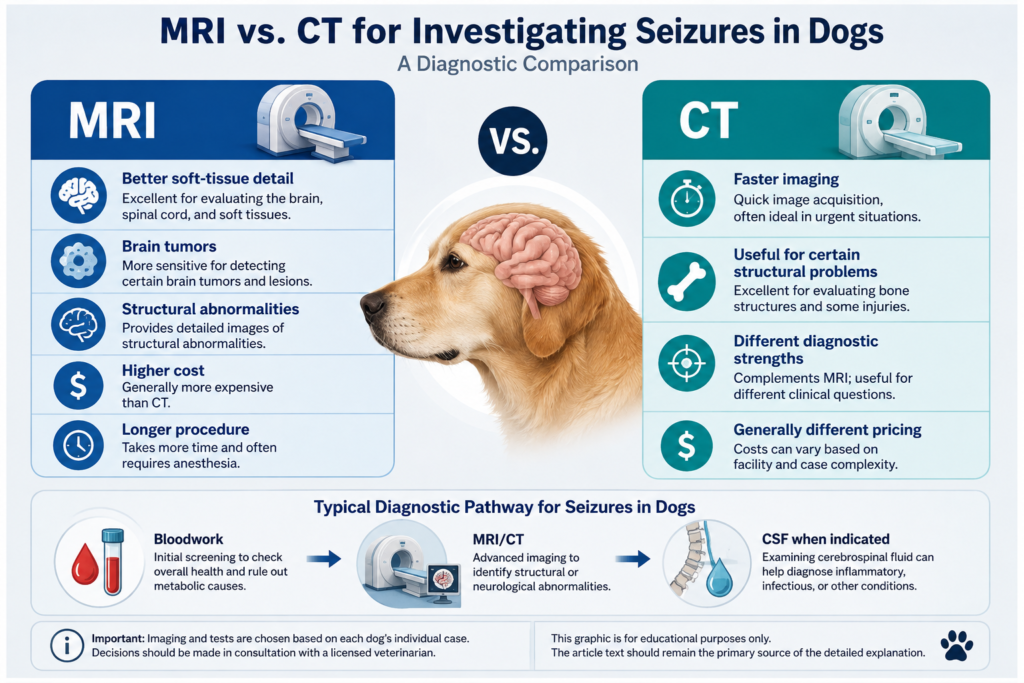
Not every dog with seizures needs an MRI. Vets typically diagnose idiopathic epilepsy in dogs 1–5 years old based on history and normal bloodwork, and start medication without imaging. MRI is preferred over CT for brain imaging because it shows soft tissue detail that CT can miss, but it requires specialized equipment usually only found at referral hospitals or university veterinary centers.
Read Related Article… Dog CT Scan Cost in the USA (2026): Real Numbers, Hidden Charges, and How to Lower the Bill
| Diagnostic | What It Checks | Typical Cost |
|---|---|---|
| Bloodwork / liver panel | Metabolic causes, medication safety baseline | $80 – $200 |
| Neurologist consult | Clinical exam and pattern assessment | $150 – $250 |
| CT scan | Structural brain changes (faster, less detailed than MRI) | $1,500 – $3,500 |
| MRI | Brain tumors, structural abnormalities | $1,800 – $5,000+ |
| CSF (spinal tap) analysis | Infection or inflammatory disease | $200 – $600 |
Neurology cases rarely stop at one test. A typical workup that starts with a consult often expands to bloodwork, a pre-anesthetic chest X-ray, the MRI itself, and sometimes CSF analysis if the scan doesn’t explain the seizures. Ask for a written estimate covering the full likely workup, not just the consult, so you’re not surprised by add-on costs mid-visit.
Read Related Article… Dog MRI Cost in the USA (2026): Average Cost, Insurance Coverage & Financing
Read Related Article … Dog Cancer Treatment Cost in the USA (2026): Surgery, Chemo & Total Costs
Long-Term Epilepsy Management Costs

Direct Answer: Once a dog is diagnosed with epilepsy, daily medication typically costs $15 to $300+ per month depending on the drug, plus periodic bloodwork every 6–12 months to check liver function, bringing the realistic annual cost to roughly $400–$3,000.
Phenobarbital and potassium bromide are the most commonly prescribed long-term options and tend to be the most affordable, especially as generics. Levetiracetam (Keppra) and zonisamide are newer alternatives, often used when phenobarbital isn’t well tolerated, and typically cost more per month. Dogs on phenobarbital also need periodic blood tests, since the drug is processed by the liver.
Real-world example: A Border Collie on phenobarbital costs its owner about $35 a month for medication plus a $90 liver panel twice a year, totaling roughly $600 annually. A German Shepherd on a combination of phenobarbital and levetiracetam for harder-to-control seizures runs closer to $250 a month, or about $3,000 a year.
Some dogs on a single anti-seizure drug still have breakthrough seizures, so vets add a second medication rather than switching entirely, which raises the monthly cost. It’s worth asking early what the plan is if the first drug doesn’t fully control seizures, and whether a lower-cost generic is appropriate before trying a pricier alternative.
Does Pet Insurance Cover Dog Seizures?
Direct Answer: Yes, most accident and illness pet insurance plans cover seizure diagnosis and epilepsy medication, but only if the seizures started after your policy’s effective date and waiting period — epilepsy diagnosed beforehand is treated as a pre-existing condition and excluded going forward.
Read Related Article… Does Pet Insurance Cover Pre-Existing Conditions? The Truth Most Pet Owners Learn Too Late (2026)
This is the part that catches owners off guard. Epilepsy is generally classified as an “incurable” pre-existing condition once a vet has documented even a single seizure. That means if your dog seizes before you enroll, or during the policy’s waiting period, seizure-related care becomes a permanent exclusion at most insurers, not a temporary one.
Read Related Article… Does Pet Insurance Cover MRI for Dogs? Coverage, Costs & What to Expect (2026)
Read Related Article… Pet Insurance Waiting Period: How Long Before Coverage Starts? (2026 Guide)
If your dog is insured before any seizure occurs, coverage is usually solid: diagnostics like MRI and bloodwork, specialist consults, and ongoing medication are typically included under illness coverage, subject to your deductible and reimbursement percentage.
| Insurance Factor | What To Expect |
|---|---|
| Monthly premium | $15 – $70 |
| Typical deductible | $0 – $1,000 |
| Reimbursement rate | 70% – 90% |
| Waiting period before coverage starts | Commonly 14–30 days |
| Coverage if diagnosed before enrollment | Usually excluded as pre-existing |
| Coverage if diagnosed after enrollment | Usually included under illness coverage |
Some insurers, like ASPCA and Fetch, cover certain pre-existing conditions again after a set symptom-free period, often 12 months. If seizures or epilepsy existed before enrollment or during the policy’s waiting period, they are generally treated as pre-existing and excluded. Some insurers have special provisions for certain pre-existing conditions, so owners should check the specific policy rather than assume every insurer uses the same rules, since it’s classified as incurable rather than curable, which makes the exclusion permanent once a vet documents that first seizure.
Should You Get an MRI or Start With Medication First?
Many owners face this exact decision after a first or second seizure.
Medication first tends to make sense when: your dog is 1–5 years old, the neuro exam is normal between seizures, and seizures follow a brief, typical pattern with full recovery.
MRI first tends to make sense when: your dog is under 1 or over 5, the neuro exam shows abnormal findings, or seizures are getting more frequent or severe.
The risk of skipping imaging: if a tumor or structural problem is the actual cause, medication alone may only mask worsening seizures temporarily, delaying a diagnosis that matters. Ask your vet directly which category they believe your dog falls into, and let that answer, not cost alone, guide the decision.
Common Mistakes That Drive Up the Bill
Waiting too long to insure a healthy dog. A single documented seizure closes the door permanently on epilepsy coverage, so if your dog is currently seizure-free, this is the cheapest moment you’ll have to protect against this cost.
Skipping recommended bloodwork. Catching a liver problem early is far cheaper than treating advanced liver disease later, both financially and for your dog’s health.
Stopping medication without vet guidance. Reducing or stopping medication to save money is a common way dogs end up back in the ER with a severe cluster seizure, which costs far more than the medication would have.
What To Do If You Can’t Afford the Vet Bill Right Now
A $1,000+ emergency bill for a first seizure is genuinely hard for a lot of households to absorb without warning. A few steps can help:
- Ask the clinic directly about an in-house payment plan before you leave
- Apply for CareCredit or Scratchpay, both widely accepted at US vet clinics
- Call local nonprofit veterinary organizations, some offer emergency financial assistance
- Request an itemized estimate before agreeing to full diagnostics, so you can choose what’s essential now versus what can wait
Read Related Article… Can’t Pay a Vet Bill in the USA? Here’s What Actually Happens (2026)
Read Related Article… Can You Pay Vet Bills in Installments? Every Option Available in the USA (2026)
Action Checklist
- Time and log every seizure (date, length, what happened before and after)
- Ask your vet whether your dog’s age and exam findings point toward imaging or medication-first
- Request a written cost estimate before agreeing to diagnostics
- Ask about generic phenobarbital or potassium bromide before pricier alternatives
- Schedule the periodic bloodwork your vet recommends once medication starts, don’t skip it
- If your dog is seizure-free and uninsured, get a policy now, before the first episode makes epilepsy a permanent exclusion
- Ask about CareCredit, Scratchpay, or in-house payment plans if the bill is a stretch
Frequently Asked Question
How much does it cost to treat a dog’s seizures overall? A single emergency visit runs $150–$800, while a full diagnostic workup with MRI can reach $2,000–$5,000. Ongoing medication typically adds $15–$300+ per month for the rest of your dog’s life.
Is it worth getting an MRI for a dog with seizures? It depends heavily on your dog’s age and exam findings. Vets often recommend imaging for dogs under 1 or over 5 years old, or when the neurological exam shows abnormalities between seizures, since these dogs have a higher chance of a structural cause like a tumor.
Does pet insurance cover epilepsy medication? Yes, if your dog was insured before the first seizure occurred and the waiting period had already passed. If epilepsy was diagnosed before enrollment, most insurers treat it as a pre-existing, permanently excluded condition.
What is the cheapest seizure medication for dogs? Phenobarbital and potassium bromide are generally the most affordable long-term options, often available as generics for $15–$150 a month, compared to $100–$250+ for newer drugs like levetiracetam or zonisamide.
Can a dog live a normal life with epilepsy? Many dogs on consistent medication live full, active lives with seizures well controlled. The main long-term commitment is daily medication and periodic bloodwork, not a shortened lifespan.
Should I insure my dog now if it hasn’t had a seizure yet? Yes, enrolling before any seizure occurs is the only way to guarantee epilepsy would be covered as an illness rather than excluded as a pre-existing condition.
What This Means For Dog Owners
A first seizure is frightening, but the cost path is more predictable than it feels in the moment. A young, healthy dog with an isolated seizure is usually a few hundred dollars to evaluate. An older dog, or one with repeat episodes, should be budgeted at several thousand for a full workup, primarily driven by whether imaging becomes necessary.
The one move that changes your financial position the most is timing: insuring your dog before any seizure happens is the difference between epilepsy being a covered illness and a permanent exclusion. If that window has already closed, focus your energy on payment plans, generic medications, and asking your vet which diagnostics are truly necessary right now versus which can wait.
External Authority Sources
- AVMA (American Veterinary Medical Association) — seizure and epilepsy management guidance
- ACVIM Small Animal Consensus Statement on Seizure Management in Dogs
- NAPHIA (North American Pet Health Insurance Association) — industry cost and coverage data
- CareCredit — veterinary financing option details
- Frontiers in Veterinary Science — retrospective US study on canine idiopathic epilepsy treatment practices (2026)
Disclaimer: This article is for informational and educational purposes only. Cost data reflects 2026. Those organizations aren’t credible sources for national veterinary medication price averages in the way this wording suggests. Pet Insurance and will vary based on your dog’s age, breed, location, and the specific plan you choose. PetInsurePrime does not sell pet insurance and receives no compensation from any insurance provider. Always compare multiple quotes and read your policy documents carefully before enrolling.
PetInsurePrime | Independent • Research-Based | Helping US dog owners understand real vet costs and coverage options — without the sales pressure.