
Updated: August 2026| Reading Time: 15minutes
Your dog hasn’t eaten in a day, keeps trying to throw up with nothing coming out, and now your vet is saying the word “surgery” over the phone. You haven’t even seen a number yet, and you’re already doing the mental math on your savings account, your credit card limit, and how fast you can get there. A gastrointestinal blockage is a potentially life-threatening veterinary emergency, and the cost can vary dramatically depending on where the object is, how long it has been there, and whether the intestine is damaged., and the price swings wider than almost any other surgery — which makes not knowing the range even scarier.
Your dog swallowed something they shouldn’t have, and now the vet is talking about an intestinal blockage and possible surgery. Before you approve a treatment estimate, you probably want to know one thing: how much is this going to cost?
Quick Answer : Dog Intestinal Blockage Surgery Cost
Dog intestinal blockage surgery typically costs about $2,000–$8,000 in the U.S. CareCredit’s 2026 cost data puts the national average at $4,383, with a reported range of $3,471–$7,976. Complicated cases involving damaged or perforated intestine, extended hospitalization, or severe infection can cost more. Your final bill depends on the location of the blockage, the procedure required, diagnostics, hospitalization, and your dog’s condition.
Important: The $4,383 CareCredit figure is a national average for intestinal blockage surgery, not necessarily the total amount of every emergency visit. Your final invoice may also include the emergency examination, imaging, bloodwork, anesthesia, hospitalization, medications, and follow-up care.
Quick Cost Summary
| Case Type | Typical Planning Range | Why |
|---|---|---|
| Stable suspected/partial blockage being monitored | Varies widely; often starts with diagnostic and monitoring costs | Only appropriate in selected stable cases under veterinary supervision |
| Simple foreign-body surgery | $2,000–$4,500 | Object can be removed without removing damaged intestine |
| Resection and anastomosis | $4,500–$8,500 | Damaged or nonviable intestine must be removed |
| Complicated/septic case | $6,500–$12,000+ | Perforation, peritonitis, ICU care or additional surgery can raise the bill |
| Endoscopic removal | Often less invasive than abdominal surgery; quote varies | Only appropriate when the object is reachable |
Table of Contents
- How Much Does Dog Intestinal Blockage Surgery Cost?
- What Drives the Price Up or Down?
- Enterotomy vs. Resection and Anastomosis: Cost Comparison
- Is Endoscopy a Cheaper Alternative?
- Can a Dog Intestinal Blockage Pass Without Surgery?
- What’s Actually Included in the Total Bill?
- Real-World Cost Examples
- Does Pet Insurance Cover This Surgery?
- Should You Pay Out of Pocket or Look for Financing?
- What to Do Right Now If You Can’t Afford It
- Action Checklist Before Surgery
- FAQ
How Much Does Dog Intestinal Blockage Surgery Cost?
Dog intestinal blockage surgery costs $1,600 to $10,000 or more, with the majority of straightforward cases falling in the $2,500–$6,500 range once diagnostics, surgery, and hospitalization are combined.
That’s a wider spread than almost any other common dog surgery, and severity is the main reason why. A young, otherwise healthy dog with a recently swallowed foreign object may have a simpler treatment course if the object is identified and removed before significant intestinal damage develops. A dog who’s been symptomatic for several days, whose intestine has lost blood supply or perforated, needs a longer, higher-risk procedure followed by intensive post-op monitoring — and that difference alone can add $3,000–$5,000 to the bill.
Location matters too, though less dramatically than severity. Urban 24-hour emergency and specialty hospitals typically charge more than daytime general practice clinics, partly due to overhead and partly because they’re equipped to handle the sicker, more complex cases that get referred to them.
A real-world example: an 18-month-old Labrador swallowed a toy, was brought in within 24 hours, and needed a straightforward enterotomy. Total vet cost came to roughly $4,700, according to a documented pet insurance reimbursement case. Compare that to a case involving a linear foreign body (string) left untreated for several days, where the intestine had to be resected in multiple places — those bills commonly exceed $8,000.
What Drives the Price Up or Down?
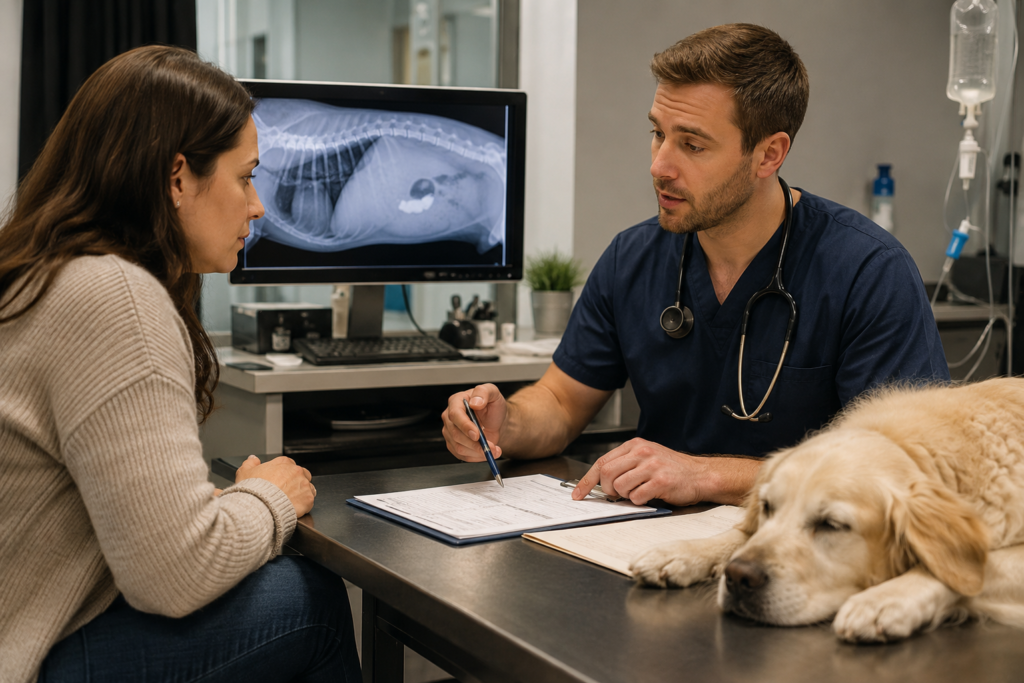
Six factors determine where your bill lands within that wide range: how long the blockage went untreated, whether the intestine is damaged, the type of object, your dog’s size, hospitalization length, and whether the case is an emergency versus scheduled surgery.
How long the obstruction has been present is one of the most important factors affecting both treatment complexity and cost. The longer a blockage sits, the more likely the intestine has lost blood supply, become necrotic, or perforated — each of which turns a simple enterotomy into a more complex, more expensive resection.
Object type changes both risk and cost. Linear foreign bodies — string, yarn, tinsel — are especially dangerous because they can saw through the intestinal wall at multiple points as the gut tries to move them along, sometimes requiring several separate incisions instead of one. Linear foreign bodies such as string, yarn, thread, or rope are particularly concerning because they can cause intestinal damage and perforation as the intestines continue moving around the fixed object.
Dog size affects anesthesia drug volume, suture material, and sometimes surgery time, with larger dogs generally costing somewhat more than small breeds for an equivalent procedure.
Hospitalization can add substantially to the final bill. A straightforward case may require a shorter inpatient stay, while complicated cases involving intestinal damage, infection, or intensive monitoring can require several days of hospitalization.
Emergency versus scheduled timing matters because true intestinal blockages are almost never scheduled — they’re emergencies by nature, and emergency/after-hours facilities carry higher exam fees and procedure surcharges than a daytime appointment would.
A practical example: two dogs both need surgery for a swallowed corn cob. For example, imagine two dogs that both swallow a corn cob…arrives dehydrated with early signs of intestinal necrosis, and needs a resection plus overnight ICU monitoring — total cost around $7,800. Same object, same breed, dramatically different bill.
Enterotomy vs. Resection and Anastomosis: Cost Comparison
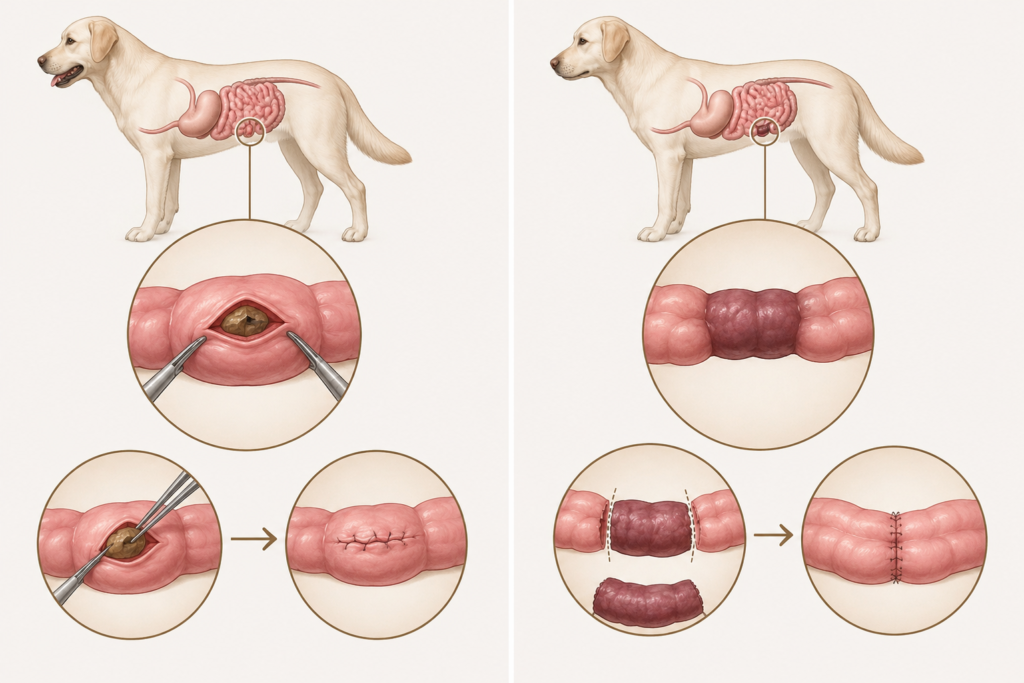
| Factor | Enterotomy | Resection & Anastomosis |
|---|---|---|
| What it involves | Opening the intestine to remove the object | Removing damaged intestine and reconnecting healthy ends |
| Typical planning cost | $2,000–$4,500* | $4,500–$8,500* |
| Hospitalization | Often shorter | Often longer |
| Complexity | Lower when tissue remains healthy | Higher when tissue is damaged or perforated |
| When used | Foreign body with viable intestinal tissue | Nonviable, perforated or severely damaged intestine |
The decision between the two isn’t made ahead of time — your surgeon determines which procedure is needed once they’re inside and can directly assess the tissue. This is one reason vets typically quote a cost range rather than a fixed price before surgery: they genuinely don’t know which category your dog falls into until the operation begins.
Is Endoscopy a Cheaper Alternative?
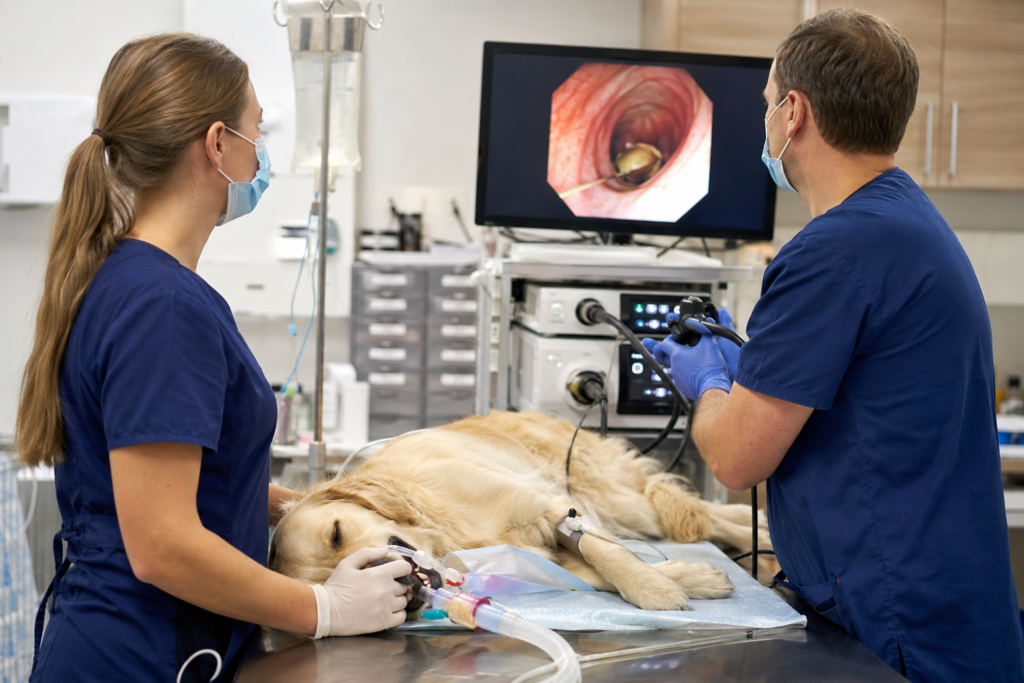
Endoscopy can sometimes remove a foreign object without abdominal surgery when the object is still in the stomach or a reachable portion of the upper gastrointestinal tract. Once an obstruction is farther into the small intestine, exploratory surgery is generally more likely to be required. The exact option depends on the object’s location, size, shape, and your veterinarian’s equipment and expertise.
This matters because once an object passes into the intestinal tract, endoscopy generally can’t reach it, and traditional surgery becomes necessary. Endoscopy typically costs less than abdominal surgery and involves a shorter recovery, but it’s only an option for a specific window of time and a specific location of the obstruction — it’s not a universal alternative to surgery. For full pricing details on this procedure specifically, see our dedicated dog endoscopy cost guide. Read Related Article… Dog Endoscopy Cost in the USA (2026): Complete Guide to Real Prices, Hidden Fees & What Comes Next
Can a Dog Intestinal Blockage Pass Without Surgery?
Sometimes, but not every suspected blockage should be watched at home.
Some small, smooth foreign objects may pass on their own in a clinically stable dog, and a veterinarian may recommend serial X-rays to confirm that the object is moving through the digestive tract. Merck Veterinary Manual notes that if an object fails to progress within roughly 36–48 hours, or the dog’s clinical signs worsen, surgical removal may become necessary.
The important distinction is that home observation is not the same as veterinary monitoring. A dog with repeated vomiting, worsening pain, weakness, dehydration, or other signs of deterioration should be reevaluated promptly. Never try to induce vomiting or pull a visible string or foreign object yourself unless a veterinarian specifically instructs you to do so.
What’s Actually Included in the Total Bill?
| Cost Component | What It May Include |
|---|---|
| Emergency exam | Physical examination and consultation |
| Diagnostic imaging | X-rays and/or ultrasound |
| Bloodwork | Pre-anesthetic and organ-function testing |
| Surgery | Foreign-body removal, enterotomy or resection |
| Anesthesia | Anesthetic drugs and monitoring |
| Hospitalization | IV fluids, pain control and nursing care |
| Medications | Antibiotics, anti-nausea and pain medications |
| Follow-up | Recheck examination and additional treatment if needed |
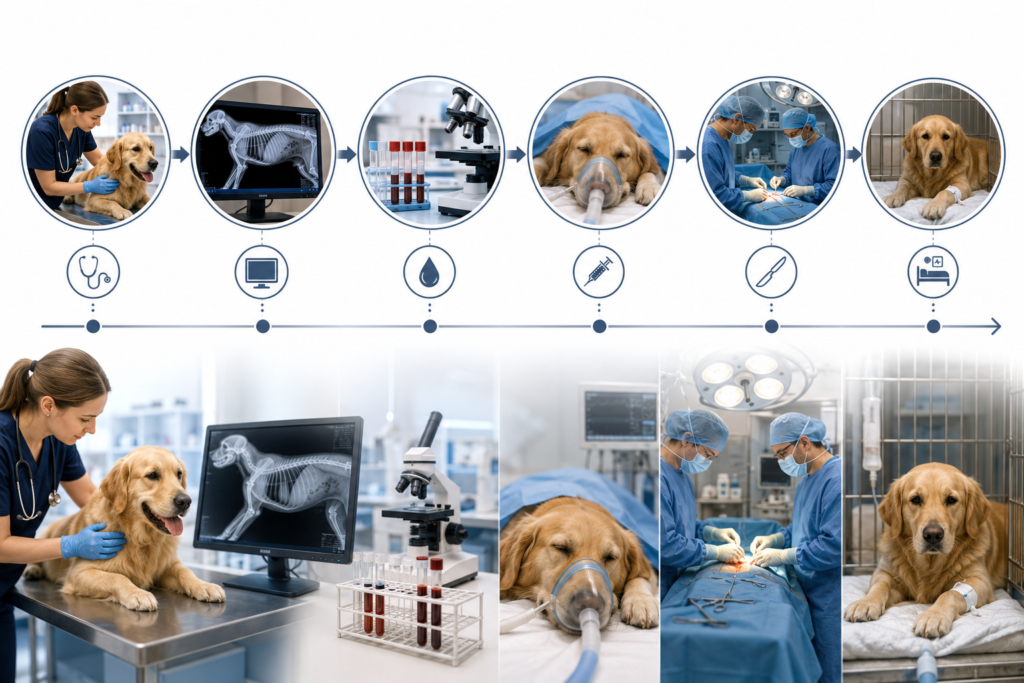
The quoted surgery price is rarely the whole bill — a full intestinal blockage case typically bundles five to six separate cost categories into one invoice.
Read Related Article… Dog X-Ray Cost in the USA (2026): Average Prices, Sedation Costs & What You’ll Actually Pay
Diagnostics come first: an emergency exam ($100–$300), X-rays or ultrasound to confirm and locate the blockage ($200–$500), and pre-surgical bloodwork to check organ function before anesthesia ($100–$250). Anesthesia and surgery form the largest single line item, scaling with how long the procedure takes and whether resection is required. Hospitalization covers IV fluids, pain management, and nursing care for however many days your dog stays inpatient. Medications — antibiotics, anti-nausea drugs, pain relievers — continue after discharge. Some cases also need post-surgical care, including bandage changes or, in rare severe cases, a temporary feeding tube.
Read Related Article… Emergency Vet Exam Cost in the USA (2026)
Real-World Cost Examples
Case 1 — Caught early, simple case: An 18-month-old Labrador swallowed a toy and was brought in within a day. Total vet cost: $4,734. Insurance reimbursed $4,201, leaving the owner with $533 out of pocket.
Case 2 — Straightforward emergency: A young dog needed diagnostic tests and surgery to remove a swallowed object. Total cost came to about $4,000, with $3,500 reimbursed through pet insurance.
Case 3 — Complicated, delayed presentation: A dog with a linear foreign body left untreated for several days required resection of a damaged intestinal segment plus multiple days of ICU monitoring. Total cost exceeded $8,000, consistent with what several major providers report as the top of the standard range.
Does Pet Insurance Cover This Surgery?
Intestinal blockage caused by swallowing a foreign object is commonly treated as an accident under pet insurance, but coverage depends on the specific policy, waiting periods, exclusions, deductible, reimbursement rate, and annual limits. If the ingestion or related clinical signs occurred before coverage began or during a relevant waiting period, the claim may be excluded.
Reimbursement in real claims has been substantial: one documented case saw a $4,734 bill reimbursed at $4,201 through Healthy Paws, leaving $533 out of pocket. A separate MetLife Pet example showed a roughly $4,000 bill reimbursed at over $3,500, based on a policy with a $500 deductible and 90% reimbursement. These aren’t guaranteed outcomes — your actual reimbursement depends entirely on your specific deductible, reimbursement percentage, and annual limit — but they illustrate that well-structured accident-and-illness plans can cover the large majority of this type of emergency bill.
Read Related Article… 15 Organizations That Help Pay Vet Bills When You Can’t Afford Care (2026)
The main exclusion to watch for: if your dog swallowed the object before your policy’s waiting period ended, or showed related symptoms during that window, the claim can be treated as pre-existing and denied.
Should You Pay Out of Pocket or Look for Financing?
Should you… pay the deposit out of pocket immediately, or explore financing first?
When paying out of pocket makes sense: you have savings or credit available and your dog is stable enough that a short delay for financing approval won’t matter clinically. Paying upfront also avoids interest if you’re using a 0% promotional period on a card you already have.
When financing makes sense: the bill exceeds what you can cover immediately, and your dog needs surgery now, not after a multi-day approval process. CareCredit and Scratchpay are two financing options commonly accepted by veterinary practices, but availability varies by hospital. Ask the clinic which payment or financing options it accepts before assuming a specific option will be available and many emergency hospitals can process an application at the front desk within minutes.
Read Related Article… Vet Payment Plans: Can You Make Monthly Payments to a Vet? (2026)
Risks to know: CareCredit’s promotional 0% periods convert to high deferred interest if not paid off in full by the deadline — read the terms before signing. Some emergency hospitals require a deposit (often 50–100% of the estimated cost) before starting surgery, which is standard industry practice, not a red flag specific to your clinic.
Alternatives: ask the hospital directly whether they offer an in-house payment plan, and ask whether a local nonprofit or breed rescue organization has an emergency fund — some do, particularly for common, fixable conditions like this one.
Next step: call your vet’s billing office before the visit ends and ask what payment options they accept on-site — this is faster than researching financing independently while your dog is still in surgery.
What to Do Right Now If You Can’t Afford It
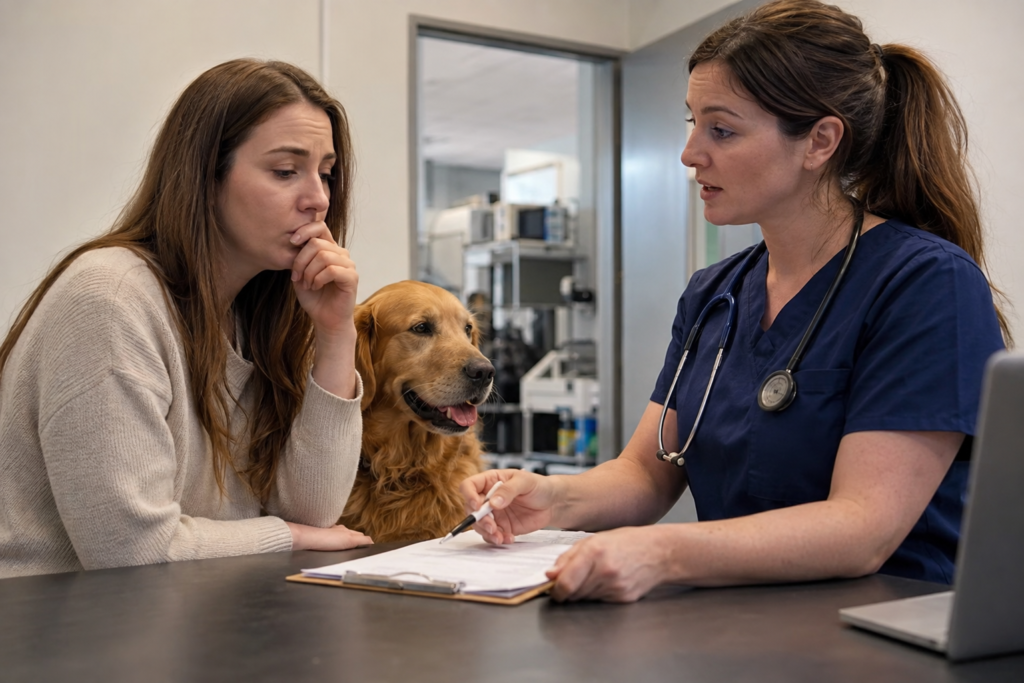
If you’re facing this bill today and don’t have the funds, tell the vet team directly and immediately — most emergency hospitals have a standard set of options they’ll walk you through, but only if you ask.
Ask your veterinarian whether non-surgical monitoring is medically appropriate for your dog’s specific case. Some stable dogs with certain small, smooth foreign objects may be monitored with repeat imaging, but this is not appropriate for every obstruction. If your veterinarian recommends surgery because the obstruction is not moving, your dog is deteriorating, or intestinal damage is suspected, don’t delay treatment solely to reduce the bill.
Read Related Article… Can You Pay Vet Bills in Installments? Every Option Available in the USA (2026)
Before committing to surgery. Apply for CareCredit or Scratchpay on the spot — Some clinics can process financing applications during the visit, but approval and terms vary, and both are accepted at most emergency and specialty hospitals nationwide. Ask whether the hospital offers an internal payment plan, particularly at nonprofit or university-affiliated veterinary hospitals. Contact breed-specific rescue organizations or local nonprofits like RedRover, which specifically fund emergency veterinary bills for qualifying cases.
Action Checklist Before Surgery
- Ask for a written estimate covering both the enterotomy-only and resection scenarios
- Confirm whether diagnostics, hospitalization, and medications are included in the quote
- Call your pet insurance provider to confirm your waiting period and estimated reimbursement
- Ask whether CareCredit, Scratchpay, or an in-house payment plan is available
- Ask directly whether endoscopy is a realistic option for your dog’s case
- Confirm expected hospitalization length so you can plan for daily cost additions
- Ask what specific signs would mean your dog needs to come back in urgently after discharge
Frequently Asked Question
How much does dog intestinal blockage surgery cost without insurance?
Dog intestinal blockage surgery commonly costs $2,000 to more than $10,000, depending on the type of surgery, severity of the blockage, tissue damage, hospitalization, and where treatment is provided. CareCredit’s 2026 data puts the national average at $4,383, with reported costs ranging from $3,471 to $7,976.
What’s the difference between an enterotomy and a resection and anastomosis?
An enterotomy opens the intestine to remove a foreign object when the surrounding tissue is still healthy. A resection and anastomosis removes a damaged section of intestine and reconnects the healthy ends. Resection is generally necessary when the intestine has become severely damaged, ischemic, or perforated and usually involves a more complicated surgery.
Can endoscopy replace surgery for a dog with a blockage?
Sometimes. Endoscopy may be used to retrieve certain foreign objects located in the stomach or upper part of the small intestine. It is not suitable for every blockage, particularly objects farther down the intestinal tract or some linear foreign bodies. If endoscopy cannot safely remove the object, surgery may be necessary.
Does pet insurance cover intestinal blockage surgery?
Many accident-and-illness pet insurance policies can cover foreign-body removal when the ingestion and resulting condition are eligible under the policy. However, coverage depends on the policy’s waiting periods, exclusions, deductible, reimbursement rate, and annual limit. If the problem or related symptoms existed before eligible coverage began, the claim may be treated differently under the policy’s pre-existing-condition rules.
How fast do I need to act if I suspect a blockage?
Don’t wait to see whether suspected intestinal blockage resolves on its own without veterinary guidance. Vomiting, loss of appetite, abdominal pain, lethargy, dehydration, or a known swallowed object can be signs of gastrointestinal obstruction. Because an untreated obstruction can cause tissue damage, perforation, infection, or shock, contact a veterinarian promptly if you suspect one.
External Authority Sources
- Merck Veterinary Manual — Gastrointestinal Obstruction in Small Animals
- AVMA (American Veterinary Medical Association)
- PetMD — Dog Intestinal Blockage Surgery
- CareCredit — financing overview
- NAPHIA
- MetLife Pet – Healthy Paws claims data
Disclaimer: This article is for informational and educational purposes only and is not veterinary or financial advice. Cost figures are U.S. planning ranges and current published benchmarks available in 2026; actual veterinary charges vary by location, hospital type, diagnostic findings, procedure complexity, hospitalization needs, and your dog’s condition. CareCredit’s current published data reports a $4,383 national average for dog intestinal blockage surgery, with a reported range of $3,471–$7,976. Pet insurance coverage, deductibles, reimbursement rates, waiting periods, exclusions, and annual limits vary by policy. PetInsurePrime does not sell pet insurance and receives no compensation from the insurance providers discussed. Always obtain a written estimate from your veterinarian and review your policy documents before making financial decisions.
PetInsurePrime | Independent • Research-Based | Helping US dog owners understand real vet costs and coverage options — without the sales pressure.