
Updated: August 2026| Reading Time: 17minutes
Your dog’s stomach is distended, they’re retching without bringing anything up, and the emergency vet just said the word “GDV” — gastric dilatation-volvulus. You’re being told this is life-threatening and surgery needs to happen now, not after you’ve had time to research pricing. This guide gives you the real numbers fast, because that’s what you actually need in this moment.
Read Related Article… Emergency Vet Costs in the USA (2026): What You’ll Really Pay by State
Quick Answer : Dog GDV Surgery Cost in the USA
Dog GDV (bloat) surgery typically costs $3,000 to $8,000 for the surgery itself, and the total bill — including diagnostics, anesthesia, and ICU hospitalization — commonly reaches $5,000 to $12,000. Straightforward cases caught early tend to land at the lower end. Cases involving stomach tissue damage, splenectomy, or shock push toward the higher end. Untreated GDV is generally fatal, which is why veterinary treatment cannot safely be delayed.
Quick Cost Summary
| Component | Typical Cost | Notes |
|---|---|---|
| Emergency exam + stabilization | $200–$500 | IV catheter, initial fluids, pain control |
| Diagnostics (X-rays, bloodwork, ECG) | $300–$800 | Confirms torsion, checks organ function and heart rhythm |
| GDV surgery + gastropexy | $3,000–$8,000 | Untwisting the stomach, assessing tissue, permanent gastropexy |
| ICU hospitalization | $500–$1,500 per day (2–3 days typical) | $1,000–$4,500 added to the bill |
| Complication add-ons (splenectomy, gastrectomy) | +$1,000–$3,000 | Only if tissue is damaged or spleen is compromised |
| Realistic total bill | $5,000–$12,000 | Most cases fall in this range once everything is combined |
| Preventive gastropexy (no emergency) | $400–$2,500 | Planned surgery for at-risk breeds, often bundled with spay/neuter |
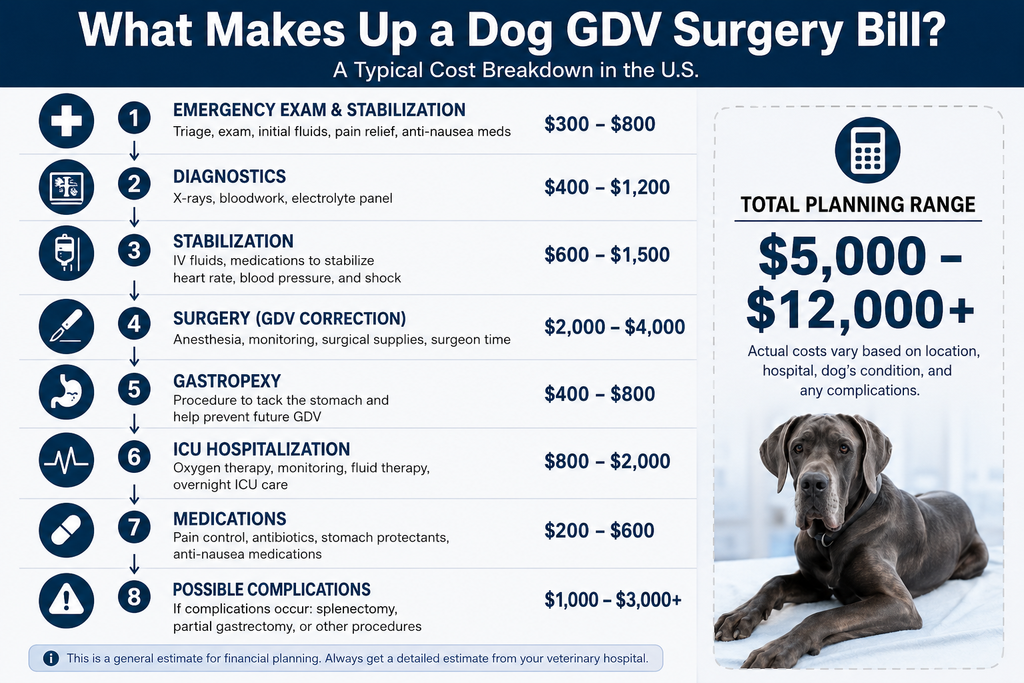
Table of Contents
- How Much Does Dog GDV Surgery Cost?
- What Does GDV Treatment Cost Before Surgery?
- What’s Actually Included in a GDV Surgery Bill?
- Emergency Vet vs. Specialty Hospital Cost
- Why Do Some GDV Bills Reach $10,000+?
- Cost by Severity: Simple Bloat vs. Full Volvulus vs. Complicated Cases
- What Should You Ask the Vet Before Approving the Estimate?
- What Drives ICU and Hospitalization Costs?
- How Long Does GDV Surgery and Recovery Take?
- Preventive Gastropexy vs. Emergency GDV Surgery: The Cost Case
- Does Pet Insurance Cover GDV Surgery?
- Is GDV Considered a Pre-Existing Condition?
- How Much Do You Have to Pay Upfront?
- What If You Can’t Afford GDV Surgery Right Now?
- Action Checklist for the Emergency Room
- FAQ
How Much Does Dog GDV Surgery Cost?
GDV surgery costs $3,000 to $8,000 for the surgical procedure alone, and the full emergency bill typically totals $5,000 to $12,000 once diagnostics, anesthesia, and post-surgical ICU care are included.
Read Related Article…. Dog Surgery Cost in the USA: Real Prices for 2026
This is one of the most expensive common emergency surgeries in dogs, and the range is wide because GDV cases vary enormously in severity by the time they reach the operating table. A dog brought in within an hour of symptoms starting, with the stomach twisted but tissue still healthy, is a very different surgical case than a dog who arrives in shock with compromised stomach or spleen tissue after several hours.
Survival rates track closely with how fast treatment happens: Survival is generally better when treatment begins quickly, while longer duration of clinical signs, shock, tissue necrosis and other complications are associated with worse outcomes. This isn’t just a medical fact — it’s also a cost fact, since the sicker a dog is at presentation, the more expensive and involved the surgery and recovery become.
What Does GDV Treatment Cost Before Surgery?
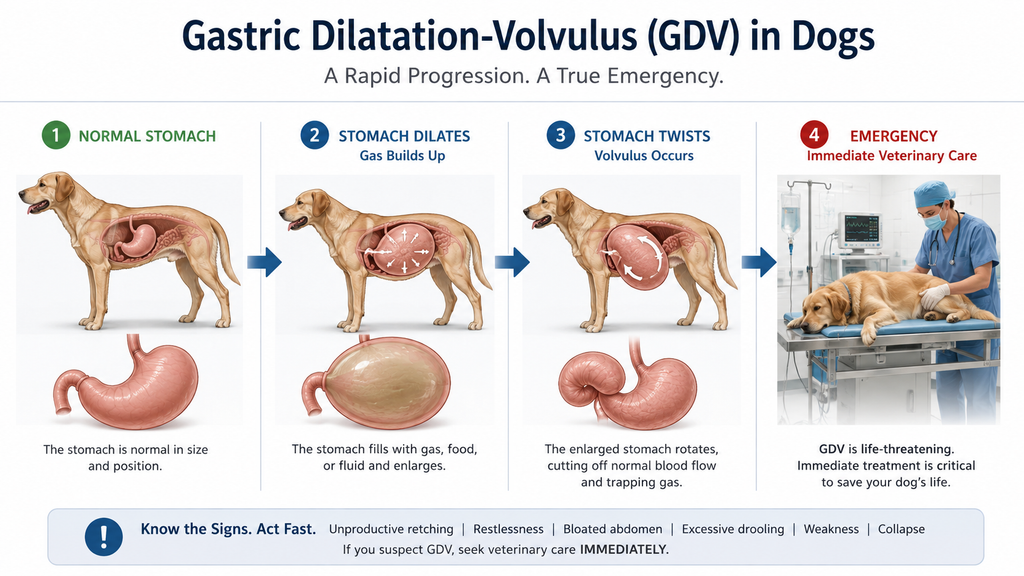
Before GDV surgery can safely begin, the emergency veterinary team usually has to stabilize your dog and determine how severely the stomach has twisted. This can add several hundred to more than $1,000 to the emergency bill, depending on the hospital, location, and your dog’s condition.
Typical pre-surgical expenses may include an emergency examination and triage, IV catheter placement and fluids to treat shock, pain medication, bloodwork, abdominal X-rays, and sometimes ECG or other monitoring. If the stomach is severely distended, the veterinarian may also decompress it using a stomach tube or, when necessary, a needle or catheter through the abdominal wall. The American College of Veterinary Surgeons notes that most GDV patients require stabilization with IV fluids and oxygen before anesthesia, followed by gastric decompression.
As a planning estimate, pre-surgical stabilization and diagnostics can add roughly $700–$2,000+ before the operation itself, although actual charges vary significantly between emergency hospitals and individual cases. A written estimate should show whether these services are included in the quoted surgery price.
What’s Actually Included in a GDV Surgery Bill?
A GDV bill bundles several distinct cost categories, and understanding each helps explain why the total is so much higher than “the surgery” alone.
Emergency stabilization happens before surgery even starts — an IV catheter, fluids to address shock, and pain control, since a dog with GDV is often in critical condition on arrival. Diagnostics confirm the torsion and assess how the body is handling it: X-rays to visualize the twisted stomach, bloodwork to check organ function, and often an ECG, since heart rhythm abnormalities are common with GDV and need to be caught before and after surgery. The surgery itself involves untwisting the stomach, assessing tissue viability, and performing a gastropexy — permanently suturing the stomach to the abdominal wall to prevent it from twisting again. ICU hospitalization follows for most dogs, typically 2–3 days of intensive monitoring. Medications — antibiotics, pain relievers, anti-nausea drugs — continue through discharge and often for a period at home.
Emergency Vet vs. Specialty Hospital Cost
For a dog with GDV, the difference between an emergency hospital and a specialty or referral hospital is not simply about paying more for the same surgery. Both may provide emergency stabilization and surgery, but specialty hospitals may have board-certified surgeons, advanced monitoring, ICU resources, and additional specialists available for complicated cases. Those additional resources can increase the total bill, particularly when a dog needs prolonged hospitalization, tissue removal, splenectomy, advanced monitoring, or other intensive care.
Read Related Article… Emergency Vet vs Regular Vet Cost: Why Emergency Care Costs So Much More (2026)
A straightforward GDV case may fall within the several-thousand-dollar range at either type of hospital, while complex cases can exceed $10,000, especially when complications or extended ICU care are involved. Current U.S. estimates commonly place GDV treatment in roughly the $3,500–$12,000 range, although actual pricing varies significantly by location and individual case.
If your dog already has suspected GDV, don’t delay treatment to shop for a cheaper hospital. Ask the veterinarian for a written estimate and whether transfer to a specialty center is medically appropriate.
Why Do Some GDV Bills Reach $10,000+?
The jump from a $5,000 case to a $10,000+ one almost always comes down to tissue damage, complications, or how sick the dog was before surgery started.
Stomach wall necrosis — tissue that died from lost blood supply during the torsion — requires removing the damaged section (partial gastrectomy) rather than just untwisting and stapling, adding significant surgical time and risk. Splenic involvement is common, since the spleen’s blood supply runs close to the stomach; if it’s damaged or twisted, a splenectomy is often performed in the same surgery, adding $1,000–$3,000. Cardiac arrhythmias develop in a meaningful percentage of GDV cases, sometimes not appearing until after surgery, requiring ECG monitoring and medication during the ICU stay. Extended ICU time — a dog in shock at presentation, or one recovering from a more extensive surgery, often needs longer monitoring than a straightforward case, and ICU charges accrue per day. Referral/specialty hospital pricing in major metro areas also runs higher than general practice or rural emergency clinics, reflecting higher facility overhead.
Cost by Severity: Simple Bloat vs. Full Volvulus vs. Complicated Cases
| Case Type | What’s Happening | Typical Total Cost |
|---|---|---|
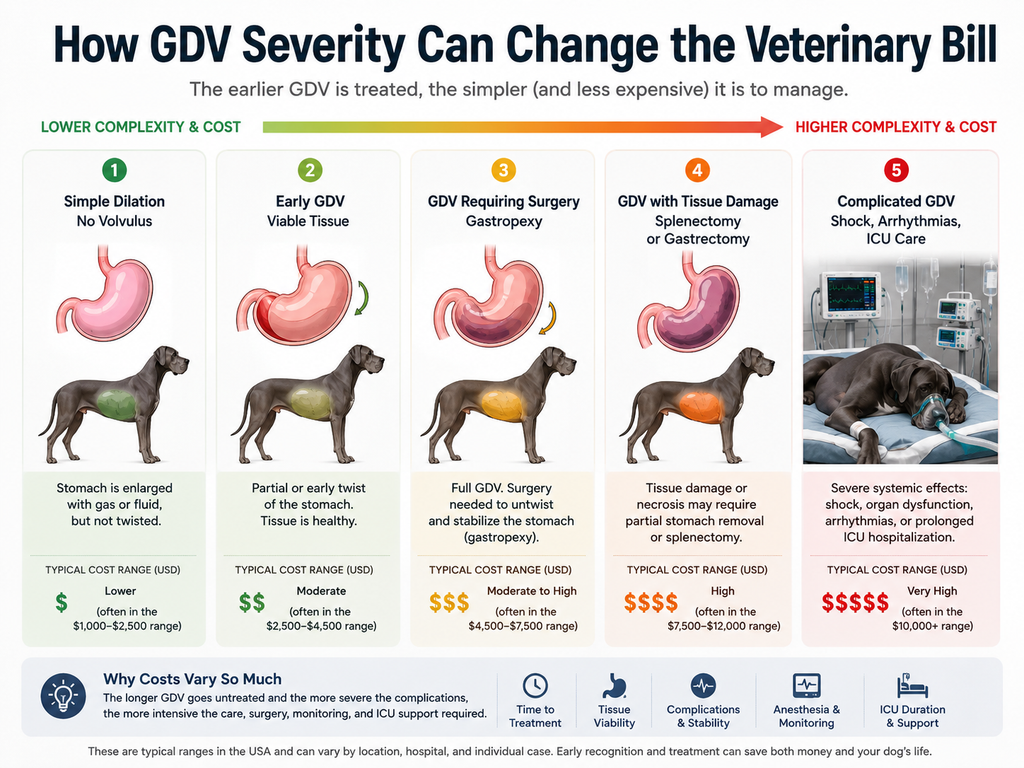
| Simple bloat (dilatation, no twist) | Stomach distended with gas, no torsion — may resolve with decompression, no surgery | $300–$1,500 |
| Straightforward GDV, caught early | Stomach twisted, tissue still healthy, prompt surgery | $5,000–$7,500 |
| GDV with tissue damage | Partial gastrectomy needed for necrotic tissue | $7,500–$10,000 |
| GDV with splenectomy | Spleen removed due to torsion/damage | $8,000–$11,000 |
| Complicated/shock presentation | Multiple complications, extended ICU, arrhythmia management | $10,000–$15,000+ |
For illustration only, an uncomplicated case may fall near the lower end of the overall range, while a case requiring tissue removal, splenectomy and prolonged hospitalization may move toward the upper end.
What Should You Ask the Vet Before Approving the Estimate?
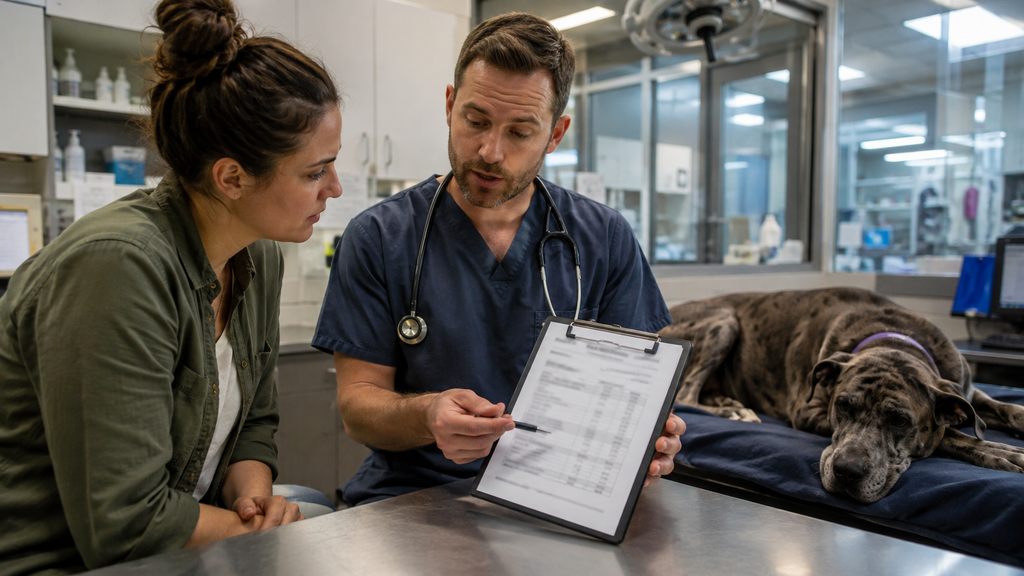
Before approving a GDV surgery estimate, ask the veterinary team what the quoted amount actually includes and what could make the final bill higher. In a GDV emergency, treatment should not be delayed while you shop around, but you can still ask for a clear breakdown while your dog is being stabilized.
Confirm whether the estimate includes emergency stabilization, X-rays, bloodwork, anesthesia, GDV surgery, gastropexy, medications, and the expected hospital or ICU stay. Also ask whether the estimate could increase if the surgeon finds damaged stomach tissue or spleen involvement, since GDV can sometimes require a partial gastrectomy or splenectomy.
Ask for the low and high ends of the estimate, how much deposit is required upfront, when the remaining balance is due, and whether the hospital will contact you before exceeding the approved estimate. U.S. veterinary hospitals commonly provide treatment estimates, but final charges can change when unexpected complications or additional care arise.
The goal isn’t to delay treatment—it’s to understand both the medical plan and your potential financial exposure before authorizing care.
What Drives ICU and Hospitalization Costs?
Post-surgical ICU care typically runs $500 to $1,500 per day, with most GDV dogs needing 2 to 3 days of intensive monitoring — adding $1,000 to $4,500 to the total bill on top of the surgery itself.
This stay isn’t optional monitoring — it’s active management of a dog recovering from major abdominal surgery who’s also at risk for complications that specifically follow GDV, particularly cardiac arrhythmias, which can develop up to 48–72 hours after surgery even in dogs that seemed stable immediately afterward. ICU charges typically bundle IV fluids, pain management, nursing care, and continuous monitoring equipment. More complicated cases — those involving gastrectomy, splenectomy, or a rocky initial recovery — often need longer stays, sometimes extending to 5–7 days.
How Long Does GDV Surgery and Recovery Take?
GDV surgery itself can take several hours, depending on how severely the stomach has twisted and whether damaged stomach tissue or the spleen needs to be removed. The dog must first be stabilized before surgery, and after the procedure, most dogs remain hospitalized for several days for monitoring and supportive care.
The hospital stay is important because complications such as abnormal heart rhythms, infection, shock, or problems related to damaged stomach tissue can occur after surgery. Dogs that require more extensive surgery or arrive in severe shock may need longer hospitalization and closer monitoring.
Once your dog is discharged, recovery continues at home. Expect restricted activity for the first few weeks, along with prescribed medications, incision monitoring, and follow-up care. ACVS recommends exercise restriction for several weeks after GDV surgery while the surgical site heals.
For cost planning: ask the veterinarian how many hospitalization days are included in your estimate and what additional daily ICU charges could apply if recovery takes longer than expected.
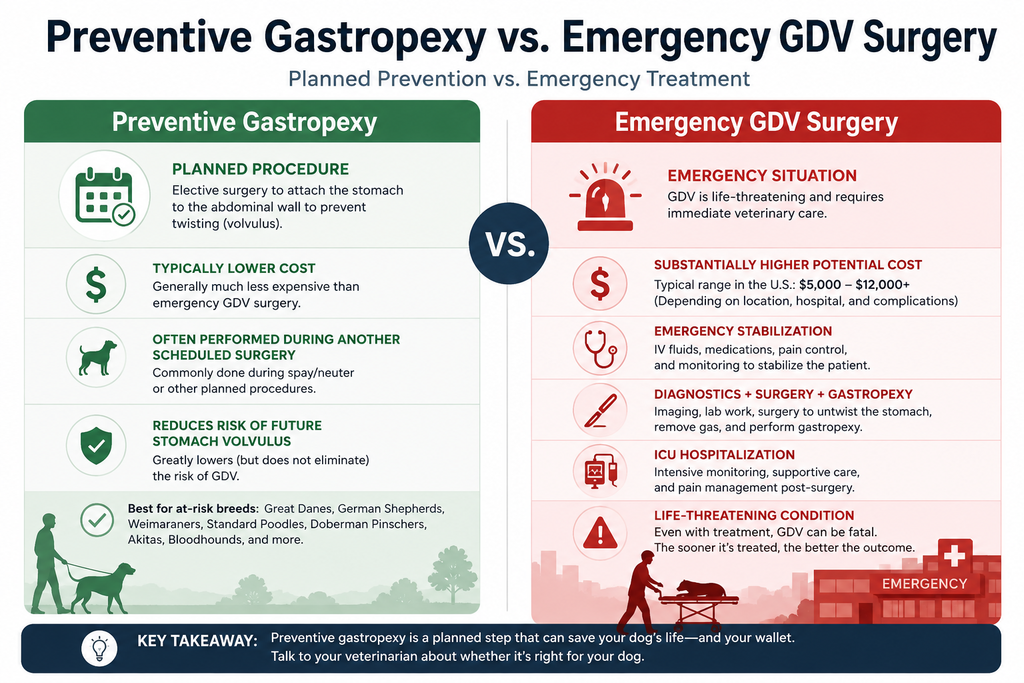
Preventive Gastropexy vs. Emergency GDV Surgery: The Cost Case
| Factor | Preventive Gastropexy | Emergency GDV Surgery |
|---|---|---|
| Timing | Planned, often bundled with spay/neuter | Emergency, unplanned |
| Typical cost | $400–$2,500 | $5,000–$12,000 |
| Prevents future torsion | Yes — reduces volvulus risk by roughly 95% | Includes gastropexy to prevent recurrence |
| Insurance coverage | Usually not covered — classified as elective | Usually covered under accident-and-illness plans |
| Best candidates | Large, deep-chested breeds (Great Danes, Standard Poodles, Weimaraners, German Shepherds, Dobermans) before any symptoms occur | Any dog already showing GDV symptoms |
If you own a high-risk breed, the math is worth having in front of you before an emergency ever happens: a planned gastropexy at $400–$2,500 versus an emergency surgery at $5,000–$12,000 with no guarantee of survival. Gastropexy doesn’t prevent simple gas bloat, but it does prevent the stomach from twisting — the part of GDV that’s actually life-threatening.
Does Pet Insurance Cover GDV Surgery?
GDV may be covered when it develops after enrollment and the policy’s waiting period, but coverage depends on the insurer’s terms and your dog’s medical history, since it’s classified as a sudden, unexpected illness rather than an elective procedure — as long as your policy was active and past its waiting period before symptoms started.
Read Related Article… Does Pet Insurance Cover Surgery? What Dog Owners Need to Know
Reimbursement mechanics work the same way as any other covered emergency: your deductible applies first, then your reimbursement percentage (typically 70–90%) applies to the remaining eligible costs, up to your policy’s annual limit. On a $8,000 bill with a $500 deductible and 80% reimbursement, for example, roughly $6,000 would come back to you after the deductible is subtracted — though actual outcomes depend entirely on your specific policy terms. Preventive gastropexy is typically treated differently — most insurers classify it as elective and exclude it from standard accident-and-illness coverage, sometimes covering it only under a separate wellness add-on if one exists.
Read Related Article… Pet Insurance Waiting Period: How Long Before Coverage Starts? (2026 Guide)
Is GDV Considered a Pre-Existing Condition?
A first-time GDV episode is generally treated as a new, covered illness — not a pre-existing condition — as long as your dog had no prior GDV diagnosis, bloat episode, or documented symptoms before your policy’s effective date and waiting period ended.
Where this gets more complicated is recurrence and breed-based exclusions. If your dog has had a prior bloat or GDV episode before enrolling, that history is typically treated as pre-existing, and future GDV-related claims may be excluded even after a full gastropexy , which can affect premiums or waiting periods even without any prior history — this varies significantly by provider and is worth confirming directly rather than assuming.
How Much Do You Have to Pay Upfront?
For emergency GDV surgery, the amount you need to pay upfront can vary significantly by veterinary hospital, your dog’s condition, and the estimated cost of treatment. Some emergency hospitals may require a deposit before surgery or hospitalization begins, while others may offer financing or other payment options.
Read Related Article… Best Vet Payment Plans in the USA (2026): CareCredit vs Scratchpay
Ask the veterinary team exactly how much is required before treatment starts and whether that deposit is based on the low or high end of the estimate. Also ask what happens if the surgeon discovers damaged stomach tissue, needs to perform a splenectomy, or your dog requires additional ICU care.
If you have pet insurance, remember that many policies reimburse eligible expenses after you pay the veterinary bill, so insurance may not eliminate the need for upfront funds.
If you cannot cover the deposit, tell the veterinary team immediately. Ask whether they accept CareCredit or another veterinary financing option, whether you can prequalify, and whether any other payment arrangements are available. CareCredit says its veterinary prequalification can provide a decision in real time, although approval is not guaranteed.
What If You Can’t Afford GDV Surgery Right Now?
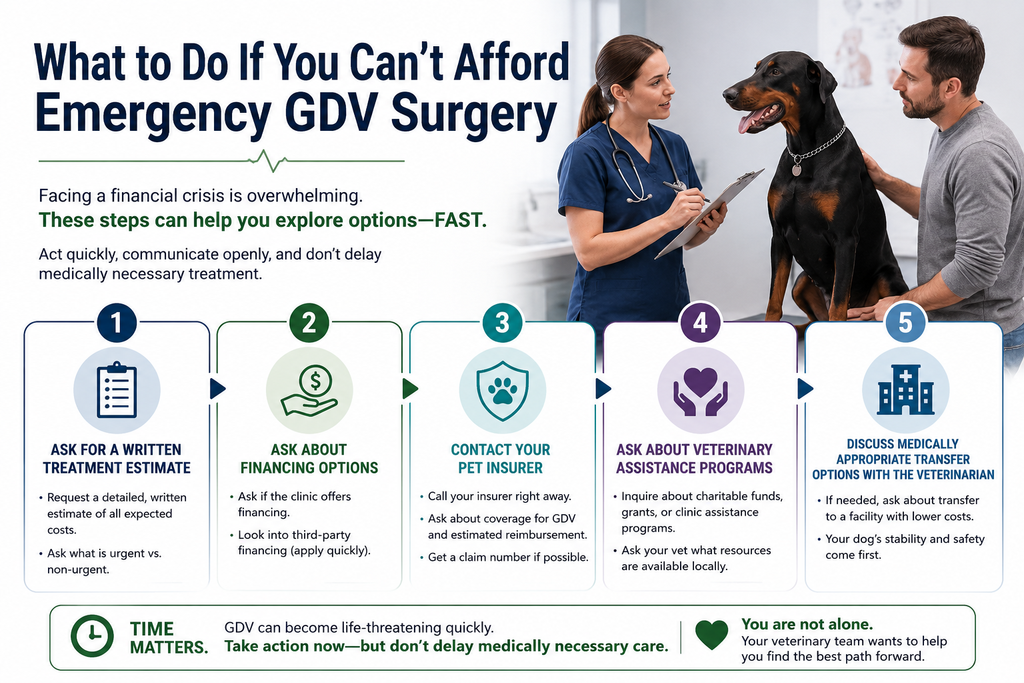
If you’re standing at the emergency vet with a $6,000–$12,000 estimate and don’t have that available, tell the care team directly and immediately — GDV moves fast, and so should your search for options.
Read Related Article… Can’t Afford an Emergency Vet Bill? 15 Real Ways Dog Owners Find Help (2026)
Ask about CareCredit or Scratchpay on the spot; Both offer fast application/decision processes for qualifying applicants, although approval and available financing depend on the applicant and provider and pay the hospital directly, which matters enormously here since GDV can’t wait for a multi-day financing process. Ask whether the hospital has an internal payment plan or can accept a partial deposit to begin surgery while you arrange the rest. Apply to emergency veterinary grant programs like RedRover Relief in parallel — even a partial grant helps, and applying doesn’t cost you anything. If your dog is stable enough to transfer (a decision only your vet can make in the moment), ask whether a nearby university veterinary teaching hospital could take the case at a lower cost. For the full breakdown of financing options, grant programs, and what to ask before agreeing to treatment, see our complete guide on what to do if you can’t afford emergency vet surgery.
Read Related Article… 15 Organizations That Help Pay Vet Bills When You Can’t Afford Care (2026)
Action Checklist for the Emergency Room
- Ask for a written estimate that includes diagnostics, surgery, and expected ICU days
- Ask specifically what happens to the estimate if tissue damage or splenectomy is found
- Call your pet insurer immediately to confirm waiting period and expected reimbursement
- Apply for CareCredit or Scratchpay from your phone while your dog is being stabilized
- Ask whether a partial deposit can get surgery started while financing is arranged
- Ask about expected hospitalization length so you can track the bill as it grows
- If you own a high-risk breed and your dog survives, ask about gastropexy timing if it wasn’t already done
Frequently Asked Questions
How much does dog GDV surgery cost without insurance?
Dog GDV surgery itself typically costs $3,000–$8,000, while the full emergency bill can reach $5,000–$12,000 or more after diagnostics, stabilization, anesthesia, gastropexy, and ICU hospitalization. Complicated cases requiring stomach tissue removal, splenectomy, blood products, or extended hospitalization can cost substantially more.
Is GDV always fatal without surgery?
Untreated GDV is a life-threatening emergency and can rapidly lead to shock, tissue death, organ damage, and death. Once GDV is confirmed, veterinary surgery is generally indicated, and early stabilization and treatment improve the chances of survival.
What’s the difference between simple bloat and GDV?
Simple bloat involves stomach dilation without twisting. GDV occurs when the stomach dilates and twists, which can restrict blood flow to the stomach and spleen and cause severe systemic complications. Simple dilation does not always require surgery, but confirmed GDV requires immediate veterinary treatment and generally surgical correction.
Does pet insurance cover GDV surgery?
GDV surgery may be covered by an accident-and-illness pet insurance policy when the condition develops after enrollment and the applicable waiting period has ended. Coverage, exclusions, deductibles, reimbursement rates, and annual limits vary by policy. A condition or symptoms documented before coverage begins or during a waiting period may be treated as pre-existing.
Is preventive gastropexy worth it for high-risk breeds?
For dogs at higher risk of GDV, preventive gastropexy can substantially reduce the risk of the stomach twisting in a future episode. It is often performed during another planned surgery, such as spay or neuter, and may be recommended for large or giant, deep-chested breeds. Gastropexy does not prevent the stomach from becoming distended, but it helps prevent the life-threatening volvulus component of GDV.
What if I can’t afford GDV surgery right now?
Tell the veterinary team immediately and ask for a written estimate, required deposit, financing options, and any available payment arrangements. Veterinary financing services such as CareCredit may offer prequalification and financing for eligible veterinary care, while other assistance programs may also be available depending on your location and circumstances. Approval is not guaranteed, so do not assume financing will cover the entire bill.
How long does a dog stay in the hospital after GDV surgery?
Many dogs remain hospitalized for several days after GDV surgery so the veterinary team can monitor vital signs, heart rhythm, pain, hydration, and possible complications. Dogs with tissue damage, shock, arrhythmias, or other complications may require longer hospitalization.
Can GDV happen again after surgery?
The gastropexy performed during GDV surgery is designed to prevent the stomach from twisting again. However, gastropexy does not prevent the stomach from becoming distended, so a dog can still experience gastric dilation or related digestive problems after surgery.
External Authority Sources
- AVMA (American Veterinary Medical Association) — GDV overview
- ACVS (American College of Veterinary Surgeons) — gastropexy and GDV surgical guidance
- PetMD — gastropexy cost and risk data
- NAPHIA
- MetLife Pet – Industry Claims Data
Disclaimer: This article is for informational and educational purposes only. Cost ranges in this guide are planning estimates compiled from current veterinary cost references and may vary substantially by location, hospital type, severity and treatment required and will vary based on your dog’s size, breed, condition severity, location, and the specific hospital or plan involved. PetInsurePrime does not sell pet insurance and receives no compensation from any insurance provider. Always compare estimates and read your policy documents carefully.
PetInsurePrime | Independent • Research-Based | Helping US dog owners understand real vet costs and coverage options — without the sales pressure.