
A dog colonoscopy typically costs around $900–$2,200 for the procedure itself, but the total bill can run higher once anesthesia, pre-procedure testing, biopsy, pathology, specialist fees, or additional imaging are added. One US cost guide estimates lower-GI colonoscopy at roughly $900–$1,500 in general practice and $1,200–$2,200 with a specialist, and the same quote can mean very different things depending on what’s bundled in.
Quick Answer : Dog Colonoscopy Cost
A dog colonoscopy typically costs about $900–$2,200 in the U.S., although the total can be higher when anesthesia, biopsies, pathology, pre-procedure testing, specialist fees, or emergency care are added. General-practice estimates tend to be lower, while specialist/referral hospitals can cost more.
The exact bill depends on what your dog needs and what the clinic includes in its estimate, so ask for an itemized quote before the procedure.
Table of Contents
- How Much Does a Dog Colonoscopy Cost?
- What Is a Dog Colonoscopy?
- What Does a Dog Colonoscopy Usually Include?
- How Much Does a Dog Colonoscopy With Biopsy Cost?
- 7 Important Factors That Can Raise the Dog Colonoscopy Bill
- Why Does a Dog Need a Colonoscopy?
- What Happens During a Dog Colonoscopy?
- Is a Dog Colonoscopy Safe?
- How Long Does a Dog Colonoscopy Take?
- When will I know what’s wrong with my dog?
- How Should You Prepare Your Dog for a Colonoscopy?
- What Happens After a Dog Colonoscopy?
- Does Pet Insurance Cover a Dog Colonoscopy?
- Can You Reduce the Cost of a Dog Colonoscopy?
- What Should I Ask My Vet Before Paying for a Colonoscopy?
- Dog Colonoscopy vs. Other Diagnostic Options
- What Should You Budget?
- FAQ
How Much Does a Dog Colonoscopy Cost?
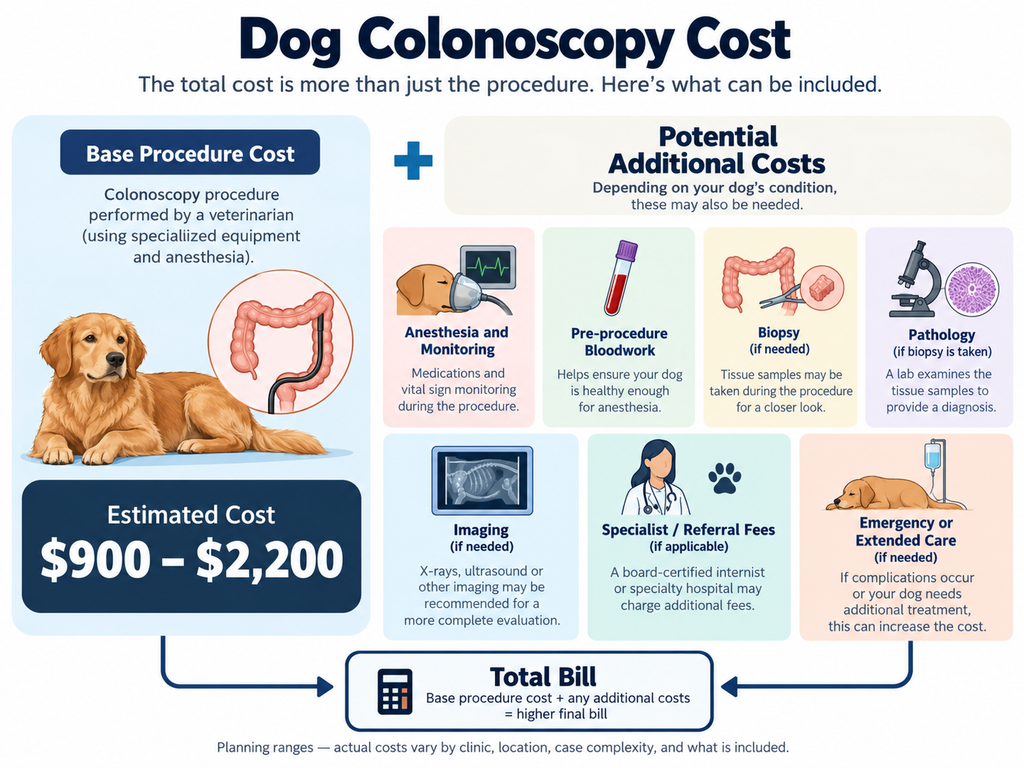
| Cost Situation | Estimated Range |
|---|---|
| General veterinary practice | $900–$1,500 |
| Veterinary specialist / referral | $1,200–$2,200+ |
| Colonoscopy + biopsy and pathology | Higher than the procedure-only price |
| Complete GI diagnostic workup | Can reach $1,500–$3,500+ |
Planning ranges, not guaranteed prices. Estimates vary by location, clinic, case complexity, and what’s bundled into the quote, and the general-practice and specialist ranges overlap.
A real-world anchor: one veterinary surgery practice publishes an all-inclusive $1,000 fee for the scope procedure, covering the intake exam, pre-anesthetic bloodwork, IV catheter and fluids, preoperative imaging, anesthesia, and monitoring. Histopathology is listed as an additional cost. That shows how a clinic’s headline price can already include a lot, or very little, depending on how it’s quoted.
Broader endoscopy estimates, especially for upper-GI procedures, can run higher when extra services are included. For that, see our dog endoscopy cost guide.
What Is a Dog Colonoscopy?
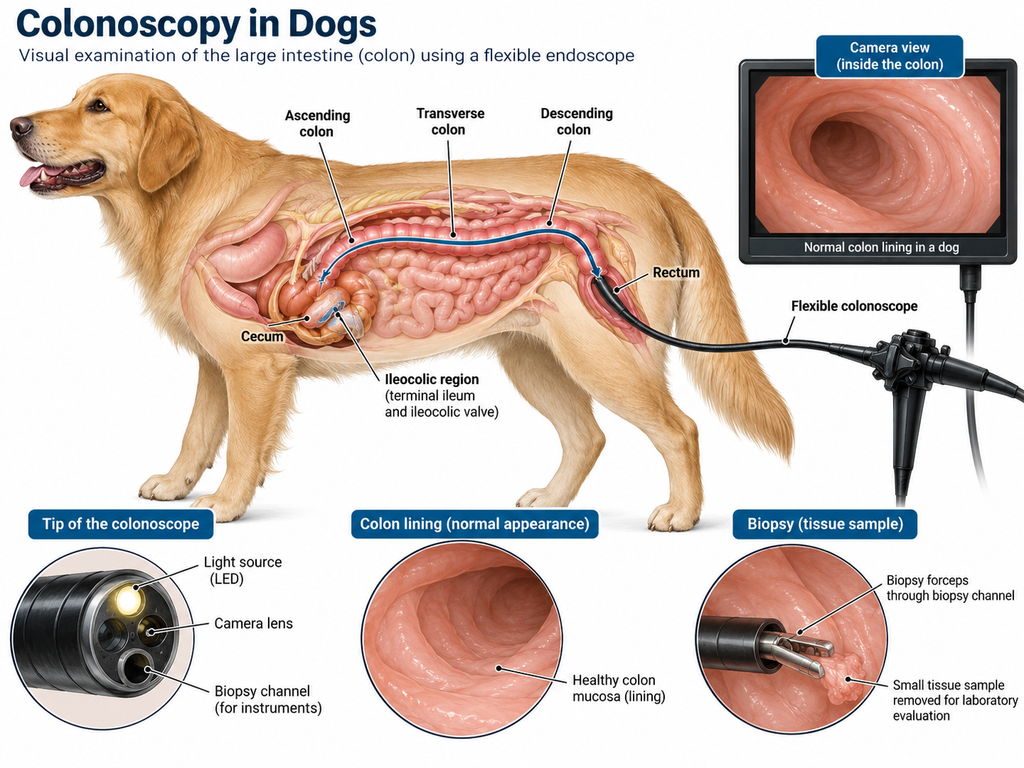
A dog colonoscopy is a minimally invasive diagnostic procedure that allows a veterinarian to examine the inside lining of a dog’s colon using a flexible camera called an endoscope. The scope is passed through the rectum while the dog is under general anesthesia, allowing the veterinarian to look for abnormalities such as inflammation, bleeding, narrowing, or masses.
During the procedure, the veterinarian can also take small tissue samples (biopsies) from the colon for laboratory examination. This can help identify conditions that may not be obvious from the colon’s appearance alone.
A colonoscopy is generally used when a dog has persistent or recurring lower-GI problems—such as chronic diarrhea, blood or mucus in the stool, straining, or suspected abnormalities—and other diagnostic approaches have not provided a clear answer.
Because the colon must be clean for the veterinarian to see the intestinal lining properly, bowel preparation and fasting are required before the procedure.
Read Related Article… Dog Endoscopy Cost in the USA (2026): Complete Guide to Real Prices, Hidden Fees & What Comes Next
What Does a Dog Colonoscopy Usually Include?
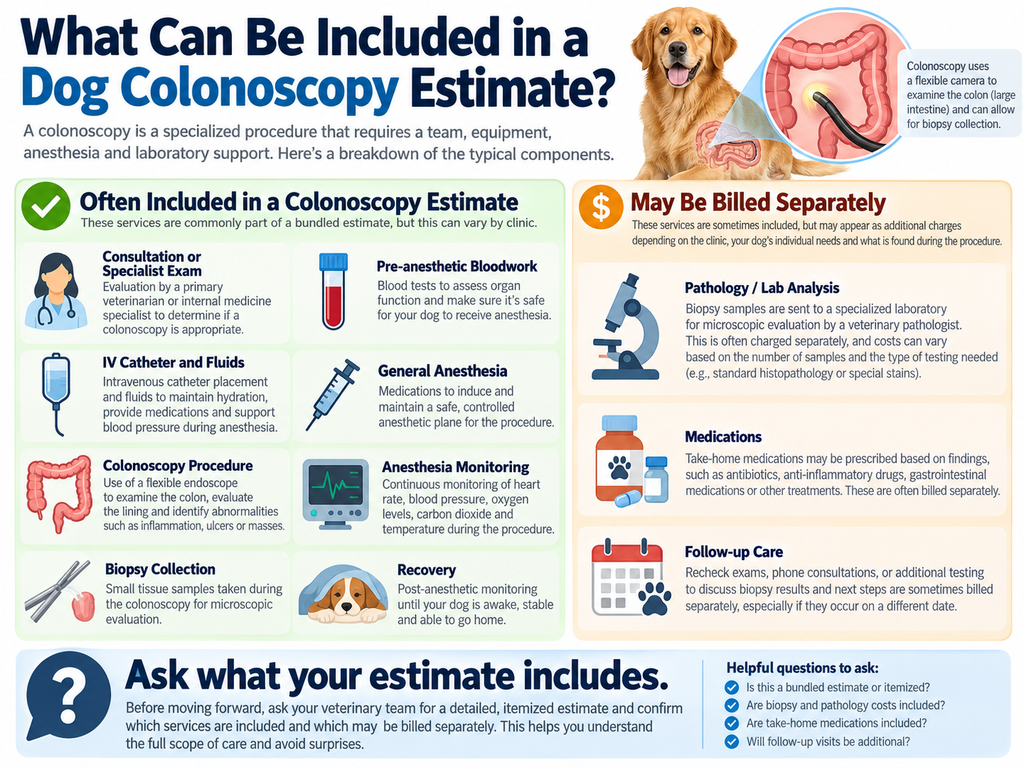
The biggest point of confusion is hearing “$1,500” and wondering whether that’s the whole bill. The scope itself is rarely the only component. A full quote can include:
- Consultation or specialist exam
- Pre-anesthetic bloodwork
- IV catheter and fluids
- Anesthesia
- The colonoscopy itself
- Anesthesia monitoring
- Biopsy collection
- Pathology (lab analysis)
- Recovery
- Medications
- Follow-up
Ask your vet: “Does your estimate include anesthesia, biopsy collection, and pathology, or are those billed separately?”
How Much Does a Dog Colonoscopy With Biopsy Cost?
A dog colonoscopy with biopsy can cost roughly $1,100–$2,700+ in the U.S., depending on the veterinary hospital, specialist involvement, anesthesia, number of samples, and pathology charges. Current veterinary cost guides estimate colonoscopy at about $900–$2,200, with biopsy collection potentially adding another $200–$500.
The important distinction is that biopsy collection and pathology may be separate charges. Your dog’s veterinarian may collect several tissue samples during the colonoscopy, which are then sent to a veterinary pathologist for examination. The laboratory fee can vary based on the specimen and number of samples.
Before approving the procedure, ask for an itemized estimate and confirm whether it includes anesthesia, biopsy collection, pathology, bloodwork, and any additional testing. This matters because two clinics can quote very different prices for what sounds like the same procedure.
Read Related Article… Dog Biopsy Cost in the USA (2026): Real Prices by Type, Hidden Lab Fees & What the Results Mean
7 Important Factors That Can Raise the Dog Colonoscopy Bill
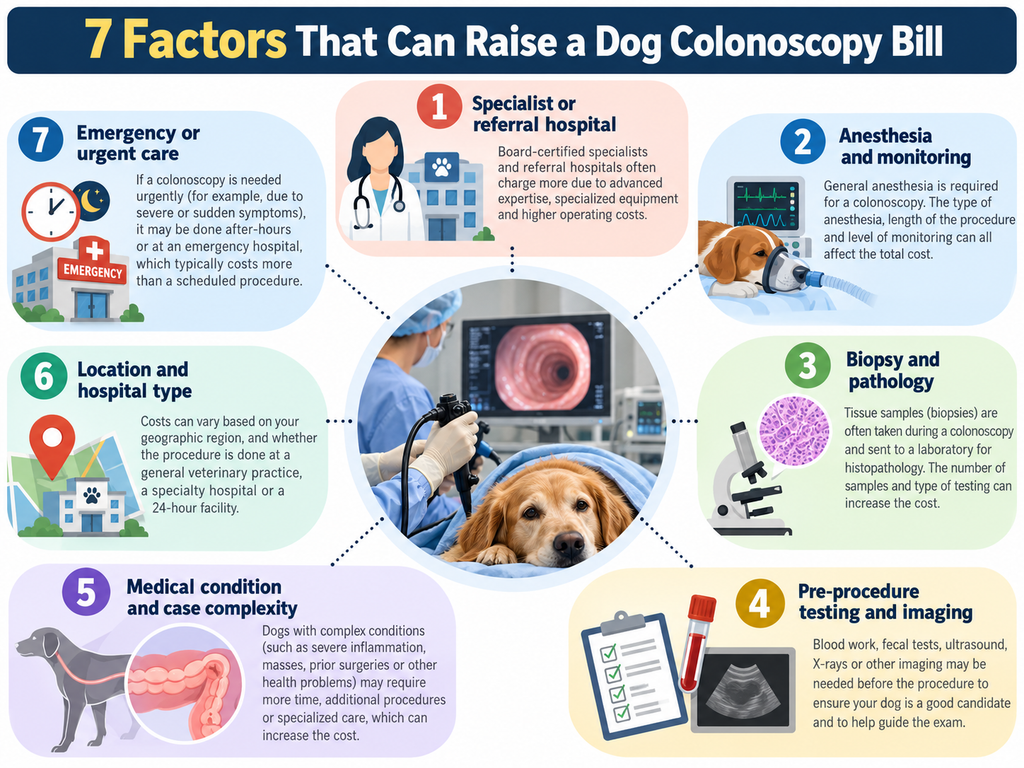
1. Specialist vs. General Veterinary Practice
General practices that offer colonoscopy may quote lower. A referral or internal medicine specialist usually costs more, reflecting advanced equipment, monitoring, and expertise. A referral doesn’t mean you’re being overcharged. Specialist hospitals simply run a different cost structure.
2. Anesthesia and Monitoring
General anesthesia is standard for colonoscopy, and it’s more than one line. It can include a pre-anesthetic assessment, bloodwork, IV access, the anesthetic itself, monitoring, and recovery. Because these pieces are bundled differently from clinic to clinic, anesthesia is one of the main reasons two quotes for “the same” procedure don’t match.
Read Related Article… Dog Blood Test Cost in the USA (2026): Real Prices, What Each Panel Tests, and How to Pay Less
3. Biopsies and Pathology
A colonoscopy is a visual examination. Biopsy plus pathology is the tissue diagnosis. If your vet sees abnormal lining, inflammation, or a mass, they may collect samples for a pathologist to examine. A quote that says “colonoscopy” may not include pathology, and histopathology commonly adds roughly $150–$400 on top. See our dog biopsy cost guide for the breakdown.
4. Pre-Procedure Testing and Imaging
Your vet may recommend bloodwork, fecal testing, X-rays, or ultrasound before or alongside the scope. Not every dog needs every test. For chronic GI problems, vets often work through an exam, fecal testing, diet trials, and imaging before moving to invasive diagnostics, so a colonoscopy usually comes later in the workup rather than first.
Read Related Article… Dog Ultrasound Cost in the USA (2026): Real Prices, Hidden Charges & What Happens After
5. Your Dog’s Medical Condition and Complexity
Two owners can receive very different estimates. Factors include chronic versus acute symptoms, suspected inflammatory disease, a suspected mass, bleeding, weight loss, abnormal bloodwork, other underlying disease, or the need for additional procedures. Whether to pursue endoscopy depends on your dog’s history, severity, chronicity, and prior results.
6. Location and Veterinary Hospital Type
A New York hospital, a Texas clinic, a rural Midwest practice, and a San Francisco specialty center won’t price the same. Hospital type matters too: local general practice, specialty or referral hospital, university teaching hospital, or emergency facility. We don’t have reliable state-by-state figures to publish, so ask for a written estimate and compare what’s actually included, not just the headline price.
7. Emergency or Urgent Care
An urgent case can add an emergency exam, stabilization, extra diagnostics, hospitalization, specialist involvement, and after-hours fees. Emergency timing, specialist referral, and additional monitoring are all recognized cost drivers for endoscopy.
Why Does a Dog Need a Colonoscopy?
Veterinary guidance places colonoscopy in the workup of selected dogs with persistent or recurrent large-bowel problems, especially when routine treatment hasn’t worked. Common reasons include:
- Chronic or recurrent diarrhea
- Blood or mucus in the stool
- Suspected colitis
- Unexplained GI symptoms
- Suspected inflammatory disease
- Suspected masses or other abnormalities
These signs have many causes, and most dogs with diarrhea never need a colonoscopy. Your veterinarian decides whether it’s appropriate after considering symptoms, previous tests, and your dog’s response to treatment.
What Happens During a Dog Colonoscopy?
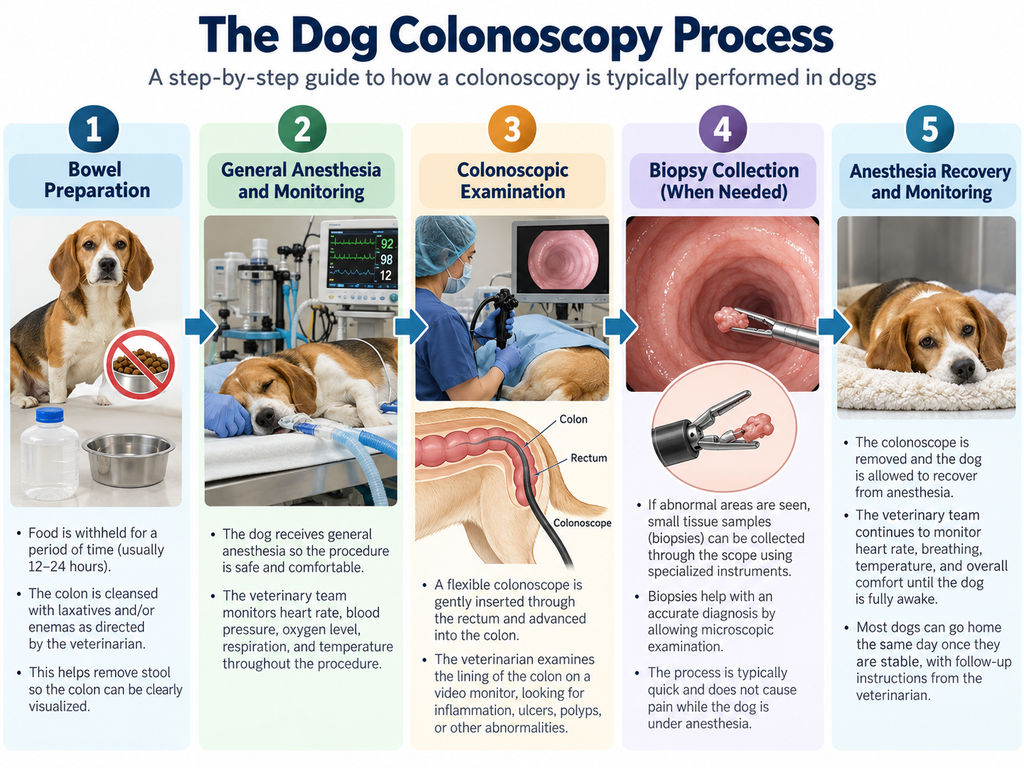
- Preparation. The colon must be cleared following your vet’s specific instructions.
- Anesthesia. Your dog is placed under general anesthesia and monitored.
- Scope examination. A flexible camera is passed through the rectum so the vet can view the colon lining.
- Biopsy, if needed. Small tissue samples may be taken from abnormal areas.
- Recovery. Your dog is monitored as the anesthesia wears off.
Is a Dog Colonoscopy Safe?
Yes. A dog colonoscopy is generally considered a low-risk, minimally invasive procedure, especially when performed by an experienced veterinary team. Unlike abdominal surgery, it allows the veterinarian to examine the colon and collect biopsies without making a large surgical incision.
However, it is not completely risk-free. Dogs require general anesthesia, which carries its own risks, particularly for pets with underlying heart, kidney, liver, or other health problems. Possible complications from endoscopy can include temporary nausea or diarrhea, bleeding, tissue irritation, infection, or injury, although serious complications are uncommon.
Your veterinarian may recommend a physical examination, bloodwork, or other pre-anesthetic testing to identify potential risks before the procedure. Proper fasting and continuous monitoring during anesthesia also help reduce complications.
How Long Does a Dog Colonoscopy Take?
The scope examination itself varies by case and is often well under an hour, but the total time at the hospital is longer. It includes check-in, bloodwork, anesthesia induction, the procedure, and recovery monitoring. Same-day discharge is common, though your vet may keep a dog longer if needed. Ask your clinic for its expected timeline.
When will I know what’s wrong with my dog?
You may know some results immediately because your veterinarian can see the colon while performing the procedure. However, seeing inflammation, abnormal tissue, or another lesion does not always provide a final diagnosis. If biopsies are taken, the tissue is sent to a veterinary pathologist for microscopic examination.
Biopsy results commonly take several days to a week, although timing varies by laboratory and the type of testing required. Some specialized tests can take longer. For example, one U.S. veterinary hospital reports 5–7 days for biopsy results, while VCA notes that final diagnosis can take longer depending on the circumstances.
Your vet may contact you sooner with the visible findings and then follow up once the pathology report is available. Ask when you should expect the final report and who will contact you with the results.
How Should You Prepare Your Dog for a Colonoscopy?
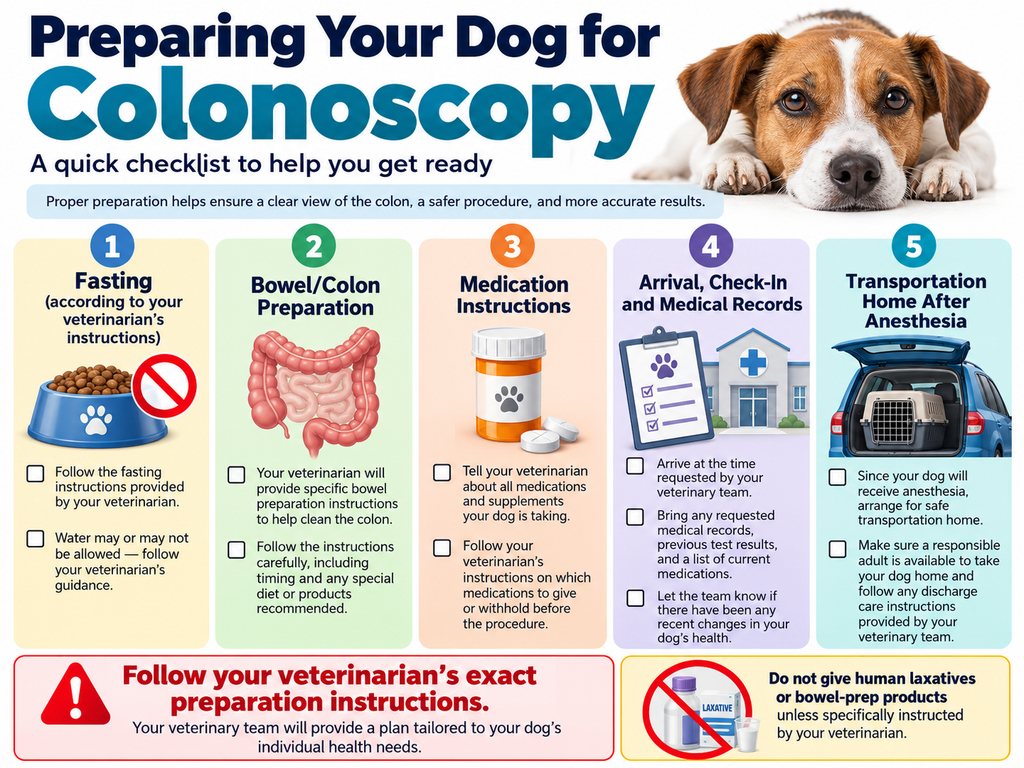
Your veterinarian sets the protocol based on your dog’s age, condition, and procedure, so follow it exactly. Typical topics include:
- Fasting instructions and when to withhold water
- Bowel or colon preparation, which colonoscopy requires
- Medications: ask which to give or skip that morning
- Arrival and check-in: bring previous test results and records
- Transportation home: your dog may be groggy
Don’t give human bowel-prep products or laxatives on your own. Dosing and timing are decisions for your vet.
What Happens After a Dog Colonoscopy?
Expect grogginess for several hours after anesthesia. Your vet will give feeding and activity instructions. Some dogs have mild, temporary stool changes. Many go home the same day, and biopsy results may take several days.
Call your veterinarian right away if you notice heavy bleeding, a swollen or painful belly, repeated vomiting, or unusual weakness.
Does Pet Insurance Cover a Dog Colonoscopy?
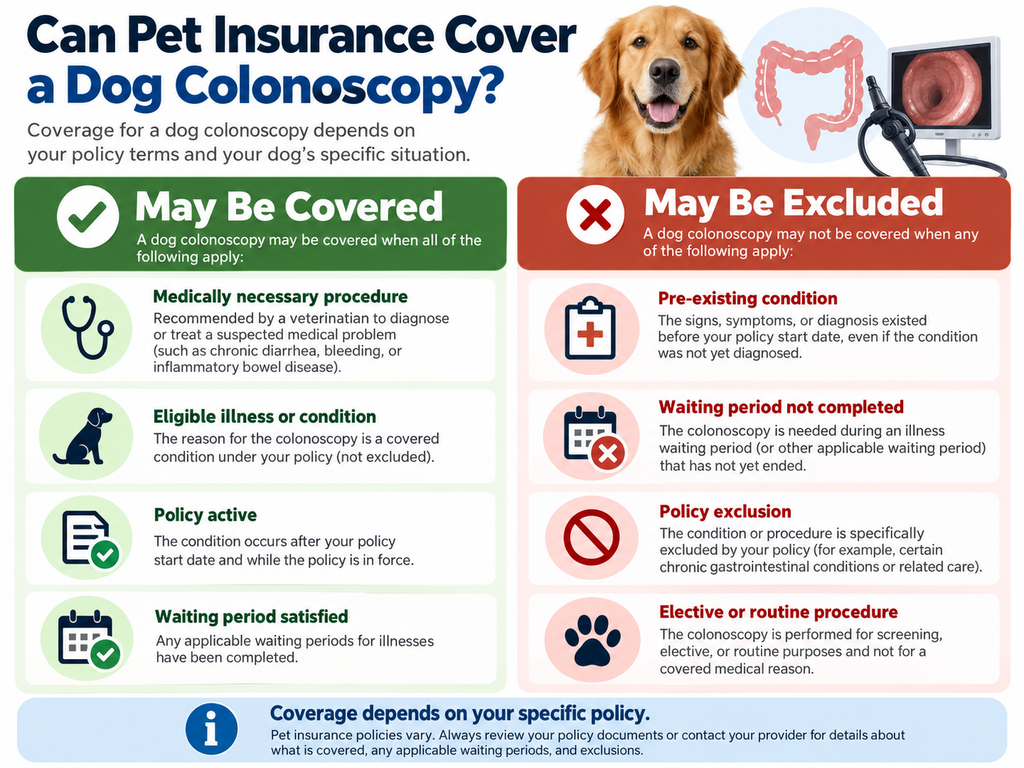
It can, but there’s no blanket yes. Coverage depends on your actual policy.
Potentially covered when the colonoscopy is medically necessary, related to an eligible illness, not pre-existing, and your waiting period has passed.
Potentially excluded when the condition is pre-existing, the procedure is elective or routine, your policy has a relevant exclusion, or the waiting period hasn’t ended.
The pre-existing question is the biggest risk here. Chronic diarrhea or other GI signs documented before your policy started can make a later colonoscopy a pre-existing claim, even if the formal diagnosis comes afterward.
An illustrative example: on a $2,000 eligible bill with a $500 deductible and 80% reimbursement, you’d get $1,200 back and pay about $800. This is not a guaranteed payout. Limits and exclusions can change it.
For the full coverage breakdown, see our guide on whether pet insurance covers endoscopy, plus our coverage guides for biopsies and diagnostic imaging.
Read Related Article… What Doesn’t Pet Insurance Cover? 13 Common Exclusions Every Pet Owner Should Know (2026)
Can You Reduce the Cost of a Dog Colonoscopy?
These steps lower cost without delaying care your dog needs:
- Ask for an itemized estimate.
- Ask what’s medically necessary now versus what can wait.
- Ask whether biopsy and pathology are included.
- Ask whether a referral is actually necessary.
- Ask about payment plans or financing like CareCredit and Scratchpay.
- Ask whether another facility can perform the procedure.
- Check your pet insurance eligibility beforehand, if you have it.
Don’t postpone recommended diagnostics just to save money, since delays can mean a more advanced and more expensive problem.
What Should I Ask My Vet Before Paying for a Colonoscopy?
Before approving a dog colonoscopy, ask for a written, itemized estimate so you know exactly what you’re paying for. Veterinary hospitals may bundle anesthesia, bloodwork, monitoring, biopsy collection, and pathology differently.
Ask your vet:
- What exactly is included in the quoted price?
- Are anesthesia, monitoring, and pre-anesthetic bloodwork included?
- Will biopsies be taken, and is pathology included in the estimate?
- Could my dog need additional X-rays, ultrasound, or other testing?
- Is a specialist or referral hospital necessary for this procedure?
- What happens if the colonoscopy doesn’t provide a diagnosis?
- When should I expect the visual findings and biopsy results?
- What is the estimated total if additional testing is needed?
Also ask whether there are lower-cost diagnostic alternatives that would still be medically appropriate. VCA recommends discussing step-by-step diagnostic options and asking whether a test is essential now or can wait.
The goal isn’t to find the cheapest colonoscopy—it’s to understand the complete expected cost before you authorize the procedure.
Dog Colonoscopy vs. Other Diagnostic Options
| Test | What It Can Help Show | When It May Be Considered | Relative Cost |
|---|---|---|---|
| X-ray | Gas, obstruction, some structural abnormalities | Initial investigation | Lower |
| Ultrasound | Organ and intestinal structure | Abdominal or GI investigation | Moderate |
| Colonoscopy | Direct view of the colon, plus biopsy | Persistent or recurrent lower-GI disease | Higher |
| Surgery | Direct exploration and treatment | Certain masses, obstruction, or perforation | Highest |
Colonoscopy isn’t automatically “better.” The right route depends on the clinical picture, and your vet recommends accordingly.
Read Related Article… Dog CT Scan Cost in the USA (2026): Real Numbers, Hidden Charges, and How to Lower the Bill
Read Related Article… Dog Intestinal Blockage Surgery Cost: $2,000–$10,000 (2026)
What Should You Budget for a Dog Colonoscopy?
For a straightforward case in the U.S., a reasonable starting estimate is around $900–$2,200 for the procedure. The total can be higher once anesthesia, pre-procedure testing, biopsies, pathology, specialist care, or emergency services are added. Published ranges vary because quotes bundle different things.
Ask your vet three questions before you approve:
- What exactly is included in the quoted price?
- Are biopsy and pathology included?
- What’s the estimated total if additional testing is needed?
Frequently Asked Question
How much does a dog colonoscopy cost?
A dog colonoscopy typically costs around $900–$2,200, depending on the veterinary practice, specialist involvement, and what is included. Anesthesia, biopsy, pathology, bloodwork, and other testing can increase the total. Ask your veterinarian for an itemized estimate before the procedure.
Is anesthesia included in the colonoscopy price?
It depends on the clinic. Some veterinary hospitals provide an all-inclusive estimate, while others charge separately for anesthesia, monitoring, bloodwork, or IV fluids. General anesthesia is standard for canine colonoscopy.
How much does a dog colonoscopy with biopsy cost?
A colonoscopy with biopsy usually costs more than the procedure alone. The biopsy may be collected during the colonoscopy, while pathology is often an additional charge. Ask whether your estimate includes both biopsy collection and laboratory analysis.
Does pet insurance cover a colonoscopy?
Pet insurance may cover a colonoscopy when it is medically necessary for an eligible condition, depending on your policy. Pre-existing conditions, waiting periods, deductibles, exclusions, and reimbursement limits can affect coverage. Check your policy or insurer before scheduling the procedure.
How long does a dog colonoscopy take?
The colonoscopy itself may take less than an hour, but your dog will usually spend several hours at the veterinary hospital because of preparation, anesthesia, monitoring, and recovery. Many dogs can go home the same day.
Does a dog have to be under anesthesia for a colonoscopy?
Yes. General anesthesia is standard because the dog needs to remain still and comfortable while the endoscope is passed through the colon. It also allows the veterinarian to perform the procedure safely.
How long does it take for a dog to recover?
Most dogs can go home after recovering from anesthesia and may be sleepy for several hours. Recovery depends on the procedure and whether biopsies or other treatments were performed. Biopsy results can take longer because the tissue must be examined by a pathologist.
Is a colonoscopy cheaper than surgery for a dog?
Often, yes, but they are not interchangeable. A colonoscopy is minimally invasive and can help examine the colon and collect biopsies, while surgery may be necessary for conditions that cannot be diagnosed or treated with endoscopy. Your veterinarian should recommend the appropriate option based on your dog’s condition.
External Authority Sources
- ACVIM-endorsed guidance on GI endoscopy and biopsy in dogs (Journal of Veterinary Internal Medicine)
- PetMD — Colitis in Dogs and Veterinary Endoscopy overviews
- Merck Veterinary Manual — gastrointestinal disorders
- University veterinary diagnostic laboratory fee schedules (pathology)
- AVMA (American Veterinary Medical Association)
Disclaimer: This article is for informational and educational purposes only and is not a substitute for veterinary advice. Cost figures are 2026 planning ranges and will vary by clinic, location, and what’s included. Coverage varies by insurer and policy, and nothing here guarantees a claim outcome. PetInsurePrime does not sell pet insurance and receives no compensation from any insurance provider or veterinary practice. Always follow your veterinarian’s instructions for preparation and aftercare.
PetInsurePrime | Independent • Research-Based | Helping US dog owners understand real vet costs and coverage options — without the sales pressure.