
Updated: August 2026| Reading Time: 18minutes
Your dog swallowed something they shouldn’t have — a toy, a sock, a bone, a piece of a chew — and now you’re at the vet hearing words like “foreign body” and “possible surgery.” Before you can even process what happened, you need to know one thing: what is this going to cost you?
Quick Answer : Dog Foreign Body Surgery Cost
Dog foreign body surgery typically costs $1,500 to $8,500, with most straightforward cases landing between $2,000 and $5,000. The exact number depends heavily on where the object is (stomach vs. intestine), whether it can be removed with endoscopy instead of surgery, and whether the surrounding tissue has been damaged. A same-day endoscopic retrieval sits at the lower end; an emergency surgery involving a damaged intestine sits at the higher end.
Read Related Article… Emergency Vet Costs in the USA (2026): What You’ll Really Pay by State
Quick Cost Summary
| Scenario | Typical Cost | Notes |
|---|---|---|
| Endoscopic retrieval (object still in stomach) | $1,500–$2,800 | No abdominal incision, shorter recovery |
| Surgery — object in stomach only (gastrotomy) | $2,000–$4,000 | Single incision, tissue typically healthy |
| Surgery — object in intestine (enterotomy) | $2,500–$5,000 | Standard obstruction surgery, 2–3 day hospitalization |
| Surgery with intestinal resection (damaged tissue) | $4,500–$8,500 | Longer surgery, higher risk, extended monitoring |
| Non-surgical monitoring (object may pass on its own) | $200–$800 | Imaging + observation, only for select cases |
These are planning ranges. Your vet’s actual quote depends on your dog’s size, the object’s location, your region, and whether this is an emergency or scheduled visit.
Table of Contents
- How Much Does Dog Foreign Body Surgery Cost?
- How Veterinarians Decide Between Monitoring, Endoscopy, and Surgery
- Where Is the Object? The Location Can Change the Cost
- Endoscopy vs. Surgery: Which Does Your Dog Need?
- Can a Dog’s Foreign Body Pass on Its Own?
- What Drives the Price Up or Down?
- What’s Actually Included in the Bill?
- What Can Make the Final Vet Bill Higher Than the Initial Estimate?
- When Is It More Than a Simple Removal?
- Does Pet Insurance Cover Foreign Body Surgery?
- Can You Get Pet Insurance After Your Dog Swallowed Something?
- What If You Can’t Afford the Surgery?
- Questions to Ask the Vet Before You Agree to Treatment
- FAQ
How Much Does Dog Foreign Body Surgery Cost?
Dog foreign body surgery costs $1,500 to $8,500 in the US, with most cases falling between $2,000 and $5,000 once diagnostics, anesthesia, the procedure, and hospitalization are combined.
Where your bill lands within that range depends on three things above all else: whether the object is still in the stomach or has moved into the intestines, whether it can be retrieved endoscopically or needs surgery, and how long the object has been in there. Objects caught early, especially those still in the stomach, are the cheapest and lowest-risk to remove. Objects that have migrated into the intestine and sat there for days carry real risk of tissue damage, which is what pushes cases toward the top of the range.
A real-world comparison: a dog who swallows a ball and is brought in the same day, with the object still visible in the stomach on X-ray, might be a candidate for endoscopic removal at $1,800–$2,500. A dog who swallowed a sock three days ago, now vomiting and lethargic with the object lodged in the intestine, needs surgery — and if the tissue shows damage, that bill can exceed $6,000.
How Veterinarians Decide Between Monitoring, Endoscopy, and Surgery
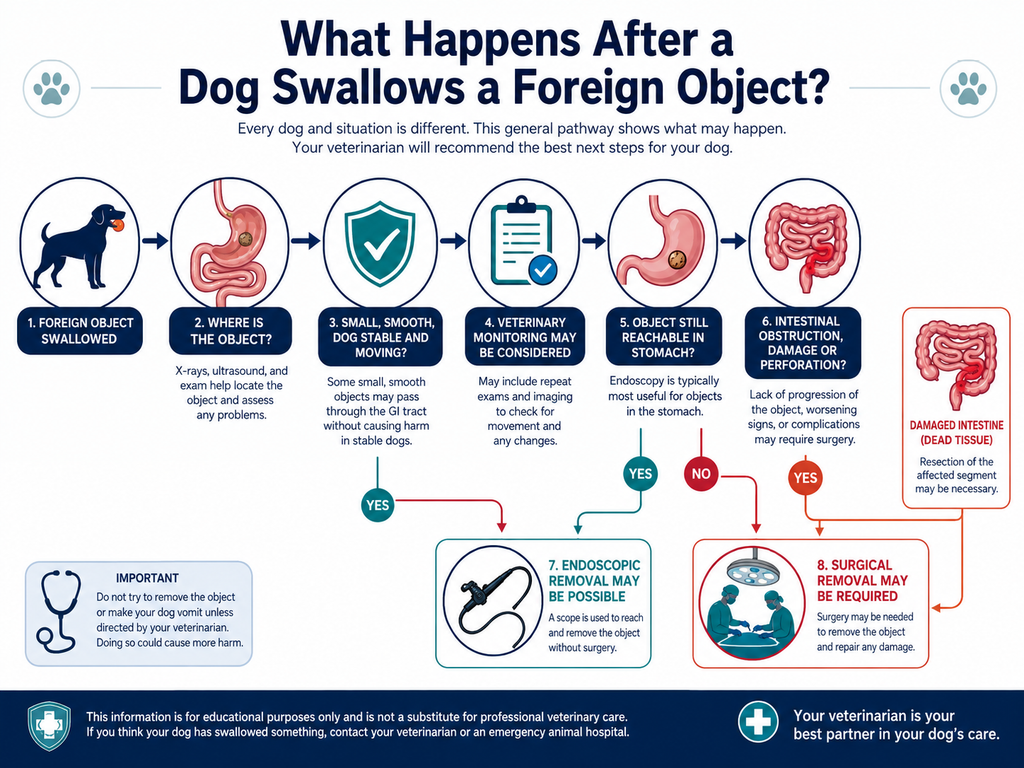
The treatment your dog needs depends mainly on where the foreign object is, what it is made of, whether it is causing an obstruction, and whether the surrounding tissue is damaged. Your veterinarian may use your dog’s symptoms, physical examination, X-rays or ultrasound, and sometimes bloodwork to make that decision.
Monitoring may be considered when a small, smooth object is not causing a complete obstruction and your dog is clinically stable. In these cases, your veterinarian may use repeat imaging to confirm that the object is moving through the digestive tract. If it stops moving or your dog’s condition worsens, surgery may become necessary.
Endoscopy may be an option when the object is reachable, particularly when it is still in the stomach. If endoscopic removal is unsuccessful or the object has moved beyond the reachable area, surgery may be required.
If the intestine is obstructed, perforated, or significantly damaged, surgical removal—and sometimes intestinal resection—may be necessary.
Where Is the Object? The Location Can Change the Cost
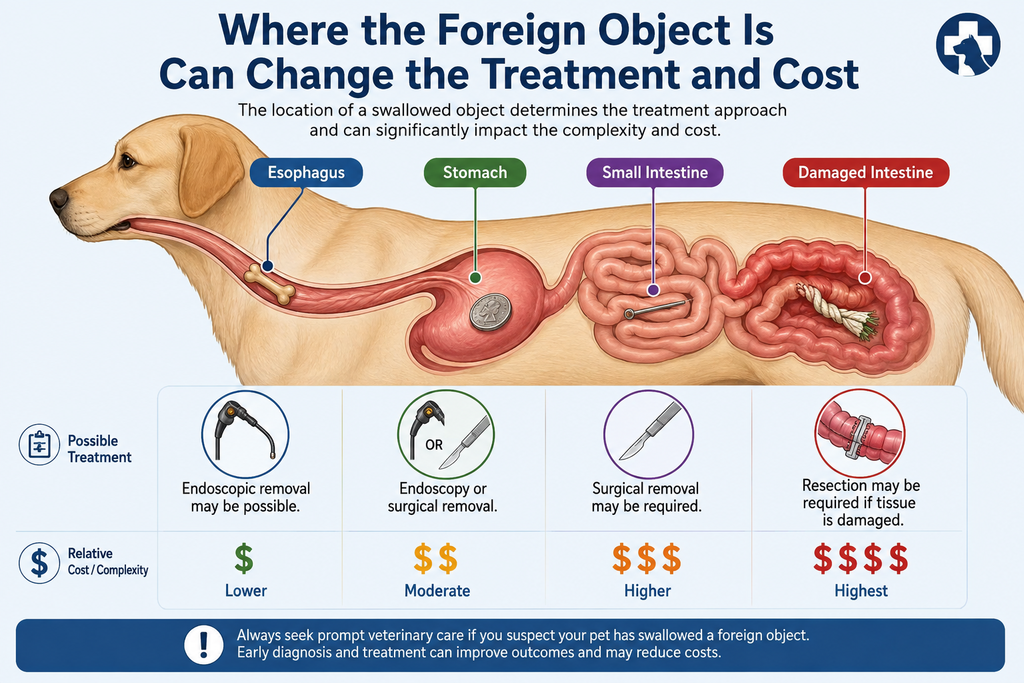
The location of the swallowed object can have a major effect on both the treatment and the final vet bill. An object lodged in the esophagus may sometimes be removed with an endoscope, while an object still in the stomach may also be reachable endoscopically in appropriate cases. If the object has moved into the small intestine and is causing an obstruction, abdominal surgery may be necessary.
The situation can become significantly more expensive if the object has damaged the intestinal wall. Reduced blood supply, tissue death, perforation, peritonitis, or infection may require the veterinarian to remove the damaged section of intestine and reconnect the healthy ends.
In practical terms, where the object is located can determine whether your dog needs monitoring, endoscopy, a simpler surgical removal, or a more complicated intestinal resection. That difference can move a case from a relatively straightforward procedure to a much larger emergency bill.
Endoscopy vs. Surgery: Which Does Your Dog Need?
| Factor | Endoscopy | Surgery |
|---|---|---|
| Where it works | Only if the object is still in the stomach | Stomach or intestine, any location |
| Typical cost | $1,500–$2,800 | $2,000–$8,500 depending on complexity |
| Invasiveness | No abdominal incision | Requires an incision (gastrotomy or enterotomy) |
| Recovery time | Faster, often 1–2 days | 2–7 days depending on severity |
| Availability | Requires specific equipment — not every clinic has it | Available at most general practice and emergency hospitals |
| When it’s not an option | Once the object moves into the intestine | Always an option regardless of location |
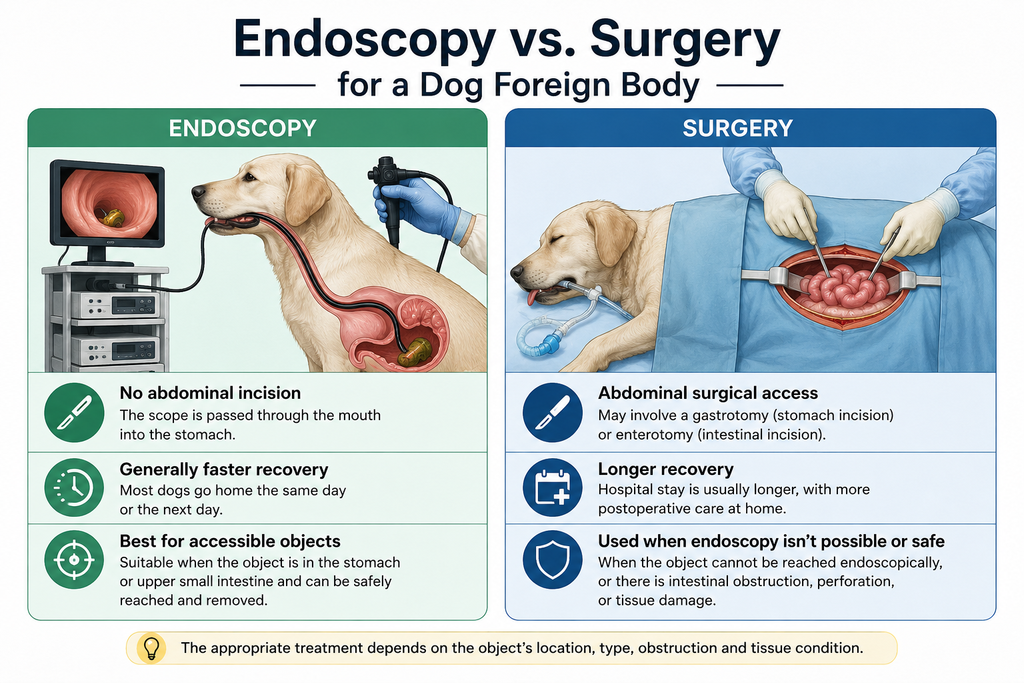
Endoscopy isn’t a universal alternative — it only works within a specific window, while the object is still accessible in the stomach. Once it passes into the intestines, endoscopy generally can’t reach it, and surgery becomes the only path forward. Not every clinic has endoscopy equipment on-site either, so even when it’s medically appropriate, it may mean a referral to a hospital that offers it. For full endoscopy pricing details on its own, see our dedicated dog endoscopy cost guide.
Read Related Guide… Dog Endoscopy Cost in the USA (2026): Complete Guide to Real Prices, Hidden Fees & What Comes Next
Can a Dog’s Foreign Body Pass on Its Own?
Sometimes, but not every swallowed object is safe to watch at home. Small, smooth objects that are not causing a complete obstruction may pass through a dog’s gastrointestinal tract without surgery. In carefully selected cases, a veterinarian may recommend hospitalization, fluids, observation, and repeat X-rays to confirm that the object is continuing to move through the digestive tract.
Whether an object can pass depends on several factors, including its size, shape, material, location, and whether it is already causing an obstruction. A small, smooth object may have a reasonable chance of passing, while larger objects, sharp items, bones, or objects that become lodged in the stomach or intestine can create a blockage. Linear objects such as string, ribbon, or thread are particularly concerning because they can damage or perforate the intestinal wall as the intestines continue moving.
The location of the object also matters. A foreign body that remains in the stomach may sometimes be retrieved endoscopically, while an object farther down the intestinal tract may require surgical removal if it cannot progress.
Do not assume that an object will pass simply because your dog seems normal. Gastrointestinal obstruction can become serious, and symptoms such as repeated vomiting, loss of appetite, abdominal pain, lethargy, or dehydration warrant prompt veterinary evaluation.
If your veterinarian chooses monitoring, they may use serial X-rays to confirm that the object is moving. MSD Veterinary Manual notes that if a monitored object fails to progress within about 36–48 hours, or your dog’s condition deteriorates, surgical removal may become necessary.
What Drives the Price Up or Down?
Five factors explain most of the difference between a $2,000 bill and an $8,000 one: time since ingestion, object location, object type, tissue damage, and hospitalization length.
Time since ingestion matters more than almost anything else — the longer an object sits, the more likely it’s caused tissue damage or moved further into the GI tract, complicating both the procedure and recovery. Object location (stomach vs. intestine) determines whether endoscopy is even possible, which alone can be a $1,000+ cost difference. Object type changes the risk profile — a smooth, solid object is generally more straightforward to remove than a linear object like string or yarn, which can saw through tissue at multiple points as the body tries to pass it. Tissue damage is what turns a simple removal into a resection, adding surgery time, risk, and recovery length. Hospitalization length adds up separately — a same-day endoscopy might mean no overnight stay, while a complicated surgery can mean 3–7 days of inpatient monitoring at $150–$400 per day.
What’s Actually Included in the Bill?
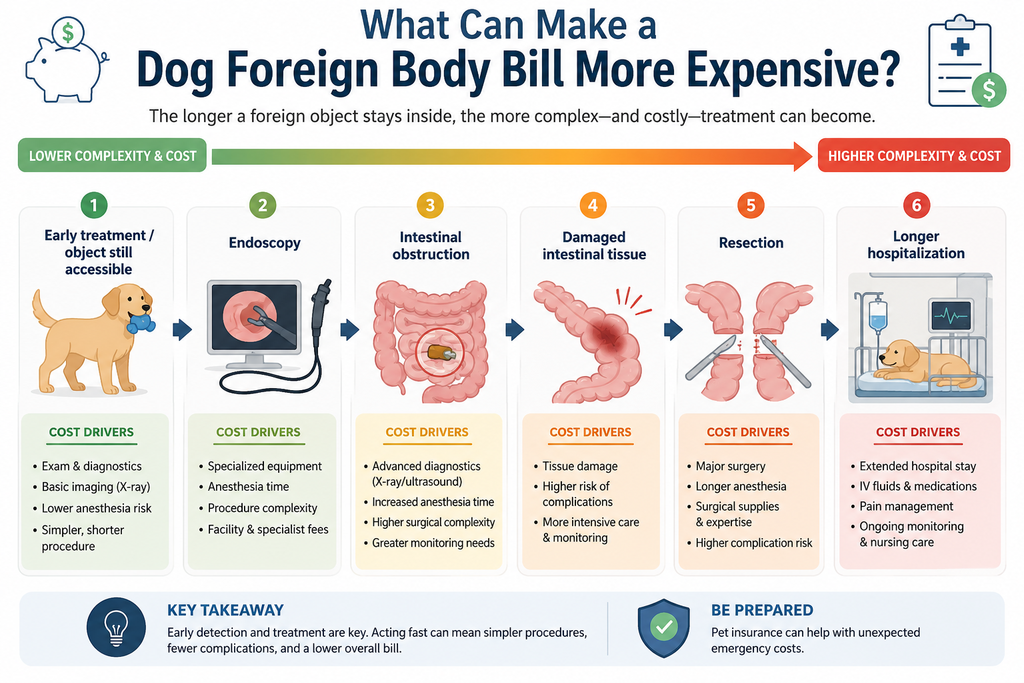
The quoted “surgery cost” rarely reflects your full invoice — a complete foreign body case typically bundles several categories.
Diagnostics come first: an exam ($100–$300), X-rays or ultrasound to locate the object ($200–$500), and pre-surgical bloodwork ($100–$250). Anesthesia and the procedure itself — endoscopy or surgery — form the largest single line item. Hospitalization covers IV fluids, pain management, and monitoring for however long your dog stays inpatient. Medications — antibiotics, anti-nausea drugs, pain relievers — continue after discharge.
Read Related Article… Dog Surgery Cost in the USA: Real Prices for 2026
What Can Make the Final Vet Bill Higher Than the Initial Estimate?
The estimate you receive before your dog’s foreign body procedure is usually based on what the veterinarian knows at that moment. The final bill can increase if the vet discovers complications or your dog needs additional treatment during hospitalization.
The Intestine Is Damaged
One of the biggest reasons a foreign body case becomes more expensive is damaged intestinal tissue. If part of the intestine has lost blood supply, become severely damaged, or perforated, the veterinarian may need to remove that section and reconnect the healthy ends. This is more complex than simply removing the object and can require additional surgery and monitoring.
The Procedure Is More Complicated Than Expected
The initial plan may change once the veterinarian locates the foreign object. A straightforward removal may become more involved if the object is lodged tightly, there are multiple foreign bodies, or the surgeon finds additional areas of concern. Linear objects such as string or yarn can be particularly complicated because they can damage multiple sections of the intestine.
Your Dog Needs Longer Hospitalization
Hospitalization before or after surgery can significantly affect the final cost. Dogs with dehydration, electrolyte abnormalities, pain, infection, or other complications may need additional fluids, medications, monitoring, or supportive care before they are ready to go home. CareCredit lists hospitalization time as one of the factors that can change the final price of intestinal blockage surgery.
Additional Diagnostics or Treatment Are Needed
X-rays, ultrasound, bloodwork, IV fluids, anesthesia, medications, and other supportive treatments can add to the total invoice. An emergency case may also require additional diagnostic testing when the initial information is not enough to determine the object’s location or the condition of the intestine.
Before approving treatment, ask your veterinarian for both a low-end and high-end estimate and ask what circumstances could push the final bill toward the higher end.
When Is It More Than a Simple Removal?
Some cases require more than pulling out one object — and this is where costs climb fastest.
If the object has caused tissue damage from lost blood supply, your vet may need to remove a section of intestine (resection) rather than just extracting the object, which meaningfully raises both cost and recovery time. A linear foreign body — string, thread, tinsel — can require multiple incisions if it’s caused damage at several points along the intestine as the body tried to move it. If infection or perforation has occurred, your dog may need extended ICU monitoring and a longer hospital stay. For the full breakdown of severity-based pricing once a case moves into this territory — including specific enterotomy and resection cost tiers — see our dedicated dog intestinal blockage surgery cost guide.
Read Related Guide… Dog Intestinal Blockage Surgery Cost: $2,000–$10,000 (2026)
Does Pet Insurance Cover Foreign Body Surgery?
Foreign-body removal is often eligible for coverage under accident or accident-and-illness policies when the ingestion occurred after enrollment and applicable waiting periods. However, coverage, exclusions, deductibles and reimbursement depend on the specific policy.
Reimbursement depends on your specific policy terms: your deductible applies first, then your reimbursement percentage (commonly 70–90%) applies to the remaining eligible costs. On a $4,000 bill with a $500 deductible and 90% reimbursement, for example, roughly $3,150 would come back to you — though actual outcomes always depend on your individual policy. The main exclusion to watch for is timing: if the object was swallowed before your policy’s waiting period ended, the claim can be treated as ineligible.
Read Related Article… Pet Insurance for Dogs in the USA: How It Works (2026)
Can You Get Pet Insurance After Your Dog Swallowed Something?
Yes, you can still buy pet insurance after your dog has swallowed a foreign object, but you generally cannot buy a new policy and use it to pay for that existing incident. Pet insurance companies typically exclude injuries or conditions that existed, showed symptoms, or were treated before the policy became effective or during the applicable waiting period.
If your dog swallowed a sock, toy, bone, or another object before you enrolled, the resulting examination, imaging, endoscopy, surgery, hospitalization, and related treatment would generally be considered part of an existing or pre-existing claim and may not be eligible for reimbursement.
Read Related Article… Does Pet Insurance Cover Pre-Existing Conditions? The Truth Most Pet Owners Learn Too Late (2026)
However, getting insurance can still protect your dog against new, unrelated accidents and illnesses in the future. Some accident-only and accident-and-illness policies specifically cover accidental foreign-object ingestion when it occurs after coverage begins and after any applicable waiting period. For example, current policy materials from MetLife explicitly list foreign-body ingestion as an accident when the policy’s coverage requirements are met.
Waiting periods matter. Policies can have different waiting periods for accidents, illnesses, and certain conditions, and the rules vary by insurer and state.
Read Related Article… Pet Insurance Waiting Period: How Long Before Coverage Starts? (2026 Guide)
There is another important issue if your dog has swallowed foreign objects before. Some policies may look at previous or repeated foreign-body ingestion when determining whether a future claim is related to a pre-existing condition or behavioral issue. Policy wording can differ significantly, so read the exclusions carefully before enrolling.
If you’re buying insurance after an emergency, don’t assume the policy will reimburse the current vet bill. Instead, ask the insurer in writing:
- When does accident coverage begin?
- Is there an accident waiting period?
- How does the policy define a pre-existing condition?
- Could previous foreign-body ingestion affect future claims?
- Are future unrelated emergencies still eligible for coverage?
The safest approach is to treat pet insurance as protection for future eligible veterinary expenses, not as a way to retroactively pay for an emergency that has already happened.
What If You Can’t Afford the Surgery?
If the estimate is more than you can cover right now, tell the vet team directly and immediately — this is a common conversation, and most emergency and general practice hospitals have real options they don’t always volunteer unprompted.
Read Related Article… Vet Payment Plans: Can You Make Monthly Payments to a Vet? (2026)
Ask about CareCredit or Scratchpay — both can approve within minutes and pay the clinic directly. Ask whether the hospital offers an internal payment plan or accepts a partial deposit to start treatment while you arrange the rest. Ask whether non-surgical monitoring is a medically reasonable option for your dog’s specific case, since some objects can pass on their own under close observation. For the complete list of financing options, grant programs, and questions to ask before agreeing to treatment, see our full guide on what to do if you can’t afford emergency vet surgery.
Read Related Article… Can’t Afford an Emergency Vet Bill? 15 Real Ways Dog Owners Find Help (2026)

Questions to Ask the Vet Before You Agree to Treatment
- Is endoscopy an option, or has the object already moved into the intestine?
- Is this quote all-inclusive, or are diagnostics and hospitalization separate?
- What’s the estimate if the tissue is healthy vs. if resection is needed?
- How long is my dog likely to be hospitalized?
- Is my dog a candidate for non-surgical monitoring instead?
- Do you accept CareCredit or Scratchpay?
- What symptoms should bring us back in urgently after discharge?
Frequenlty Asked Questions
How much does dog foreign body surgery cost without insurance?
Dog foreign body surgery typically costs about $1,500 to $8,500 without insurance, with many straightforward cases falling around $2,000 to $5,000. Endoscopic removal may cost less when the object is still reachable, while intestinal obstruction, tissue damage, bowel resection, longer hospitalization, or complications can push the bill toward the higher end. Actual prices vary by location, emergency hospital, procedure, and your dog’s condition. Current U.S. cost sources show substantial variation because foreign-body cases can range from simple retrieval to complex intestinal surgery.
Is endoscopy cheaper than surgery for a dog that swallowed something?
Often, yes, when endoscopy is medically appropriate. Current U.S. estimates commonly put gastrointestinal endoscopy for foreign-body retrieval around $1,200 to $3,000, while surgical removal can cost several thousand dollars more when an intestinal obstruction or tissue damage is involved. Endoscopy is generally most useful when the object is accessible, particularly in the stomach or upper gastrointestinal tract; it is not a suitable replacement for surgery in every case.
How do I know if my dog needs surgery or if the object might pass on its own?
Your veterinarian should make that decision based on the object’s size, shape, location, your dog’s symptoms, and imaging findings. Some stable dogs with small, smooth objects may be monitored under veterinary supervision, while an obstruction, worsening symptoms, sharp or dangerous objects, or evidence of intestinal damage may require urgent intervention. Do not try to make your dog vomit or wait for an object to pass without veterinary guidance.
How much does it cost if my dog needs emergency treatment after swallowing something?
The total emergency bill can be much higher than the surgery fee alone. You may pay for the emergency exam, X-rays or ultrasound, bloodwork, IV fluids, anesthesia, endoscopy or surgery, hospitalization, medications, and follow-up care. Current U.S. emergency-veterinary cost guides put serious foreign-body or obstruction cases anywhere from roughly $800 to $7,000+, with complicated cases potentially exceeding that range.
Does pet insurance cover dog foreign body surgery?
Many accident and accident-and-illness pet insurance policies can cover eligible foreign-body ingestion, but coverage is not automatic. The incident generally needs to occur after the policy becomes effective and after any applicable waiting period, and reimbursement depends on the policy’s deductible, reimbursement percentage, annual limits, exclusions, and claim rules. Some policies also have specific restrictions involving repeated foreign-body ingestion or prior behavioral patterns.
Can I get pet insurance after my dog swallowed something?
You can usually buy pet insurance after the incident, but a new policy generally will not pay for the emergency that already happened. The swallowed object, related symptoms, diagnostics, surgery, hospitalization, and treatment may be considered part of an existing or pre-existing condition. Insurance may still help with eligible, unrelated accidents and illnesses that occur after coverage begins and applicable waiting periods are satisfied.
What should I ask the vet before agreeing to foreign body surgery?
Ask for a written estimate and clarify:
- Is endoscopy medically possible?
- Where exactly is the object located?
- What is the estimate if the intestine is healthy?
- What happens to the cost if intestinal resection is needed?
- Are X-rays, ultrasound, anesthesia, medications, and hospitalization included?
- How long is my dog expected to stay in the hospital?
- What is the low-end and high-end estimate?
- What financing or payment options does the hospital accept?
Getting the low and high estimates before treatment can help you understand the financial range without delaying medically necessary care.
External Authority Sources
- Merck Veterinary Manual — Gastrointestinal Foreign Bodies
- AVMA (American Veterinary Medical Association)
- PetMD — Foreign Body Ingestion in Dogs
- NAPHIA
- MetLife – Pet claims data
Disclaimer: This article is for informational and educational purposes only. Cost data reflects 2026 national averages and will vary based on your dog’s size, breed, location, and the specific case. PetInsurePrime does not sell pet insurance and receives no compensation from any insurance provider. Always compare estimates and consult your veterinarian directly about your dog’s individual case.
PetInsurePrime | Independent • Research-Based | Helping US dog owners understand real vet costs and coverage options — without the sales pressure.