
Updated: November 2026| Reading Time: 17minutes
Yes, you can generally switch pet insurance after filing a claim, and you can usually switch at any time. But switching means buying a brand-new policy, not transferring your old one. Conditions that your old policy covered may be treated as pre-existing by the new insurer, waiting periods typically restart, and your deductible progress doesn’t come with you.
The real question isn’t whether you’re allowed to switch. It’s what happens to your existing, pending, and future claims when you do.
Quick Answer : Can You Switch Pet Insurance After a Claim
Yes. Pet owners can generally switch providers after filing a claim, and at any point in the policy term. Claims for treatment your pet received while the old policy was active generally stay with the old insurer. The new insurer isn’t responsible for them, and coverage under the new policy starts on its own effective date, subject to its own terms, exclusions, and waiting periods.
Table of Contents
- Can You Switch Pet Insurance After Filing a Claim?
- What Happens to Your Pet’s Previous Claim When You Switch Insurance?
- Can You Still Get Reimbursed After Canceling Your Old Pet Insurance?
- 5 Costly Mistakes to Avoid When Switching Pet Insurance After a Claim
- Will Filing a Pet Insurance Claim Increase Your Premium?
- Can Your Pet Insurance Company Cancel or Refuse to Renew Your Policy After a Claim?
- What Happens to Pre-Existing Conditions When You Change Pet Insurance?
- Do Pet Insurance Waiting Periods Restart When You Switch Providers?
- How to Switch Pet Insurance After a Claim Without Losing Coverage
- What if a new insurer rejects your application?
- Is It Worth Switching Pet Insurance After Filing a Claim?
- Can you change plans with the same insurer?
- What Should You Ask Before Switching Pet Insurance Companies?
- Frequently Asked Question
Can You Switch Pet Insurance After Filing a Claim?
Yes. You can generally switch pet insurance providers after filing a claim, even if your current policy term hasn’t ended. However, switching means purchasing a new policy rather than transferring your existing coverage. Your new insurer will apply its own exclusions, deductibles, and waiting periods.
What happens next depends on your claim status:
- Approved claim: Your previous insurer generally remains responsible for eligible treatment received while the old policy was active.
- Pending claim: Submit outstanding documents to your current insurer and confirm its claim submission deadlines before canceling.
- Denied claim: You can still apply with another provider, but the medical condition behind the denial may be considered pre-existing.
Before switching, review your pet’s medical history, compare the new policy’s exclusions, and confirm its effective date. A lower monthly premium may not be worth losing coverage for an existing health condition.
What Happens to Your Pet’s Previous Claim When You Switch Insurance?
Does Your Old Pet Insurance Still Pay a Pending Claim?
Generally yes, for treatment that happened while the old policy was active. Pending claims usually stay with the old insurer, so file outstanding claims before you cancel and confirm in writing that they’re being processed. Check your old policy’s rules on filing deadlines and on claims submitted after cancellation.
Keep copies of the final invoice, your pet’s medical records, and the claim confirmation. You can ask the old insurer for a status update at any time.
Can a Denied Pet Insurance Claim Affect Your New Policy?
A denied claim doesn’t automatically mean a future insurer will reject you. What matters is the underlying history: symptoms, diagnosis, and treatment. A new insurer reviews your pet’s veterinary records and may exclude any condition it considers pre-existing, whether or not your old insurer denied the claim.
Read Related Article… How to Appeal a Denied Pet Insurance Claim: Step-by-Step Guide to Improve Your Chances (2026)
A denial and a pre-existing exclusion are different things. A claim can be denied for reasons unrelated to your pet’s history, like a policy limit or a non-covered service. But if the denial came from a pre-existing finding, switching won’t fix it.
Read Related Article… Why Was My Pet Insurance Claim Denied? 5 Common Reasons (And How to Fix Them)
Can You Still Get Reimbursed After Canceling Your Old Pet Insurance?
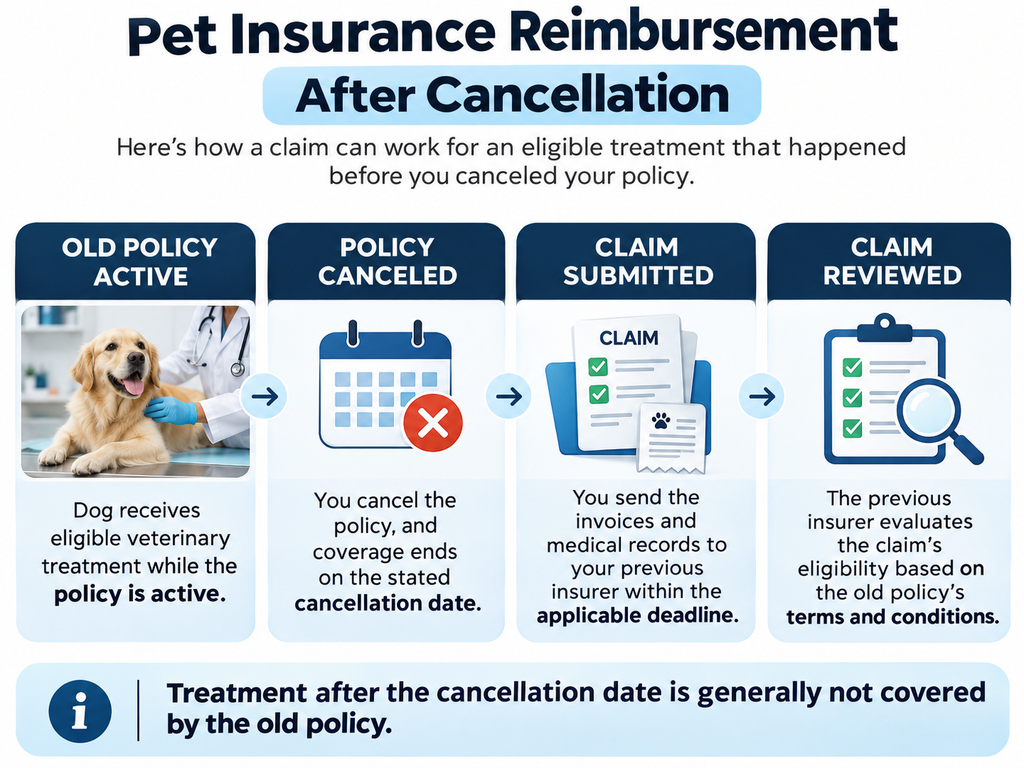
Yes. You may still be eligible for reimbursement after canceling your pet insurance if your pet received the treatment while the policy was active. Canceling coverage does not automatically eliminate your right to submit a claim for eligible expenses incurred before the cancellation date. However, your insurer’s claim submission deadline and policy terms still apply. For example, AKC Pet Insurance allows eligible claims to be submitted after cancellation as long as the treatment occurred during the coverage period. Other insurers may require outstanding claims to be submitted within a specific period after cancellation. Keep copies of veterinary invoices, medical records, prescriptions, and claim documents, and confirm the deadline directly with your previous insurer. Remember, treatment received after the cancellation effective date generally won’t be covered under your old policy. If reimbursement is still pending, check the claim status and obtain written confirmation before closing your account.
5 Costly Mistakes to Avoid When Switching Pet Insurance After a Claim
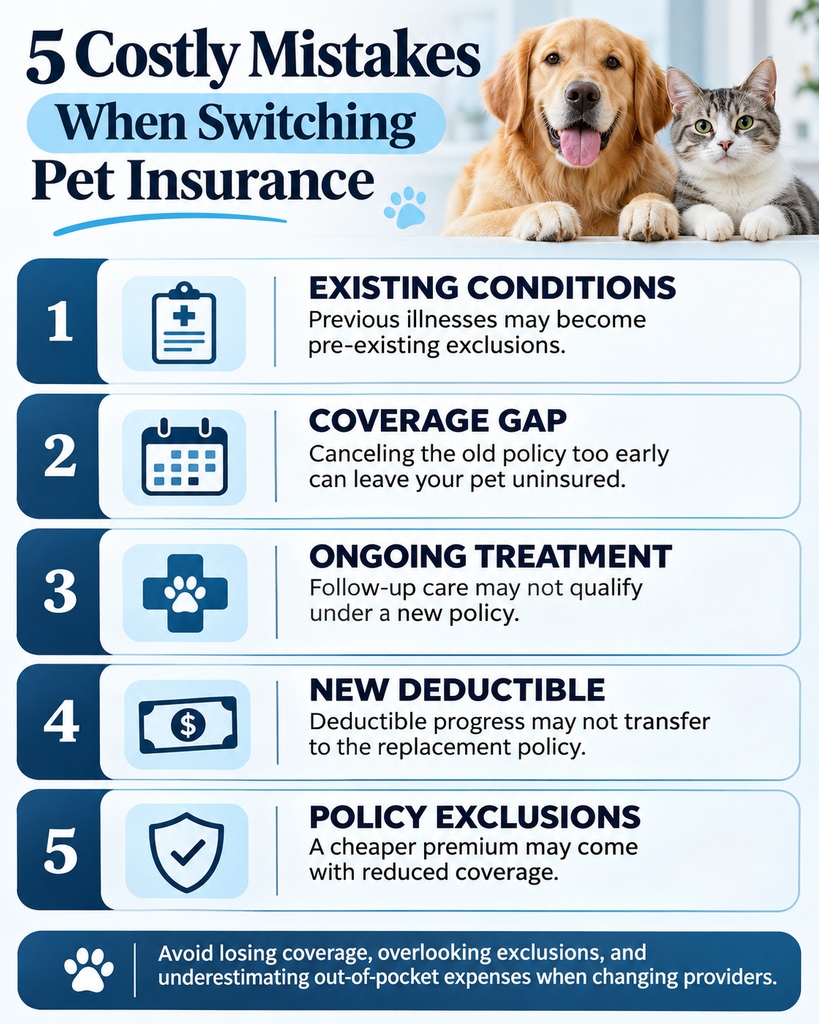
Mistake 1: Assuming Your Pet’s Existing Condition Will Stay Covered
Switching doesn’t carry coverage for a condition forward. A pre-existing condition is a health issue that showed signs, was diagnosed, or was treated before the new coverage began, and most policies exclude those. Previously diagnosed illnesses, chronic conditions, and recurring treatments are the highest-risk categories. Records and symptom history drive the decision.
Example: A dog’s ACL injury was covered under the old policy. The owner switches to a cheaper insurer, which treats the ACL history as pre-existing. Some policies also treat the other knee as related to the first, so a second injury could be excluded too.
A few insurers may cover certain curable conditions after a symptom-free period. That’s carrier-specific and doesn’t help active or chronic problems.
Mistake 2: Canceling Your Old Policy Before New Coverage Starts
Cancel the old policy before the new one is active and you create a coverage gap. The new policy has an effective date, and accident, illness, and sometimes orthopedic waiting periods run from that date. Anything that happens during the waiting period is generally treated as excluded, and you’d pay for it yourself.
Many guides recommend keeping the old policy until the new coverage is fully active, even if that means paying for both temporarily. Overlap avoids a gap, but it doesn’t make an old condition eligible under the new contract.
Verify the new policy’s start date and read the documents before you cancel anything.
Mistake 3: Assuming Pending or Future Treatment Will Be Covered
A pending claim for past treatment is different from future treatment. If your pet’s treatment continues after the switch, such as follow-up visits, prescriptions, or recurring care, the new insurer may call it an ongoing condition and deny related expenses.
Disclose your pet’s full medical history to the new insurer. Leaving something out may feel like a shortcut, but it can put a claim at risk later.
Mistake 4: Ignoring the New Deductible and Out-of-Pocket Costs
Your deductible and annual limit progress reset when you change insurers. Whatever you’ve paid toward this year’s deductible doesn’t transfer.
Illustrative example: A $2,000 eligible vet bill, 80% reimbursement.
| Old Plan (deductible already met) | New Plan ($500 deductible) | |
|---|---|---|
| Eligible bill | $2,000 | $2,000 |
| Amount after deductible | $2,000 | $1,500 |
| Reimbursement (80%) | $1,600 | $1,200 |
| Your share | $400 | $800 |
The $400 difference is the cost of the reset, and a lower monthly premium can easily be eaten up by it. Also compare reimbursement percentage, annual limit, exam fees, and prescription coverage, not just the premium.
Mistake 5: Choosing a Cheaper Plan Without Comparing Exclusions
A cheaper plan often cuts coverage in places that matter for a pet with a history. Compare:
| What to Compare | Why It Matters |
|---|---|
| Hereditary and congenital conditions | Some policies exclude them |
| Chronic illness exclusions | Recurring conditions can be carved out |
| Bilateral conditions | A second joint may be treated as related to the first |
| Orthopedic waiting periods | Some carriers add longer waits (one comparison cites around six months at some), while others don’t |
| Prescriptions and rehabilitation | Often limited or excluded |
| Policy-specific exclusions | Read the exclusions page, not just the summary |
Will Filing a Pet Insurance Claim Increase Your Premium?

Filing a pet insurance claim does not automatically mean your monthly premium will increase. However, some insurers may consider your pet’s claim history when calculating renewal premiums, while others state that claims do not affect pricing. Premium changes can also depend on factors such as your pet’s age, breed, location, coverage level, and rising veterinary costs. For example, MetLife Pet states that its premiums do not increase based on claim history, whereas other policy disclosures may allow claims history to influence pricing. Before submitting a claim, check your policy documents or ask your insurer whether filing claims can affect future premiums. Also, review your renewal notice carefully to understand why your premium has changed. The rules and disclosure requirements can vary by state, so never assume that every pet insurance company follows the same pricing practices.
Can Your Pet Insurance Company Cancel or Refuse to Renew Your Policy After a Claim?
Filing a pet insurance claim does not automatically mean your insurer can cancel or refuse to renew your policy. However, cancellation and nonrenewal rules vary by state and insurance provider.
Some policies may consider claim history when determining renewal premiums or coverage. Check your policy documents to understand your rights and any applicable notice requirements.
If your insurer threatens to cancel or not renew your policy, ask for the specific reason in writing before making any decisions.
What Happens to Pre-Existing Conditions When You Change Pet Insurance?
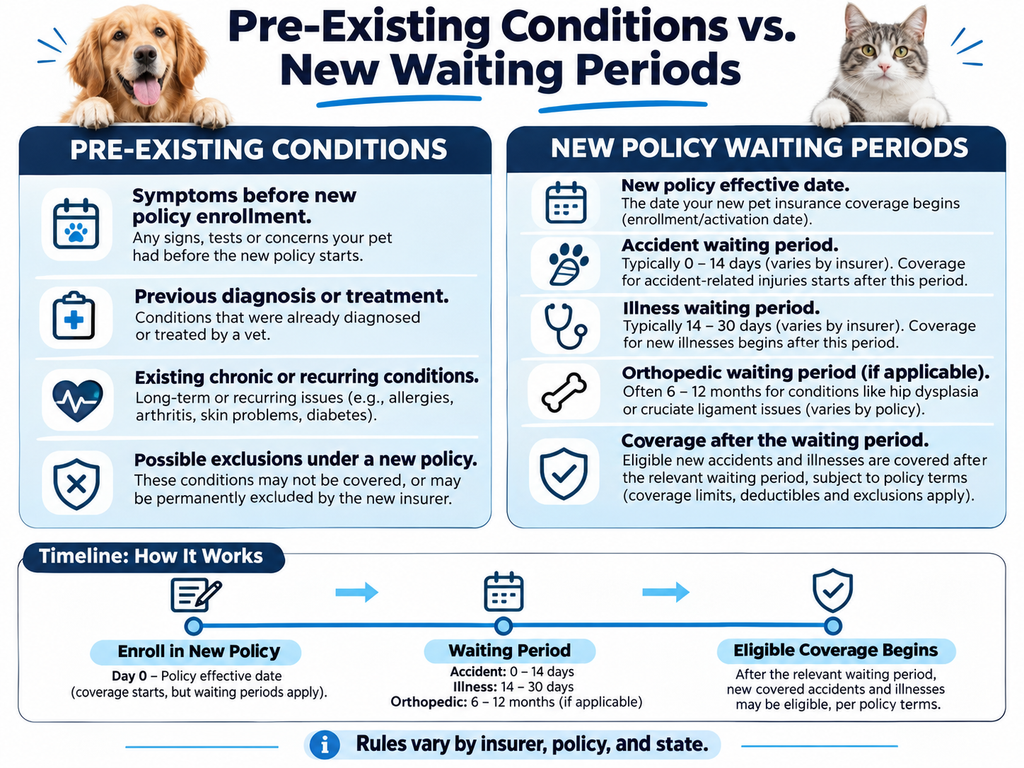
This is the heart of the switching question: switching insurance and transferring coverage for a condition are two different things.
- Records review. A new insurer reviews your pet’s veterinary records, either at enrollment or when you file a claim. Look-back windows are commonly in the range of 12 to 24 months.
- Symptoms vs. diagnosis. Signs your vet noted earlier can count as pre-existing even if no diagnosis was made.
- Previously treated conditions. Anything diagnosed or treated before the new coverage began is typically excluded.
- Curable vs. incurable. Some insurers may reinstate coverage for curable conditions after a symptom-free period. Chronic or incurable conditions generally stay excluded.
- Can a condition covered by your old insurer be covered by the new one? Generally no. The new policy starts fresh.
Rules differ by insurer. MetLife, for example, describes a special arrangement where, if you switch to a MetLife Pet policy through your employer, it may continue coverage for pre-existing conditions already covered by another provider. That’s one insurer’s employer-sponsored program, not a universal rule.
Read Related Article… Does Pet Insurance Cover Pre-Existing Conditions? The Truth Most Pet Owners Learn Too Late (2026)
Do Pet Insurance Waiting Periods Restart When You Switch Providers?
Typically yes. A new policy has its own waiting periods, regardless of how long you were covered before.
- Accident waiting periods are usually short. MetLife Pet, for example, lists 0 days.
- Illness waiting periods are commonly around two weeks. MetLife lists 14 days.
- Orthopedic waiting periods vary. MetLife lists none beyond the illness wait, while some carriers add much longer ones.
- Condition-specific waiting periods may apply as well.
Some insurers offer waivers after a veterinary exam, so ask. Anything that develops during the waiting period is generally excluded.
Illustrative timeline, not a promise. Actual waiting periods depend on the insurer, policy, and state rules.
- Day 1: Apply for new insurance.
- New policy effective date: Coverage begins, subject to its terms and exclusions.
- Waiting period: Certain illnesses or injuries aren’t yet covered.
- Waiting period complete: Eligible new conditions may qualify for coverage.
A condition that appears during the waiting period can be treated as pre-existing even if you kept your old policy active at the time.
Read Related Article… Pet Insurance Waiting Period: How Long Before Coverage Starts? (2026 Guide)
How to Switch Pet Insurance After a Claim Without Losing Coverage
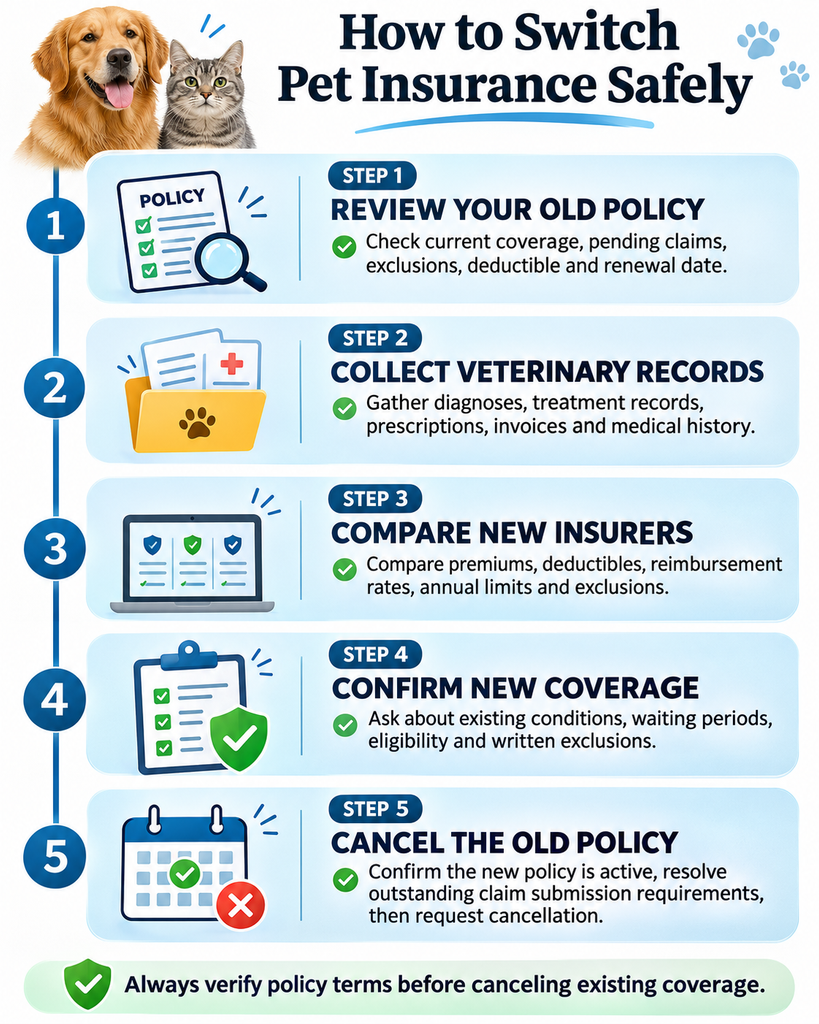
Step 1: Review Your Current Policy and Claim Status
Check your current coverage, pending and approved claims, existing exclusions, your deductible balance, and your renewal date.
Step 2: Request Your Pet’s Complete Veterinary Records
Ask your vet for the medical history, diagnoses, treatment records, prescriptions, lab and imaging reports, and any claim documentation.
Step 3: Compare New Insurers Before Applying
Compare monthly premium, deductible, reimbursement percentage, annual limits, pre-existing condition rules, and waiting periods.
Step 4: Ask the New Insurer About Your Pet’s Specific Medical History
- Will my pet’s previously diagnosed condition be excluded?
- Will a previously covered condition qualify for continued coverage?
- Do waiting periods restart?
- Are follow-up treatments covered?
- Can you confirm applicable exclusions in writing?
Some insurers also require a recent exam or records at enrollment. See our guide to [pet insurance without a vet exam].
Step 5: Confirm New Coverage Before Canceling the Old Policy
- Verify the effective date.
- Read the policy documents.
- Confirm outstanding claims with the old insurer.
- Get written confirmation of cancellation.
- Keep copies of both policies.
Cancel the old policy once the new one is active, and ask about a pro-rated refund.
What if a new insurer rejects your application?
A new pet insurance company may decline your application based on its underwriting guidelines, your pet’s age, medical history, existing health conditions, or other eligibility requirements. This can become a serious concern when you’re switching after a claim, especially if your pet has an ongoing illness or previous injury.
If your application is rejected, don’t cancel your existing policy immediately. First, ask the new insurer for the specific reason for its decision. Find out whether the issue is your pet’s medical history, age restrictions, breed-related eligibility, or another underwriting requirement.
You can also ask whether the insurer would offer coverage with specific condition exclusions instead of rejecting the entire application. If another provider is willing to consider your pet, compare its exclusions, waiting periods, deductibles, and reimbursement limits before applying.
Most importantly, keep your current policy active until you’ve secured suitable replacement coverage. If no alternative offers comparable protection, staying with your existing insurer may be financially safer than switching to a cheaper policy that excludes your pet’s ongoing medical needs.
Is It Worth Switching Pet Insurance After Filing a Claim?
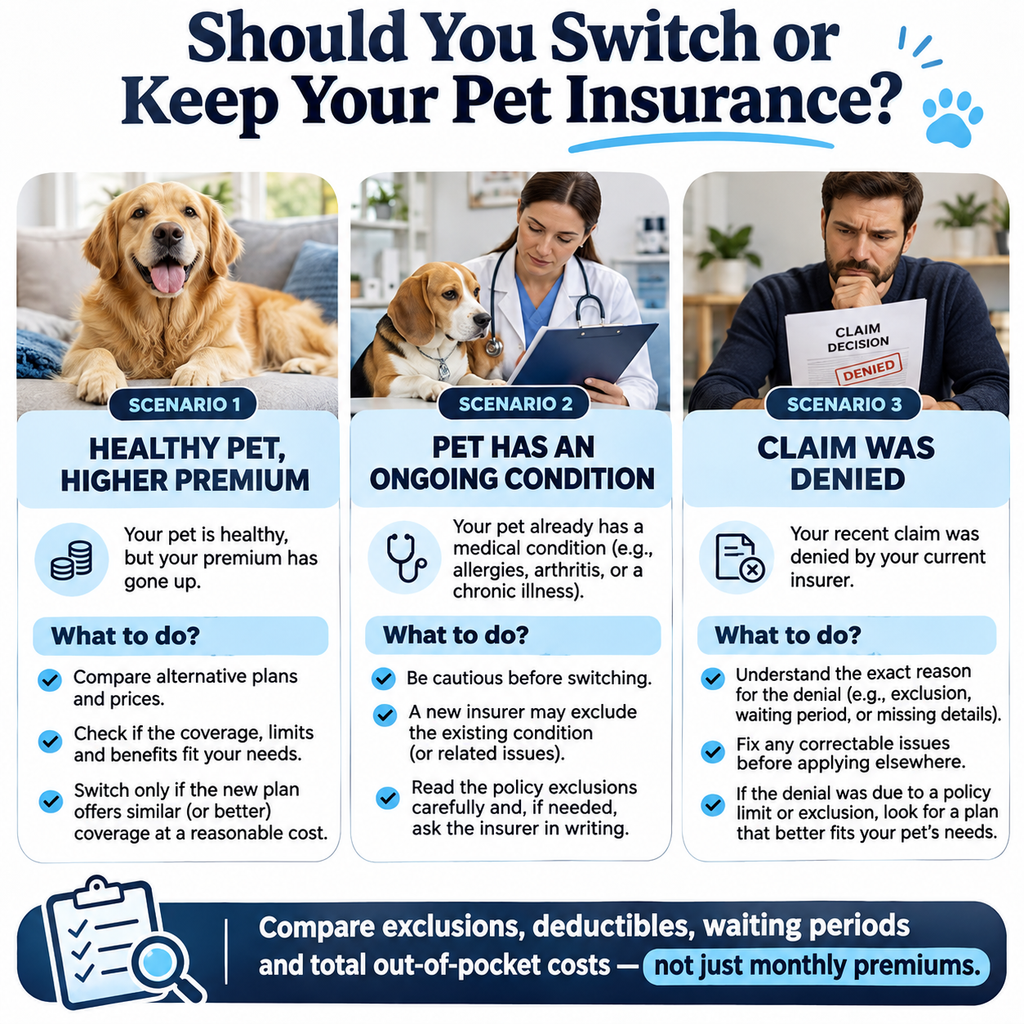
Situation 1: Your Pet Is Healthy and Your Premium Increased
It may be worth comparing, as long as the new policy offers suitable coverage and you’re comfortable with a deductible reset.
Situation 2: Your Pet Has an Ongoing Medical Condition
Switching can be financially risky. The new insurer may exclude the condition entirely, which can cost far more than any premium savings.
Situation 3: Your Current Insurer Denied Your Claim
Understand the exact denial reason first. Switching alone won’t fix an underlying coverage or pre-existing condition issue.
| Factor | Current Policy | New Policy |
|---|---|---|
| Monthly premium | Existing | Quoted |
| Deductible | Remaining balance | New deductible |
| Existing condition | Current coverage terms | New exclusions |
| Waiting periods | Already completed, if applicable | New waiting periods |
| Annual limit | Remaining limit | New limit |
| Pending claims | Old insurer | Not automatically transferred |
Can you change plans with the same insurer?
Depending on the insurer, you may be able to increase your annual coverage limit, lower your deductible, change reimbursement percentages, or remove optional benefits. However, upgrades may require underwriting approval and could introduce new waiting periods or exclusions for previously developed conditions. Downgrading coverage may be easier, but it can reduce future reimbursements. Before making changes, ask your insurer whether your existing conditions will remain covered and whether the adjustment affects your current policy.
What Should You Ask Before Switching Pet Insurance Companies?
- Will my previous claim affect underwriting?
- Which medical conditions will be excluded?
- Will my deductible reset?
- Are there new waiting periods?
- How are ongoing treatments handled?
- Can I get written confirmation of exclusions?
- What happens to claims submitted before cancellation?
- Are there cancellation fees or refund conditions?
Frequently Asked Question
Can I switch pet insurance after filing a claim?
Yes. You can generally switch pet insurance providers at any time. However, claims for eligible treatment received while your old policy was active usually remain with your previous insurer. Your new policy will have separate coverage terms, exclusions, and waiting periods.
Can I change pet insurance if my claim is still pending?
Yes. You can generally switch while a claim is pending. Submit all outstanding documents to your current insurer and confirm how the claim will be handled after cancellation. Check your policy’s claim submission deadlines before ending your coverage.
Can I switch pet insurance after a claim is denied?
Yes. A denied claim does not automatically prevent you from getting a new policy. However, the medical condition behind the denial may be considered pre-existing by another insurer. Review the denial reason before switching.
Will my new pet insurance cover an existing condition?
Generally, no. New insurers typically exclude conditions that showed symptoms, received treatment, or were diagnosed before the new policy started. Some providers may offer exceptions for certain curable conditions after a symptom-free period, depending on their policy terms.
Does switching pet insurance reset the deductible?
Usually, yes. Your deductible progress and annual coverage limits generally do not transfer to a new provider. You may need to meet a new deductible before receiving reimbursements under your replacement policy.
Do waiting periods restart when changing pet insurance?
Usually, yes. A new provider generally applies its own waiting periods for accidents, illnesses, and certain orthopedic conditions. Check these requirements before switching because treatment received during a waiting period may not be covered.
Can a new pet insurance company see previous claims?
A new insurer may review your pet’s veterinary medical records during enrollment or when you submit a claim. These records can reveal previous diagnoses, symptoms, treatments, and medical history that may affect coverage decisions.
Can I have two pet insurance policies at the same time?
You may be able to maintain two policies simultaneously, depending on their terms. However, you will generally pay both premiums, and reimbursement is subject to each policy’s coordination and claim rules. Having two policies does not automatically make pre-existing conditions eligible.
Can I switch pet insurance in the middle of a policy term?
Yes. You can generally change providers before your current policy expires. Before canceling, review your cancellation terms, check for possible fees, and ask whether you qualify for a prorated refund of unused premiums.
Should I cancel my old pet insurance before getting a new one?
No. Apply for the new policy first and confirm its effective date, exclusions, and waiting periods before canceling your existing coverage. This helps reduce the risk of a coverage gap and unexpected veterinary expenses.
External Authority Sources
- MetLife Pet switching page (employer-sponsored continuation example)
- Pets Best guidance on switching providers
- State Department of Insurance / NAIC consumer resources
- NAPHIA (waiting periods and pre-existing conditions)
Disclaimer: This article is for informational and educational purposes only. Policy terms, waiting periods, pre-existing condition rules, and switching programs vary by insurer, plan, and state, and nothing here guarantees a claim outcome. PetInsurePrime does not sell pet insurance and receives no compensation from any insurance provider. Always read your policy documents and confirm terms directly with each insurer before canceling or switching.
PetInsurePrime | Independent • Research-Based | Helping US dog owners understand real vet costs and coverage options — without the sales pressure.
Pingback: Pet Insurance Claim on Hold? 6 Frustrating, Easy Fixes