
Updated: October 2026| Reading Time: 20minutes
Your pet needs treatment, and you’re wondering something very specific: not “can I get a payment plan,” but “can they just treat her now and bill me afterward?” It’s a fair question, and the honest answer is: sometimes, for the right client, at the right clinic — but it’s never something to assume.
Quick Answer : Can a Vet Bill You Later?
Sometimes, depending on the clinic’s policy and your relationship with them — but there’s no universal rule across US veterinary practices. Deferred billing (being treated now and invoiced afterward) is different from financing through a third party like CareCredit. Most clinics default to payment at the time of service, but some extend billing arrangements specifically to established, long-term clients with a reliable payment history. New clients and emergency walk-ins are far less likely to be offered this option.
Cornell University’s veterinary hospital policy illustrates this distinction clearly: new clients must pay at the time of service, while established clients may leave a credit card on file or pay when they receive an invoice by email or mail afterward. This is a real, documented example of deferred billing existing — but only for a specific category of client, not as a general policy anyone can expect.
Table of Contents
- Quick Answer : Can a Vet Bill You Later?
- Do Vets Require Payment Upfront?
- What Happens If You Can’t Pay Your Vet Bill at Discharge?
- Can a Vet Increase Your Bill After Giving You an Estimate?
- Will a Vet Treat Your Pet If You Can’t Pay Right Away?
- Can You Get a Vet Bill After the Visit?
- What If You Disagree With a Vet Bill or Find an Unexpected Charge?
- Do Vets Offer Payment Arrangements for Existing Clients?
- Can a Vet Send an Unpaid Bill to Collections?
- What Should You Ask Your Vet Before Treatment If You Can’t Pay in Full?
- What Can You Do If Your Vet Won’t Let You Pay Later?
- What Is the Difference Between Deferred Billing and Veterinary Financing?
- FAQ
Do Vets Require Payment Upfront?
Most veterinary clinics do require payment at the time of service, particularly for new clients, routine outpatient visits, and emergency care — this is the default across US veterinary medicine, not the exception.
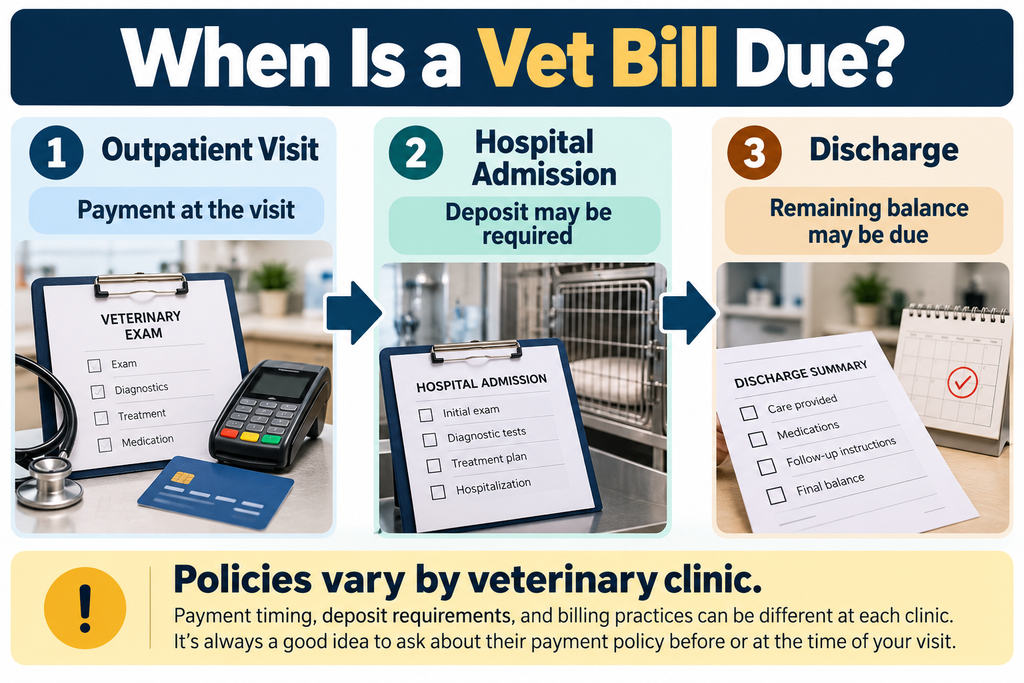
For outpatient visits, this typically means payment at checkout, the same day. For emergency or inpatient treatment, many hospitals require a deposit at admission — commonly a significant percentage of the estimate — with the remaining balance due at discharge. Colorado State University’s veterinary hospital, for example, requires an 80% deposit of the low-end estimate for any estimate over $250, with the account balance due at checkout. Cornell’s Companion Animal Hospital similarly requires at least 50% of the highest estimate at admission, with the remainder due at discharge, and explicitly states they are not able to offer payment plans.
Read Related Article… Emergency Vet vs Regular Vet Cost: How Much More Will You Pay in the USA?
What Happens If You Can’t Pay Your Vet Bill at Discharge?
If you cannot pay the remaining balance when your pet is ready to leave the veterinary hospital, speak with the billing office or practice manager before leaving. Explain how much you can pay now and ask whether the clinic can approve a payment arrangement. Do not assume the clinic will let you take your pet home and pay later; its written financial policy and your individual circumstances will determine what options are available.
Start by asking for a clear breakdown of the amount due. Request an itemized bill showing the examination, diagnostic tests, medications, procedures, hospitalization, payments already made, and any outstanding charges. If the final amount differs from the original estimate, ask the veterinary team to explain the difference and whether additional charges are still pending.
Next, ask what the clinic can offer. Some practices may consider an arrangement for an existing client, while others require the full balance at discharge and do not offer in-house payment plans. You can ask whether a deposit followed by scheduled payments is possible, whether the clinic accepts third-party veterinary financing, or whether any financial assistance is available. Get any approved arrangement in writing, including the amount due, payment dates, fees, and consequences of missed payments.
Policies vary between veterinary hospitals. For example, NC State Veterinary Hospital generally requires payment of the remaining balance when a hospitalized pet is released. It also explains that some charges may be finalized after discharge, with an itemized bill sent following a review period of 10 to 30 days and payment expected within 30 days of receiving that bill. This is a specific hospital policy, not a guarantee that other clinics will offer the same terms.
If the clinic cannot offer deferred billing, ask whether it can discuss medically appropriate treatment options within your budget or direct you to legitimate veterinary financial assistance programs. Be honest about your financial limits rather than agreeing to charges you know you cannot manage.
Before leaving, make sure you understand the outstanding balance, the payment deadline, and whom to contact with billing questions. If you cannot reach an agreement, ask the clinic to explain its policy and the next steps in writing. Taking these steps can help you understand your obligations and avoid confusion about what you owe.
Can a Vet Increase Your Bill After Giving You an Estimate?
Yes. A vet bill can be higher than the original estimate if your pet needs additional tests, medication, treatment, or hospitalization that was not anticipated during the initial examination. A veterinary estimate is generally based on the information available at that time, so the final cost may change as your pet’s condition becomes clearer. Iowa State University Veterinary Hospital, for example, explains that its estimates are not binding quotes and that additional charges may arise during treatment.
However, a higher final bill does not automatically mean every additional charge was properly communicated or authorized. Ask your veterinarian to explain why the cost increased and which services caused the difference. If further treatment is needed and time allows, ask the clinic to contact you with an updated estimate before proceeding.
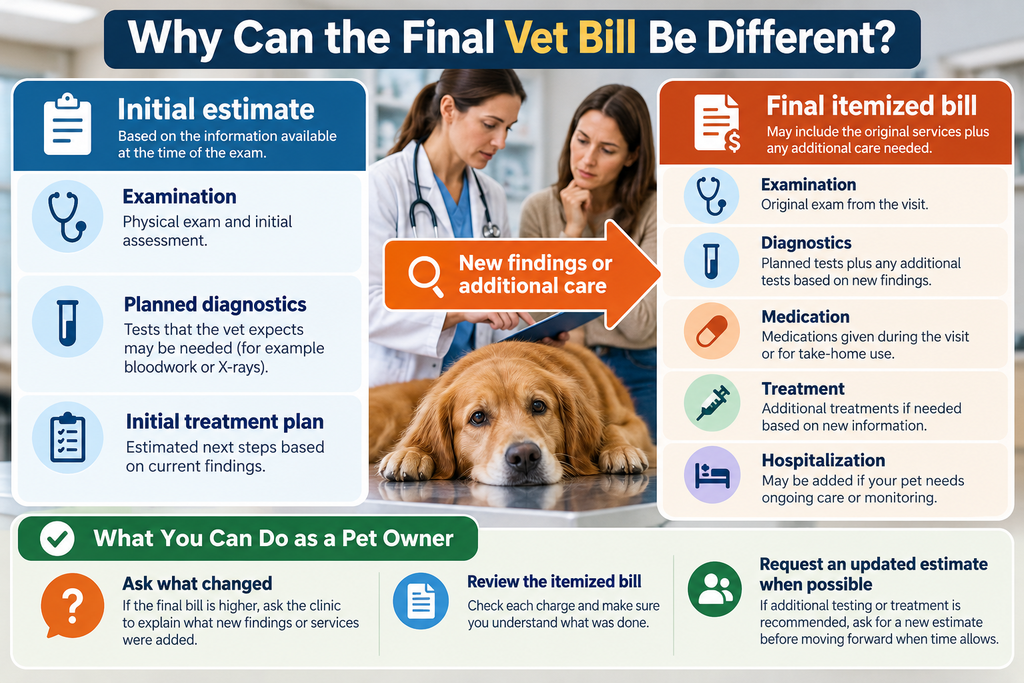
For example, your dog might initially need an examination and X-rays, but the results could indicate that additional diagnostic tests or overnight monitoring are necessary. These services can increase the final bill beyond the original estimate.
Before approving treatment, ask whether the estimate is a fixed price or a range, what services it includes, and how the clinic handles unexpected costs. You can also request a copy of the signed estimate and an itemized final invoice.
If you believe a charge is incorrect or you were not informed about additional costs, contact the clinic’s billing office and request a written explanation. Rules and complaint procedures vary by state, so check your state veterinary medical board for applicable guidance. For example, California’s veterinary board notes that it does not regulate veterinary fees.
Will a Vet Treat Your Pet If You Can’t Pay Right Away?
Whether treatment proceeds without immediate full payment depends on the clinic’s specific policy and the circumstances — there’s no blanket answer, and it’s not guaranteed either way.
Be upfront with the clinic about your budget before authorizing treatment, rather than after. Ask directly what medically appropriate options exist within what you can actually pay right now — many conditions have more than one reasonable treatment path, and a good clinic will walk through those with you rather than presenting only the most expensive option. If your pet’s situation is a potentially life-threatening emergency, contact an emergency veterinary hospital immediately rather than spending time researching payment options first — you can have the payment conversation with the care team once you’re there, in parallel with getting your pet seen.
Read Related Article… Can a Vet Refuse Emergency Treatment If You Can’t Pay? (2026)
Can You Get a Vet Bill After the Visit?
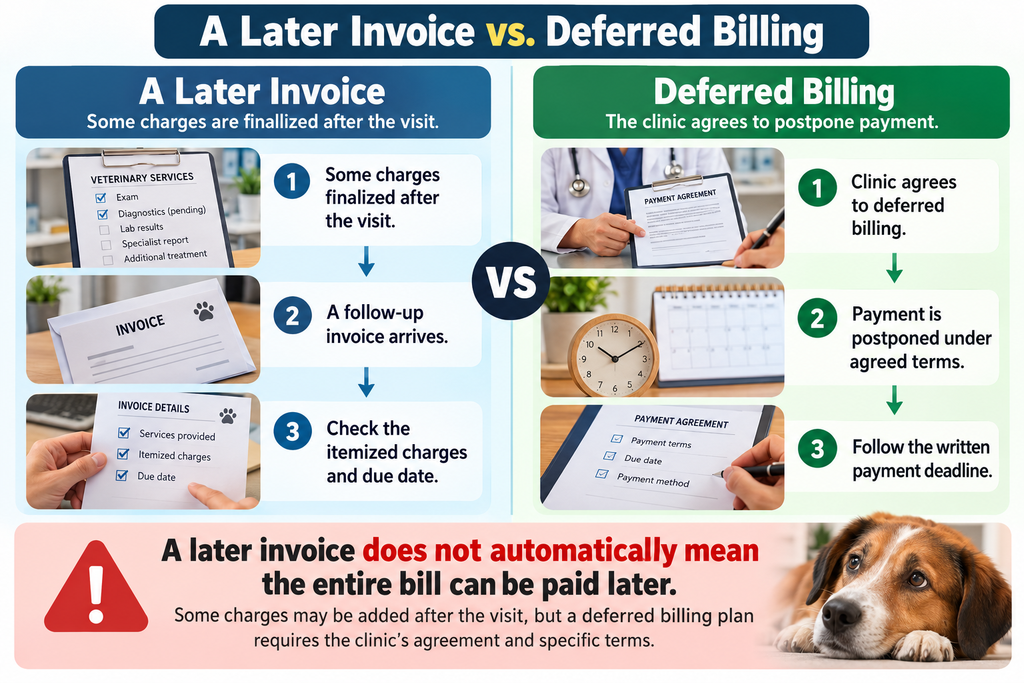
Yes, but this is a different thing from being given permission to delay payment — it’s worth understanding the distinction clearly.
Sometimes a bill or invoice legitimately arrives after you’ve left the clinic, separate from any agreement about deferred payment. NC State Veterinary Hospital notes that some charges may not be fully posted to the original bill by the time of discharge and are invoiced afterward — a lab result that comes back after you’ve gone home, for example. This is an administrative timing issue, not the clinic agreeing to let you pay later; the balance from your actual visit is still generally expected at discharge, with the follow-up invoice covering only what wasn’t yet finalized.
If a charge appears on a bill after your visit that you don’t recognize or weren’t expecting, contact the clinic’s billing office directly to ask what it’s for and confirm the due date.
What If You Disagree With a Vet Bill or Find an Unexpected Charge?
If your final vet bill is higher than expected or includes a charge you do not recognize, ask the clinic to explain it before assuming it is an error. The total may have changed because your pet needed additional tests, medication, treatment, or monitoring. However, you can ask for clarification about any charge you do not understand.
Start by requesting an itemized invoice rather than relying only on the total amount due. It should help you identify individual services, diagnostic tests, medications, procedures, and other charges. Compare the invoice with the written estimate you received before treatment, along with any updated estimates or treatment approvals provided during your pet’s visit.
Next, contact the clinic’s billing department or practice manager and identify the specific charge you are questioning. For example, you might see a laboratory fee you do not recognize, a duplicate-looking charge, or an amount that differs from the original estimate. Ask what the charge covers, when the service was provided, and whether it was included in an earlier estimate. If the clinic added treatment or services after the initial estimate, ask whether the veterinary team can explain why the additional costs were necessary and whether the changes were communicated to you.
Sometimes, a charge appears after you have already taken your pet home. A laboratory result, outside service, or other expense may not have been finalized when the original invoice was prepared. Contact the clinic to confirm what the new charge relates to, whether it is a separate outstanding balance, and when payment is due. Do not assume that a later invoice means the clinic has agreed to defer payment on the entire bill.
Keep copies of the original estimate, revised estimates, invoices, receipts, and relevant emails or messages. If the explanation does not resolve your concern, send a written request to the practice manager describing the specific charges you question and why. Ask the clinic to review the account and provide a written response. Keep the conversation factual and retain any reply you receive.
If you still disagree with the bill, ask about the clinic’s formal complaint or billing-review process. The appropriate next step will depend on the nature of the dispute and the applicable rules in your state. An unexpected charge is not automatically an incorrect charge, but you should be able to ask questions and seek a clear explanation of what you are being billed for.
Do Vets Offer Payment Arrangements for Existing Clients?
Some clinics do extend billing flexibility specifically to established, long-term clients — but this is discretionary, clinic-specific, and never guaranteed simply because you’ve been going there a while.
Cornell’s ambulatory billing policy is a useful real-world illustration: new clients must pay at the time of service, while established clients may leave a card on file or pay via an invoice sent afterward — though even then, bills unpaid after 30 days begin accruing an annual service fee, and accounts unpaid after 90 days must be settled in full before new services are provided and shift back to pay-at-service going forward. This shows that even a documented billing-arrangement policy comes with real terms and limits, not open-ended flexibility.
If you want this kind of arrangement, ask your clinic directly for a written agreement specifying the due date, any applicable fees for late payment, and what happens if the balance isn’t settled on time. If the clinic says no, that’s a normal and common answer — it doesn’t mean something is wrong with your request.
Can a Vet Send an Unpaid Bill to Collections?
Yes, a veterinary clinic may refer an overdue, unpaid account to a collection agency, depending on its billing policy and the applicable law. If you cannot pay your vet bill by the due date, do not assume the balance will be forgiven or that the clinic will automatically agree to a payment plan.
What Does the Vet’s Billing Policy Say About Overdue Balances?
Your invoice, financial agreement, or the clinic’s written billing policy should explain when payment is due and what may happen if the balance remains unpaid. Depending on the practice, consequences may include late fees or finance charges where permitted, restrictions on future non-emergency services, or referral of the account for collection.
For example, Cornell University’s Ambulatory and Production Medicine Clinic states that bills should be paid within one month of the invoice date. Its published policy also explains that accounts remaining unpaid beyond 90 days must be settled before new services are provided, and that accounts still unpaid the following month may be sent to a credit bureau for collection. These are Cornell’s specific terms, not a universal deadline for veterinary bills.
Can an Unpaid Vet Bill Be Sent to a Collection Agency?
It may be. The timing and process depend on the clinic’s agreement, its collection procedures, and applicable state and federal law. An overdue balance does not necessarily go to collections immediately, but ignoring invoices or reminders can make the situation harder to resolve.
If you receive a collection notice, review the amount, the original invoice, and any payment records. If you believe the balance is incorrect, ask for an itemized statement and dispute the specific charges in writing. Keep copies of invoices, emails, receipts, and any payment agreement.
What Should You Do If You Cannot Pay Your Vet Bill?
Contact the clinic’s billing department as soon as possible, ideally before the payment deadline. Explain what you can afford, ask whether a short extension or written payment arrangement is available, and confirm any fees or deadlines in writing. The clinic does not have to approve your request, so get confirmation rather than relying on a verbal assumption.
If the account has already been referred to a collection agency, ask for written details about the debt and the process for disputing it. Do not ignore formal notices or legal documents. Your options and deadlines may depend on where you live.
What Should You Ask Your Vet Before Treatment If You Can’t Pay in Full?
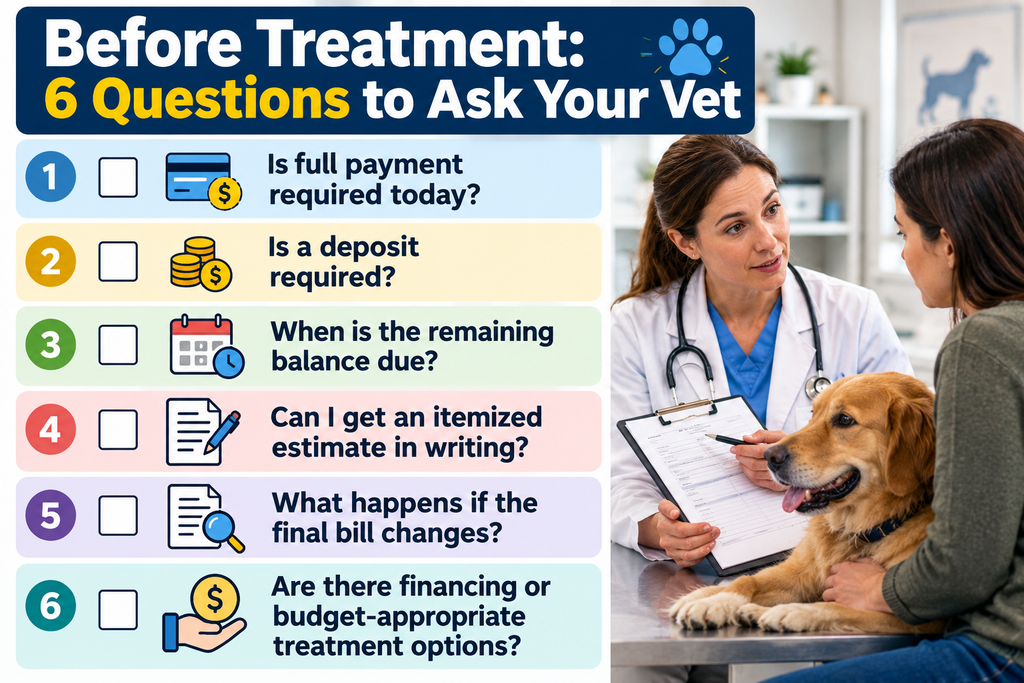
Use something close to this script, directly with the front desk or practice manager, before treatment begins:
- “Is full payment required today?”
- “Can I pay the remaining balance later, and if so, by when?”
- “Do you offer an in-house billing arrangement for established clients?”
- “Is a deposit required, and when is the rest due?”
- “Can you provide an itemized estimate and written payment terms?”
- “Are there medically appropriate lower-cost treatment options?”
What Can You Do If Your Vet Won’t Let You Pay Later?
If deferred billing isn’t an option at your clinic, you still have real paths forward — just not that specific one.
Ask about a treatment plan scaled to your actual available budget — your vet may be able to prioritize the most medically urgent pieces now and discuss the rest separately. Ask whether the clinic accepts third-party veterinary financing like CareCredit or Scratchpay — both can often approve within minutes and pay the clinic in full immediately, which is a fundamentally different mechanism than the clinic itself agreeing to bill you later, but accomplishes a similar practical outcome. If clinically appropriate and your pet’s condition allows it, ask about a referral to a lower-cost provider, such as a university teaching hospital.
It’s worth being precise about the distinction here: financing means a third party pays the clinic now and you repay that lender over time — the clinic still gets paid immediately. The clinic itself agreeing to bill you later means they’re extending you credit directly, which is what most of this article has been about, and which most clinics simply don’t do for anyone outside an established relationship.
Read Related Article… Cannot Afford Emergency Vet Surgery USA? 8 Ways to Get Help Now
What Is the Difference Between Deferred Billing and Veterinary Financing?
Deferred billing and veterinary financing can both help when you cannot afford your pet’s entire veterinary bill upfront, but they work differently. The main difference is who agrees to let you pay later: the veterinary clinic or a financing provider.
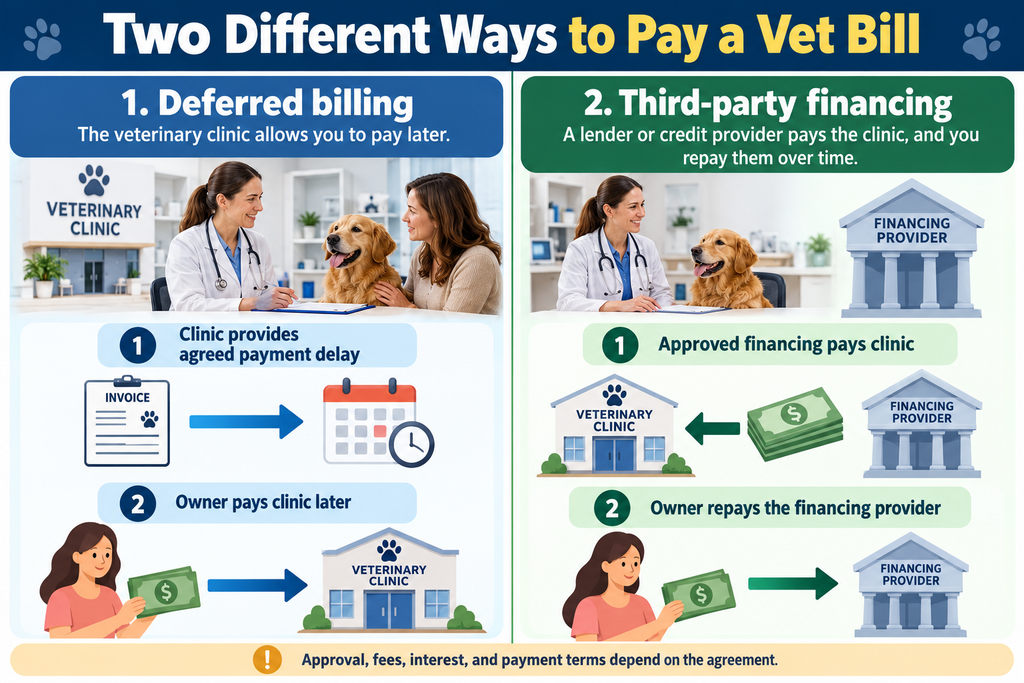
Deferred Billing: The Vet Lets You Pay Later
With deferred billing, the veterinary clinic agrees to let you receive treatment without paying the entire balance immediately. The clinic bills you afterward, according to the payment terms you have agreed to.
Not every veterinary practice offers this arrangement. Some may consider it for established clients, while others require payment at the time of service. Before treatment begins, ask whether deferred billing is available, when the balance is due, and whether any late fees or other charges apply. Get the agreement in writing rather than assuming you can pay later.
Veterinary Financing: A Lender Pays the Vet
Veterinary financing works differently. You apply for a credit product, such as CareCredit, that may be accepted by your veterinary clinic. If your application is approved and the purchase qualifies, you can use the financing to pay for treatment and repay the provider over time.
Approval is not guaranteed. The application may involve a credit check, and the terms depend on the provider and the offer available to you. Review the repayment schedule, interest rate, fees, minimum payments, and any promotional conditions before accepting financing.
Can Veterinary Financing Cost You More Than Expected?
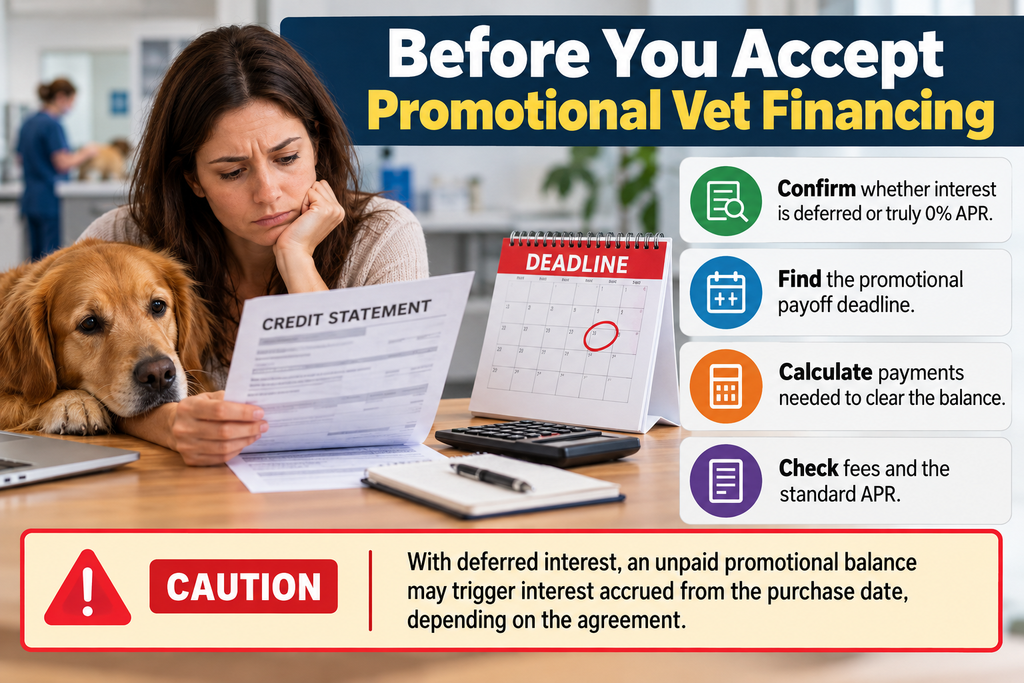
Some veterinary financing offers advertise no interest if you pay the promotional balance in full within a specified period. However, this may be a deferred-interest offer rather than a true 0% APR promotion.
With deferred interest, failing to pay the qualifying balance in full by the deadline can trigger interest calculated from the original purchase date, subject to the agreement’s terms. You may owe substantially more than expected. Making the minimum monthly payment does not necessarily mean you will clear the balance before the promotional period ends.
Before accepting an offer, confirm the promotional end date, calculate how much you need to pay each month to clear the balance on time, and check what interest or fees could apply if you do not.
External Authority Sources
- Cornell University College of Veterinary Medicine — Ambulatory and Companion Animal Hospital billing policies
- Colorado State University Veterinary Health — Payment policy
- NC State Veterinary Hospital — billing practices
Frequently Asked Questions
Can a vet refuse to let you pay later?
Yes. A veterinary clinic may require payment at the time of service instead of offering deferred billing. Payment arrangements depend on the clinic’s written policy and whether it agrees to extend credit. Ask about payment terms before treatment begins.
Do emergency vets let you pay after treatment?
Some emergency hospitals may require a deposit before treatment and payment of the remaining balance at discharge. Policies vary, so call the hospital if possible and ask about its payment requirements. If your pet may have a life-threatening emergency, seek veterinary care immediately rather than delaying care to compare payment options.
Can a vet charge you after your appointment?
Yes. A clinic may send a later invoice for charges that were not finalized when you left, depending on its billing policy. However, receiving a bill afterward does not automatically mean the clinic has agreed to postpone payment for the entire visit.
Can a vet require a deposit before surgery?
Yes. A veterinary hospital may require a deposit before surgery and set a deadline for paying the remaining balance. The amount and payment terms depend on the hospital’s policy and the treatment estimate. Ask for the deposit requirement and balance due date in writing.
Is deferred billing the same as a vet payment plan?
Not necessarily. With deferred billing, the clinic agrees to collect payment later. With third-party veterinary financing, an approved financing provider pays for eligible treatment, and you repay that provider under the credit agreement. Some clinics also offer installment arrangements, so confirm who receives your payments and what terms apply.
What happens if I cannot pay my vet bill at discharge?
Speak with the billing department or practice manager before leaving. Ask for an itemized bill, explain what you can afford, and find out whether the clinic will approve a payment arrangement or accepts veterinary financing. Get any agreement, payment deadline, and applicable fees in writing. The clinic may still require payment under its existing policy.
Can a vet send an unpaid bill to collections?
An overdue veterinary bill may be referred to a collection agency, depending on the clinic’s procedures and applicable law. Contact the clinic promptly if you cannot pay by the due date. If you dispute the balance, request an itemized statement and keep copies of your invoices, receipts, and written communications.
Can a vet change the bill after giving me an estimate?
Yes. The final bill may differ if additional tests, medication, treatment, or hospitalization become necessary. Ask the clinic to explain the difference between the estimate and final invoice. When circumstances allow, request an updated estimate before authorizing additional treatment.
Does veterinary financing always offer 0% interest?
No. Some offers have promotional terms, including deferred-interest arrangements. Under a deferred-interest offer, failing to pay the qualifying balance in full by the deadline may result in interest being charged retroactively from the purchase date, subject to the agreement. Read the terms carefully and check whether the minimum payments will clear the balance on time. The Consumer Financial Protection Bureau explains these risks in its.
Disclaimer: This article is for informational and educational purposes only and does not constitute legal or financial advice. Billing and payment policies vary significantly by individual veterinary practice — always confirm directly with your specific clinic before treatment. PetInsurePrime does not sell pet insurance and receives no compensation from any veterinary practice or financing provider.
PetInsurePrime | Independent • Research-Based | Helping US dog owners understand real vet costs and coverage options — without the sales pressure.