
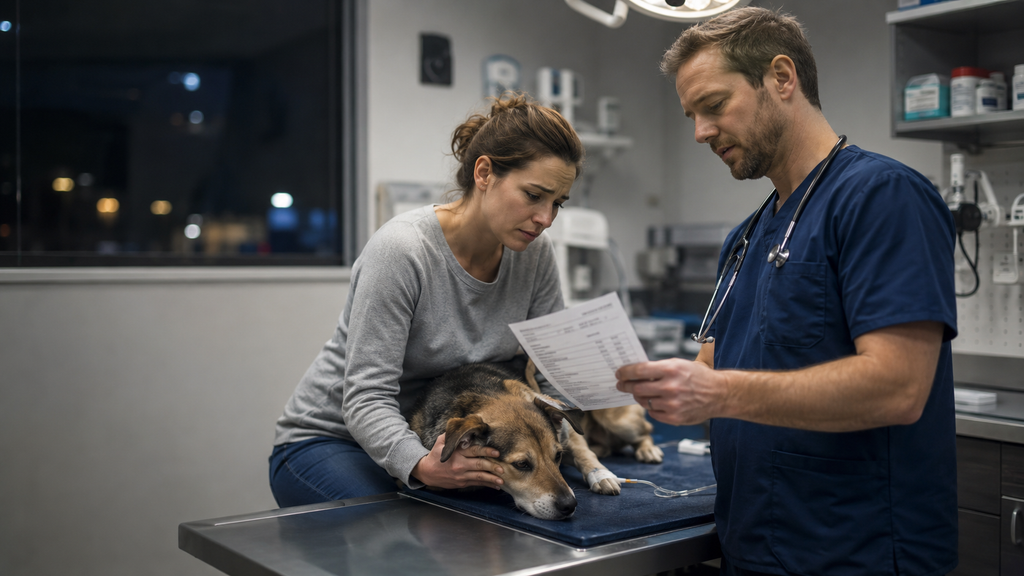
Your dog or cat needs surgery right now, and the number the vet just gave you isn’t one you can pull together today. You’re not a bad pet owner for being in this position — this happens to families with steady incomes all the time, not just people in financial crisis. What matters right now isn’t how you got here. It’s what you do in the next hour.
Quick Answer : Cannot Afford Emergency Vet Surgery USA
If you can’t afford emergency vet surgery, your fastest real options are: ask the clinic directly about a payment plan or hardship discount, apply for CareCredit or Scratchpay financing (CareCredit applications can be completed quickly, but approval is subject to credit approval and the clinic must participate in the CareCredit network.), apply to emergency grant programs like RedRover Relief or Frankie’s Friends in parallel, ask about a nearby university veterinary teaching hospital, and start a crowdfunding campaign the same day rather than waiting. For a large unexpected bill, combining several options may be more realistic than relying on a single source.
Quick Summary: Your Options Right Now
| Option | Speed | What It Actually Does |
|---|---|---|
| Ask the clinic for a payment plan/hardship fund | Minutes to hours | Some clinics can reduce fees or hold billing directly, no application needed |
| CareCredit | Minutes | Credit card built for medical/vet expenses, 70% of vets accept it |
| Scratchpay | Minutes | Soft credit check only, plans from $200–$10,000 over 12–24 months |
| RedRover Relief grant | 1–2 business days | Pays the clinic directly, average grant around $200–$500 |
| Frankie’s Friends grant | 3–5 business days | Larger grants for critical/specialty care, income cap ~$73,000/year |
| University veterinary teaching hospital | Same day to a few days | Often 20–40% lower pricing than private specialty hospitals |
| Crowdfunding (GoFundMe, Waggle) | Hours to days | No guarantee, but many owners raise meaningful amounts fast with a clear ask |
Table of Contents
- If Your Pet Needs Surgery Today, Start Here
- Talk to the Vet Before You Assume You Can’t Afford It
- CareCredit vs. Scratchpay: Which Financing Fits Your Situation?
- Emergency Grants and Charitable Assistance Programs
- Can a Veterinary Teaching Hospital Help?
- Ask About a Lower-Cost Option or Second Opinion
- Can Crowdfunding Actually Help in Time?
- The Stacking Strategy: Combining Everything at Once
- What Happens If You Genuinely Cannot Pay?
- Questions to Ask the Emergency Vet Before You Agree to Treatment
- Action Checklist for the First Hour
- FAQ
If Your Pet Needs Surgery Today, Start Here
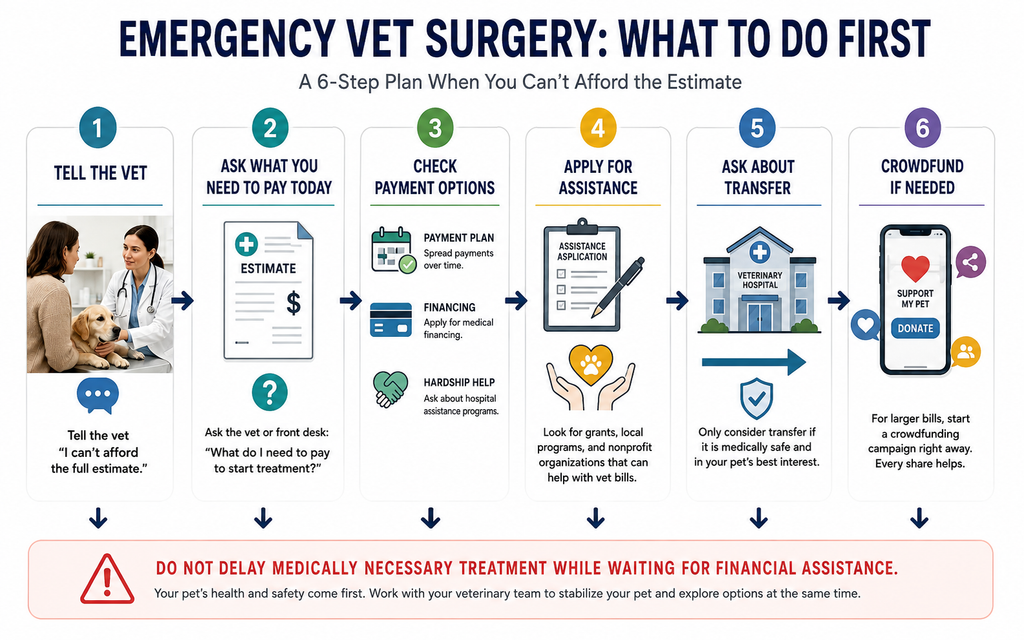
- Tell the vet you cannot pay the full estimate.
If the surgery estimate is more than you can afford, tell the veterinary team before you agree to treatment or leave the clinic. Be direct about what you can realistically pay today. Veterinary organizations recognize that cost can be a major barrier to care, and discussing financial limits can help the team identify available payment or treatment options.
“I want to get my pet the care they need, but I cannot afford the full estimate today. What options do we have?”
- What is the minimum amount I need to pay today to start treatment?
- Do you offer a payment plan or financing option?
- Do you have any hardship assistance or financial-aid fund?
- Is there a medically reasonable lower-cost treatment option?
- If my pet is stable, is there another facility that could provide the treatment at a lower cost?
2. Ask what minimum amount is needed to begin treatment.
When you cannot afford the full surgery estimate, ask the veterinary team exactly how much you need to pay today to begin medically necessary treatment. Do not assume you need to have the entire quoted amount available upfront. Every hospital has its own payment and deposit policy, and the amount required can vary depending on the treatment, urgency, and whether your pet needs hospitalization.
3. Ask about payment plans, hardship assistance, or financing.
If you cannot pay the full emergency surgery estimate upfront, tell the veterinary team before treatment begins and explain exactly what you can afford today. Ask whether the clinic offers an in-house payment plan, hardship assistance, a charitable fund, or a short payment arrangement. Availability varies by clinic, and emergency hospitals may require payment upfront.
4. Apply for financing immediately if the clinic accepts it.
If the veterinary clinic accepts financing, check your options immediately rather than waiting until you have exhausted your savings. CareCredit allows pet owners to apply and, if approved, use the account for eligible veterinary services, including emergency care. CareCredit says applicants can receive a credit decision on the spot and approved accounts can be used the same day.
Scratchpay is another option offered by participating veterinary practices. Its eligibility check does not affect your credit score, and applicants can see available payment plans after applying. Approved Scratchpay plans can be used to pay the veterinary provider directly.
Before accepting any financing, look at the APR, promotional period, monthly payment, total repayment amount, and late-payment terms. Approval does not mean the financing is affordable for your budget.
If your clinic accepts both options, you can check your eligibility for each and compare the actual terms before deciding which one you can realistically repay.
5. Apply for emergency assistance while financing is being processed.
Don’t wait for a financing decision before looking for emergency assistance. If your pet needs urgent treatment, apply to relevant veterinary assistance programs at the same time you apply for financing. For example, RedRover Relief provides grants for qualifying life-threatening veterinary situations, but applications can take one to two business days and assistance is not guaranteed.
Frankie’s Friends also provides financial assistance for qualifying emergency and specialty veterinary care. Your pet generally must already have been examined by a veterinarian, have a documented diagnosis and treatment plan, and have a good prognosis with treatment. The organization does not reimburse payments that have already been made.
Have your vet’s diagnosis, written treatment estimate, treatment plan, and financial information ready before applying. Most importantly, don’t delay medically necessary treatment while waiting for a grant decision. If delaying surgery could put your pet at risk, follow your veterinarian’s recommendation and continue looking for financial assistance in parallel.
6. Ask whether transfer to another facility is medically safe.
If the surgery estimate is beyond what you can afford, ask the emergency veterinarian whether your pet can be safely transferred to another clinic, specialty hospital, or veterinary teaching hospital for treatment. Do not move a critically ill or unstable pet on your own simply to find a cheaper option. Emergency patients may need stabilization before transportation, and the receiving hospital should be contacted before you leave.
Ask your veterinarian:
- Is my pet stable enough to travel right now?
- Could delaying surgery during the transfer increase the risk?
- Which nearby facility could provide the treatment my pet needs?
- Can you speak directly with that hospital before we leave?
- Can you send the medical records, lab results, X-rays, and treatment information with us?
In some situations, transferring to a facility with different capabilities or pricing may be reasonable. But cost should not be the only factor. Your veterinarian can help determine whether the potential savings are worth the medical risk and travel time. If your pet is unstable, ask whether stabilization should happen first or whether the current hospital can coordinate an emergency transfer.
Talk to the Vet Before You Assume You Can’t Afford It
Many emergency and general practice clinics have more flexibility than owners expect, but only if you ask directly and specifically.
Some practices maintain an internal hardship fund or discretionary discount they can apply on a case-by-case basis. Others will hold billing for a short window — sometimes 24 to 48 hours — while you pursue financing or a grant, especially if your pet’s condition is stable enough to wait that long. Ask specifically: “Do you have any internal payment assistance, and can you hold the balance while I apply for a grant?” This is a normal, common question — you’re not the first owner to ask it today.
CareCredit vs. Scratchpay: Which Financing Fits Your Situation?
| Factor | CareCredit | Scratchpay |
|---|---|---|
| Credit check | Hard credit check | Soft credit check (no score impact) |
| Acceptance | Roughly 70% of US vet practices | Growing but smaller network — confirm your clinic accepts it |
| Approval speed | Minutes, often at the clinic | Minutes, applied online or in the waiting room |
| Typical terms | 6–24 month promotional 0% interest periods | Plans from $200–$10,000 over 12–24 months |
| Key risk | Deferred interest applies retroactively if not paid off by the promo deadline | Fixed payment plan, no deferred-interest trap |
| Best for | Owners confident they can pay off the full balance within the promo window | Owners who want predictable payments without a hard credit check |
Both send funds directly to the clinic, not to you, so approval translates into treatment starting immediately rather than reimbursement later.
Emergency Grants and Charitable Assistance Programs
Several national nonprofits provide grants specifically for emergency and life-threatening veterinary situations, and most pay the clinic directly rather than reimbursing you after the fact.
RedRover Relief is typically the fastest, usually responding within one to two business days, with average urgent-care grants in the roughly $200–$500 range — helpful as a contribution toward a larger bill rather than covering the full cost alone. Frankie’s Friends focuses on critical and specialty care with a higher income threshold (around $73,000/year for a family of four), though it typically takes three to five business days to process. Other regional and condition-specific programs, including breed rescue organizations and disease-specific funds, exist in many states — a quick search for “[your state] pet emergency fund” alongside the national names Teaching hospitals may offer a different cost structure than private specialty hospitals, but prices vary substantially by hospital, procedure, location and case complexity.
Income requirements are usually more generous than owners assume — many programs are built for the middle ground of families with steady income who simply can’t absorb a sudden four-figure bill, not exclusively for those at the poverty line.
Can a Veterinary Teaching Hospital Help?
University veterinary teaching hospitals often charge less than private emergency and specialty hospitals for equivalent surgical care, sometimes by a significant margin, because their overhead structure is different and care is partly delivered by supervised residents.
If your pet’s condition is stable enough to travel, calling the nearest vet school’s teaching hospital before committing to treatment at a private emergency clinic is worth the phone call — many accept walk-in or referred emergency cases and can quote a price for comparison. The trade-off is usually a longer wait for non-critical cases and appointments involving residents working under faculty supervision, not a lower standard of care.
Ask About a Lower-Cost Option or Second Opinion
Not every case has just one treatment path, and asking your vet directly about alternatives can sometimes meaningfully change the cost without changing the outcome.
Ask whether a less extensive procedure is medically appropriate for your pet’s specific situation, whether staging diagnostics or treatment over time is reasonable given the condition, and whether a second opinion from another clinic — including a lower-cost general practice rather than a specialty hospital — might offer a more affordable path forward. This isn’t about pushing for cheaper care against medical advice; it’s about making sure you understand all the medically reasonable options, not just the first one presented.
Can Crowdfunding Actually Help in Time?
Crowdfunding through GoFundMe or pet-specific platforms like Waggle can raise meaningful money quickly, especially when the campaign includes a clear photo, the specific diagnosis, and an exact dollar goal — but it’s not guaranteed and shouldn’t be your only plan.
The campaigns that perform best are specific and shared immediately and widely: your pet’s name and photo, what happened, the vet’s estimate, and a direct link shared to your own social circles, neighborhood groups like Nextdoor, and local pet community pages. Waggle is built specifically for vet bills and can sometimes move faster than a general platform because it’s a recognized use case for its donor base.
The Stacking Strategy: Combining Everything at Once
The owners who successfully cover a large, unexpected surgery bill almost always combine multiple sources rather than relying on one.
A practical sequence: ask the clinic about internal hardship options and whether they’ll hold billing briefly. Apply for CareCredit and Scratchpay the same hour — approval for both costs nothing, and you only use what you need. Apply to RedRover Relief and Frankie’s Friends (or relevant local programs) the same day, since applying to multiple doesn’t hurt your chances at any single one. Launch a crowdfunding campaign immediately if the bill is large, so it has time to gain traction while the other applications process. Use whatever financing is approved first to get treatment started, then apply any grant funds or fundraising proceeds toward paying down that balance once they arrive.
What Happens If You Genuinely Cannot Pay?
If every option above falls short, have an honest, direct conversation with the vet team about what’s realistically possible for your pet’s specific situation — this is a conversation experienced emergency staff have had many times before, not a failure on your part.
If treatment is financially impossible, ask the veterinary team about transfer options, lower-cost facilities, rescue partnerships or other medically appropriate alternatives before making a surrender decision.
Depending on the condition and your pet’s status, the care team may discuss humane options that don’t involve full surgical treatment, a transfer to a lower-cost facility or teaching hospital if your pet is stable enough, or, in some cases, surrender to a shelter or rescue organization equipped to provide treatment — a difficult decision, but sometimes one that gives a pet a better outcome than no treatment at all. These are deeply personal decisions that depend entirely on your specific circumstances, and the vet team is there to walk through the realistic options with you, not to judge the outcome.
Questions to Ask the Emergency Vet Before You Agree to Treatment
- Do you offer an internal payment plan or hardship discount?
- Can you hold billing for 24–48 hours while I apply for financing or a grant?
- Is there a less extensive but medically reasonable treatment option?
- Would a nearby teaching hospital be appropriate for my pet’s condition?
- Do you accept CareCredit and/or Scratchpay?
- What’s the realistic minimum needed to start treatment today?
- If I can only cover part of the bill now, what happens next?
Action Checklist for the First Hour
- Tell the vet team directly that you need to explore payment options
- Ask about an internal hardship fund or short billing hold
- Apply for CareCredit and Scratchpay from your phone
- Apply to RedRover Relief and Frankie’s Friends (or local equivalents) the same day
- Launch a GoFundMe or Waggle campaign if the bill is significant
- Ask whether a teaching hospital nearby could help, if your pet can safely travel
- Ask what the realistic minimum is to begin treatment today
Frequently Asked Questions
What’s the fastest way to get money for emergency vet surgery?
Financing options such as CareCredit and Scratchpay may be among the fastest options because applications can often be completed online and decisions may be available quickly. If approved, you may be able to use the financing for eligible veterinary expenses during the same visit. Emergency grants can take longer, so don’t rely on a grant as your only immediate funding option.
Do emergency vet grants pay me or the vet directly?
Many veterinary assistance programs provide approved funds directly to the veterinary clinic rather than reimbursing the pet owner. However, payment rules vary by organization, and some programs may require the clinic to provide treatment estimates or other documentation. Always check the specific program’s current requirements before assuming a grant will cover your bill.
Can I apply to multiple vet bill assistance programs at once?
You can contact multiple assistance organizations when you need help paying an emergency veterinary bill. However, each program has its own eligibility rules and policies regarding other sources of funding. Be honest about assistance you’ve already received or are expecting, and don’t assume that applying to several programs guarantees that the full bill will be covered.
Will a veterinary teaching hospital really be cheaper?
It can be, but don’t assume a teaching hospital will always cost less. Prices vary by hospital, procedure, location, and the level of emergency care required. If your pet is stable enough to travel, call the facility and ask for an estimate before transferring. Never delay urgent treatment or move an unstable pet solely to save money.
What if I still can’t afford treatment after trying everything?
Tell the veterinary team exactly what you can afford and ask what options remain. Depending on your pet’s condition and local resources, possibilities may include a lower-cost facility, veterinary teaching hospital, additional financial assistance, or working with a rescue organization. If your pet is unstable, ask whether transfer is medically safe before leaving the current hospital.
Does CareCredit charge interest if I pay it off late?
CareCredit’s promotional offers can have different terms, so read the specific offer carefully before accepting it. Some promotions use deferred interest, meaning interest can accrue from the purchase date and may be charged if the promotional balance is not paid in full by the deadline. Don’t assume that every “0%” offer works the same way.
Can I get emergency vet surgery without paying the entire bill upfront?
Sometimes. Ask the veterinary hospital whether it requires the full estimate, a deposit, or only a minimum payment to begin treatment. You can also ask about financing, payment assistance, charitable programs, or whether another medically appropriate facility is available. The amount required upfront varies by clinic and situation, so ask “What is the minimum amount I need to pay today to start medically necessary treatment?”
External Authority Sources
- RedRover Relief
- Frankie’s Friends Fund
- CareCredit
- Scratchpay
- AVMA (American Veterinary Medical Association)
- Best Friends Animal Society — Pet Financial Assistance Resources
Disclaimer: This article is for informational and educational purposes only and does not constitute financial or veterinary advice. Program eligibility, grant amounts, and financing terms change frequently and vary by organization, lender, and location — always confirm current details directly with each provider. PetInsurePrime does not sell pet insurance or financial products and receives no compensation from any lender or assistance organization.
PetInsurePrime | Independent • Research-Based | Helping US dog owners understand real vet costs and coverage options — without the sales pressure.