
Updated: August 2026| Reading Time: 15minutes
Your vet just said the word “murmur,” and now you’re sitting in the car trying to figure out what that actually means — and how much it’s about to cost you. Maybe your dog is still a puppy and this came up during a routine check. Maybe your dog is older and you’re bracing for bad news. Either way, the next word your vet used was probably “echocardiogram,” and you have no idea what that number is going to look like.
Quick Answer : Dog Echocardiogram Cost
A dog echocardiogram typically costs $300 to $1,200 in the United States. Most owners going through a board-certified veterinary cardiologist at a specialty hospital pay $500 to $850, including the ultrasound and the cardiologist’s interpretation. University veterinary teaching hospitals usually run 20–40% cheaper than private specialty practices. Mobile cardiology services and nonprofit clinics can bring the price down to $250–$425 in some areas.
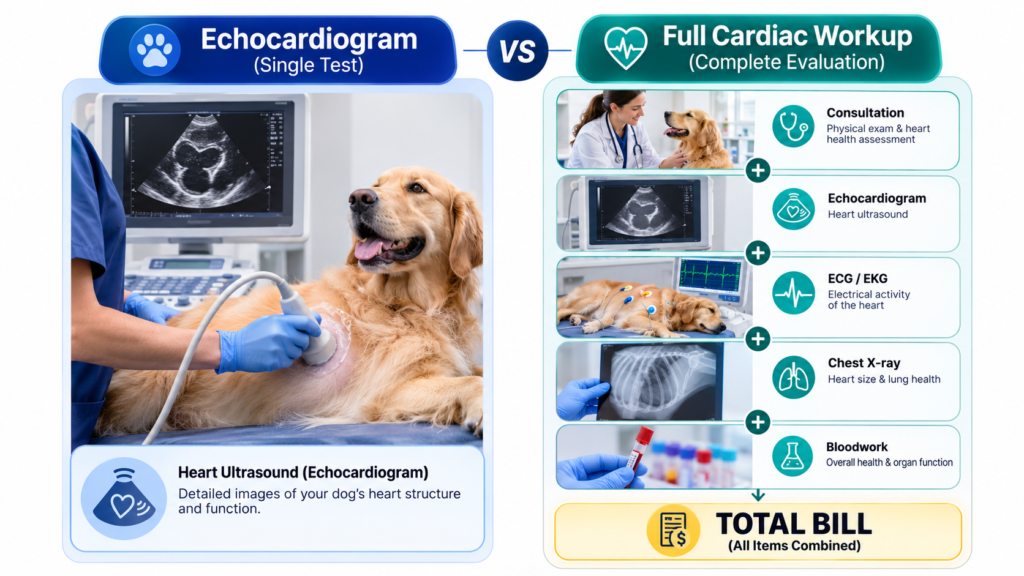
Quick Cost Summary
| Provider Type | Typical Cost | What’s Included |
|---|---|---|
| Board-certified cardiologist (specialty hospital) | $500–$1,200 | Full echo, cardiologist interpretation, written report |
| University veterinary teaching hospital | $350–$750 | Full echo, resident + faculty supervision |
| Mobile cardiology service | $395–$425 | Echo with cardiologist interpretation, at your regular vet’s office |
| General practice vet (basic cardiac ultrasound, non-specialist) | $250–$450 | Limited-view scan, no formal cardiologist report |
| Nonprofit or low-cost clinic | $250–$425 | Varies by availability of equipment and staff |
| Add-on: chest X-rays | +$150–$300 | Often recommended alongside the echo |
| Add-on: EKG | +$75–$200 | Sometimes bundled with the cardiac workup |
Table of Contents
- How Much Does a Dog Echocardiogram Cost in the USA?
- What Affects the Price of a Dog Echocardiogram?
- Echocardiogram Cost by Provider Type
- Regional Price Differences Across the US
- Why Might a Vet Recommend an Echocardiogram?
- Does Pet Insurance Cover a Dog Echocardiogram?
- Should You Get It Done Right Away or Wait?
- Ways to Reduce the Cost Without Cutting Corners
- Action Checklist Before You Book
- FAQ
How Much Does a Dog Echocardiogram Cost in the USA?
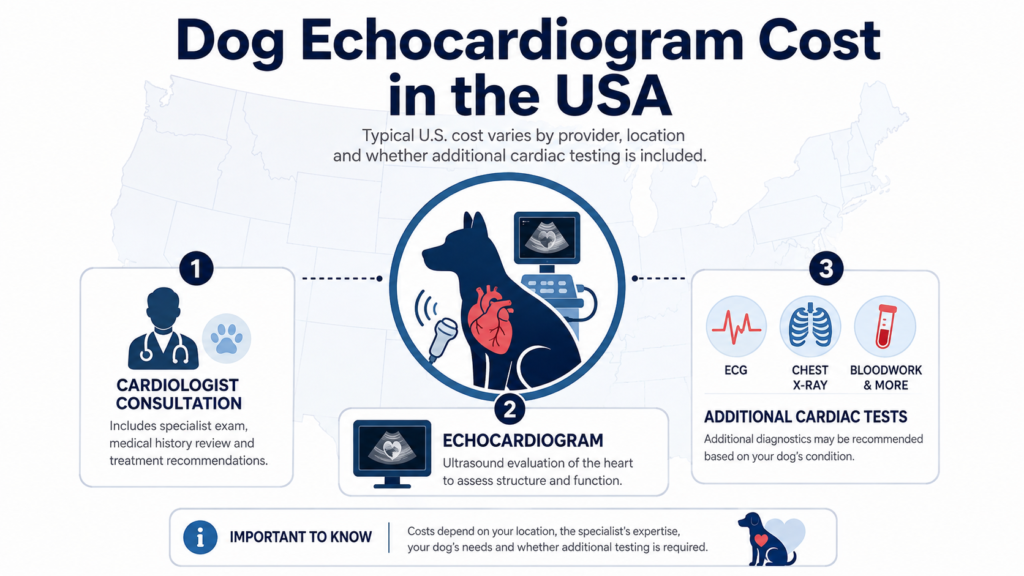
A dog echocardiogram in the U.S. commonly costs about $500–$1,200 when performed as part of a specialty cardiology visit, although lower-cost and higher-cost cases exist.
That range exists because “echocardiogram” isn’t one standardized service. A general practice vet with a basic ultrasound machine might do a limited scan for $250–$450. A board-certified cardiologist at a referral hospital, using higher-resolution equipment and providing a full written interpretation with Doppler flow measurements, charges closer to $500–$1,200.
In cities like New York, Los Angeles, Boston, San Francisco, and Chicago, prices can climb above the national range simply because overhead — rent, staff, equipment maintenance — is higher there.
Read Related Article… Dog Ultrasound Cost in the USA (2026): Real Prices, Hidden Charges & What Happens After
A real-world example: a Cavalier King Charles Spaniel owner in a mid-sized Midwest city might pay $550 total for an echo plus cardiologist consultation. The same procedure at a specialty hospital in Manhattan could run closer to $900–$1,100 once the consultation fee is added separately.
Bottom Line: Expect $500–$850 as your realistic budget if a cardiologist is involved. The exception is major metro areas, where costs regularly exceed $1,000. Ask for an itemized quote before scheduling — the “echo” price and the “cardiologist consult” price are frequently billed as two separate line items.
What Affects the Price of a Dog Echocardiogram?
Five factors drive the price up or down: who performs the scan, where you live, whether sedation is needed, what add-on tests are ordered, and whether the visit is scheduled or an emergency.
Who performs it matters more than almost anything else. A board-certified DACVIM cardiologist commands a premium because that certification requires years of additional residency training beyond general veterinary school. A general practitioner using an ultrasound probe can offer a rough read, but it isn’t the same clinical-grade evaluation.
Sedation is uncommon for this test — most dogs tolerate it while lying on their side, fully awake, for 15 to 35 minutes. But an anxious, painful, or aggressive dog may need light sedation, which adds $50–$150.
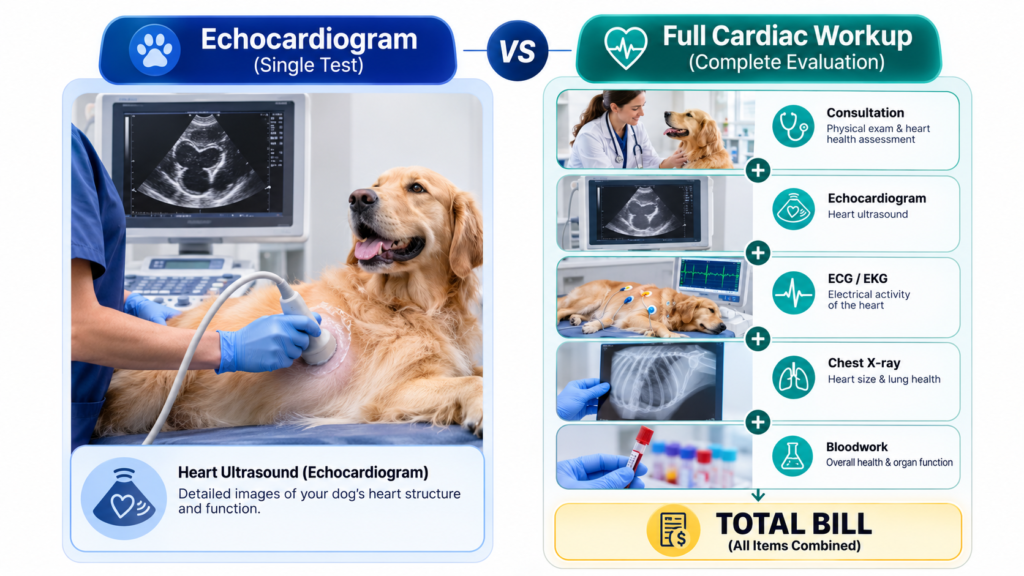
Add-on diagnostics are common. Vets frequently pair the echo with chest X-rays (to check for fluid around the lungs) or an EKG (to catch rhythm abnormalities the ultrasound alone won’t show). Each adds separately to the bill.
Read Related Article… Dog CT Scan Cost in the USA (2026): Real Numbers, Hidden Charges, and How to Lower the Bill
Timing changes everything. A scheduled, daytime appointment at a specialty clinic is priced normally. The same echo performed during an emergency hospital visit — because your dog is in respiratory distress — often carries an emergency exam fee of $150–$250 on top of the procedure itself.
Read Related Article… Dog X-Ray Cost in the USA (2026): Average Prices, Sedation Costs & What You’ll Actually Pay
Consider a real scenario: a Boxer with a new arrhythmia comes in for a routine echo ($650), but the cardiologist also orders an EKG ($150) and chest X-rays ($220) to rule out dilated cardiomyopathy. The visit that started as a $650 estimate becomes a $1,020 bill.
Read Related Article… Dog MRI Cost in the USA (2026): Average Cost, Insurance Coverage & Financing
Bottom Line: The base echo price is rarely your final bill. Ask specifically which additional tests the vet expects to order before you agree to the appointment, and request a written estimate that includes likely add-ons, not just the scan itself.
Echocardiogram Cost by Provider Type
Choosing where to go for the echo can change your total cost by several hundred dollars without changing the quality of the diagnosis in most straightforward cases.
| Setting | Cost Range | Best For | Trade-Off |
|---|---|---|---|
| Private specialty/referral hospital | $500–$1,200 | Complex cases, surgical candidates, second opinions | Highest cost, but fastest scheduling and most experienced cardiologists |
| University veterinary teaching hospital | $350–$750 | Owners wanting expert care at a lower price | Longer wait times, appointment may involve residents under supervision |
| Mobile cardiology service | $395–$425 | Owners who want a cardiologist without hospital overhead | Limited availability by region, fewer appointment slots |
| General practice vet | $250–$450 | Initial screening, low-risk murmurs in young dogs | Not a full cardiologist-grade read; may need a referral anyway |
A practical example: UC Davis, Cornell, Texas A&M, NC State, and Colorado State all run veterinary teaching hospitals that typically charge 20–40% less than private specialty practices for equivalent procedures, according to industry pricing trackers. If you live within driving distance of a vet school, it’s worth a phone call before booking elsewhere.
Bottom Line: University hospitals and mobile cardiology services offer real savings without sacrificing expertise in most cases. The trade-off is scheduling flexibility — private specialty hospitals get you in faster, which matters if your dog is symptomatic.
Regional Price Differences Across the US
Where you live shifts the price by hundreds of dollars, mostly because specialty veterinary care clusters around major metro areas with higher operating costs.
The West Coast (California, especially the Bay Area and LA) and the Northeast Corridor (New York, Boston) tend to sit at the top of the national range, often $800–$1,200 for a full cardiologist-interpreted echo. Texas and the broader Midwest tend to run closer to $450–$750 for the same service, reflecting lower facility overhead. Rural areas frequently have no local cardiologist at all, which means either traveling to the nearest city or using a mobile cardiology service that visits regional general practices on a rotating schedule.
A useful comparison: a Golden Retriever in rural Iowa might pay $500 through a mobile cardiology visit to their regular vet, while a Golden Retriever in San Francisco could pay $950–$1,100 for the identical scan at a specialty hospital.
Bottom Line: Urban-heavy states cost more; call two or three clinics in your area for quotes since prices vary even within the same city. If you’re in a rural area, ask your regular vet whether a mobile cardiologist visits their practice — it’s often the cheapest path to a specialist-grade result.
Why Might a Vet Recommend an Echocardiogram?
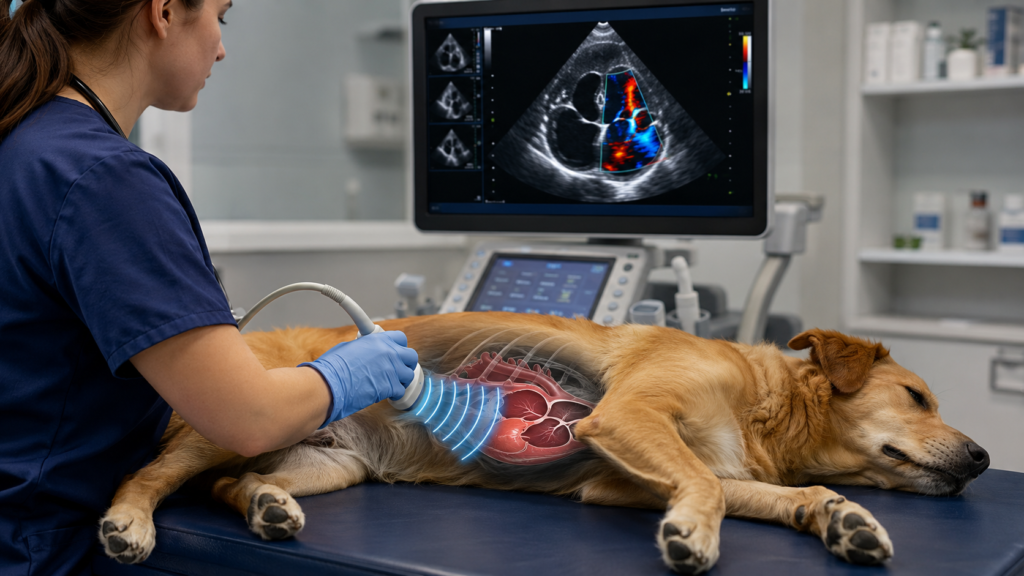
Most echocardiograms are recommended after a vet hears a heart murmur during a routine exam, or when a dog shows symptoms like coughing, fatigue, fainting, or labored breathing.
A heart murmur is an abnormal “whooshing” sound between heartbeats, caused by turbulent blood flow. Murmurs are graded 1 through 6 by loudness, but grade alone doesn’t tell your vet what’s actually happening structurally — that’s what the echo is for. It lets the cardiologist see the heart’s chambers, valves, and blood flow in real time.
Read Related Article… Dog Blood Test Cost in the USA (2026): Real Prices, What Each Panel Tests, and How to Pay Less
Certain breeds carry known genetic risk. Small and medium breeds — Cavalier King Charles Spaniels, Dachshunds, Cocker Spaniels — are prone to degenerative mitral valve disease, where a heart valve gradually weakens and leaks. In Cavaliers specifically, roughly half develop a murmur by age 5, and nearly all do by age 10. Large and giant breeds — Doberman Pinschers, Boxers, Great Danes — are more prone to dilated cardiomyopathy, where the heart muscle itself weakens and the chambers enlarge. DCM doesn’t always cause an audible murmur, which is part of why it’s harder to catch early without imaging.
A real-world example: a 10-year-old mixed-breed dog goes in for a routine dental cleaning. The vet hears a murmur during the pre-anesthetic exam, refers the owner to a cardiologist, and the echo confirms degenerative mitral valve disease. What started as a $200 dental visit becomes a cardiac workup costing several hundred dollars more — a common and disorienting sequence for owners who weren’t expecting it.
Bottom Line: A murmur doesn’t automatically mean serious disease, but it’s the standard trigger for recommending an echo. If your dog’s breed is on the higher-risk list, ask your vet whether periodic screening makes sense even before symptoms appear.
Does Pet Insurance Cover a Dog Echocardiogram?
Pet insurance typically covers echocardiograms as a diagnostic tool when the underlying heart condition is not a pre-existing condition and your policy includes illness coverage.
Accident-only policies won’t cover this at all, since a heart murmur isn’t an accident. Illness or accident-and-illness plans generally do cover it, along with related bloodwork, X-rays, and treatment — as long as the condition wasn’t diagnosed or showing symptoms before your policy’s effective date or during the waiting period.
Read Related Article… Does Pet Insurance Cover Pre-Existing Conditions? The Truth Most Pet Owners Learn Too Late (2026)
Reimbursement in practice varies. Trupanion reported paying out close to $5.9 million for dog heart murmur claims in a single recent year, with typical individual reimbursements landing between $200 and $500 per claim. On the higher end, MetLife Pet documented reimbursing a customer nearly $1,500 — over 80% — of a roughly $1,800 cardiac workup. In a more extreme case, one Embrace policyholder was reimbursed close to $40,000 toward more than $62,000 in total cardiac care, including surgery, after their dog’s murmur progressed to degenerative mitral valve disease requiring open-heart surgery at a university hospital.
Read Relate Article… Pet Insurance Waiting Period: How Long Before Coverage Starts? (2026 Guide)
That range illustrates something important: insurance reimbursement scales with your plan’s reimbursement percentage, annual limit, and deductible — not with a fixed dollar amount. A $500 echo might get you $400 back on an 80% reimbursement plan after your deductible is met, or nothing at all if you’re still within a waiting period.
Bottom Line: New murmurs discovered after your policy is active and past the waiting period are usually covered. Murmurs detected before you enrolled are typically treated as pre-existing and excluded. Call your provider and ask specifically about cardiac waiting periods before assuming coverage.
Should You Get It Done Right Away or Wait?
Should you… get the echocardiogram immediately, or is it reasonable to wait and monitor?
When it makes sense to act quickly: your dog is showing symptoms — coughing at night, tiring on short walks, fainting, or breathing rapidly at rest. These signs suggest the heart may already be struggling to keep up, and delaying the scan delays a treatment plan that could slow disease progression.
When it doesn’t need to be urgent: your vet detected a soft, incidental murmur during a routine exam and your dog shows zero symptoms — normal energy, normal breathing, normal exercise tolerance. In many of these cases, especially in puppies, vets recommend monitoring with a re-check in a few months rather than an immediate specialist referral.
Risks of waiting too long: undiagnosed heart disease can progress to congestive heart failure, a genuine emergency that costs significantly more to treat and carries a worse prognosis.
Alternatives to a full specialist echo: some vets offer a limited in-house cardiac ultrasound as a first-pass screening tool, or a simple blood test (pro-BNP) that flags whether the heart is under strain, before committing to the full specialist workup.
Next step: ask your vet directly, “Is this murmur something we watch, or something we image now?” That single question usually clarifies urgency faster than researching on your own.
Bottom Line: Symptomatic dogs should be scanned promptly; asymptomatic dogs with a mild murmur often have room to monitor first. When in doubt, a pro-BNP blood test is a low-cost way to gauge urgency before committing to the full echo cost.
Ways to Reduce the Cost Without Cutting Corners
You can meaningfully lower the price of a dog echocardiogram without settling for a lower standard of care, mainly by shopping providers and asking the right questions upfront.
Call a nearby veterinary teaching hospital first if one exists within a reasonable drive — the 20–40% discount compared to private specialty practices adds up fast on a $700+ procedure. Ask your regular vet whether a mobile cardiology service visits their clinic; these visits bring board-certified interpretation to you at a flat, often lower, rate. Request a bundled quote that includes the echo, any recommended X-rays, and the consultation fee together, rather than approving each line item separately as it comes up. Ask nonprofit organizations or breed-specific rescue groups in your area whether they know of low-cost cardiac screening clinics — some run periodic reduced-cost events specifically for at-risk breeds. Finally, if cost is a genuine barrier, ask the specialty hospital directly about CareCredit or in-house payment plans before the appointment, not after you’re already holding the bill.
Bottom Line: University hospitals and mobile cardiologists are the two biggest realistic savings levers. Combine that with a bundled quote request, and it’s common to shave 20–35% off the total cost of the visit.
Action Checklist Before You Book
- Ask whether the echo will be read by a board-certified DACVIM cardiologist
- Get a written, itemized estimate — echo, consult fee, and likely add-ons separately
- Ask if a nearby university veterinary hospital offers the same service for less
- Confirm whether sedation is likely, and what that adds to the bill
- Call your pet insurer to check your cardiac waiting period and reimbursement rate
- Ask about CareCredit, Scratchpay, or in-house payment plans if cost is a concern
- Bring a list of your dog’s symptoms and their timeline to the appointment
FAQ
How much does a dog echocardiogram cost without insurance? Expect $300 to $1,200, with most cardiologist-read echoes landing between $500 and $850 depending on your location and provider type.
Is an echocardiogram painful for dogs? No. It’s a non-invasive ultrasound, similar to a human pregnancy ultrasound, and most dogs lie comfortably through the 15–35 minute scan without sedation.
Does pet insurance cover an echocardiogram for a heart murmur? Usually yes, if the murmur was first detected after your policy’s effective date and waiting period, and your plan includes illness coverage. Pre-existing murmurs are typically excluded.
Can my regular vet do an echocardiogram, or do I need a specialist? A general practice vet can perform a basic scan, but a full diagnostic-grade echo with structural and blood flow analysis requires a board-certified veterinary cardiologist.
Which dog breeds need cardiac screening most? Cavalier King Charles Spaniels, Dachshunds, and Cocker Spaniels for mitral valve disease; Doberman Pinschers, Boxers, and Great Danes for dilated cardiomyopathy.
Is a heart murmur always serious? Not always. Some murmurs, especially in young puppies, are innocent and resolve on their own. An echocardiogram is how your vet tells the difference between an innocent murmur and one linked to structural heart disease.
Disclaimer: This article is for informational and educational purposes only. Cost data reflects 2026 national averages from NAPHIA, Insurify, and MetLife Pet Insurance and will vary based on your dog’s age, breed, location, and the specific plan you choose. PetInsurePrime does not sell pet insurance and receives no compensation from any insurance provider. Always compare multiple quotes and read your policy documents carefully before enrolling.
PetInsurePrime | Independent • Research-Based | Helping US dog owners understand real vet costs and coverage options — without the sales pressure.
External Authority Sources
- AVMA (American Veterinary Medical Association)
- ACVIM (American College of Veterinary Internal Medicine — cardiology certification body)
- PetMD breed heart disease risk data
- AKC congestive heart failure overview
- Merck Veterinary Manual — cardiovascular disorders
Disclaimer: This article is for informational and educational purposes only. Cost data reflects 2026. Those organizations aren’t credible sources for national veterinary medication price averages in the way this wording suggests. Pet Insurance and will vary based on your dog’s age, breed, location, and the specific plan you choose. PetInsurePrime does not sell pet insurance and receives no compensation from any insurance provider. Always compare multiple quotes and read your policy documents carefully before enrolling.
PetInsurePrime | Independent • Research-Based | Helping US dog owners understand real vet costs and coverage options — without the sales pressure.
Pingback: Does Pet Insurance Cover Ultrasounds? 5 Proven Tips