
Updated: July 2026 | Reading Time: 23 Minutes
You just picked up your dog from the vet. Or you’re staring at an estimate that’s more than your rent. And you’re wondering — can I actually say something about this bill, or do I just have to pay whatever they’re asking?
You can say something. In fact, for most planned procedures, Asking the right questions before treatment, discussing alternative treatment options, requesting generic medications, and exploring payment plans can sometimes lower your overall veterinary costs or make them easier to manage. The amount varies depending on the clinic, treatment, and your individual situation.
Quick Answer Can You Negotiate Vet Bills in the USA
Yes — vet bills can be negotiated in the USA, especially before a procedure begins. Vets and clinic managers have flexibility on optional line items, medication sourcing, payment timing, and sometimes fee reductions for financial hardship. The most effective approach is honest, specific, and early. Asking after the invoice is finalized is significantly harder — but still worth trying. Payment plans, third-party financing, and charity programs are also real options that clinics use regularly.
Read Related Article… Can’t Pay a Vet Bill in the USA? Here’s What Actually Happens
| Question | Answer |
|---|---|
| Can you negotiate vet bills? | Yes, especially before treatment begins. |
| Best time to negotiate | Before approving the estimate |
| Best alternative | Payment plans and financing |
| Emergency visits | Ask about minimum necessary treatment first |
At a Glance: Negotiation Options Summary
| Situation | Can You Negotiate? | Best Approach |
|---|---|---|
| Before a planned procedure | ✅ Yes — most effective | Ask line by line what’s required vs. optional |
| After receiving an estimate | ✅ Yes | Ask about alternatives, generics, timing |
| After a finalized invoice | ⚠️ Harder, but possible | Request payment plan or hardship adjustment |
| Emergency vet bill (mid-treatment) | ⚠️ Limited during, more after | Focus on payment plan, not price reduction |
| Corporate/chain clinic | ⚠️ Limited flexibility | Ask about financing options instead |
| Independent private practice | ✅ More flexibility | Speak directly with the vet or practice owner |
| Medication costs | ✅ Yes — often overlooked | Request written prescription, fill at pharmacy |
| Repeat long-term treatment | ✅ Yes | Ask about volume or protocol discounts |
Table of Contents
- Will Vets Actually Lower the Bill? What the Industry Data Says
- The Most Important Rule: When You Ask Changes Everything
- What To Say — Word-for-Word Scripts That Work
- Negotiating an Emergency Vet Bill Specifically
- The Medication Loophole Most Owners Don’t Know About
- Corporate Clinic vs. Independent Practice — Why It Matters
- Payment Plans: How To Ask and What To Expect
- CareCredit, Scratchpay, and Third-Party Financing
- What Happens If You Don’t Pay a Vet Bill in the USA
- Financial Help Programs That Actually Exist
- Action Checklist
- FAQ
Will Vets Actually Lower the Bill? What the Industry Data Says
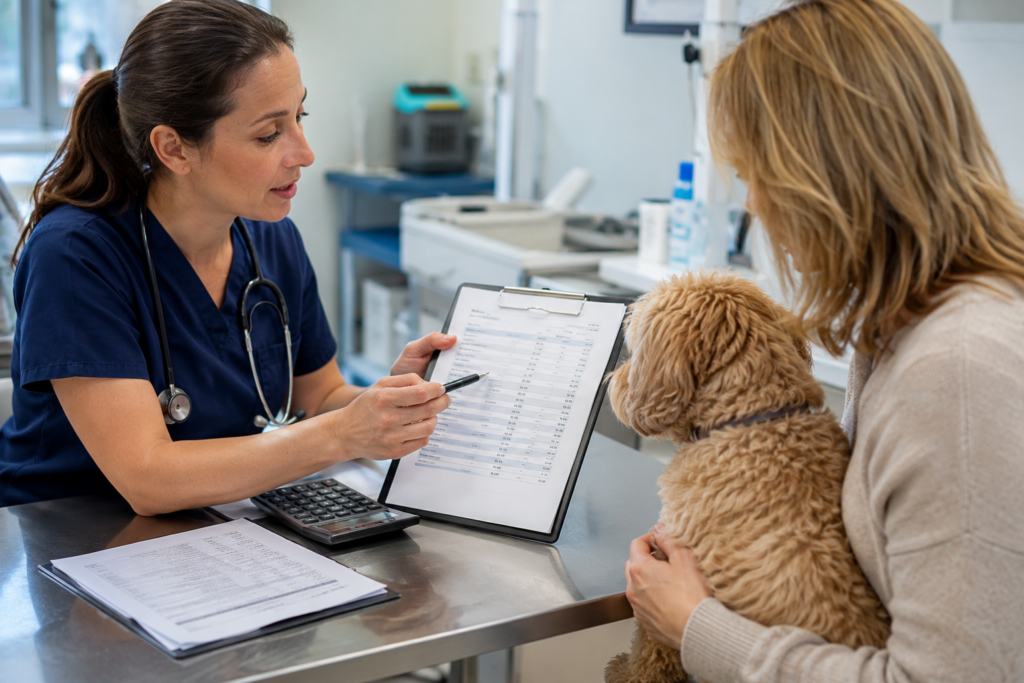
Yes — but the context matters more than most people realize.
Veterinary practices raised prices an average of 6.57% from 2024 to 2025, while clinic visits dropped 3% — the third straight year of declining patient volume. Industry data shows 81% of vets say their clients are more cost-sensitive than the prior year. The result: clinics are actively being trained by their own industry consultants to offer tiered treatment plans and be more flexible on payment.
Read Related Article… Vet Payment Plans: Can You Make Monthly Payments to a Vet?
These trends suggest that many veterinary practices recognize affordability as a growing concern. As a result, some clinics may be more willing to discuss alternative treatment plans, payment options, or lower-cost solutions when asked respectfully.
What vets are generally flexible on:
- Optional diagnostic tests that are recommended but not essential
- Substituting brand-name medications for generic equivalents
- Timing of non-urgent procedures (waiting affects urgency pricing)
- Payment structure — especially at independent practices
- Hardship adjustments for long-term clients in genuine financial crisis
What vets cannot typically flex on:
- Services already performed and invoiced
- Required medications already administered
- Mandatory safety protocols (anesthesia monitoring, pre-surgical bloodwork)
- Fixed hospital fees at corporate-owned chains
The important nuance: most veterinarians did not go into this profession to extract maximum billing from distressed pet owners. When a client comes in with honesty, a specific request, and a genuine commitment to pay something, most vets respond to that differently than they respond to someone who just refuses to engage.
The Most Important Rule: When You Ask Changes Everything
This is the single piece of advice that separates owners who successfully reduce bills from those who don’t.
Negotiate before the procedure, not after. Once a service has been performed and the invoice is printed, clinics have very limited ability to adjust it — the staff who ordered the services, the medications that were already administered, and the time already spent are all committed.
Read Related Article… Dog Surgery Cost in the USA: Real Prices
Before the procedure: Maximum flexibility. You can ask what’s essential versus optional, request generic medications, choose a less invasive diagnostic approach, or delay non-urgent work to a lower-cost appointment time.
During the estimate phase: Still very effective. The estimate is a proposal, not a contract. Asking questions about individual line items is completely appropriate.
After the invoice is finalized: Much harder. The clinic has committed real costs. A payment plan is more realistic than a price reduction at this stage — though hardship adjustments do exist at some practices.
After discharge with no payment discussion: Least leverage. At this point you’re in debt negotiation territory, not treatment planning.
The single most important sentence in any pre-procedure cost conversation:
“Can we go through this estimate line by line? I want to understand what’s essential for my dog’s safety and what might be optional or deferrable.”
Asking for an itemized estimate often helps owners better understand which services are essential, which may be optional, and whether lower-cost alternatives are available.
What To Say — Word-for-Word Scripts That Work
Framing matters as much as the ask itself. Clinics respond to clients who want to pay and are figuring out how — not clients who seem to be looking for an argument.
Here are exact phrases that work in real clinic conversations:
To open the cost conversation:
“Before we proceed, I want to be upfront — I’m on a tight budget right now. Can we look at the estimate together and you help me understand what’s truly necessary versus what’s recommended?”
When asking about optional line items:
“I see there are several tests on here. Which of these would you consider absolutely required for my dog’s safety, and which could we defer or skip without significantly changing the outcome?”
When you’ve received a quote that’s out of reach:
“I really want to get this done, but this amount is beyond what I can manage right now. Is there a more basic version of this treatment plan that still addresses the core problem?”
When asking about payment flexibility:
“I can’t pay this all today, but I absolutely intend to pay it. Would it be possible to set up a payment plan? I can put down [X amount] today and pay the rest over [X months].”
When the bill is already finalized:
“I understand the services were already provided and I know I owe this. I’m not trying to avoid paying — I just genuinely can’t pay this all at once. Is there any possibility of a payment arrangement?”
When asking for a hardship adjustment (use carefully, for genuine situations):
“I’m in a real financial hardship right now and I’m worried about being able to cover this fully. I’ve been coming here for [X years] and I want to stay a client. Is there any flexibility given my situation?”
What to avoid saying:
- “This is too expensive” without a specific counter-proposal
- “I’ll just go somewhere else” as a bluff — it closes doors
- “My last vet charged less” without being able to confirm the comparison
- Anything that sounds accusatory about pricing being unfair
The tone that works is: I want this done, I am committed to paying, and I need help figuring out how.
Negotiating an Emergency Vet Bill Specifically
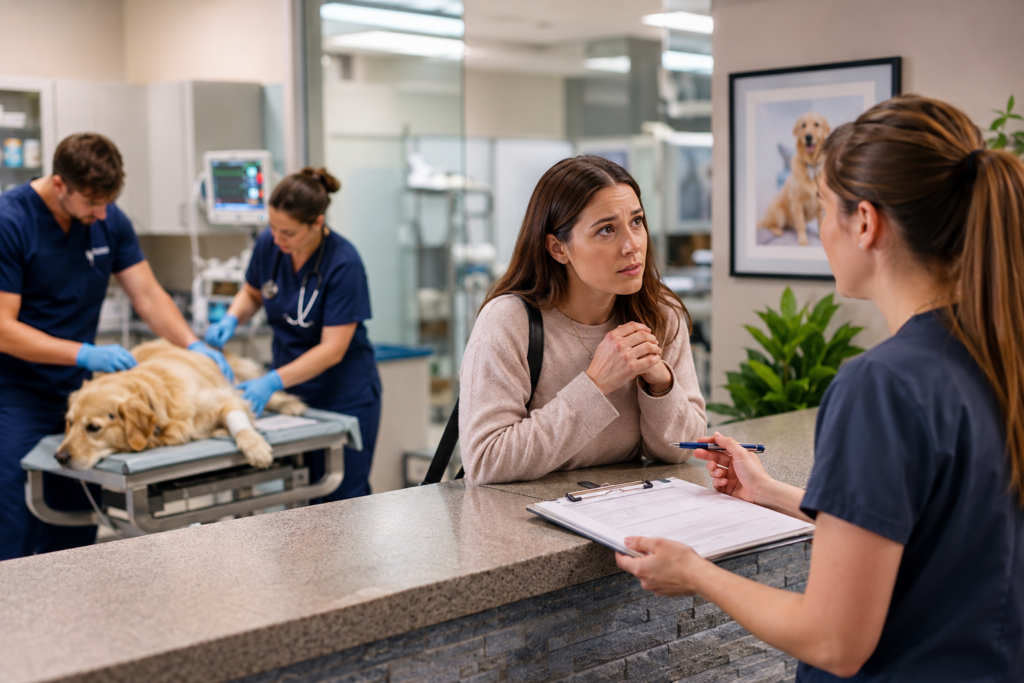
Emergency vet bill negotiation works differently — and requires a different approach — because the power dynamic is completely reversed.
During an emergency, your dog’s life may depend on immediate treatment. You’re not in a position to compare prices or defer care. The clinic knows this. Asking for discounts mid-emergency reads differently than asking about an elective procedure.
Read Related Article… Emergency Vet Costs in the USA (2026): What You’ll Really Pay by State
What does and doesn’t work at the emergency vet:
| Approach | Works? | Notes |
|---|---|---|
| Asking for price reduction mid-emergency | ❌ Rarely | Not the right moment — focus on care |
| Asking for itemized estimate before authorizing | ✅ Yes | Always appropriate before signing consent |
| Asking what the minimum safe treatment is | ✅ Yes | “What’s the minimum we need to do right now?” |
| Asking about payment plan at checkout | ✅ Yes | After treatment, this is the main avenue |
| Applying for CareCredit at the clinic | ✅ Yes | Most emergency clinics accept it |
| Asking for hardship adjustment after the fact | ⚠️ Sometimes | Better at independent clinics, rare at ERs |
| Contesting unclear line items after discharge | ✅ Yes | Always appropriate to ask for clarification |
The best leverage you have at an emergency clinic is at two specific moments:
Read Related Article… Emergency Vet vs Regular Vet Cost: Why Emergency Care Costs So Much More
Moment 1: Before you authorize. When they hand you the estimate to sign, you can say: “What’s the minimum treatment required to stabilize my dog right now? I want to authorize that first and understand what else might be needed.” This separates immediate necessary costs from additional recommended diagnostics that can be reassessed.
Moment 2: At checkout. After your dog is discharged, you can ask about a payment plan, apply for CareCredit on the spot, or — at independent practices — ask about a hardship arrangement if the bill is truly beyond reach.
Corporate-owned veterinary clinics don’t usually offer payment plans. You’ll be more likely to have payment flexibility at small independent practices.
The Medication Loophole Most Owners Don’t Know About
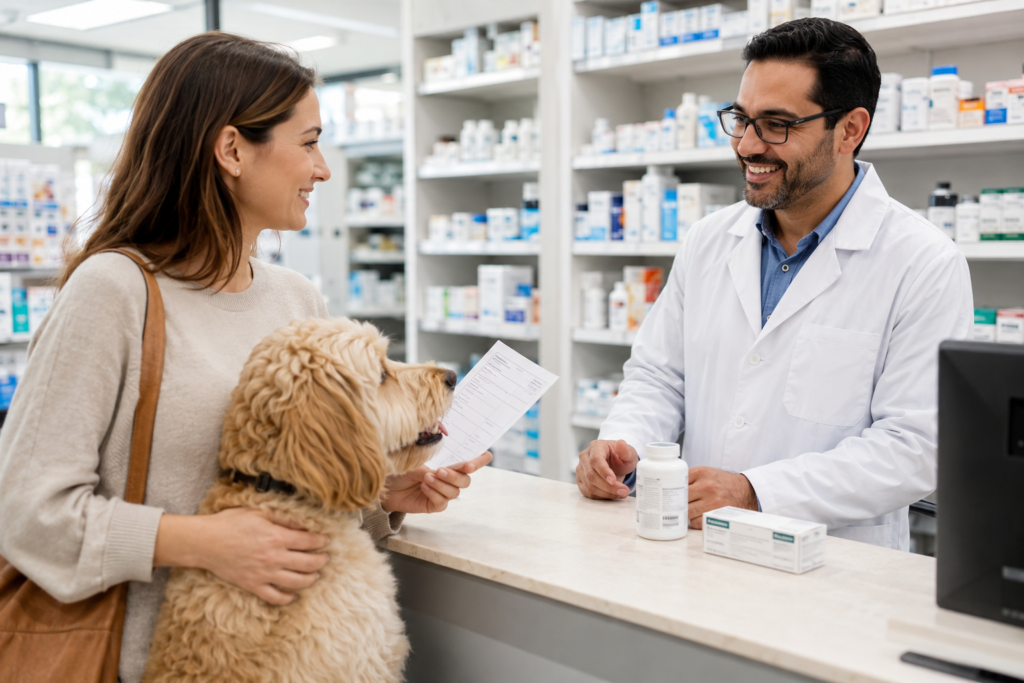
This is the most consistently overlooked cost-reduction strategy in veterinary medicine — and it works legally at any clinic in the USA.
Many medications your vet prescribes are identical to drugs used in human medicine. Antibiotics like amoxicillin, pain medications like gabapentin, anti-anxiety medications like fluoxetine, thyroid medications, and several heart drugs are routinely prescribed for dogs using human-approved formulations.
Read Related Article…Pet Insurance for Dogs in the USA: How It Works
Some states have introduced laws that strengthen clients’ rights to receive written veterinary prescriptions. Even where no specific law exists, pet owners can ask their veterinarian whether a written prescription can be filled at a licensed pharmacy. Florida recently adopted additional prescription disclosure requirements for veterinarians, but requirements vary by state.
Comparison — clinic dispensed vs. pharmacy filled:
| Medication | Typical Clinic Price | Human Pharmacy Price |
|---|---|---|
| Amoxicillin (antibiotic, 30 days) | $35 – $60 | $4 – $12 (GoodRx) |
| Gabapentin (pain, 30 days) | $40 – $80 | $8 – $20 (GoodRx) |
| Fluoxetine (anxiety, 30 days) | $40 – $70 | $10 – $25 (GoodRx) |
| Metronidazole (GI infection, 10 days) | $25 – $50 | $5 – $15 (GoodRx) |
| Prednisone (anti-inflammatory, 30 days) | $20 – $45 | $5 – $10 (GoodRx) |
The savings on a single long-term prescription can be $300–$600 per year. For a dog on multiple chronic medications, this one change can save more than the negotiation conversation itself.
How to ask:
“For any medications my dog needs long-term, can I get a written prescription to fill at a pharmacy? I’d like to compare costs.”
Most vets will agree without hesitation. Some may charge a nominal prescription writing fee ($5–$15), which is still far less than the markup on dispensed medications.
GoodRx (goodrx.com) lets you search any medication by drug name and find the lowest price at pharmacies near you. It’s free to use and accepted at most major pharmacy chains including CVS, Walgreens, Walmart, and Costco.
Corporate Clinic vs. Independent Practice — Why It Matters
Not all clinics have the same ability to negotiate — and knowing the difference saves you from having the wrong conversation in the wrong place.
Independent private practices are owned by one or more veterinarians who set their own pricing, policies, and financial flexibility. They have the discretion to:
- Offer payment plans directly
- Make hardship adjustments for long-term clients
- Create tiered treatment options on the spot
- Sometimes waive or reduce specific fees
Corporate-owned chains — including Banfield (owned by Mars), BluePearl (also Mars), VCA (Mars), National Veterinary Associates, and Thrive — operate under standardized billing systems set at the corporate level. Individual staff often cannot deviate from those price lists. Payment plans are typically handled through third-party financing only.
Read Related Article… Best Vet Payment Plans in the USA (2026): CareCredit vs Scratchpay
How to find out before you ask:
You can search the clinic’s name plus “independently owned” or check whether the practice is listed under a corporate parent. Alternatively, just ask: “Is this clinic independently owned or part of a larger group?”
At a corporate clinic, your best options are:
- CareCredit or Scratchpay financing (almost universally accepted)
- Wellness plan enrollment for future cost management
- Requesting the Banfield Optimum Wellness Plan if you’re already a Banfield client
At an independent practice, all the negotiation approaches in this article apply.
Payment Plans: How To Ask and What To Expect
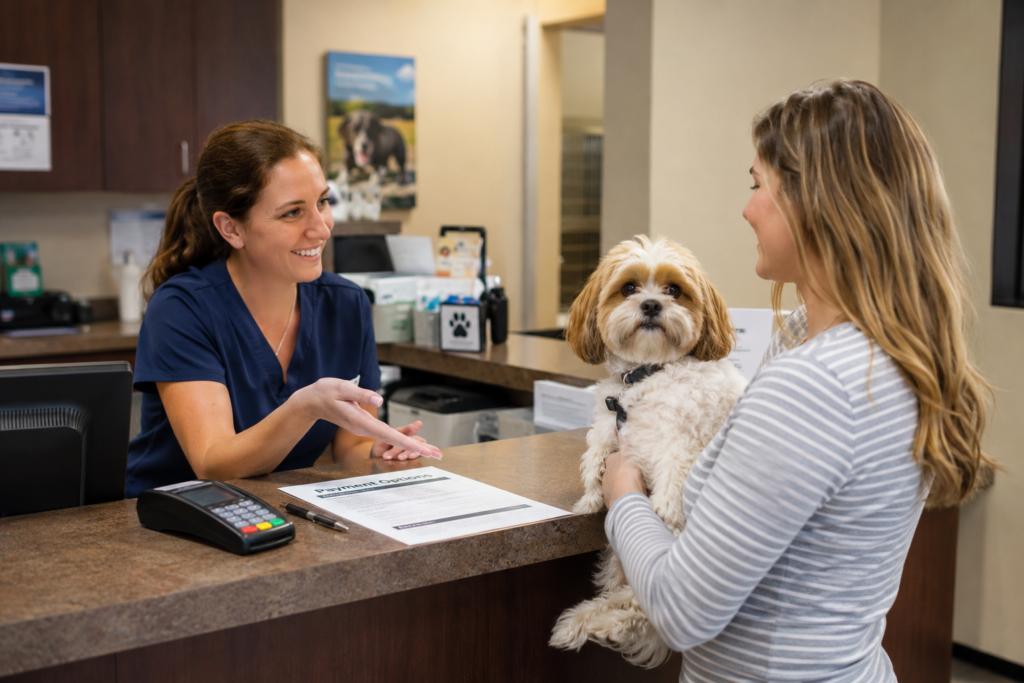
A payment plan is often more achievable than a price reduction — and for many families, spreading a $3,000 bill over 3–6 months is the difference between being able to proceed with treatment and not.
What to expect from clinic-offered payment plans:
- Most independent practices require a deposit of 25–50% upfront
- The remaining balance is paid in monthly installments
- Some clinics use VetBilling.com, a third-party payment plan service that handles the arrangement professionally
- Interest is usually not charged on clinic-direct plans (unlike credit cards)
- Plans are typically 3–6 months; longer terms are rare without third-party involvement
How to ask:
“I can put down [X amount] today — that’s what I have available right now. Would it be possible to pay the remaining [X amount] over [number of months]? I’m committed to paying the full amount.”
Being specific about what you can pay today — even a relatively small deposit — demonstrates good faith. “I can’t pay anything now” is a harder conversation than “I can pay $300 today.”
What clinics need from you:
- A specific deposit amount
- A realistic repayment timeline
- Your contact information (they need to reach you)
- Sometimes a signed payment agreement form
Some practices run a soft credit check for larger payment plans. This is uncommon but worth asking about if your credit is a concern.
CareCredit, Scratchpay, and Third-Party Financing
If your clinic can’t offer a direct payment plan — or if the bill is too large for a standard arrangement — third-party veterinary financing is the fastest and most widely available option.
CareCredit
A healthcare credit card accepted at most veterinary clinics — including emergency hospitals, specialty centers, and corporate chains like Banfield and VCA. Offers 0% promotional financing for 6–24 months when the balance is paid in full before the period ends.
- Apply online or at the clinic desk in minutes
- Approval is based on credit score (typically 620+ for approval)
- Deferred interest applies if the balance isn’t paid before the promotional period ends — this is the critical fine print
- Works for amounts from $1 to over $25,000
Scratchpay
A veterinary-specific financing option with straightforward installment plans and no deferred interest. This is the key difference from CareCredit — if you miss the payoff window on CareCredit, you owe all the accumulated interest retroactively. With Scratchpay, your payment is fixed from the start.
- Apply at the clinic or online
- Multiple plan options with different rates and terms
- Often easier to qualify for than CareCredit
- Accepted at a growing number of veterinary clinics
Which to choose:
| CareCredit | Scratchpay | |
|---|---|---|
| Interest-free period | ✅ Yes (promotional) | ❌ No (but fixed rate) |
| Deferred interest risk | ⚠️ Yes | ❌ No |
| Acceptance at clinics | ✅ Very wide | ✅ Growing |
| Approval threshold | Moderate credit required | More accessible |
| Best for | People confident they can pay by deadline | People who prefer predictable fixed payments |
The practical advice: apply for both before your appointment if possible. Having both options available gives you flexibility at checkout regardless of which the clinic accepts.
What Happens If You Don’t Pay a Vet Bill in the USA
This section answers the question many owners are afraid to ask directly.
The most important myth to debunk first:
Veterinarians legally cannot take your pet away if you don’t pay. They can send your bill to collections, which may impact your credit score, or they may refuse future services until the bill is paid — but they cannot seize your pet.
Read Related Article… Can a Vet Refuse Emergency Treatment If You Can’t Pay?
What can actually happen:
1. Referral to collections. If you receive a vet bill you cannot pay, the clinic can refer your account to a collections agency. Any balance that goes to collections can negatively impact your credit score. This typically happens after 60–90 days of non-payment, though timelines vary by clinic.
2. Denial of future services. Many clinics will not schedule future appointments for an account with an unpaid balance. This is a practical concern — especially for ongoing care, vaccinations, or prescription refills.
3. Withholding of medical records. If you owe money to your previous vet, you may not get your dog’s records from them. You need those records, especially vaccination history, to continue care at a new clinic. State laws differ regarding access to veterinary records, so ask your clinic about its policy.
4. Small claims court. Unpaid vet bills can be pursued in small claims court. For bills under $5,000–$10,000 (limits vary by state), this is a realistic legal path for veterinary practices.
5. Your pet’s care is interrupted. The most significant practical consequence — not a legal one, but a real one — is that without a resolution, your dog may not receive needed follow-up care, prescriptions, or monitoring.
What to do instead of ignoring the bill:
Call the clinic. Explain your situation honestly. Propose a payment plan. Most clinics would rather collect $200/month for six months than send a bill to collections and lose both the money and the relationship.
Ignoring the bill is almost always worse than the conversation you’re dreading.
Financial Help Programs That Actually Exist

If negotiation and financing aren’t enough, these programs provide real assistance to US dog owners who qualify.
RedRover Relief (redrover.org) RedRover Relief provides funding to pet owners for animals in life-threatening situations for households with income under $60,000. Average grants are approximately $250 — meaningful for medication or follow-up costs. Applications require a diagnosis from a vet and financial documentation.
The Pet Fund (thepetfund.com) Provides up to $500 in financial assistance for non-emergency veterinary care including cancer treatment, heart disease, and chronic conditions. Has a waitlist — apply early. Best for ongoing treatment costs rather than same-day emergencies.
Brown Dog Foundation (browndogfoundation.org) Provides funding for families in temporary financial crisis when their pet has a treatable condition. Focus is on situations where euthanasia is being considered because of financial inability to pay, not lack of treatment options.
Paws 4 A Cure (paws4acure.org) Maximum one-time grant of $500 for US residents. All illnesses and injuries covered, no breed discrimination. Funding is limited — apply as early as possible.
Live Like Roo (wearethecure.org) Grants of $500–$1,500 specifically for dogs with a confirmed cancer diagnosis. Application requires medical records. One of the more accessible programs for general US residents.
Waggle (waggle.org) A crowdfunding platform specifically for pet medical bills. You create a campaign, share it on social media, and collect donations. Works well for owners with active social networks or compelling stories.
Local humane societies and animal shelters Many local shelters maintain small emergency funds or can refer you to local organizations that do. Call the nearest humane society and ask specifically: “Do you know of any local funds or organizations that help with vet bills for owned pets?”
University veterinary teaching hospitals Not a grant — but often 20–40% cheaper than private specialty clinics for the same quality of care. Worth asking your regular vet for a referral to the nearest university vet hospital if you’re facing a large planned procedure.
Read Related Article… 15 Organizations That Help Pay Vet Bills When You Can’t Afford Care
| Program | What It Covers | Max Assistance | Who Qualifies |
|---|---|---|---|
| RedRover Relief | Life-threatening illness/injury | ~$250 | Income under $60,000, US residents |
| The Pet Fund | Non-emergency care, chronic conditions | $500 | US residents, all pets |
| Brown Dog Foundation | Treatable conditions, financial crisis | Varies | US residents |
| Paws 4 A Cure | All illnesses and injuries | $500 | US residents, all pets |
| Live Like Roo | Cancer diagnoses only | $500 – $1,500 | Cancer-diagnosed dogs, US |
| Waggle | Any vet care | Crowdfunded | Any pet owner |
Action Checklist
Before the appointment:
- Ask for a full itemized estimate — not just a total figure
- Go through the estimate line by line and ask what’s required vs. optional
- Ask whether any medications can be prescribed externally and filled at a pharmacy
- Apply for CareCredit or Scratchpay before the appointment if a large bill is expected
- Research whether the clinic is independently owned or corporate
At the appointment:
- Confirm your deposit amount and ask about payment plan terms if needed
- Ask “What is the minimum we need to do today for my dog’s safety?” for emergency or urgent situations
- Get all estimates and treatment plan changes in writing
After the appointment:
- If the bill is higher than expected, call the clinic and ask specifically about a payment plan
- If you cannot pay at all, call before ignoring — propose a specific arrangement
- Apply to nonprofit programs (Paws 4 A Cure, Pet Fund, Live Like Roo) as soon as possible if the bill is beyond reach
- Use GoodRx to price any long-term prescriptions before filling them at the clinic
For the future:
- Enroll in pet insurance while your dog is healthy — before any conditions develop
- Keep a dedicated pet emergency fund separate from your regular savings
What You Should Do Next
If you have a bill in front of you right now — call the clinic. Not tomorrow. Today. The conversation you’re dreading is much shorter than the one you’ll have with a collections agency.
If you’re in the middle of treatment planning — this is exactly when you have the most options. Ask the question before you sign the estimate. One sentence — “Can we go through this line by line?” — opens most of the doors available to you.
And if your dog is healthy right now — the cheapest vet bill is the one you’re covered for before it arrives. Pet insurance for a healthy dog costs $40–$70/month. The average emergency vet bill is $800–$3,000. The math is clear.
Read Related Article.. Can’t Afford an Emergency Vet Bill? 15 Real Ways Dog Owners Find Help
Frequently Asked Questions
Can you negotiate vet bills in the USA?
Yes. You can often negotiate vet bills before a procedure begins by asking about optional services, generic medications, or payment timing. Independent veterinary clinics usually have more flexibility than corporate chains. The best results come from discussing costs before treatment starts, not after the final invoice.
Will veterinarians lower the bill?
Sometimes. Many independent veterinarians may adjust treatment plans, recommend lower-cost alternatives, or offer hardship assistance when asked respectfully. Corporate clinics are less likely to reduce prices directly but often provide financing options.
Can I ask a vet for a payment plan?
Yes. Many independent veterinary practices offer payment plans, especially if you explain your financial situation early. Be prepared to suggest a realistic deposit and monthly payment amount. If the clinic doesn’t offer in-house plans, ask about CareCredit or Scratchpay.
What if I can’t afford my dog’s vet bill?
If you can’t afford your dog’s vet bill, contact the clinic immediately instead of ignoring the invoice. Ask about payment plans, CareCredit, or Scratchpay, and explore nonprofit organizations such as RedRover Relief or The Pet Fund for financial assistance. Acting early gives you more options than waiting until the bill goes to collections.
Can I negotiate emergency vet bills?
Yes, but timing matters. Before approving emergency treatment, ask which services are immediately necessary and which can wait. After treatment, focus on requesting a payment plan or financing rather than expecting a price reduction.
Do vets offer discounts?
Some veterinarians offer discounts for senior citizens, military members, rescue organizations, multi-pet households, or first-time clients. Availability varies by clinic, so it’s always worth asking politely if any discounts apply to your situation.
What happens if I don’t pay my vet bill?
An unpaid vet bill may be sent to a collections agency, which can affect your credit. The clinic may also refuse future services or pursue legal action to recover the balance. Contacting the clinic early to arrange payment is usually the best solution.
Can I fill my dog’s prescriptions at a regular pharmacy?
Yes. Your veterinarian can provide a written prescription, allowing you to fill many common pet medications at a licensed pharmacy. Comparing prices with services like GoodRx may help reduce long-term medication costs.
Is it rude to negotiate with a vet?
No. Most veterinarians understand that treatment costs can be challenging. A respectful conversation focused on finding affordable care is generally welcomed and is more productive than delaying treatment or avoiding communication.
External Authority Sources
- CareCredit Veterinary Financing
- Scratchpay
- RedRover Relief
- The Pet Fund
- Paws 4 A Cure
- GoodRx (prescription price comparison)
- Live Like Roo / National Canine Cancer Foundation
- Waggle (pet crowdfunding)
Disclaimer:
This article is for informational and educational purposes only. Cost data reflects 2026 national averages from NAPHIA, Insurify, and MetLife Pet Insurance and will vary based on your dog’s age, breed, location, and the specific plan you choose. PetInsurePrime does not sell pet insurance and receives no compensation from any insurance provider. Always compare multiple quotes and read your policy documents carefully before enrolling.
PetInsurePrime | Independent • Research-Based | Helping US dog owners understand real vet costs and coverage options — without the sales pressure.