
Your veterinarian just recommended a CT scan, and your next question may be less about the scan itself and more about the bill: will pet insurance pay for it?
Yes, many accident-and-illness pet insurance plans cover CT scans when they’re medically necessary to diagnose or treat a covered accident or illness. But coverage can change if the condition is pre-existing, the waiting period hasn’t ended, or your policy excludes the underlying condition. Even when a claim is approved, “covered” doesn’t mean free. Your deductible, reimbursement rate, and annual limit decide what you actually pay. Below: when claims get paid, when they get denied, a worked out-of-pocket example, and what to ask your insurer before the scan.
Quick Answer : Does Pet Insurance Cover CT Scans
Often yes. Accident-and-illness plans generally cover medically necessary CT scans for new, covered accidents and illnesses. Accident-only plans generally cover them only for covered accidents, and wellness add-ons usually don’t cover them. Pre-existing conditions, waiting periods, exclusions, deductibles, reimbursement rates, and annual limits all affect the outcome, and your insurer’s reading of your policy wording makes the final call.
Table of Contents
- Quick Answer : Does Pet Insurance Cover CT Scans
- 5 Critical Facts About Pet Insurance and CT Scans
- Does Pet Insurance Cover CT Scans?
- When Will Pet Insurance Cover a CT Scan?
- When Won’t Pet Insurance Cover a CT Scan?
- Does Pet Insurance Cover the Full Cost of a CT Scan?
- How Much Does a CT Scan Cost for a Dog or Cat?
- Does Pet Insurance Cover CT Scans for Pre-Existing Conditions?
- Can You Get Pet Insurance After Your Vet Recommends a CT Scan?
- Does Pet Insurance Cover Emergency CT Scans?
- Does Pet Insurance Cover CT Scan Anesthesia and Contrast?
- Do You Need Pre-Authorization for a Pet CT Scan?
- How to File a Pet Insurance Claim for a CT Scan
- What If Your Pet Insurance Denies the CT Scan?
- Do You Have to Pay for a CT Scan Upfront With Pet Insurance?
- How Much Will You Pay Out of Pocket for a CT Scan With Insurance?
- How to Check Your Policy Before Scheduling a CT Scan
- FAQ
5 Critical Facts About Pet Insurance and CT Scans
1. Coverage depends on the condition being investigated.
Many accident-and-illness plans cover medically necessary CT scans for eligible accidents and illnesses. The scan itself does not guarantee coverage; the underlying condition must qualify under your policy.
2. Pre-existing conditions and waiting periods can lead to denials.
A CT scan performed after enrollment may still be excluded if it investigates symptoms or a condition that existed before coverage began or during the waiting period.
3. Insurance may reimburse only part of the bill.
Your deductible, reimbursement percentage, remaining annual limit, and eligible expenses determine how much you receive. You may still owe a substantial amount out of pocket.
4. The total bill may include more than the scan.
Anesthesia, contrast dye, bloodwork, and radiologist interpretation may appear as separate charges. Ask your insurer which items qualify for reimbursement.
5. Verify coverage before the procedure when possible.
Ask whether the suspected condition is covered, whether pre-authorization is required, and how your deductible and reimbursement rate apply. Request written confirmation, but remember that it may not guarantee final claim approval.
Does Pet Insurance Cover CT Scans?
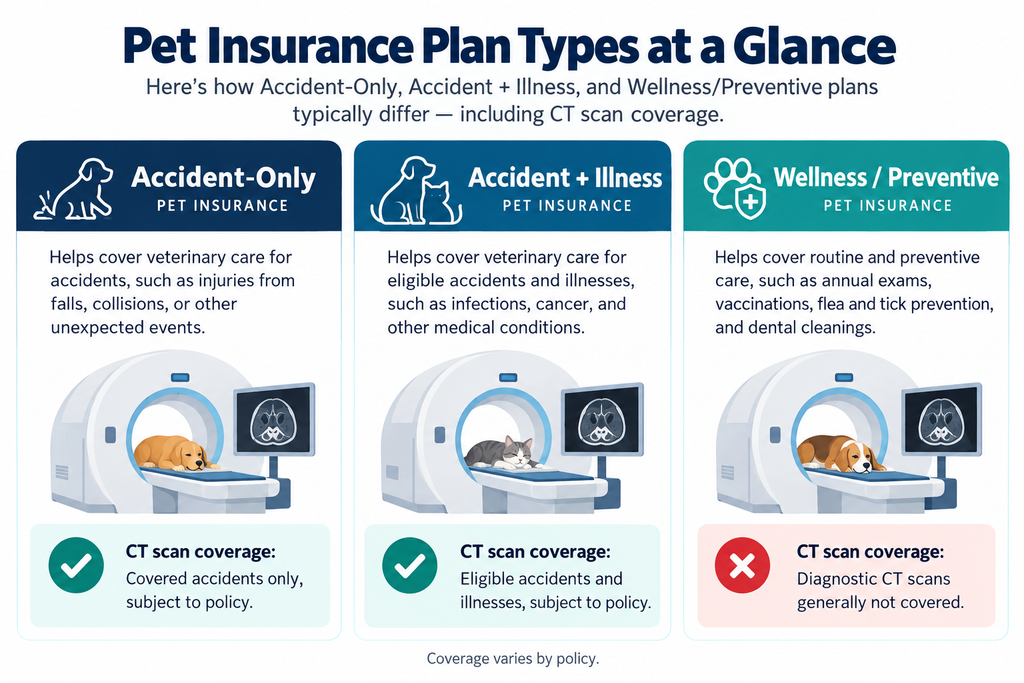
Often, yes. Accident-and-illness plans generally cover medically necessary CT scans, and what matters is the condition behind the scan, not the fact that it’s a CT.
Read Related Article… Dog CT Scan Cost in the USA (2026): Real Numbers, Hidden Charges, and How to Lower the Bill
Accident-only plans generally cover CT scans related to covered accidents, not illnesses. Wellness or preventive coverage is built for routine care, so it generally doesn’t cover diagnostic CT scans. Policy terms, exclusions, and limits still apply on top of all of this, and the same rules work for dogs and cats.
| Pet Insurance Plan | CT Scan Coverage |
|---|---|
| Accident-only | Usually covered when needed for a covered accident |
| Accident + illness | Usually covered for covered accidents and illnesses |
| Wellness/preventive | Generally not covered |
| Pre-existing condition | Usually excluded |
General examples only. Your policy wording and insurer decide every claim.
When Will Pet Insurance Cover a CT Scan?
CT Scans for Accidents
After an accident, vets use CT to see bones and internal structures quickly. Common examples include being hit by a car, a serious fall, trauma, a suspected internal injury, or a complex fracture. If the accident happened after your coverage began and your waiting period ended, the scan is typically treated as a diagnostic for a covered accident.
CT Scans for Illnesses
For illness, CT is often used to investigate a suspected tumor, unexplained seizures or other neurological signs, internal organ problems, or nasal and respiratory disease. Scans used to stage or monitor a covered cancer can be eligible too, subject to your limits.
The CT Scan Must Be Medically Necessary
A scan isn’t covered just because it’s a CT. The insurer generally asks which condition is being investigated and whether that condition is covered. Your vet’s records explaining why the scan was recommended carry real weight.
When Won’t Pet Insurance Cover a CT Scan?
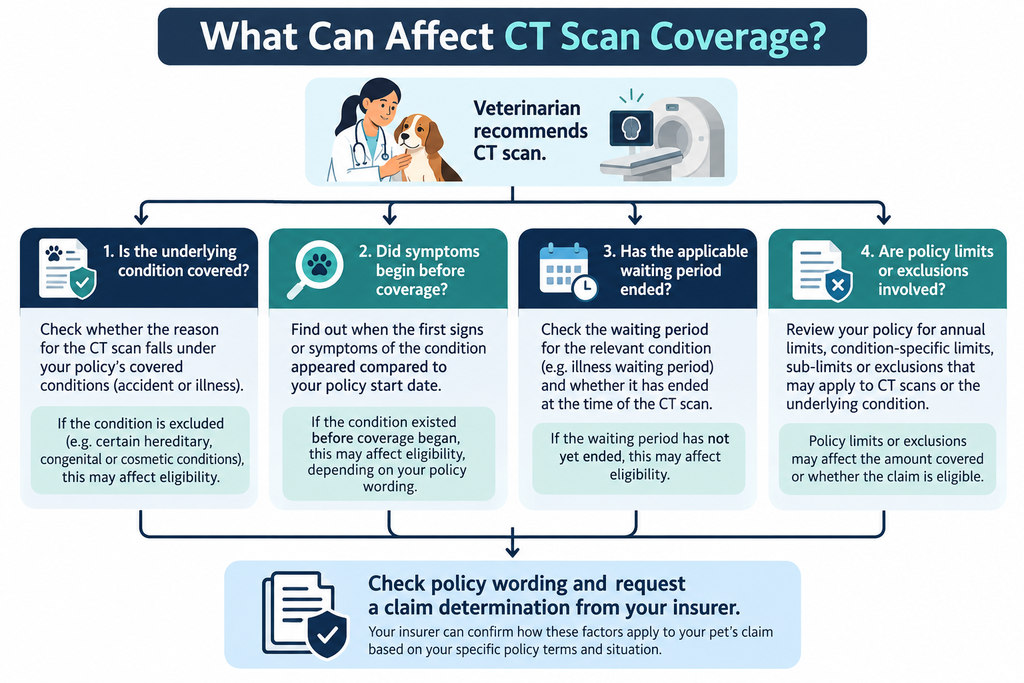
Pre-Existing Conditions
A CT done after your policy starts can still be excluded if it investigates a condition or signs that existed before coverage. This is the biggest source of denials, so it has its own section below.
Waiting Periods
Your policy starts, then a waiting period runs. If a condition develops during that window, a CT months later may still be excluded, depending on the policy. Waiting periods differ by insurer and plan, and accident waiting periods are often shorter than illness ones.
Read Related Article… Pet Insurance Waiting Period: How Long Before Coverage Starts? (2026 Guide)
Routine or Preventive Screening
A CT requested as screening, with no symptoms behind it, isn’t treated the same as diagnostic imaging for symptoms. It generally falls outside typical coverage, so verify your terms.
Policy Exclusions and Limits
Annual limits, condition-specific exclusions, diagnostic exclusions, and the benefit you have left in the year can all reduce or block payment. No rule applies to every insurer.
Bottom Line: Most “no” answers come from timing (waiting periods, pre-existing history), not from the scan type.
Does Pet Insurance Cover the Full Cost of a CT Scan?
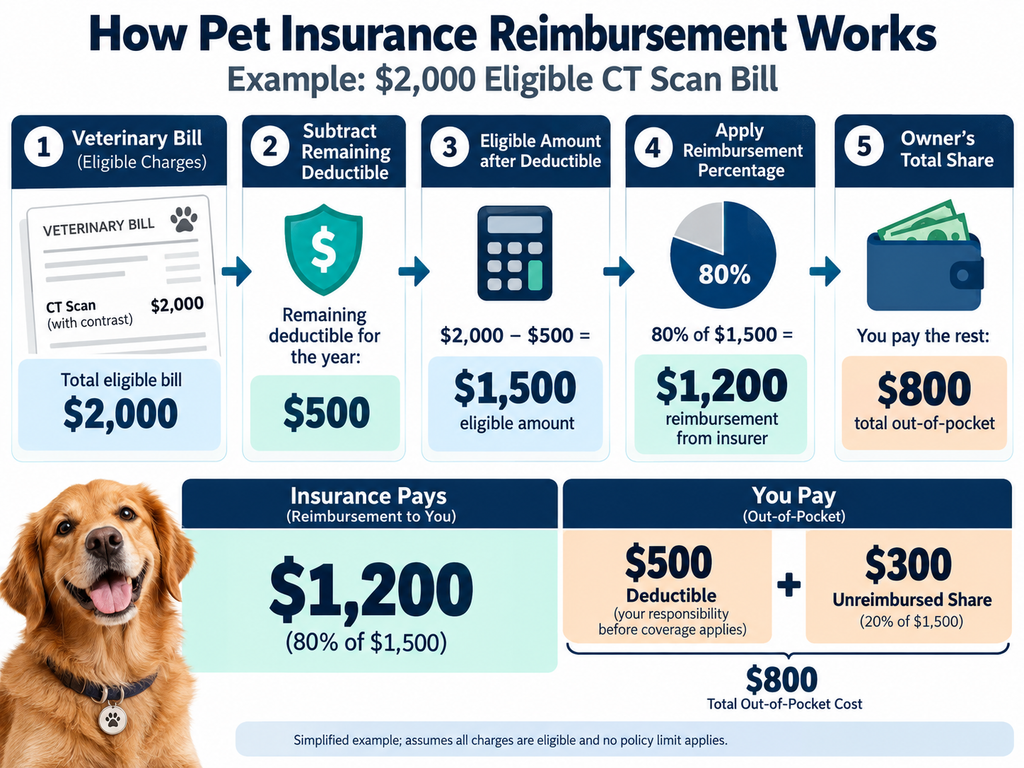
Covered does not mean free. Here’s how the pieces work.
Your Deductible
Say the eligible bill is $2,000 and you still have a $500 deductible. Your deductible comes off first: $2,000 − $500 = $1,500 eligible amount.
Your Reimbursement Percentage
At 80% reimbursement: $1,500 × 80% = $1,200 back. You pay the $500 deductible plus the $300 your insurer doesn’t reimburse, so your share is $800. This is a simplified example. Actual calculations depend on how your policy sequences the deductible, on exclusions, and on which charges are eligible.
Annual Limits
If your pet has already used part of the annual benefit, the insurer pays only up to what’s left. Some policies also apply per-condition or lifetime limits.
Non-Covered Charges
Exam fees, services unrelated to the covered condition, excluded conditions, and other policy-specific charges may not be reimbursed.
How Much Does a CT Scan Cost for a Dog or Cat?
Prices vary widely, mainly because of what’s bundled in. One invoice-based 2026 guide breaks down a complete single-region dog CT like this:
| Line Item | Typical Range |
|---|---|
| Scan fee (per body region) | $350–$1,200 |
| Sedation or general anesthesia | $200–$600 |
| Pre-anesthetic bloodwork | $100–$250 |
| IV catheter | $50–$100 |
| IV contrast, when indicated | $100–$300 |
| Radiologist interpretation | $100–$350 |
Other published sources run higher, and emergency or specialty facilities typically cost more. We don’t have reliable cat-specific figures to publish here, so ask your vet for a written estimate. For the detailed 2026 breakdown, see our [Dog CT Scan Cost in the USA] guide.
Does Pet Insurance Cover CT Scans for Pre-Existing Conditions?
Generally no. Insurers typically treat a condition as pre-existing if signs or records predate your effective date or fall within the waiting period, even if the CT happens months after you enroll.
Scenario A: Before insurance. Your dog has recurring seizures noted in the vet’s chart. You enroll, and six months later your vet orders a CT to investigate the seizures. The insurer may treat the underlying neurological issue as pre-existing, and the CT may be excluded.
Scenario B: After insurance. Your dog is covered, past the waiting period, and then has a completely new accident. The vet orders a CT. That claim is potentially covered, subject to your policy terms.
A few insurers have exceptions for certain conditions after a symptom-free period or continuous coverage, so read your policy’s definition. Nothing here promises approval either way.
Can You Get Pet Insurance After Your Vet Recommends a CT Scan?
Yes, you can generally apply for pet insurance after your veterinarian recommends a CT scan, but a new policy is unlikely to cover the condition that prompted the recommendation.
Pet insurers commonly exclude pre-existing conditions, which may include symptoms, veterinary advice, or treatment that occurred before coverage began or during the policy’s waiting period. The exact definition depends on your policy and applicable state rules.
For example, if your dog has been experiencing seizures and your vet recommends a CT scan to investigate them, buying insurance afterward generally won’t make that existing problem eligible for coverage. Even if the scan takes place weeks later, the insurer may review your pet’s medical records and symptom history when assessing the claim.
However, getting insurance may still help with eligible, unrelated accidents or illnesses that arise in the future, subject to the policy’s exclusions, waiting periods, and coverage limits.
Before purchasing a policy, read its pre-existing condition definition and ask the insurer how it handles previously documented symptoms and recommended diagnostic tests. Don’t assume that a new policy will pay for an already-recommended scan.
Does Pet Insurance Cover Emergency CT Scans?
Often yes, when the emergency involves a covered accident or illness. Typical cases include trauma, suspected internal bleeding, a neurological emergency, or a serious accident at an emergency hospital.
Emergency does not automatically override a policy’s exclusions or waiting periods. An urgent scan for a pre-existing condition can still be excluded.
If your pet needs a CT scan today:
- Ask the vet for an itemized estimate.
- Call the insurer.
- Ask whether the CT needs pre-authorization or pre-determination.
- Ask whether anesthesia and interpretation are eligible.
- Ask how your deductible and reimbursement rate would apply.
- Get the answer in writing if possible.
Don’t delay urgent care while waiting on answers. If the upfront cost is the problem, see our full guide, [Can’t Pay a Vet Bill in the USA? 15 Real Ways to Get Help in 2026].
Does Pet Insurance Cover CT Scan Anesthesia and Contrast?
A CT bill is rarely just “CT scan = $X.” It can include anesthesia, contrast dye, bloodwork, and the radiologist’s interpretation.
Whether those items are reimbursed depends on whether your policy treats them as eligible expenses tied to the covered diagnostic procedure. Many comprehensive plans do, but don’t assume anesthesia is always covered. Ask your insurer about each item by name.
Do You Need Pre-Authorization for a Pet CT Scan?
Some insurers may recommend or require pre-authorization (sometimes called pre-determination or pre-approval) for expensive diagnostics. Requirements differ by insurer and policy, and many insurers won’t guarantee payment in advance. Don’t assume approval just because your vet recommends the CT. When it’s medically possible, ask before the procedure.
Ask your insurer:
- “Is my pet’s CT scan covered?”
- “Is pre-authorization required?”
- “Is the suspected condition covered?”
- “Is anesthesia covered?”
- “Is contrast covered?”
- “How will my deductible apply?”
- “What reimbursement percentage applies?”
Save the written reply, since it’s useful if a claim is questioned later.
How to File a Pet Insurance Claim for a CT Scan
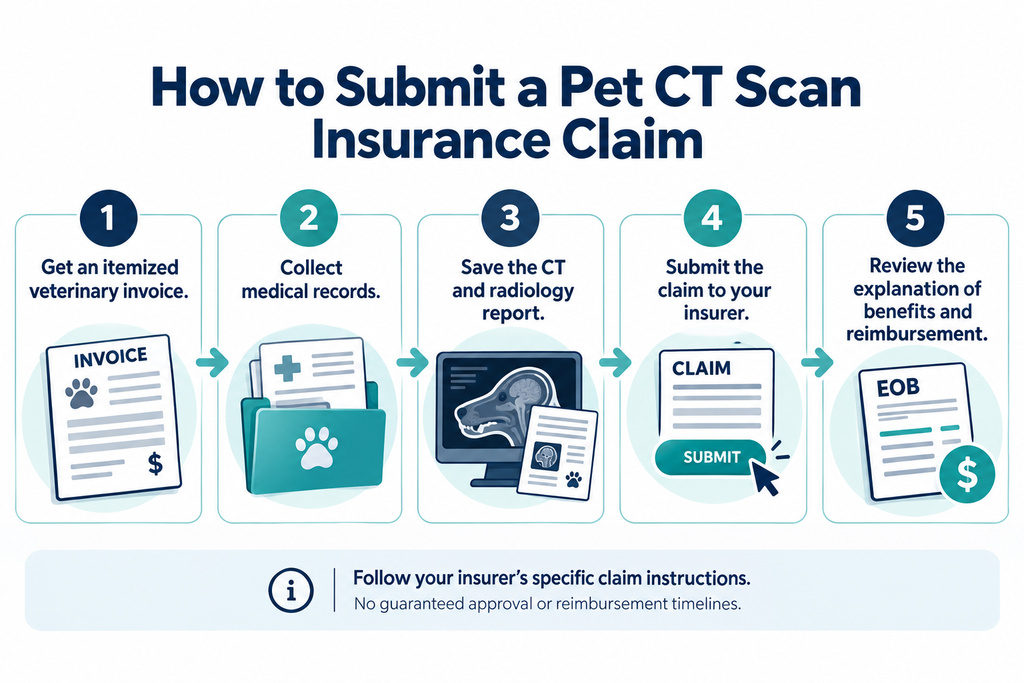
- Get the itemized invoice showing each charge.
- Get your pet’s medical records for the relevant period.
- Keep the CT and radiology report.
- Submit the claim through your insurer’s portal or form.
- Review the explanation of benefits to see what was paid and why.
Reimbursement generally happens after you pay the veterinary bill, though some insurers offer direct payment to the clinic under specific arrangements. Ask yours.
What If Your Pet Insurance Denies the CT Scan?
Common reasons include a pre-existing condition, a waiting period, an excluded condition, insufficient medical documentation, a scan not considered medically necessary under the policy, a reached annual limit, or a policy-specific exclusion. A denial is different from partial reimbursement, which means the claim was approved but reduced.
What to Do After a Denial
- Read the denial reason carefully.
- Request the exact policy language it relies on.
- Ask your veterinarian for supporting records and a statement of when symptoms began and why the CT was needed.
- Ask whether additional documentation could change the determination.
- File an appeal if appropriate, within the stated deadline.
- Keep copies of everything. For unresolved disputes, your state insurance department may offer guidance, where applicable.
Do You Have to Pay for a CT Scan Upfront With Pet Insurance?
Usually, yes—but it depends on your insurer and its payment arrangements. Most pet insurance plans work on a reimbursement basis: you pay the veterinary bill first, submit a claim, and receive reimbursement for eligible expenses after the claim is processed. Your deductible, reimbursement rate, policy limits, and exclusions determine how much you get back.
For example, if your pet’s CT scan costs $2,000, you may need to pay the full amount upfront even if the scan is covered. Your insurer may reimburse part of the bill later, but you’ll still be responsible for your deductible and any non-covered expenses.
Some insurers offer direct-to-vet payment options that can reduce the amount you need to pay at checkout. However, availability depends on the insurer’s program and whether your veterinary clinic can participate. Direct payment also doesn’t guarantee that every charge will be covered.
Before scheduling the CT scan, ask your insurer:
- Do I need to pay the full bill upfront?
- Can you pay my veterinary clinic directly?
- Is pre-authorization available or required?
- What amount would I owe after my deductible and reimbursement?
If you can’t afford the upfront cost, tell your veterinarian before the procedure and ask about payment arrangements or other financing options. If your pet needs urgent care, don’t delay treatment while waiting for an insurance response.
How Much Will You Pay Out of Pocket for a CT Scan With Insurance?
These are illustrative examples, not guaranteed reimbursement amounts. They assume a $500 deductible still unmet, 80% reimbursement, and all charges eligible.
| CT Bill | After $500 Deductible | Insurer Reimburses (80%) | Your Share |
|---|---|---|---|
| $1,500 | $1,000 | $800 | $700 |
| $2,500 | $2,000 | $1,600 | $900 |
| $3,500 (emergency CT) | $3,000 | $2,400 | $1,100 |
Limits change the math. If your pet had only $1,000 of annual benefit left, the $3,500 emergency CT would reimburse $1,000 instead of $2,400, leaving you with $2,500.
How to Check Your Policy Before Scheduling a CT Scan
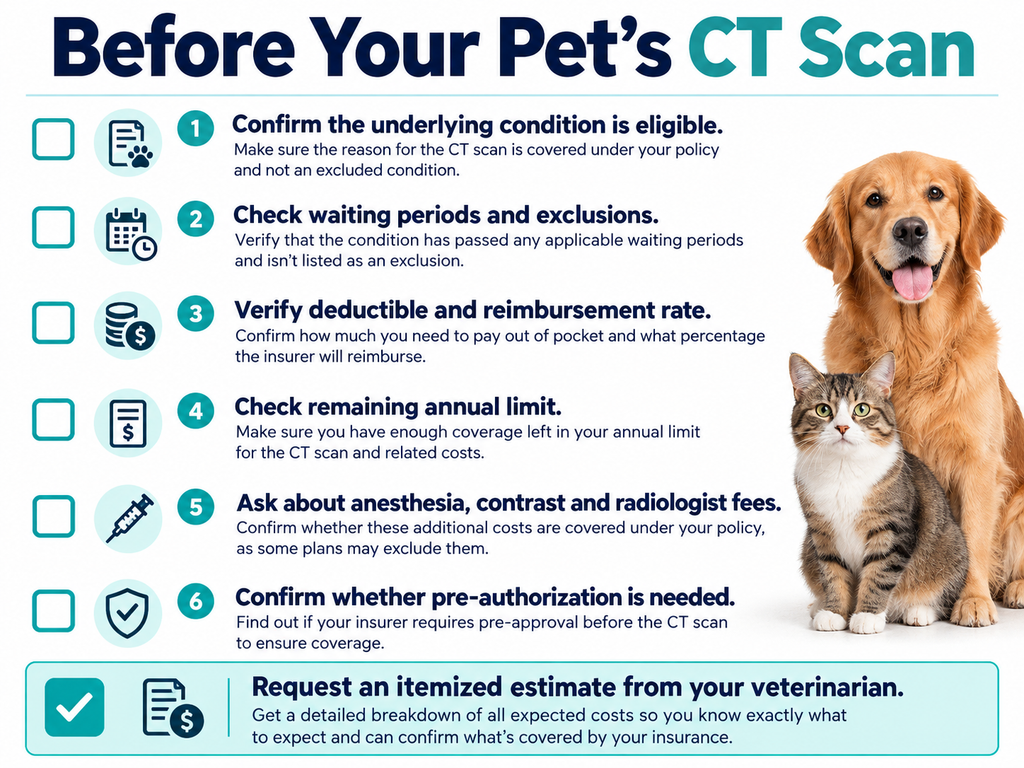
☐ CT or advanced diagnostic imaging is eligible
☐ The accident or illness is covered
☐ The underlying condition isn’t excluded
☐ Waiting period is complete
☐ Deductible remaining
☐ Reimbursement percentage
☐ Annual limit remaining
☐ Pre-authorization requirement
☐ Anesthesia coverage
☐ Contrast coverage
☐ Radiologist fee coverage
Frequently Asked Question
Does pet insurance cover CT scans for dogs?
Often yes, under an accident-and-illness plan, when the scan is medically necessary for a new, covered condition past your waiting period. Accident-only plans cover it only for covered accidents. Your deductible and reimbursement rate still apply.
Does pet insurance cover CT scans for cats?
Generally the same rules apply as for dogs: eligibility depends on plan type, a covered condition, and waiting periods. Check your policy wording, since limits and exclusions differ by insurer.
Does pet insurance cover CT scans for pre-existing conditions?
Generally no. If signs or records predate your effective date or fall within the waiting period, the scan is usually excluded, even if it happens later.
Does pet insurance cover emergency CT scans?
Often, if the emergency relates to a covered accident or illness. Emergency status alone doesn’t override exclusions or waiting periods.
Does pet insurance cover CT scan anesthesia?
Often when the CT itself is covered, but line items can be reviewed separately. Ask your insurer whether anesthesia, contrast, and radiologist fees are eligible.
How much does a CT scan cost for a dog?
Published ranges vary widely, from roughly $750 to $3,500+, depending on what’s bundled and where it’s done. See our Dog CT Scan Cost guide for the breakdown.
Do I need pre-authorization for a pet CT scan?
Some insurers may recommend or require it for expensive diagnostics, and requirements vary. Ask before the procedure when medically possible, and keep the answer in writing.
What happens if my pet insurance denies my CT scan claim?
Request the written reason and policy language, gather records and a vet statement, and file an appeal within the deadline. Your state insurance department may help with unresolved disputes.
External Authority Sources
- Individual insurer policy and coverage pages Pets Best
- Lemonade Individual insurer policy and coverage pages
- MetLife Pet Individual insurer policy and coverage pages
- NAPHIA (industry framing on waiting periods and pre-existing conditions)
- State insurance department / NAIC consumer resources (appeals)
- AVMA (medical-necessity framing, kept minimal)
Disclaimer: This article is for informational and educational purposes only. Coverage varies by insurer, plan, state, and the specific wording of your policy, and nothing here guarantees a claim outcome. Cost figures are 2026 planning ranges and will vary by clinic, location, and what’s included. PetInsurePrime does not sell pet insurance and receives no compensation from any insurance provider. Always read your policy documents carefully and confirm coverage with your insurer when possible.
PetInsurePrime | Independent • Research-Based | Helping US dog owners understand real vet costs and coverage options — without the sales pressure.