
Updated: October 2026| Reading Time: 15minutes
Your vet suspects something neurological is going on and has mentioned a spinal tap — maybe with an MRI, maybe without. Before you can think clearly about what that means medically, you need a number. Here’s a straight answer, plus the five things that actually determine where your bill lands.
Quick Answer : Dog Spinal Tap Cost
A dog spinal tap (CSF collection and analysis) typically costs $250 to $2,500 on its own, depending on whether it’s a straightforward in-house collection or a more comprehensive workup with outside lab analysis. When combined with an MRI — which is often done in the same anesthetic event — the full neurology workup commonly totals $3,000 to $5,500, and can reach higher at private specialty hospitals.
Table of Content
- Quick Answer : Dog Spinal Tap Cost
- Quick Cost Summary
- What Is a Spinal Tap in Dogs, and Why Is It Recommended?
- Does Your Dog Need an MRI Before a Spinal Tap?
- How Much Do Anesthesia and Monitoring Add to the Cost?
- Does the Veterinary Neurologist or Hospital Affect the Price?
- How Much Do CSF Testing and Additional Lab Tests Cost?
- Can Hospitalization and Emergency Care Increase the Total Bill?
- What Are the Risks of a Spinal Tap in Dogs?
- What Is the Total Cost of a Dog Spinal Tap With MRI?
- Why Is a Dog Spinal Tap So Expensive?
- What If You Cannot Afford Your Dog’s Spinal Tap?
- Does Pet Insurance Cover a Dog Spinal Tap?
- Frequently Asked Questions
Quick Cost Summary
| Scenario | Typical Cost |
|---|---|
| CSF tap alone (collection, sedation included) | $250–$700 |
| CSF tap + comprehensive lab analysis | $800–$2,500 |
| MRI alone | $1,500–$5,000 |
| MRI + CSF tap, combined workup (teaching hospital) | $3,000–$3,500 |
| MRI + CSF tap, combined workup (private specialty) | $4,000–$5,500+ |
These figures come from multiple published sources and vary by whether in-house or outside lab analysis is used, and by facility type — see below for why.
Published sources differ noticeably here: one neurology-cost source cites the CSF tap alone at $250–$700 with sedation included, while another estimates the tap-plus-analysis portion at $800–$2,500. A university teaching hospital’s own published fee sheet puts the full neurologic evaluation — MRI and CSF tap together — at $3,000–$3,500. The spread mostly reflects whether the figure covers just collection, collection plus full lab analysis, or the entire combined workup with imaging.
What Is a Spinal Tap in Dogs, and Why Is It Recommended?
A spinal tap, also called cerebrospinal fluid (CSF) collection, is a diagnostic procedure that allows a veterinarian to collect a small sample of the fluid surrounding your dog’s brain and spinal cord. The sample is examined for abnormalities that may help explain neurological symptoms.
Vets may recommend a spinal tap when a dog has unexplained seizures, difficulty walking, loss of coordination, circling, or persistent neck or back pain. CSF analysis can help investigate conditions such as meningitis, inflammation of the brain or spinal cord, certain infections, and some cancers.
The procedure is performed under general anesthesia to keep your dog still while the veterinarian collects the sample using a specialized needle. Depending on your dog’s symptoms and examination findings, the sample may be collected near the base of the skull or from the lower spine.
A spinal tap does not always provide a definitive diagnosis on its own. Veterinarians interpret the results alongside your dog’s symptoms, neurological examination, blood tests, and imaging such as an MRI. This is why the recommended workup—and the final vet bill—can vary considerably from one dog to another.
1. Does Your Dog Need an MRI Before a Spinal Tap?
Is MRI Included in the Dog Spinal Tap Cost?
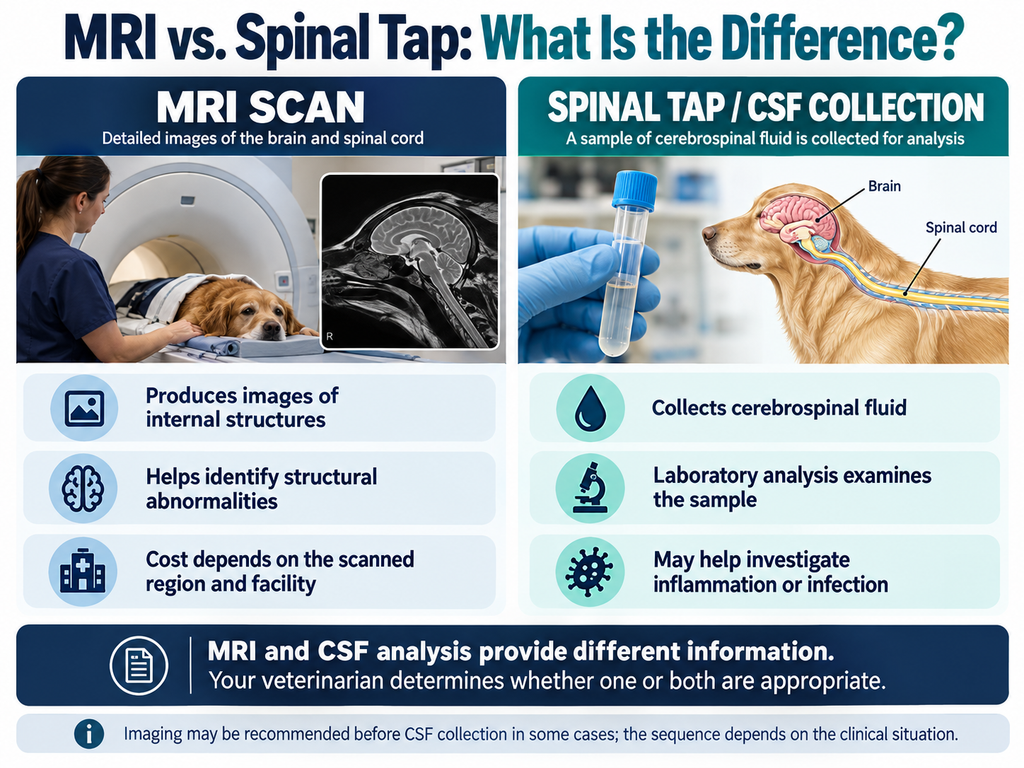
No — MRI and CSF collection are separate procedures with separate costs, even when they’re performed during the same anesthetic event. A quote for “the spinal tap” doesn’t automatically include imaging unless your vet explicitly says so.
How Much Can an MRI Add to Your Dog’s Vet Bill?
MRI typically adds $1,500 to $5,000 on its own, varying by facility and whether more than one region is scanned. For the full breakdown of MRI pricing specifically, see our dedicated dog MRI cost guide.
Why Might a Vet Recommend MRI Before CSF Collection?
CSF analysis is often most useful when combined with MRI findings — the imaging helps the neurologist identify the optimal collection site and interpret what the fluid results actually mean. Your vet’s clinical findings determine the sequence; some cases need imaging first, others may go straight to CSF collection depending on the suspected condition. Don’t assume the same sequence applies to every dog — ask your vet specifically why they’re recommending the order they are.
Read Related Article… Dog MRI Cost in the USA: How Much Does a Dog MRI Cost?
2. How Much Do Anesthesia and Monitoring Add to the Cost?
Does a Dog Need General Anesthesia for a Spinal Tap?
Yes — CSF collection requires your dog to be completely still for safety and accuracy, so general anesthesia is standard, not optional, for this procedure.
Are Pre-Anesthetic Blood Tests Charged Separately?
Usually yes. Bloodwork to confirm your dog is safe for anesthesia is typically billed as its own line item, commonly $75–$200, separate from the tap itself.
What Should You Check on the Anesthesia Estimate?
Ask whether the estimate includes the anesthesia drugs, the monitoring equipment and staff time during the procedure, and recovery monitoring afterward — these are sometimes bundled and sometimes itemized separately depending on the hospital.
3. Does the Veterinary Neurologist or Hospital Affect the Price?
General Vet vs. Specialty Hospital: What Changes?
A general practice vet may be able to perform a basic CSF collection, but interpreting results and performing the procedure safely in complex cases typically falls to a board-certified veterinary neurologist at a specialty or referral hospital — which generally carries higher fees than a general practice visit, though the exact difference varies enough by location and hospital that it’s not useful to quote a fixed percentage.
What Does a Veterinary Neurology Consultation Cost?
A neurology consultation alone typically runs $180–$450, before any testing, imaging, or procedures are added.
Can You Get a Second Estimate From Another Referral Hospital?
Yes, and it’s worth doing if your dog’s condition allows any time to compare — published neurologist fees for the same procedure (such as a hemilaminectomy) have been documented to vary by $1,000–$2,000 between hospitals in similar markets.
4. How Much Do CSF Testing and Additional Lab Tests Cost?
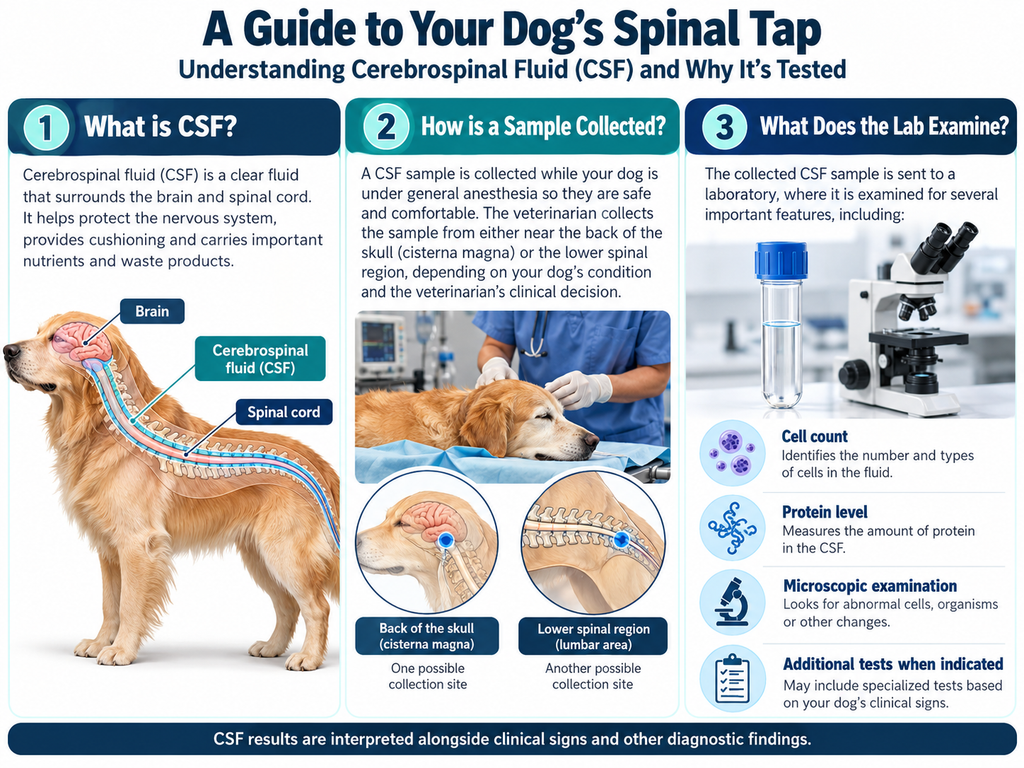
What Is Included in Cerebrospinal Fluid (CSF) Analysis?
Standard CSF analysis typically includes a cell count, protein level, and microscopic examination of the fluid — looking for signs of infection, inflammation, or other abnormalities.
Are Culture and Infectious Disease Tests Extra?
Often yes. If your vet suspects an infectious cause, additional tests like a bacterial culture or specific infectious disease panels are typically billed separately from the standard CSF analysis.
Why Can Additional Testing Increase the Final Bill?
Additional tests are ordered based on what the initial findings suggest and your vet’s clinical suspicion for your dog’s specific symptoms — not every case needs the same panel, so the final lab bill can vary even among dogs having “the same” procedure.
5. Can Hospitalization and Emergency Care Increase the Total Bill?
Is Overnight Hospitalization Always Necessary?
No. Many dogs recover from anesthesia within a few hours and go home the same day. Hospitalization becomes more likely if your dog’s underlying condition requires monitoring, or if the workup happens later in the day and recovery monitoring extends past normal hours.
What Recovery and Follow-Up Costs Should You Ask About?
Ask about a recheck visit, any prescribed medications, and whether results interpretation is included in your original quote or billed as a separate follow-up consultation.
Why Can an Emergency Neurology Workup Cost More?
An emergency presentation — sudden paralysis, severe pain, or rapid symptom progression — often means the workup happens on an urgent timeline at whatever facility is available, which can carry emergency pricing on top of the standard procedure costs. The exact difference isn’t reliably quantifiable across sources, so ask your specific hospital directly rather than assuming a fixed emergency surcharge.
Read Related Article… Emergency Vet Costs in the USA (2026): What You’ll Really Pay by State
What Are the Risks of a Spinal Tap in Dogs?
A spinal tap, also called cerebrospinal fluid (CSF) collection, requires general anesthesia and careful needle placement. Most dogs in a 2023 multicenter study had no major complications, but risks can vary depending on the dog’s neurological condition and overall health.
Anesthesia-Related Complications
General anesthesia can cause complications, particularly in dogs with underlying health problems. Your veterinarian may recommend blood tests and a pre-anesthetic assessment to evaluate your dog’s health before the procedure.
Spinal Cord Injury or Bleeding
The needle can potentially injure nearby nervous tissue or cause bleeding. Infection at the collection site is another possible complication, although careful sterile technique helps reduce this risk.
Increased Pressure Inside the Skull
Dogs with increased intracranial pressure may face a risk of brain herniation following CSF collection. This is a serious complication, which is why veterinarians evaluate neurological findings and imaging results before deciding whether the procedure is appropriate.
How Can These Risks Be Reduced?
A thorough pre-procedure assessment, appropriate imaging when indicated, and a trained veterinary team help identify potential risks. Ask your veterinarian which complications are relevant to your dog’s condition and what monitoring will be provided during recovery.
What Is the Total Cost of a Dog Spinal Tap With MRI?
| Line Item | Illustrative Cost |
|---|---|
| Neurology consultation | $180–$450 |
| Pre-anesthetic bloodwork | $75–$200 |
| MRI | $1,500–$5,000 |
| CSF collection (same anesthetic event) | $250–$700 |
| CSF lab analysis | Often bundled with collection, or $200–$500 separately |
| Anesthesia and monitoring | Often bundled with MRI/procedure time |
| Hospitalization (if needed) | $200–$600/night |
Illustrative combined total: A university teaching hospital’s own published fee sheet lists the full neurologic evaluation — MRI and CSF tap together — at $3,000–$3,500. At a private specialty hospital, the same combined workup more commonly runs $4,000–$5,500 or higher, consistent with individual MRI and CSF pricing found across multiple sources.
These are illustrative scenarios built from published cost data, not a guaranteed quote. Your vet’s actual itemized estimate may differ based on your dog’s specific case and your hospital’s fee structure.
Why Is a Dog Spinal Tap So Expensive?
A dog spinal tap can be expensive because the bill may include much more than collecting a small sample of cerebrospinal fluid (CSF). The procedure requires general anesthesia, careful positioning, sterile equipment, trained veterinary staff, and prompt laboratory analysis. CSF samples must be processed quickly because their cells can deteriorate within 30–60 minutes, which may require referral to a facility with appropriate testing capabilities.
Anesthesia and monitoring are major cost factors. Your estimate may include pre-anesthetic bloodwork, anesthesia medications, continuous monitoring, and recovery care. These charges may be bundled into the procedure price or listed separately, depending on the hospital.
MRI can increase the total bill substantially. When a veterinarian recommends both MRI and CSF collection, the imaging, anesthesia, and specialist services may be included in a combined neurological workup. Some facilities perform CSF collection during the same anesthetic event as the MRI, while others may structure the procedures differently.
Laboratory testing also affects the final price. Standard CSF analysis examines factors such as cell counts, protein levels, and cell appearance. Depending on the suspected condition, additional testing for infectious organisms or other abnormalities may be recommended and charged separately.
Finally, the type of veterinary facility matters. A specialty or university hospital may have access to veterinary neurologists, advanced imaging equipment, and specialized laboratory services that are not available at every general practice.
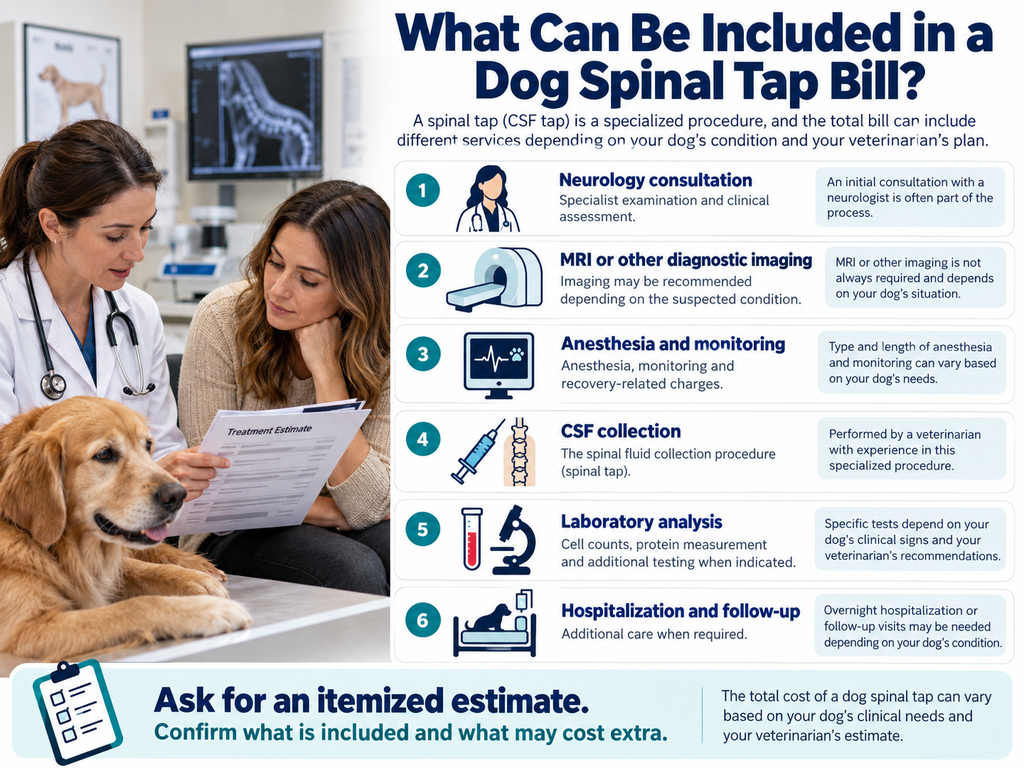
Before approving the procedure, request an itemized estimate showing the consultation, anesthesia, CSF collection, laboratory analysis, MRI, and hospitalization separately. This helps you understand whether the quoted amount covers the spinal tap alone or the entire diagnostic workup.
What If You Cannot Afford Your Dog’s Spinal Tap?
Can You Ask the Vet for an Itemized Estimate?
Yes, always — ask for a written breakdown covering consultation, imaging, the tap itself, lab analysis, anesthesia, and any hospitalization, so you understand exactly what you’re being asked to pay for.
Can You Discuss Staged Testing or Alternative Diagnostic Options?
Ask directly whether a CSF tap without MRI, or a consultation and bloodwork first, could provide useful initial information before committing to the full combined workup — this depends entirely on your dog’s specific symptoms and isn’t appropriate for every case.
Are Veterinary Payment Plans or Financial Assistance Available?
Ask about CareCredit or Scratchpay, both of which can often approve within minutes. Some hospitals also offer internal payment arrangements for established clients. For the complete breakdown of every financial assistance option.
Read Realted Article… Can’t Pay a Vet Bill in the USA? 15 Real Ways to Get Help in 2026
What Questions Should You Ask Before Approving the Procedure?
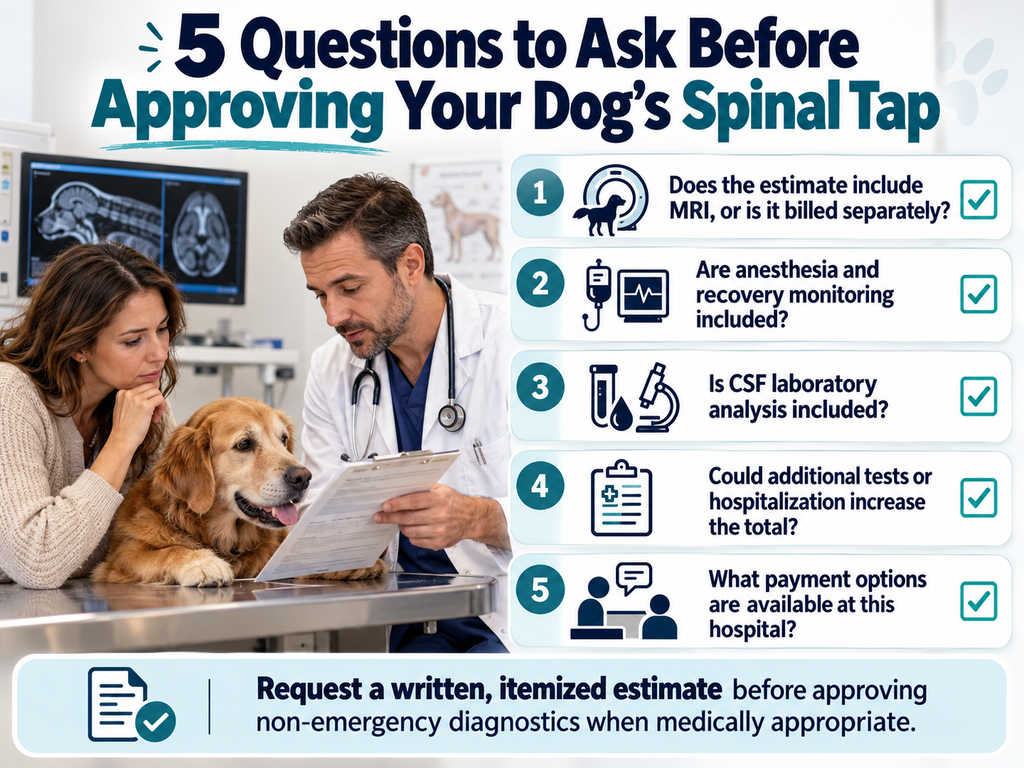
- Is this quote for the tap alone, or the full workup with MRI?
- Does the estimate include anesthesia and recovery monitoring?
- What additional lab tests might be added based on findings?
- Is hospitalization likely, and for how long?
- Do you accept CareCredit or Scratchpay?
These options depend on eligibility, hospital policy, and your dog’s specific medical situation — none are guaranteed, and your vet determines what’s medically appropriate for your dog’s case.
Does Pet Insurance Cover a Dog Spinal Tap?
Is Diagnostic Testing Covered Under Accident-and-Illness Plans?
Often yes — CSF analysis and related neurology diagnostics are generally eligible under standard accident-and-illness policies when used to diagnose a new, covered condition, as long as your policy is active and past its waiting period.
Read Related Article… Pet Insurance Waiting Period: How Long Before Coverage Starts? (2026 Guide)
Can Pre-Existing Symptoms Affect Coverage?
Yes. If your dog showed neurological symptoms before your policy started or during the waiting period, related diagnostics — including a spinal tap performed later — may be excluded as pre-existing, even if the test itself happens well after enrollment.
Read Related Article… Does Pet Insurance Cover Pre-Existing Conditions? The Truth Most Pet Owners Learn Too Late (2026)
What Should You Confirm With Your Insurer Before Testing?
Confirm your waiting period status, whether your dog’s specific symptoms could be classified as pre-existing, and your expected reimbursement percentage and deductible before scheduling. For more on how pre-existing conditions and waiting periods work generally, see our dedicated pet insurance coverage guide.
Frequently Asked Question
How much does a spinal tap cost for a dog?
A dog spinal tap with CSF collection and analysis may cost around $800–$2,500 in the US, based on a published 2026 estimate. If MRI, specialist consultation, anesthesia, and hospitalization are added, the total neurological workup may reach $3,000–$5,500 or more. Actual costs depend on the hospital and services included.
Is MRI included in the cost of a dog spinal tap?
Not always. MRI and CSF collection are separate procedures, but some veterinary hospitals include both in a bundled neurological workup estimate. Ask whether imaging, anesthesia, laboratory analysis, and recovery monitoring are included in your quote.
Does a dog need anesthesia for a spinal tap?
Yes. CSF collection in dogs requires general anesthesia so the veterinarian can position the dog correctly and collect the sample safely. Your vet may recommend pre-anesthetic bloodwork to assess your dog’s health before the procedure.
Why would a vet recommend a spinal tap for a dog?
A veterinarian may recommend a spinal tap to investigate unexplained seizures, balance problems, circling, neck pain, back pain, or suspected inflammation or infection affecting the brain and spinal cord. CSF results are usually interpreted alongside the neurological examination and other diagnostic tests.
How long does it take to get dog spinal tap results?
CSF samples need prompt processing because their cells can deteriorate within 30–60 minutes after collection. The time required for the final results depends on the tests performed and whether the sample is analyzed in-house or sent to an outside laboratory. Ask your veterinary team when to expect the findings.
What are the risks of a spinal tap in dogs?
Potential risks include complications related to general anesthesia, injury from the collection needle, infection, and brain herniation in certain high-risk cases. Your veterinarian will assess your dog’s condition and determine whether the procedure is appropriate.
Does pet insurance cover a dog spinal tap?
Some accident-and-illness pet insurance plans may cover medically necessary CSF testing when it relates to an eligible condition. Coverage depends on the policy, waiting periods, exclusions, and whether neurological symptoms existed before coverage began. Confirm the details with your insurer before the procedure.
Can a dog have a spinal tap without an MRI?
In some cases, yes. Whether MRI should be performed before CSF collection depends on the suspected condition, neurological findings, and the veterinarian’s assessment. Ask your veterinary neurologist why imaging is recommended—or whether it can safely be omitted in your dog’s specific case.
External Authority Sources
- UW Veterinary Care (University of Wisconsin) — Neurology Service Information Sheet (published fee data)
- VCA Animal Hospitals — CSF Analysis overview
- Sage Veterinary Imaging — CSF Analysis and MRI workflow
- AVMA (American Veterinary Medical Association)
Disclaimer: This article is for informational and educational purposes only. Cost data reflects 2026 figures from multiple veterinary industry and academic sources and will vary based on your dog’s condition, location, facility type, and whether additional testing or hospitalization is needed. PetInsurePrime does not sell pet insurance and receives no compensation from any veterinary facility. Always obtain an itemized estimate from your veterinary neurologist before proceeding.
PetInsurePrime | Independent • Research-Based | Helping US dog owners understand real vet costs and coverage options — without the sales pressure.