
Updated: September 2026| Reading Time: 17minutes
Your dog is struggling to breathe, and the vet has her on oxygen right now. You’re watching her chest rise and fall a little easier through the oxygen cage window, relieved — and also doing the math on what this is about to cost. Here’s a straight answer to both the “how much” and the “why so much” questions.
Quick Answer : Dog Oxygen Therapy Cost in the USA
CareCredit’s current national veterinary cost data lists average oxygen therapy costs of about $1,194 for small dogs and $1,861 for large dogs. PetMD, citing CareCredit data, rounds those figures to roughly $1,200 and $1,900. These figures represent oxygen therapy as a veterinary treatment and are not necessarily your entire emergency-hospital bill; hospitalization, diagnostics, medications, and treatment of the underlying condition may add substantially to the total — but the full treatment episode, once you include the emergency exam, diagnostics, and hospitalization that almost always come with it, commonly totals $1,200 for small dogs to $1,900 for large dogs, according to CareCredit’s national veterinary cost data cited by PetMD. Cases requiring mechanical ventilation run significantly higher — often $1,500–$2,000 for the first day and $1,500 per additional day, with total bills sometimes exceeding $15,000.
Quick Cost Summary
| What’s Being Measured | Typical Cost |
|---|---|
| Oxygen billed by time increment | $80–$125 per half hour |
| Overnight oxygen cage care | $600–$900 |
| Full oxygen therapy episode (small dog/cat) | ~$1,200 (CareCredit/PetMD) |
| Full oxygen therapy episode (large dog) | ~$1,900 (CareCredit/PetMD) |
| Mechanical ventilation — first day | $1,500–$2,000 |
| Mechanical ventilation — additional days | ~$1,500/day |
| Total bill for a ventilated patient | Often $15,000+ |
These figures come from different sources measuring different things — see below for why that matters.
Table of Contents
- How Much Does Dog Oxygen Therapy Cost?
- Why Do Online Cost Estimates Vary So Much?
- What Determines the Cost of Dog Oxygen Therapy?
- Oxygen Delivery Methods and How They Affect Cost
- How Long Does a Dog Need Oxygen Therapy?
- What Else Gets Billed Alongside Oxygen Therapy?
- Is Oxygen Therapy Included in the Emergency Vet or Hospitalization Fee?
- Why Is My Bill So High for “Just Oxygen”?
- Short-Term Support vs. Emergency Hospitalization vs. ICU
- What Happens If My Dog Needs Oxygen for More Than One Night?
- Can Oxygen Therapy Be Done at Home for a Dog?
- Does Pet Insurance Cover Oxygen Therapy for Dogs?
- What If You Can’t Afford Oxygen Therapy for Your Dog?
- Questions to Ask Your Vet
- FAQ
How Much Does Dog Oxygen Therapy Cost?
The honest answer depends on whether you’re asking about the oxygen itself or the full treatment episode — and most of the sticker shock owners feel comes from not realizing those are two different numbers.
Oxygen alone, when billed separately, tends to run $80–$125 per half hour, with overnight oxygen cage care commonly landing at $600–$900. But oxygen therapy is rarely given in isolation — CareCredit’s national veterinary cost data, cited by PetMD, puts the full oxygen therapy episode at roughly $1,200 for small dogs and cats, and roughly $1,900 for large dogs, once the emergency visit, diagnostics, and associated treatment are included. If your dog needs mechanical ventilation rather than standard oxygen support, costs escalate sharply — typically $1,500–$2,000 for the first day and about $1,500 for each additional day, with total bills for ventilated patients often exceeding $15,000.

Why Do Online Cost Estimates Vary So Much?
This isn’t inconsistency for its own sake — different sources are genuinely measuring different pieces of the same care.
Some sources quote oxygen the way a utility is billed: by time, at $80–$125 per half hour, or $600–$900 for an overnight stay in an oxygen cage. Others, like CareCredit’s national data, report the average cost of the full oxygen therapy episode — the exam, the oxygen, the diagnostics, and associated treatment bundled together — which lands at $1,200–$1,900. A handful of factors explain the rest of the spread: delivery method, how long your dog needs support, your dog’s size, whether you’re at a general practice or 24-hour emergency hospital, and whether an underlying condition requires ongoing treatment alongside the oxygen itself.
What Determines the Cost of Dog Oxygen Therapy?
The cost of oxygen therapy for a dog depends on several factors, and the oxygen itself is only one part of the bill. Treatment duration is one of the biggest variables: a dog needing oxygen for a few hours will generally cost much less than one requiring overnight or multi-day hospitalization.
The oxygen delivery method also affects pricing. Flow-by oxygen may be used briefly during emergency stabilization, while oxygen cages, nasal cannulas, or more advanced respiratory support require more equipment, monitoring, and staff time. Mechanical ventilation is substantially more intensive and expensive.
Your dog’s underlying condition can have an even bigger impact. Pneumonia, congestive heart failure, smoke inhalation, trauma, or airway obstruction may require X-rays, bloodwork, medications, IV treatment, and continuous monitoring in addition to oxygen.
The type of hospital and location matter too. A 24-hour emergency hospital or specialty center may charge more than a daytime general practice because of higher staffing and equipment costs. Your dog’s size, need for sedation, length of hospitalization, and ICU-level monitoring can also increase the final bill.
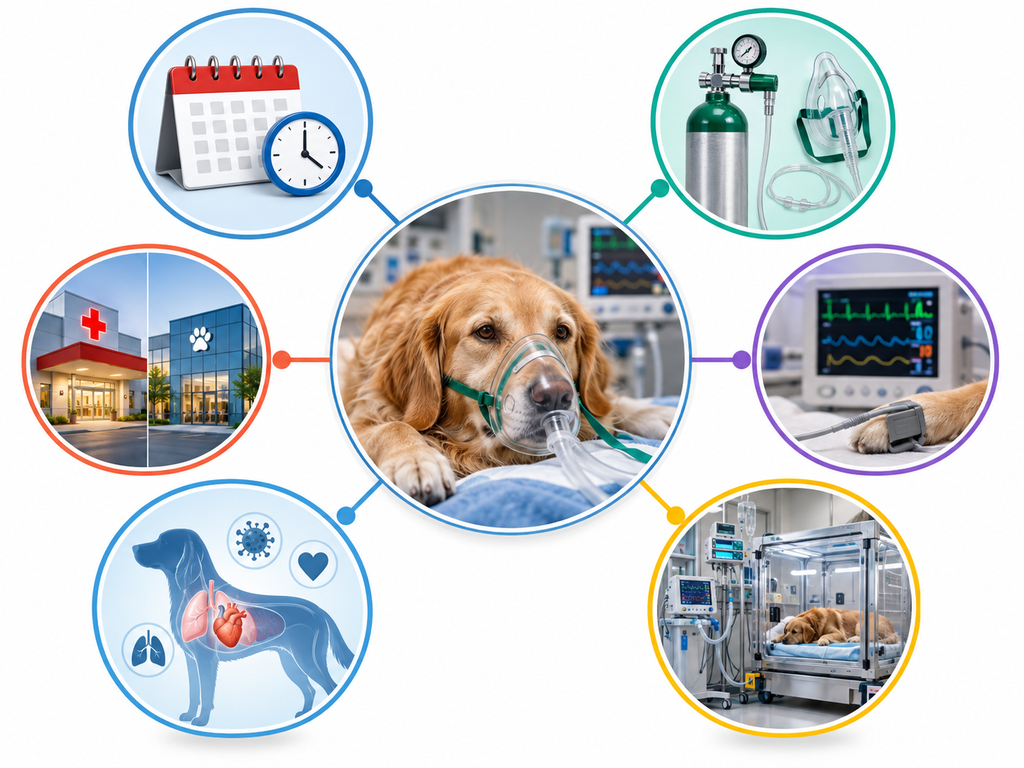
Oxygen Delivery Methods and How They Affect Cost
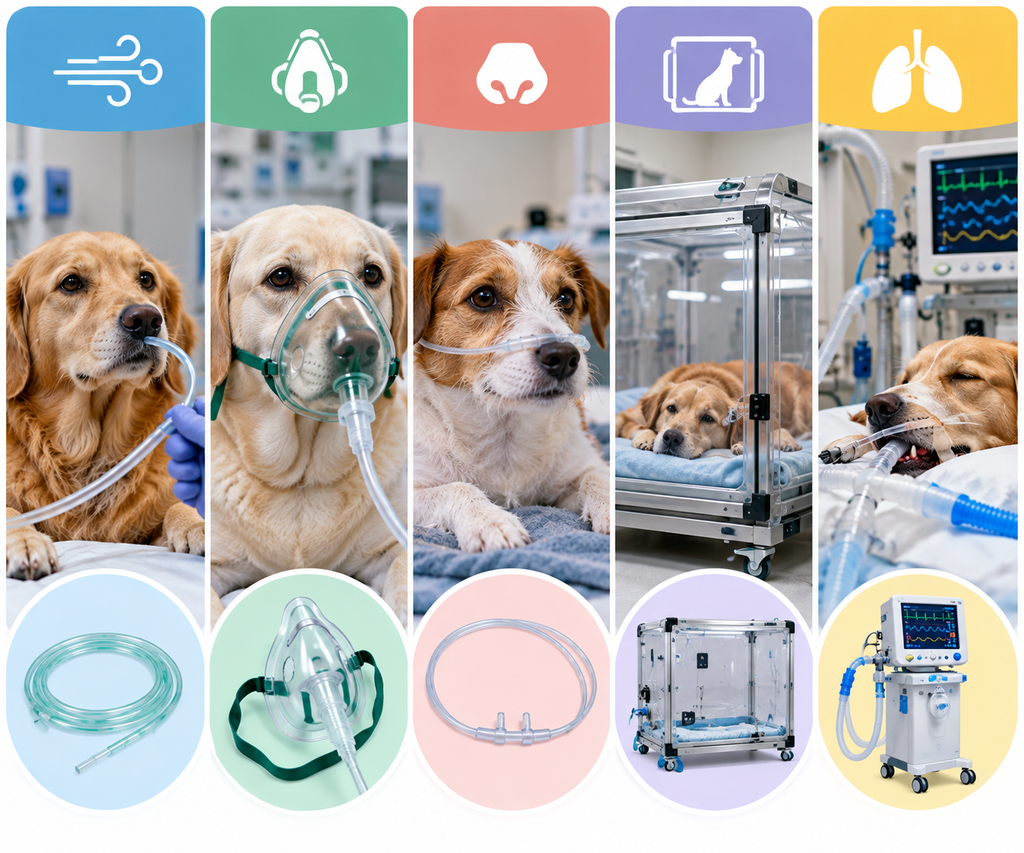
| Method | What It Is | Typical Use Case | Cost Impact |
|---|---|---|---|
| Flow-by oxygen | Oxygen held near the nose/mouth, no equipment attached to the dog | Brief, immediate support during triage | Lowest — often bundled into the exam |
| Oxygen mask | Mask held or secured over the muzzle | Short-term support during exam or transport | Low to moderate |
| Nasal cannula | Tube placed in the nostril for continuous delivery | Ongoing support while allowing more mobility | Moderate |
| Oxygen cage | Enclosed chamber maintaining an oxygen-rich environment | Standard for hospitalized respiratory patients | Moderate to high, billed hourly or per stay |
| Mechanical ventilation | Machine fully manages breathing | Severe respiratory failure | Highest — $1,500+ per day |
Your vet chooses the method based on your dog’s specific condition and how much oxygen support is needed — not based on cost. A dog needing only brief support during evaluation might get flow-by oxygen at minimal added cost, while a dog with ongoing respiratory distress typically needs an oxygen cage for continuous, hands-off support.
How Long Does a Dog Need Oxygen Therapy?
How long a dog needs oxygen therapy depends on why the dog is having trouble breathing, how severe the condition is, and how quickly the dog responds to treatment.
Some dogs may need oxygen for only a few minutes to several hours while an emergency veterinarian stabilizes them. Dogs with conditions such as pneumonia, heart failure, or significant lung disease may need continuous oxygen support for one to three days or longer.
The delivery method can also change during treatment. A dog may initially receive oxygen through a mask or flow-by oxygen during stabilization and later be moved to an oxygen cage or nasal cannula for longer-term support. Dogs requiring mechanical ventilation may need intensive, round-the-clock respiratory support.
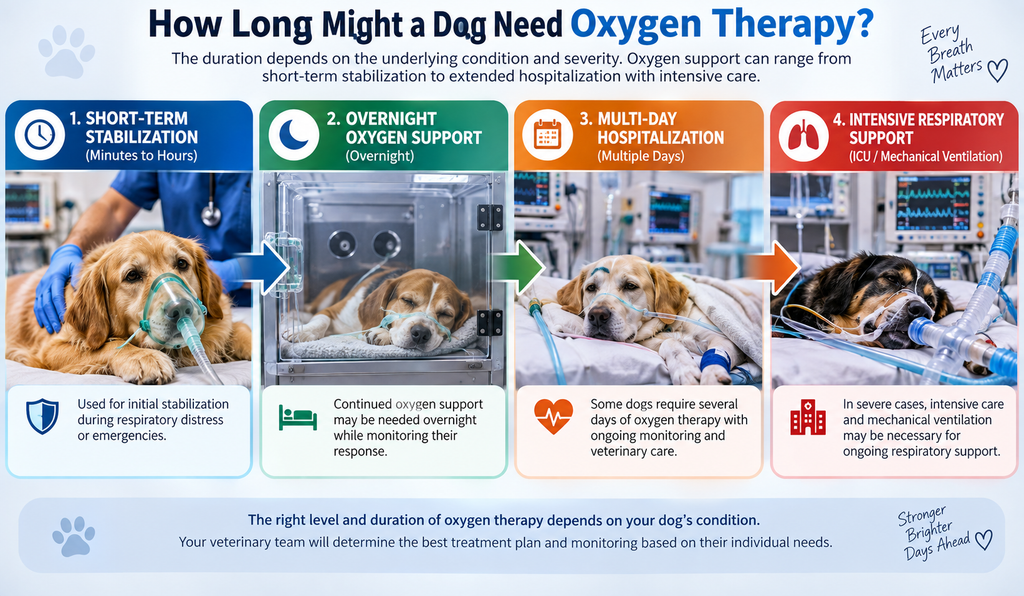
Veterinarians generally wean dogs off oxygen rather than stopping it suddenly. The goal is to reduce oxygen support as the underlying problem improves and the dog can maintain adequate oxygen levels without assistance.
Because every extra hour or day can add hospitalization, monitoring, and treatment costs, the duration of oxygen therapy is one of the biggest factors affecting the final veterinary bill.
What Else Gets Billed Alongside Oxygen Therapy?
Oxygen therapy is almost always part of a larger emergency workup, not a standalone charge — which is the single biggest reason a “$1,200 oxygen therapy” quote doesn’t feel like it matches “just oxygen.”
Read Related Article… Dog Blood Test Cost in the USA (2026): Real Prices, What Each Panel Tests, and How to Pay Less
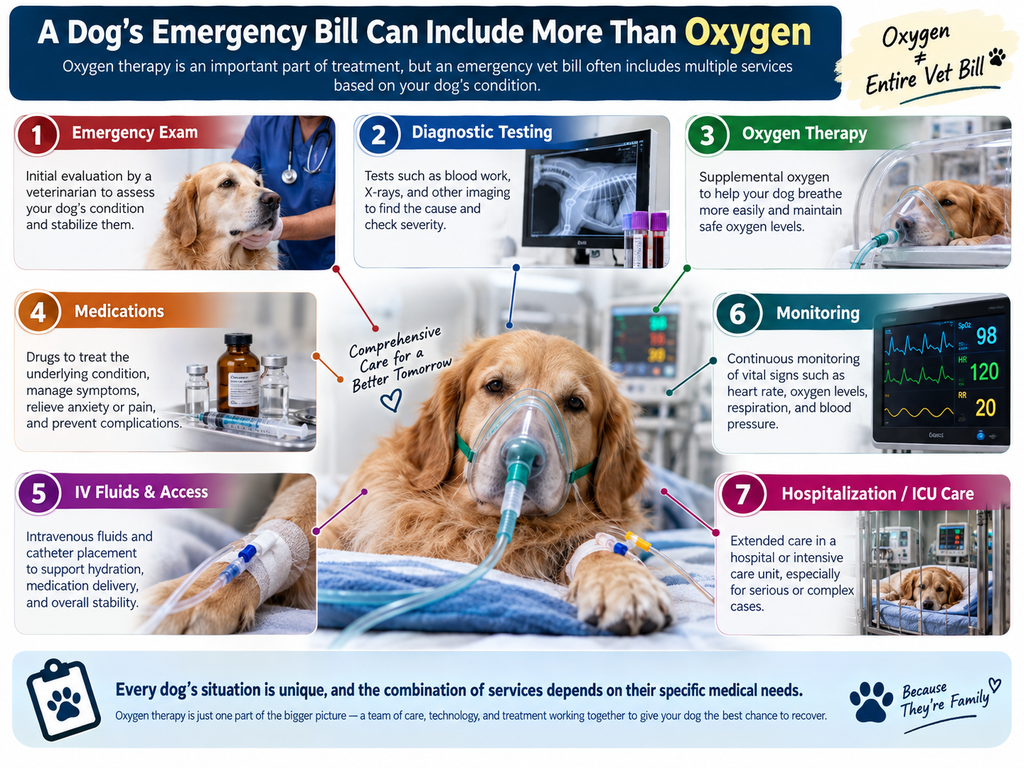
The emergency exam comes first, assessing how severe the respiratory distress is. Diagnostics — chest X-rays, sometimes a heart ultrasound, and bloodwork — help identify the underlying cause, since labored breathing can stem from fluid around the lungs, heart disease, trauma, or an airway obstruction, each requiring different treatment. An IV catheter and fluids are frequently placed for ongoing care access. Medications — to reduce fluid buildup, manage pain, or treat the underlying condition — are typically added once a cause is identified. Hospitalization, whether standard monitoring or ICU-level care, continues for as long as your dog needs oxygen support.
Read Related Article… Emergency Vet Costs in the USA (2026): What You’ll Really Pay by State
Read Related Article… Dog X-Ray Cost in the USA (2026): Average Prices, Sedation Costs & What You’ll Actually Pay
Is Oxygen Therapy Included in the Emergency Vet or Hospitalization Fee?
Not always. At an emergency veterinary hospital, oxygen therapy may appear as a separate charge from the emergency exam, hospitalization, diagnostics, medications, and other treatments. The way it is billed depends on the hospital, the oxygen delivery method, how long your dog needs support, and whether your dog requires general hospitalization or ICU-level care.
For example, current veterinary cost data lists oxygen therapy and hospitalization as separate cost categories, showing that they can be charged independently. PetMD also notes that emergency oxygen therapy can be an additional cost on top of hospitalization and other treatment.
Some hospitals may bundle certain oxygen-related services into a hospitalization or ICU rate, while others may charge separately for oxygen equipment, oxygen time, or the treatment itself.
Before approving treatment, ask the veterinary team:
- Is oxygen included in the hospitalization fee or billed separately?
- Is the oxygen charge hourly, per treatment, or per day?
- Does the estimate include monitoring and nursing care?
- What additional costs should I expect if my dog needs oxygen overnight?
- Is my dog being treated in standard hospitalization or an ICU?
Requesting an itemized estimate can help you understand whether the quoted oxygen cost is the entire oxygen-related expense or only one line of a larger emergency-care bill.
Why Is My Bill So High for “Just Oxygen”?
It’s worth naming the psychological gap directly: seeing “Oxygen Therapy — $1,200” on an invoice can feel jarring when it seems like your dog is “just” breathing air from a machine.
In practice, oxygen therapy is almost never a standalone treatment — it’s part of emergency stabilization for a dog in real respiratory distress, and it’s typically bundled with continuous monitoring, the equipment and space required to maintain an oxygen-rich environment, and staff checking on your dog regularly to ensure the treatment is working. The oxygen cage or ventilator itself represents real equipment cost that sits ready whether or not it’s in use, similar to how ICU equipment works more broadly.
Short-Term Support vs. Emergency Hospitalization vs. ICU
| Level of Care | What It Looks Like | Typical Duration |
|---|---|---|
| Short-term support | Oxygen during exam/stabilization only | Minutes to a few hours |
| Emergency hospitalization | Oxygen + monitoring + diagnostics, dog stays for observation | Several hours to overnight |
| Critical/ICU care | Continuous oxygen + intensive monitoring + treatment of underlying disease | 1 or more days |
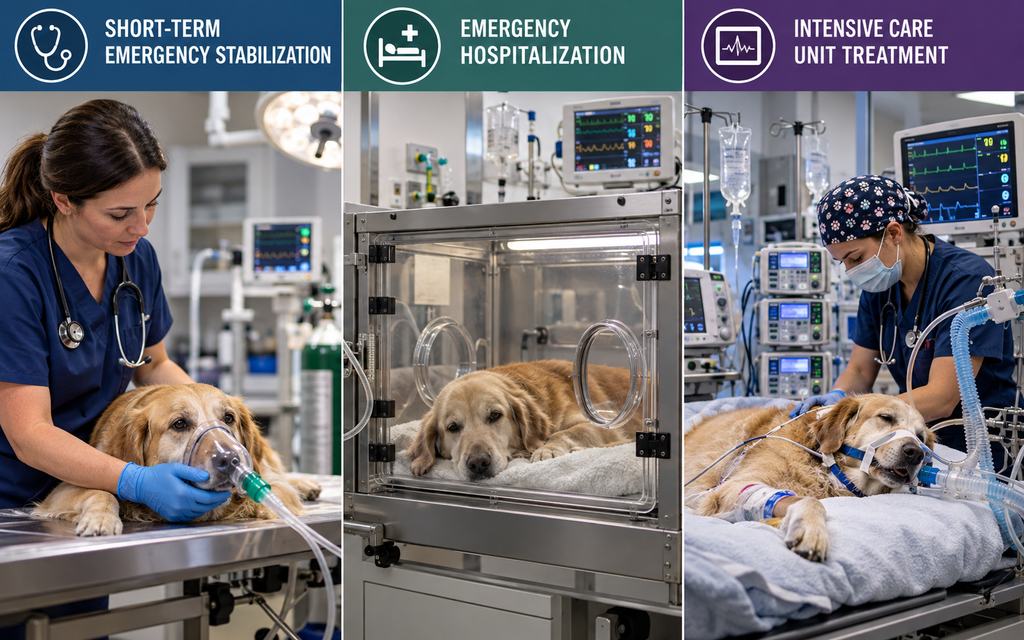
Which category your dog falls into depends on the severity of the respiratory distress and the underlying cause, not simply how the symptoms looked when you arrived. A dog that stabilizes quickly after brief oxygen support is a very different cost situation than one needing days of continuous oxygen and cardiac care.
Read Related Article… Dog ICU Cost Per Day in the USA (2026): How Much Does Canine Intensive Care Cost?
What Happens If My Dog Needs Oxygen for More Than One Night?
If your dog needs oxygen for more than one night, the cost can rise quickly because you are usually paying for more than the oxygen itself. Continued oxygen support often means ongoing hospitalization, monitoring, nursing care, medications, diagnostics, and treatment for the condition causing the breathing problem. Veterinary hospitals may also reassess your dog’s oxygen levels and overall response regularly before reducing or stopping oxygen support.
Some dogs improve after several hours or one night of oxygen and can be gradually weaned off it. Others may need oxygen for multiple days, particularly when pneumonia, heart disease, trauma, severe respiratory disease, or another serious condition is involved. Severe cases may require 24-hour intensive care or mechanical ventilation, which can increase the bill substantially.
If your dog needs another night in the hospital, ask your veterinarian for an updated estimate showing the expected daily hospitalization cost, oxygen charges, monitoring, medications, and any additional tests. Also ask what improvement your dog needs to show before oxygen can be reduced or hospitalization can safely end.
Can Oxygen Therapy Be Done at Home for a Dog?
Yes, but only in certain cases and under your veterinarian’s direction. Most dogs that suddenly need oxygen are treated in a veterinary hospital because they may also need continuous monitoring, diagnostic testing, medications, or other emergency treatment.
Home oxygen may sometimes be considered for dogs with chronic respiratory or heart conditions when a veterinarian believes it is appropriate. Your vet should determine the oxygen delivery method, equipment, flow rate, and how often it should be used. They should also explain when your dog needs to return to the hospital.
Home oxygen can require specialized equipment, which adds to the overall cost. It also requires careful handling because oxygen must be used safely around the home.
If your dog is currently struggling to breathe, has pale or blue gums, is collapsing, or cannot settle because of breathing difficulty, do not try to manage the situation with home oxygen alone. These can be signs of a medical emergency requiring immediate veterinary care.
Does Pet Insurance Cover Oxygen Therapy for Dogs?
Oxygen therapy is generally treated as medically necessary treatment under accident-and-illness pet insurance plans, but whether it’s covered in your specific case depends on your policy’s terms — not a blanket yes or no.
Read Related Article… Does Pet Insurance Cover Emergency Vet Visits? What Most Dog Owners Don’t Know (2026)
Coverage typically hinges on the underlying condition causing the respiratory distress: if it’s a new accident or illness, most standard policies apply their usual deductible and reimbursement percentage (commonly 70–90%) to the eligible costs. If the underlying condition is something your dog was diagnosed with, or showed symptoms of, before your policy started or during the waiting period, it may be treated as pre-existing and excluded — even though the oxygen therapy itself is a new event. Hospitalization associated with the oxygen therapy is typically handled under the same claim as the treatment itself, though always worth confirming with your specific insurer. Your annual policy limit also matters for cases involving extended ICU stays or ventilation, where costs can climb quickly.
What If You Can’t Afford Oxygen Therapy for Your Dog?
If the estimate is more than you can cover right now, say so directly to the vet team immediately — oxygen therapy situations are often time-sensitive, so speed in this conversation matters.
Read Related Article… Can’t Afford an Emergency Vet Bill? 15 Real Ways Dog Owners Find Help (2026)
Ask for a written, itemized estimate so you understand what’s included beyond the oxygen itself. Ask what treatment is medically necessary right now to stabilize your dog versus what can be discussed once she’s breathing more comfortably. Ask about CareCredit or Scratchpay, both of which can often approve within minutes and pay the hospital directly. Ask whether the hospital accepts a partial deposit to begin treatment while you arrange the rest. If you’re insured, contact your provider as soon as possible to understand your likely reimbursement. For the complete breakdown of financing options, grant programs, and questions to ask before agreeing to treatment, see our full guide on what to do if you can’t afford emergency vet surgery.
Read Related Article… Best Vet Payment Plans in the USA (2026): CareCredit vs Scratchpay
Questions to Ask Your Vet
- Does this quote cover just the oxygen, or the exam, diagnostics, and hospitalization too?
- What delivery method is my dog on, and why?
- Is my dog in short-term support, standard hospitalization, or ICU-level care?
- What’s driving the respiratory distress, and how does that affect the treatment plan?
- Do you accept CareCredit or Scratchpay?
- If I’m insured, is there anything I should document now for my claim?
Frequently Asked Questions
How much does oxygen therapy cost for a dog?
Dog Oxygen Therapy Cost in the USA is about $1,194 for small dogs and $1,861 for large dogs, based on current CareCredit veterinary cost data. Your total bill can be higher when hospitalization, diagnostics, and treatment are added.
How much does a dog oxygen cage cost?
An oxygen cage may be billed separately or as part of hospitalization, depending on the veterinary hospital. Current CareCredit data lists oxygen therapy as a separate emergency-care cost, while the final bill varies by location, treatment duration, and the dog’s condition.
Why is oxygen therapy so expensive for dogs?
Oxygen therapy involves more than oxygen itself. The cost can include specialized equipment, monitoring, veterinary staff, hospitalization, diagnostics, and treatment of the condition causing breathing problems.
Does pet insurance cover oxygen therapy for dogs?
Pet insurance may cover oxygen therapy when it is medically necessary for a covered accident or illness. Coverage depends on your policy, waiting periods, exclusions, deductible, reimbursement rate, and whether the condition is considered pre-existing.
What’s the difference between an oxygen mask, cage, and ventilation?
An oxygen mask or flow-by oxygen may provide short-term support. An oxygen cage provides continuous oxygen for hospitalized dogs. Mechanical ventilation is more intensive and may be needed when a dog cannot breathe adequately without machine assistance.
What if I can’t afford my dog’s oxygen therapy?
Tell your veterinary team immediately. Ask for an itemized estimate and discuss payment options such as CareCredit or Scratchpay, as well as which treatments are medically necessary right now.
How long does a dog need oxygen therapy?
Some dogs need oxygen for only minutes or hours during emergency stabilization, while dogs with conditions such as pneumonia or heart failure may need oxygen for one to three days or longer.
Does oxygen therapy mean my dog needs ICU care?
Not necessarily. A dog may receive oxygen during emergency stabilization or standard hospitalization. ICU-level care is generally associated with more intensive monitoring or advanced respiratory support, depending on the dog’s condition.
Can a dog receive oxygen therapy at home?
Sometimes, but only when a veterinarian determines that home oxygen is appropriate and provides instructions for the equipment and monitoring. Dogs in acute respiratory distress generally need immediate veterinary evaluation.
External Authority Sources
- PetMD — Oxygen Therapy for Pets (citing CareCredit national data)
- CareCredit — Veterinary Cost Data
- AVMA (American Veterinary Medical Association)
Disclaimer: This article is for informational and educational purposes only and is not a substitute for veterinary care. If your dog is having difficulty breathing, contact your veterinarian or an emergency animal hospital immediately. Cost data reflects 2026 figures from CareCredit’s national veterinary cost data, PetMD, and other veterinary industry sources, and will vary based on your dog’s size, condition, location, and treatment duration. PetInsurePrime does not sell pet insurance and receives no compensation from any insurance provider.
PetInsurePrime | Independent • Research-Based | Helping US dog owners understand real vet costs and coverage options — without the sales pressure.
Your blog has become my go-to source for positive and uplifting content Thank you for consistently delivering high-quality posts
Thank you for reading and for the kind words! We’re glad you found the information helpful.