
Updated: June 2026 | Reading Time: 14 Minutes
You just got the estimate. Maybe it’s $800. Maybe it’s $4,000. Either way, your stomach dropped.
Most people don’t have that money sitting around — and the guilt of loving a dog you can’t fully afford to help is one of the worst feelings a pet owner can experience. But before you assume you’re out of options, know this: there are real organizations specifically built for exactly this situation.
This isn’t a list of vague suggestions. These are 15 legitimate programs — nonprofits, foundations, and financial tools — that have helped thousands of USA dog owners cover vet bills they couldn’t pay alone. Each entry includes what they actually offer, who qualifies, and what to realistically expect.
| Program | Grant | Emergency Help | Dogs Only |
|---|---|---|---|
| RedRover | Yes | Yes | No |
| Frankie’s Friends | Yes | Yes | No |
| Bow Wow Buddies | Yes | Yes | Yes |
| CareCredit | Financing | Yes | No |
Quick Answer Organizations That Help Pay Vet Bills
If you can’t afford emergency veterinary care, organizations such as RedRover Relief, Frankie’s Friends, Bow Wow Buddies Foundation, The Pet Fund, and Paws 4 A Cure may help cover part of your dog’s medical expenses. Some provide grants, while others offer financing assistance or low-cost treatment options.
Read Realted Article… what happens if you can’t pay a vet bill
The 3 Types of Help Available
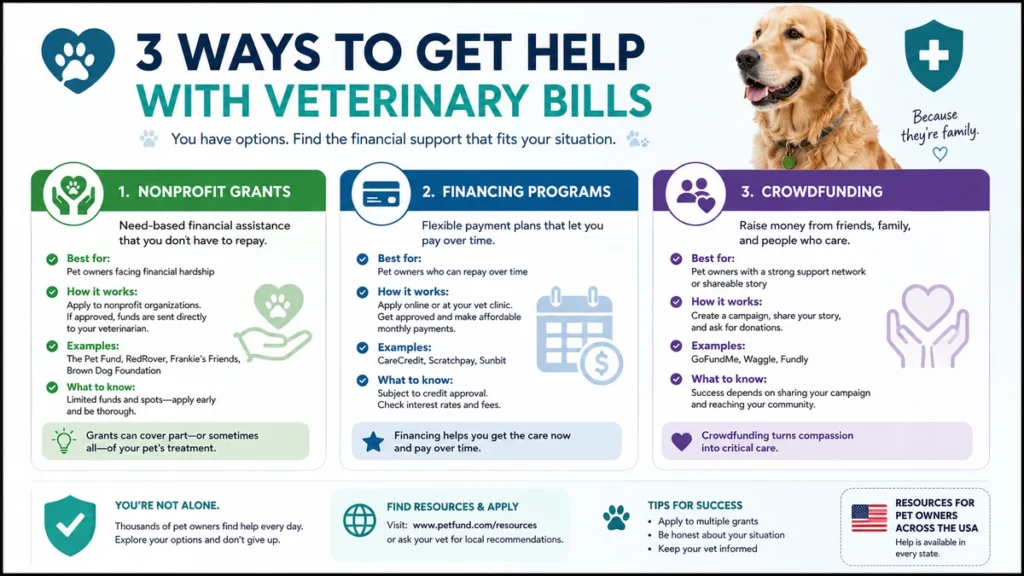
Not all assistance works the same way. Understanding the difference saves time when you’re already stressed.
| Type | How It Works | Best For |
|---|---|---|
| Grants / Nonprofit Funds | You apply; money goes directly to vet | True financial need, emergency care |
| Deferred Credit | You borrow; repay over time | Bridging a gap you can pay back |
| Crowdfunding | You raise funds publicly | Any situation, especially shareable stories |
Most people need a combination. Start with grants — if denied or too slow, supplement with financing.
15 Organizations That Help Pay Vet Bills
Program requirements, grant amounts, and availability can change. Always verify eligibility directly with the organization before applying.
Read Related Article… emergency vet costs in the USA
1. RedRover Relief — Best for Urgent Cases Within 10 Days
RedRover Relief is one of the few programs that moves fast. If your dog needs treatment within the next 10 days and you have a confirmed diagnosis and treatment plan, this is often the first place to apply.
Read Related Article… emergency vet care costs
What they offer: Emergency grants typically ranging from $200–$300, designed to fill a funding gap — not cover the entire bill.
Key eligibility rules:
- Household income must be under $60,000/year
- You must already have a diagnosis, prognosis, and treatment plan from a vet
- The program cannot pay for initial exams or diagnostic testing
- They cannot help if the remaining unfunded amount exceeds $1,000
That last point trips up a lot of applicants. RedRover is a gap-filler. If your total remaining balance is $900 and you’ve already raised $300 yourself, they may bridge the rest. If you’re $3,000 short with nothing raised, you’ll need additional resources alongside this application.
They also offer Safe Escape Grants — which help domestic violence survivors cover temporary pet boarding costs while in a shelter.
Apply at: redrover.org/relief
2. The Pet Fund — Best for Non-Emergency Ongoing Treatment
The Pet Fund focuses on secondary, non-emergency care — conditions that aren’t immediately life-threatening but are serious and expensive. Think chronic illness management, specialist referrals, or ongoing treatment for conditions like cancer or heart disease.
What they offer: Financial assistance grants for conditions requiring advanced, non-basic veterinary care.
Key eligibility rules:
- Proof of financial need required
- Not designed for emergency or acute care situations
- Application review takes time — not a same-day resource
If your dog was just diagnosed with a condition that requires months of treatment and you’re worried about the long-term cost, The Pet Fund is more appropriate than emergency-focused programs.
Apply at: thepetfund.com
3. Brown Dog Foundation — Best for Bridging Exact Funding Gaps
Brown Dog Foundation takes a different approach than most programs. Instead of offering a fixed grant amount, they calculate the exact difference between what you can contribute and what the treatment costs — and fund that specific gap.
What they offer: Variable assistance — if a surgery costs $3,500 and you can pay $1,000, they may contribute $2,500.
Key eligibility rules:
- Pet owner must have experienced a financial setback (job loss, medical bills, housing loss)
- Application submitted online only; phone approvals are not offered
- Incomplete applications are automatically denied — read instructions carefully
One important note: Brown Dog primarily serves specific counties across Minnesota and some surrounding areas. Verify your location qualifies before investing time in the application.
Apply at: browndogfoundation.org
4. Frankie’s Friends — Best for Life-Threatening or Specialty Care
Frankie’s Friends specifically targets pets in need of emergency or specialty care — situations where a pet will not survive without immediate intervention and the cost is beyond what the owner can handle alone.
What they offer: National Fund grants up to $2,000 per pet per household. This is a maximum, not a guarantee.
Read Related Article… dog surgery cost guide
Key eligibility rules:
- Must involve life-threatening or specialty care (oncology, cardiology, neurology, etc.)
- Financial need must be demonstrated
- Requires vet documentation of diagnosis and treatment plan
This is one of the higher grant ceiling programs available nationally. If your dog needs a specialist referral for something serious and the quote is several thousand dollars, Frankie’s Friends is worth applying to early.
Apply at: frankiesfriends.org
5. Paws 4 A Cure — Best for Any Breed, Any Age, Any Diagnosis
Most financial assistance programs have quiet exclusions — certain breeds, age limits, or conditions they won’t cover. Paws 4 A Cure doesn’t discriminate on any of those factors.
What they offer: Financial assistance grants for illnesses and injuries in dogs and cats, regardless of breed, age, or diagnosis. Up to $500.
Key eligibility rules:
- All-volunteer organization; processing time varies
- Financial need required
- Assists pet owners throughout the United States, including Guam and Puerto Rico
- Does not fund routine care (vaccines, spay/neuter, dental cleanings)
If you’ve been turned away elsewhere because of your dog’s breed or a “pre-existing condition” type exclusion, Paws 4 A Cure is worth the application.
Apply at: paws4acure.org
6. Shakespeare Animal Fund — Best for Veterans, Elderly, and Disabled Pet Owners
Shakespeare Animal Fund was created specifically to help emergency vet bills for pets belonging to veterans, the elderly, and disabled individuals — though they don’t restrict applications to only those groups.
What they offer: Emergency vet bill assistance for accidents, illness, or other urgent situations.
Key notes:
- Prioritizes applicants who are veterans, elderly, or disabled
- Focuses on emergency situations, not routine care
- Application details and current availability should be confirmed directly with the organization
Apply at: shakespeareanimalfund.org
7. Bow Wow Buddies Foundation — Best for Higher Grant Amounts
Bow Wow Buddies Foundation focuses specifically on dogs — and offers one of the higher grant amounts in this category, up to $2,500 per application.
What they offer: Up to $2,500 in financial assistance for dog owners dealing with serious veterinary bills.
Key notes:
- Dogs only
- Works with both individual owners and rescue organizations
- Financial need documentation required
If your dog’s surgery estimate is on the higher end — $2,000 to $5,000 range — Bow Wow Buddies is one of the few grant programs where a single approval could make a meaningful dent.
Apply at: bowwowbuddiesfoundation.org
8. The Mosby Foundation — Best for Critically Ill Dogs
The Mosby Foundation focuses its resources on limited-income pet owners facing unforeseen bills related to critically ill, injured, or neglected dogs specifically.
What they offer: Financial aid for urgent, unplanned veterinary expenses for dogs in critical condition.
Key eligibility:
- Income-based qualification required
- Dogs only
- Must be an unforeseen, urgent expense — not planned procedures
Apply at: themospyfoundation.org
9. Onyx and Breezy Foundation — Dogs and Cats
Onyx and Breezy Foundation accepts grant applications for both dogs and cats requiring medical care. It’s a smaller program but worth including in a simultaneous multi-application approach.
What they offer: Medical care grants for dogs and cats in financial need.
Key notes:
- Application-based; financial need required
- Confirm current availability and processing time directly
Apply at: onyxandbreezyfoundation.org
10. Pet Assistance, Inc. — Best for Long-Term Pet Owners
Pet Assistance, Inc. has an unusual qualification criterion: they tend to prioritize long-term pet owners facing their first major financial crisis. If you’ve had your dog for years and this is the first time you’ve needed help, your application tends to carry more weight with this organization.
What they offer: Urgent care financial assistance for cats and dogs.
Key notes:
- Not available for newly acquired pets
- Focuses on emergency care, not preventive or routine treatment
- Proof of financial need required
Apply at: petassistanceinc.org
11. ASPCA — For Spay/Neuter and Low-Cost Preventive Services
The ASPCA doesn’t offer direct cash grants for most medical bills, but their network is one of the most valuable resources for finding low-cost care options — especially for spay/neuter, vaccinations, and preventive services.
What they actually provide:
- A national directory of low-cost vet clinics
- Information on breed-specific assistance programs
- Regional and state-level resources for ongoing financial aid
If you’re looking for affordable ongoing care rather than emergency grant money, the ASPCA’s resource directory can point you toward community clinics and subsidized programs you’d never find through a Google search.
Visit: aspca.org
12. Humane Society of the United States — Resource Directory
Like the ASPCA, the Humane Society doesn’t hand out individual grants — but they maintain one of the most comprehensive directories of local and state-level assistance programs in the country.
What they provide:
- State-by-state listings of pet financial assistance
- Help with pet food costs and housing situations involving pets
- Connections to regional low-cost vet care options
If national programs are full or you don’t qualify, the Humane Society’s database is often where owners find local help that doesn’t show up anywhere else.
Visit: humanesociety.org
13. University Veterinary Teaching Hospitals — Often the Most Underused Resource
This one surprises most dog owners. Veterinary teaching hospitals affiliated with universities often charge 30%–60% less than private emergency animal hospitals for the same procedures — and in some cases, offer entirely free care for animals enrolled in specific clinical research programs.
Examples include:
- Colorado State University Veterinary Teaching Hospital
- Cornell University Hospital for Animals
- UC Davis School of Veterinary Medicine
- Texas A&M College of Veterinary Medicine
The care is supervised by licensed faculty veterinarians. The equipment is often more advanced than what private clinics carry. And the cost is substantially lower.
Read Related Article… cannot afford emergency vet surgery
If your dog’s condition isn’t immediately life-threatening but is serious enough to require specialist-level care, calling the nearest veterinary school is one of the most financially practical steps you can take.
Visit: avma.org
14. CareCredit — Deferred Payment for When You Need Treatment Now
CareCredit isn’t a grant — you’re borrowing money you’ll need to repay. But for dog owners who need treatment today and have reasonable ability to repay over time, it’s one of the most accessible options available.
What it offers:
Read Related Article… CareCredit vs Scratchpay comparison
- Healthcare credit card accepted at many vet clinics nationwide
- Promotional 0% interest periods (typically 6–24 months, depending on the amount)
- Approval decisions are usually fast
The critical warning: If the promotional period expires and the balance isn’t paid in full, deferred interest can be applied retroactively to the original purchase amount. Read the terms before accepting.
CareCredit works best as a bridge — not a long-term debt solution. If you’re confident you can pay the balance within the promotional window, it’s an effective tool.
Apply at: carecredit.com
15. GoFundMe / Crowdfunding — When Your Story Can Move People
Crowdfunding won’t work for everyone, but it works more often than most owners expect — especially when the story is specific, honest, and accompanied by a photo of the dog.
What makes a vet bill campaign succeed:
- A specific diagnosis and treatment plan (not vague “my dog is sick”)
- A real photo of your dog — ideally one with emotional connection
- A specific dollar amount tied to a real vet estimate
- Updates as the situation develops
- Sharing to social media, local community groups, and neighborhood apps like Nextdoor
Campaigns that reach 20% of their goal in the first 48 hours are statistically more likely to succeed. Start sharing immediately after posting, not after waiting.
Start at: gofundme.com

How to Apply Strategically (Don’t Wait for One Answer)
The single biggest mistake dog owners make is applying to one program, waiting for a response, and then moving to the next.
Apply to multiple programs simultaneously. Most applications take 20–30 minutes each. While one organization reviews your case, another may approve it faster.
A practical order for most situations:
- Confirm your dog’s diagnosis and get a written treatment estimate first — most programs require this before you can even start an application
- Apply to RedRover Relief (fastest turnaround for urgent cases)
- Apply to Frankie’s Friends (highest grant ceiling for serious conditions)
- Apply to Bow Wow Buddies (specifically for dogs, higher grant amounts)
- Contact university vet hospitals (significantly lower overall costs)
- Set up a GoFundMe while other applications are processing
- Ask your current vet about an in-house payment plan — many offer this without advertising it
What Most Grant Programs Won’t Cover
Knowing these limits upfront saves time:
- Routine care — vaccines, annual exams, dental cleanings, spay/neuter (unless at low-cost clinic)
- Euthanasia costs — most programs explicitly exclude this
- Diagnostic testing — some programs (including RedRover) cannot fund exams or tests
- New pets — some organizations (Pet Assistance, Inc.) prioritize long-term pet owners
- Preventive medications — flea/tick prevention, heartworm prevention are typically excluded
A Note on Processing Times
| Program | Typical Timeline |
|---|---|
| RedRover Relief | 24–72 hours for urgent cases |
| Frankie’s Friends | Several business days |
| Brown Dog Foundation | 1–2 weeks |
| The Pet Fund | 2–4 weeks |
| Paws 4 A Cure | Variable (volunteer-run) |
| CareCredit | Same day in many cases |
| GoFundMe | Immediate setup; funding varies |
If your dog’s situation is genuinely life-threatening, lead with RedRover and CareCredit simultaneously while other applications are pending. Don’t let processing timelines delay necessary care.
If Your Dog Needs Care Right Now
Start by getting a written estimate from your veterinarian. Then apply to multiple assistance programs at the same time rather than waiting for one response. Combining grants, payment plans, lower-cost veterinary hospitals, and crowdfunding often works better than relying on a single source.
Frequently Asked Questions
Can I apply to multiple organizations at the same time?
Yes. Most pet assistance programs allow you to apply to multiple organizations simultaneously. In fact, applying to several programs at once often increases your chances of getting help faster during an emergency.
Do I need to pay back grant money?
No. Veterinary assistance grants are not loans and do not need to be repaid. If approved, funds are usually sent directly to the veterinary clinic rather than the pet owner.
What if my dog’s bill is more than $5,000?
Large vet bills often require multiple funding sources. Many owners combine grants, payment plans, CareCredit, crowdfunding, and lower-cost veterinary hospitals to reduce out-of-pocket expenses.
What if I make too much money to qualify for most grants?
Some programs have income limits, while others do not. If you don’t qualify for grants, options such as CareCredit, veterinary payment plans, crowdfunding, or university veterinary hospitals may still help reduce costs.
Can I get help for a dog I just adopted?
Possibly. Some organizations prioritize long-term pet owners, while others accept applications regardless of how recently the pet was adopted. Always review the program’s eligibility requirements before applying.
What’s the fastest way to get vet bill help?
For immediate assistance, ask your veterinarian about payment plans and check financing options like CareCredit. Emergency grant programs such as RedRover Relief may also provide help for urgent cases, depending on eligibility.
Disclaimer
This article is for informational and educational purposes only. Cost data reflects 2026 national averages from NAPHIA, Insurify, and MetLife Pet Insurance and will vary based on your dog’s age, breed, location, and the specific plan you choose. PetInsurePrime does not sell pet insurance and receives no compensation from any insurance provider. Always compare multiple quotes and read your policy documents carefully before enrolling.
PetInsurePrime | Independent • Research-Based | Helping US dog owners understand real vet costs and coverage options — without the sales pressure.