
Updated: June 2026 | Reading Time: 14 Minutes
Your vet just said your dog needs “stomach surgery,” and that phrase alone doesn’t tell you much — it could mean a $900 planned procedure or a $10,000 emergency. This guide breaks down what you’ll actually pay depending on which type of stomach surgery your dog needs.
Quick Answer : How Much Does Dog Stomach Surgery Cost?
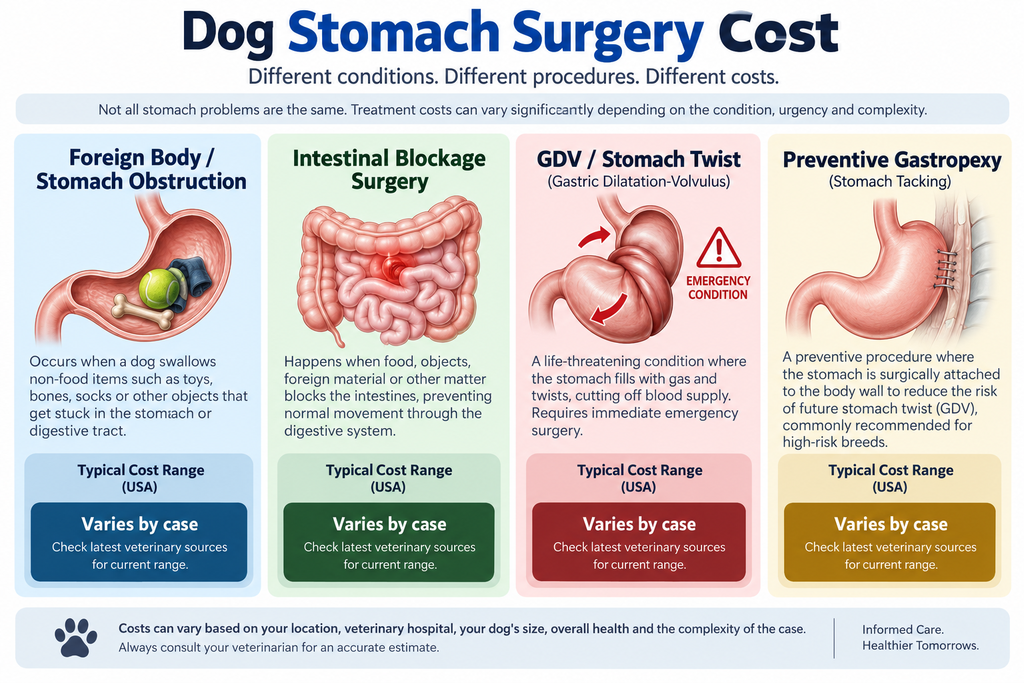
Dog stomach surgery costs vary enormously by type: preventive gastropexy runs $800–$2,500, intestinal blockage surgery averages $4,383 nationally with a realistic range of $2,000–$10,000, and emergency GDV (bloat) surgery costs $3,000–$8,000 for the procedure alone, with total bills including diagnostics and ICU care commonly reaching $7,000–$12,000. Emergency cases cost significantly more than planned ones, and the final bill depends heavily on whether complications, hospitalization, or ICU care are involved.
Dog Stomach Surgery Cost at a Glance
Typical Cost Range by Surgery Type
| Surgery Type | Typical US Cost | Emergency? |
|---|---|---|
| Foreign body / stomach obstruction | $1,500–$8,500 | Often |
| Intestinal blockage surgery | $2,000–$10,000 (avg. $4,383) | Often |
| GDV / stomach-twist surgery | $3,000–$8,000 surgery; $7,000–$12,000 total | Yes |
| Gastropexy (preventive) | $800–$2,500 | Usually no |
| Exploratory abdominal surgery | $1,500–$5,000+ | Depends on findings |
These are planning ranges from multiple industry sources. Actual cost depends on severity, location, hospital type, and complications.
Table of Contents
- Why Does My Dog Need Stomach Surgery?
- What Is Included in a Dog Stomach Surgery Bill?
- How Much Does Dog Intestinal Blockage Surgery Cost?
- How Much Does GDV or Bloat Surgery Cost for a Dog?
- How Much Does Gastropexy or Stomach-Tacking Surgery Cost?
- What Makes Dog Stomach Surgery So Expensive?
- Dog Stomach Surgery Cost: Simple Case vs. Complicated Case
- Dog Intestinal Blockage Surgery Cost by State
- Does Pet Insurance Cover Dog Stomach Surgery?
- What If You Can’t Afford Dog Stomach Surgery?
- Dog Stomach Surgery Recovery and Additional Costs
- How to Read a Dog Stomach Surgery Estimate
- FAQ
Why Does My Dog Need Stomach Surgery?
Dogs may need stomach or abdominal surgery when a condition cannot be safely treated with medication or monitoring alone. One of the most common reasons is a foreign object or intestinal blockage—such as a toy, sock, bone, string, or other material that becomes stuck and prevents food and fluids from passing normally. If the blockage damages the intestine or causes tissue death, the damaged section may need to be removed.
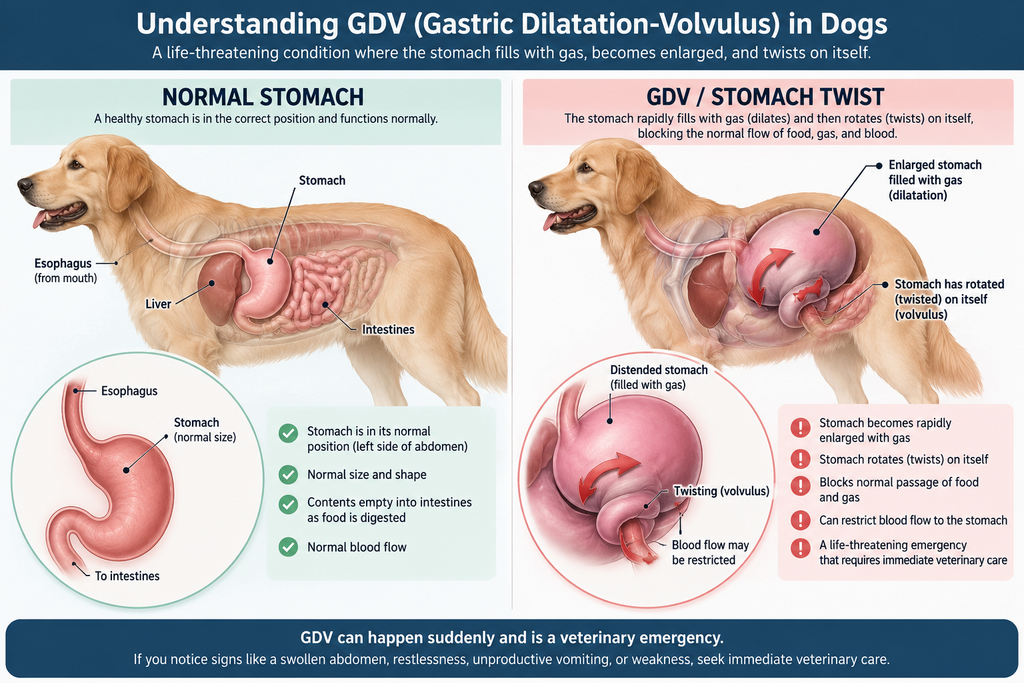
Another major emergency is GDV (gastric dilatation-volvulus), also called stomach bloat or stomach twist. In GDV, the stomach becomes distended and rotates, which can restrict blood flow and lead to severe complications. Immediate medical and surgical treatment is generally required.
Other reasons for surgery can include intestinal tumors or masses, intestinal twisting, hernias, intussusception, severe gastrointestinal damage, or certain foreign bodies that cannot be removed through endoscopy. The exact procedure—and therefore the final cost—depends on what caused the problem and how much tissue is affected.
What Is Included in a Dog Stomach Surgery Bill?
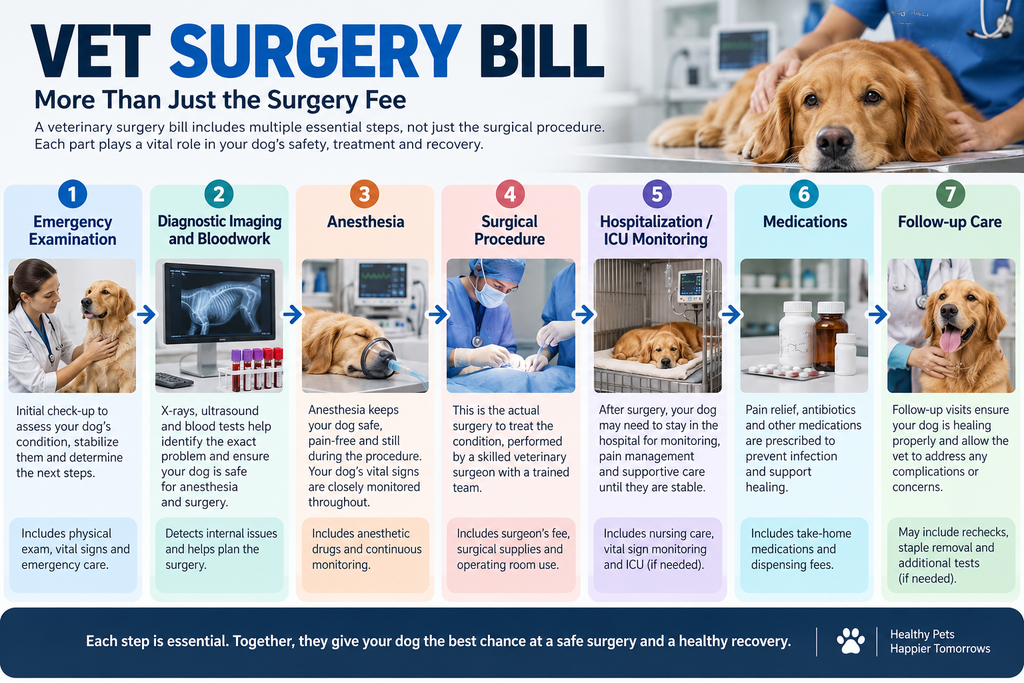
Whatever type of stomach surgery your dog needs, the quoted price almost always bundles several distinct pieces — understanding each helps explain how a bill grows from a few hundred dollars to several thousand.
Read Related Article… Dog MRI Cost in the USA (2026): Average Cost, Insurance Coverage & Financing
The emergency examination is the starting point, assessing severity and confirming surgery is needed. X-rays and diagnostic imaging locate the problem — a foreign object, a twisted stomach, or a blockage — and help your vet plan the surgical approach. Bloodwork checks organ function and confirms your dog is stable enough for anesthesia. Anesthesia is required for any of these procedures and is priced separately from the surgery itself. The surgery is the actual procedure — which varies enormously depending on what’s found. Hospitalization and monitoring follow surgery, ranging from same-day discharge to several days of ICU care depending on severity. Medications and follow-up care continue after discharge, including pain control, antibiotics, and a recheck visit.
Read Related Article… Dog X-Ray Cost in the USA (2026): Average Prices, Sedation Costs & What You’ll Actually Pay
How Much Does Dog Intestinal Blockage Surgery Cost?
Intestinal blockage surgery has a national average of $4,383, according to CareCredit’s claims data, with costs ranging from $3,471 to $7,976 depending on location, and a broader realistic range of $2,000 to $10,000 across all severity levels.
Read Related Article… Dog Intestinal Blockage Surgery Cost: $2,000–$10,000 (2026)
Foreign Body Removal
When an object is causing the blockage, surgery involves locating and removing it — either through a single incision (enterotomy) if the intestine is healthy, or through a more involved procedure if tissue is damaged.
Endoscopy vs. Open Surgery
If the object is still in the stomach rather than the intestine, endoscopy can sometimes retrieve it without an abdominal incision — generally less invasive and often less expensive, but only an option within a specific window before the object moves further into the GI tract.
Intestinal Resection and Anastomosis
When intestinal tissue has lost blood supply or died, your surgeon removes the damaged section and reconnects the healthy ends — a longer, more expensive, higher-risk procedure than a simple enterotomy.
Emergency Hospitalization
Most intestinal blockage cases require 1–3 days of hospitalization; cases involving resection or complications often need longer, more intensive monitoring.
What Makes Intestinal Blockage Surgery More Expensive?
Time since ingestion is the biggest factor — the longer an object sits, the more likely it’s caused tissue damage requiring resection rather than a simple removal. For the full severity-tiered breakdown, real-world cost scenarios, and object-specific pricing, see our dedicated dog intestinal blockage surgery cost guide.
How Much Does GDV or Bloat Surgery Cost for a Dog?
What Is GDV?
GDV (gastric dilatation-volvulus), commonly called bloat, is when a dog’s stomach fills with gas and twists — a true, life-threatening emergency requiring immediate surgery.
GDV Surgery Cost
The surgical procedure itself typically costs $3,000 to $8,000.
Read Related Article… Dog GDV Surgery Cost in the USA: Is $5,000–$10,000 Normal? (2026)
Emergency Stabilization Costs
Before surgery, dogs in shock need IV fluids, pain control, and stabilization — this is billed separately from the surgery and is essential given how critically ill GDV patients often are on arrival.
Gastropexy During GDV Surgery
GDV surgery always includes a gastropexy — permanently suturing the stomach to the abdominal wall to prevent future twisting — performed as part of the same procedure, not an add-on.
ICU and Hospitalization Costs
Post-surgical ICU monitoring, typically 2–3 days, adds significantly to the bill. Combined with diagnostics, stabilization, and hospitalization, the total GDV episode commonly reaches $7,000 to $12,000.
Read Related Article… Dog Ultrasound Cost in the USA (2026): Real Prices, Hidden Charges & What Happens After
How Much Does Gastropexy or Stomach-Tacking Surgery Cost?
Preventive Gastropexy
Performed electively, often bundled with spay/neuter, before any symptoms occur — typically $800 to $2,500.
Emergency Gastropexy
Performed as part of emergency GDV surgery rather than as a standalone procedure — its cost is included within the GDV surgery total above, not billed separately.
Laparoscopic vs. Open Gastropexy
Laparoscopic (minimally invasive) gastropexy is available at some specialty practices and may cost somewhat more upfront than open surgery, but often comes with a shorter recovery.
Is Gastropexy Covered by Pet Insurance?
Preventive gastropexy is typically classified as elective and excluded from standard accident-and-illness coverage. Gastropexy performed as part of emergency GDV treatment is generally covered under the same terms as the GDV surgery itself, since it’s part of treating the emergency.
What Makes Dog Stomach Surgery So Expensive?
Emergency vs. Planned Surgery
Emergency procedures carry after-hours surcharges, higher facility overhead, and a mother/patient who’s often already in distress — all of which add cost compared to a scheduled procedure.
Severity of the Condition
A straightforward case caught early costs meaningfully less than one involving significant tissue damage or systemic illness.
Damaged or Dead Intestine
Tissue that’s lost blood supply requires resection rather than simple removal — longer surgery, higher risk, more expensive.
Emergency or Specialty Hospital
24-hour emergency and specialty hospitals typically charge more than general practice clinics, reflecting round-the-clock staffing and equipment.
Length of Hospitalization
Each additional day adds its own daily rate — often the single largest driver of how a $3,000 estimate becomes a $7,000 final bill.
Complications
Infection, perforation, or a longer-than-expected recovery all add cost beyond the initial surgical estimate.
Where You Live
CareCredit’s claims data shows real geographic variation — intestinal blockage surgery alone ranges from $3,471 to $7,976 depending on location.
Read Related Article… Emergency Vet Costs in the USA (2026): What You’ll Really Pay by State
Dog Stomach Surgery Cost: Simple Case vs. Complicated Case
Dog stomach surgery can cost very differently depending on how serious the condition is and what the veterinarian finds during surgery. A relatively simple foreign-body or intestinal blockage case may require only an enterotomy, where the veterinarian makes an incision to remove the obstruction. PetMD places intestinal blockage surgery at roughly $2,000 to more than $10,000, with simpler enterotomies toward the lower end.
A complicated case becomes much more expensive when the intestine has lost blood supply, become damaged, perforated, or developed dead tissue. The veterinarian may then need intestinal resection and anastomosis, removing the damaged section and reconnecting the healthy ends. Multiple surgical sites and longer hospitalization can increase the bill substantially.
For reference, CareCredit reports a $4,383 national average for dog intestinal blockage surgery, with an average range of $3,471–$7,976 depending on location.
In practical terms, simple cases tend to involve less surgical work and shorter recovery, while complicated cases may require more extensive surgery, intensive monitoring, and additional hospitalization.
Dog Intestinal Blockage Surgery Cost by State
Why Veterinary Surgery Costs More in Some States
Cost of living, facility overhead, and the availability of specialty/emergency hospitals all vary by region. CareCredit’s claims data for intestinal blockage surgery specifically shows a real spread — $3,471 on the lower end to $7,976 on the higher end — reflecting genuine regional differences rather than arbitrary pricing. We’re citing this range specifically for intestinal blockage surgery, since that’s the procedure with verified location-specific claims data; broader “stomach surgery” pricing by state isn’t reliably published and shouldn’t be treated as precise.
Emergency Hospital vs. Regular Veterinary Clinic
Within any given region, emergency and specialty hospitals typically charge more than a general practice vet for comparable procedures, and university veterinary teaching hospitals often charge meaningfully less than private specialty hospitals for the same care.
Read Related Article.. Emergency Vet vs Regular Vet Cost: Why Emergency Care Costs So Much More (2026)
Does Pet Insurance Cover Dog Stomach Surgery?
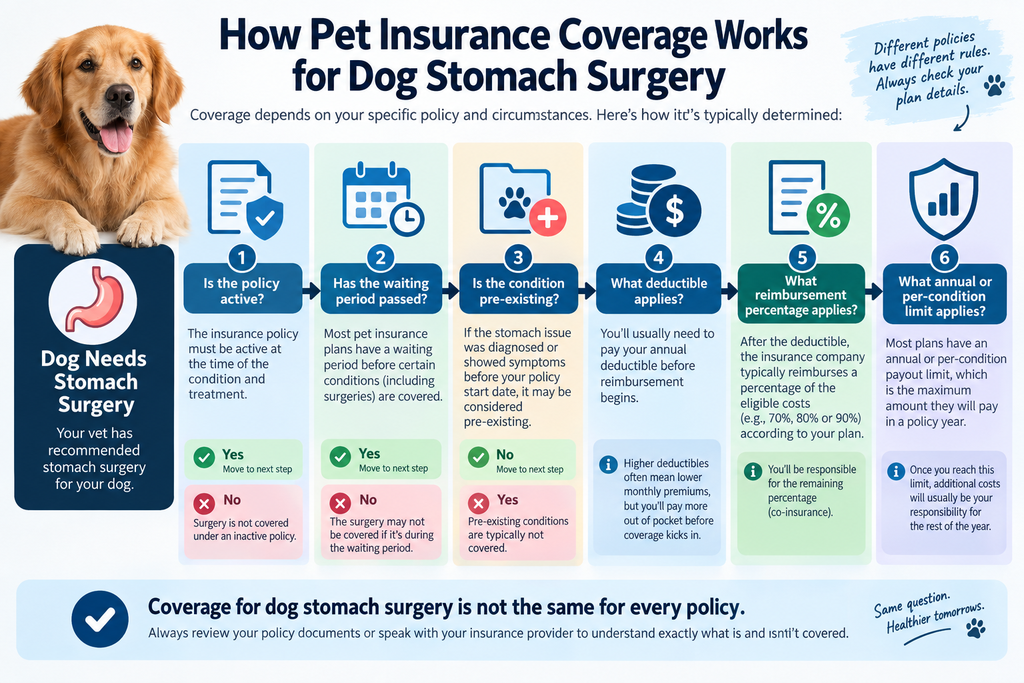
Coverage depends on the policy, diagnosis, waiting period, exclusions, and whether the condition is considered pre-existing — there’s no blanket answer that applies to every insurer or every situation.
Accident and Illness Coverage
Most emergency stomach surgeries — GDV, intestinal blockage, foreign body removal — are classified as covered accidents or illnesses under standard accident-and-illness policies, assuming your policy is active and past its waiting period.
Pre-Existing Conditions
If your dog had a prior GDV episode, chronic GI issue, or documented symptoms before your policy started, related claims may be excluded even years later.
Waiting Periods
Most insurers require a waiting period — often shorter for accidents than illnesses — before coverage begins. A GDV episode occurring during that window is typically not covered.
Deductibles and Reimbursement
Your deductible applies first, then your reimbursement percentage (commonly 70–90%) applies to the remaining eligible costs, up to your annual limit.
Annual Limits
For expensive emergencies like GDV, check whether your policy’s annual limit is high enough to meaningfully cover a $7,000–$12,000 episode.
Preventive Gastropexy vs. Emergency Surgery
Preventive gastropexy is typically excluded as elective, while gastropexy performed during emergency GDV surgery is usually covered under the same terms as the emergency itself.
What If You Can’t Afford Dog Stomach Surgery?
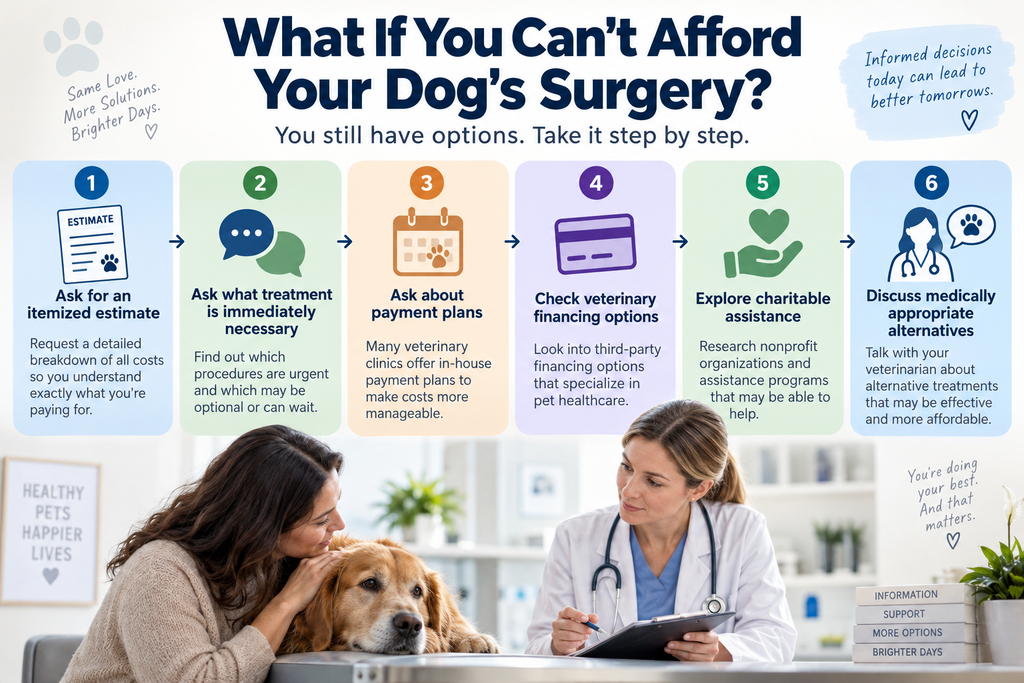
If the estimate is more than you can cover right now, say so directly to the vet team immediately — these are often genuine emergencies, so speed in this conversation matters.
Ask for an Itemized Estimate
Understand exactly what’s included before agreeing to anything.
Ask Which Treatment Is Immediately Necessary
Some stabilization steps are essential right now; others may have more flexibility.
Ask About Veterinary Payment Plans
Some clinics, particularly for established clients, offer internal arrangements.
Read Related Article… Best Vet Payment Plans in the USA (2026): CareCredit vs Scratchpay
Veterinary Financing Options
CareCredit or Scratchpay can often approve within minutes and pay the hospital directly.
Read Related Article… Can You Pay Vet Bills in Installments? Every Option Available in the USA (2026)
Charitable Veterinary Assistance
Grant programs like RedRover Relief and Frankie’s Friends can be applied to in parallel with financing.
Low-Cost Veterinary Options
A university teaching hospital may offer meaningfully lower pricing if your dog’s condition allows travel or a short wait.
Questions to Ask Before Approving Surgery
Is this quote all-inclusive? What happens if complications are found mid-surgery? Do you accept CareCredit or Scratchpay?
For the complete breakdown of every financing and assistance option available, including how to apply to multiple programs at once, see our full guide: [Can’t Pay a Vet Bill in the USA? 15 Real Ways to Get Help in 2026].
Dog Stomach Surgery Recovery and Additional Costs
The surgery price is rarely your entire financial commitment — recovery brings its own costs.
Hospitalization
Post-surgical monitoring, typically 1–3 days for straightforward cases, longer for complicated ones.
Prescription Medications
Pain control and antibiotics continue for days to weeks after discharge.
Follow-Up Visits
A recheck exam, often with suture or staple removal, is standard for most abdominal surgeries.
Repeat Imaging
Some cases require follow-up X-rays or ultrasound to confirm healing, particularly after resection.
Potential Complications
Infection, incisional issues, or slower-than-expected recovery can add unplanned costs.
When a Second Surgery May Be Needed
Rarely, complications like a leak at a resection site or recurrence of GDV (in a dog without gastropexy) can require a return to surgery — another reason gastropexy is always included during GDV treatment.
How to Read a Dog Stomach Surgery Estimate
| Estimate Item | What It Means |
|---|---|
| Exam | Initial veterinary evaluation |
| Diagnostics | X-ray, ultrasound, bloodwork |
| Anesthesia | Keeping your dog unconscious and pain-free during surgery |
| Surgery | The procedure itself |
| Hospitalization | Overnight or ICU monitoring |
| Medication | Pain control, antibiotics, and related drugs |
| Follow-up | Recheck visit and recovery monitoring |
Frequently Asked Questions
How Much Does Dog Stomach Surgery Cost?
Dog stomach surgery can cost anywhere from about $800 to $12,000+, depending on the procedure and severity. Preventive gastropexy may cost $800–$2,500, while intestinal blockage surgery averages $4,383 nationally. Severe GDV cases can cost substantially more when emergency stabilization and hospitalization are included.
How Much Does Intestinal Blockage Surgery Cost for a Dog?
CareCredit reports a $4,383 national average for dog intestinal blockage surgery, with reported costs of $3,471–$7,976 depending on location. The final bill can be higher when the intestine is damaged, hospitalization is longer, or complications require additional treatment.
How Much Does GDV Surgery Cost for a Dog?
GDV, commonly called bloat or stomach twist, is a life-threatening emergency requiring immediate veterinary treatment. The total cost depends on stabilization, surgery, the condition of the stomach and spleen, hospitalization, and complications.
How Much Does Dog Bloat Surgery Cost?
Dog bloat surgery and GDV surgery generally refer to treatment for the same emergency condition. Your total bill can include emergency examination, X-rays, bloodwork, stabilization, anesthesia, surgery, medications, and several days of hospitalization.
How Much Does Gastropexy Cost for a Dog?
Preventive gastropexy is typically less expensive than emergency GDV surgery. The procedure permanently attaches the stomach to the abdominal wall to reduce the risk of stomach twisting. ACVS notes that prophylactic gastropexy may be performed during spay/neuter or using minimally invasive techniques.
Does Pet Insurance Cover Dog Stomach Surgery?
Pet insurance may cover medically necessary stomach surgery, depending on your policy, diagnosis, waiting periods, deductible, reimbursement percentage, annual limits, and pre-existing-condition rules. Always check your policy or contact your insurer before assuming a procedure is covered.
Can a Dog With an Intestinal Blockage Avoid Surgery?
Sometimes, depending on where the object is located, what was swallowed, and your veterinarian’s assessment. CareCredit notes that endoscopy can sometimes retrieve objects from the stomach or upper small intestine and may be less invasive than exploratory surgery. Surgery may be necessary when the obstruction cannot be safely removed or tissue is damaged.
What Is Included in a Dog Stomach Surgery Estimate?
An estimate may include the examination, diagnostic imaging, bloodwork, anesthesia, surgery, hospitalization, medications, and follow-up care. Ask your veterinary team which items are included, which are optional, and what could increase the estimate if complications are discovered.
External Authority Sources
- CareCredit — Intestinal Blockage Surgery Cost and Financing (claims data)
- AVMA (American Veterinary Medical Association)
- ACVS (American College of Veterinary Surgeons)
- NAPHIA – pet insurance industry data
Disclaimer
Disclaimer: This article is for informational and educational purposes only. Cost data reflects 2026 national averages from NAPHIA, Insurify, MetLife Pet Insurance, Lemonade, VetCostCalc, and SpectrumCare, and will vary based on your dog’s age, breed, location, and the specific clinic you visit. PetInsurePrime does not sell pet insurance and receives no compensation from any insurance provider. Always get an itemized estimate from your veterinarian and read your policy documents carefully before making coverage decisions.
PetInsurePrime | Independent • Research-Based | Helping US dog owners understand real vet costs and coverage options — without the sales pressure.