
Your dog just ate something they shouldn’t have, and you’re already picturing the vet reaching for a tube. Before you process anything else, you need a number. Here’s the honest one — plus the six other costs that usually show up on the same bill, which is why “how much does stomach pumping cost” and “how much is this visit going to cost” are two very different questions.
Quick Answer : Dog Stomach Pump Cost
Gastric lavage (stomach pumping) alone typically costs $200 to $500 as a standalone procedure, or $500 to $1,500 when performed at an emergency hospital with anesthesia, monitoring, and recovery included. Larger dogs or more complex cases can push this toward $3,000. But the lavage is rarely your entire bill — once the exam, bloodwork, imaging, and possible hospitalization are added, the total emergency visit commonly reaches $500 to $3,000 or more, depending on severity.
Published estimates for gastric lavage specifically vary quite a bit — one source cites $200–$500, another cites $500–$1,500 inclusive of anesthesia and recovery, and a third cites a broader $200–$3,000 range. This isn’t inconsistency for its own sake: some figures describe the lavage alone, others describe the full procedure bundled with anesthesia and monitoring, and facility type and dog size both shift the number further. This article is explicit about which is which throughout.
Table of Contents
- Quick Answer : Dog Stomach Pump Cost
- What Should You Do If Your Dog Just Ate Something Dangerous?
- How Much Does It Cost to Pump a Dog’s Stomach?
- What Is a Dog Stomach Pump?
- The 7 Costs That Can Make Your Dog’s Emergency Bill More Expensive
- Why Your Dog May Not Need Stomach Pumping
- How Much Does It Cost to Induce Vomiting at the Vet?
- Does Timing Affect Whether a Dog Needs Stomach Pumping?
- Toxic Substance vs. Foreign Object: Why It Changes Everything
- How Much Could the Total Emergency Vet Bill Be?
- Does Dog Stomach Pumping Cost More at an Emergency Vet?
- Does Cost Vary Depending on Where You Live?
- Does Pet Insurance Cover Dog Stomach Pumping?
- What If You Can’t Afford the Emergency Vet Bill?
- How to Prepare for the Vet After a Dangerous Ingestion
- FAQ
What Should You Do If Your Dog Just Ate Something Dangerous?
If your dog just swallowed something potentially toxic or dangerous, don’t wait for symptoms before getting advice. Some substances can cause delayed problems, and treatment options may depend on what your dog ate, how much was swallowed, and how long ago it happened.
First, move your dog away from the substance so there is no further exposure. If you can, keep the product packaging, label, pills, or any remaining material. Your veterinarian or veterinary poison-control professional may need the product name, ingredients, approximate amount eaten, time of ingestion, your dog’s weight, and any symptoms you’re seeing.
Call your veterinarian, a local emergency veterinary hospital, or an animal poison-control service promptly. If your dog is having trouble breathing, having seizures, is unconscious or unresponsive, bleeding, or rapidly deteriorating, go directly to an emergency veterinary hospital.
Most importantly, don’t try to make your dog vomit or give a home remedy unless a veterinary professional specifically tells you to do so. Some substances can cause more injury when brought back up.
Once you’ve contacted a veterinary professional, the next question is usually cost. Here’s what you may actually see on the bill.
How Much Does It Cost to Pump a Dog’s Stomach?
Typical Cost of Gastric Lavage
Gastric lavage alone typically costs $200–$500 as a base procedure. When performed at an emergency hospital — where it’s commonly bundled with anesthesia, monitoring, and recovery time — the more realistic range is $500–$1,500. Larger dogs, complicated cases, or facilities with higher overhead can push this toward $3,000.
Why Prices Vary So Much
A few concrete factors explain the spread. Whether anesthesia is bundled in or billed separately is the single biggest reason two sources quote different numbers for “the same” procedure. Emergency clinic vs. regular vet matters too — emergency hospitals generally charge more across every line item. Dog size affects anesthesia dosing and monitoring intensity. Geographic location shifts baseline pricing the way it does for any veterinary service.
What Is a Dog Stomach Pump?
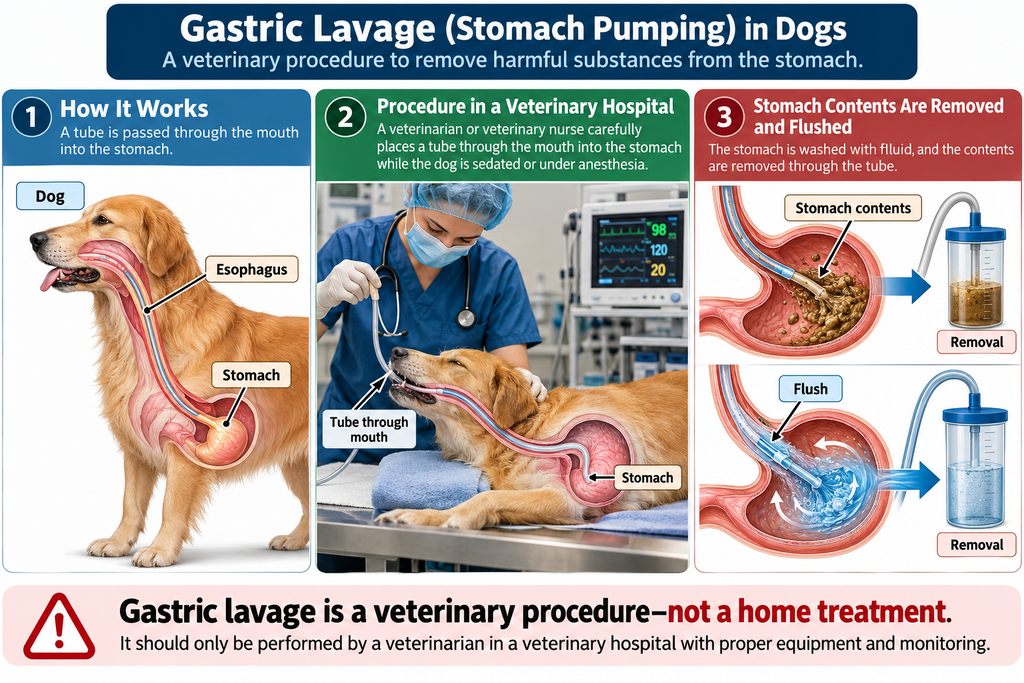
“Stomach pumping” is the common term for gastric lavage — a procedure where a tube is used to flush and remove contents from the stomach. It’s performed by veterinary professionals, typically under sedation or general anesthesia, with careful attention to protecting the airway, since aspiration (fluid entering the lungs) is a real risk during the procedure. Vets generally consider gastric lavage when inducing vomiting isn’t recommended for the specific substance involved, or when vomiting was attempted but wasn’t productive.
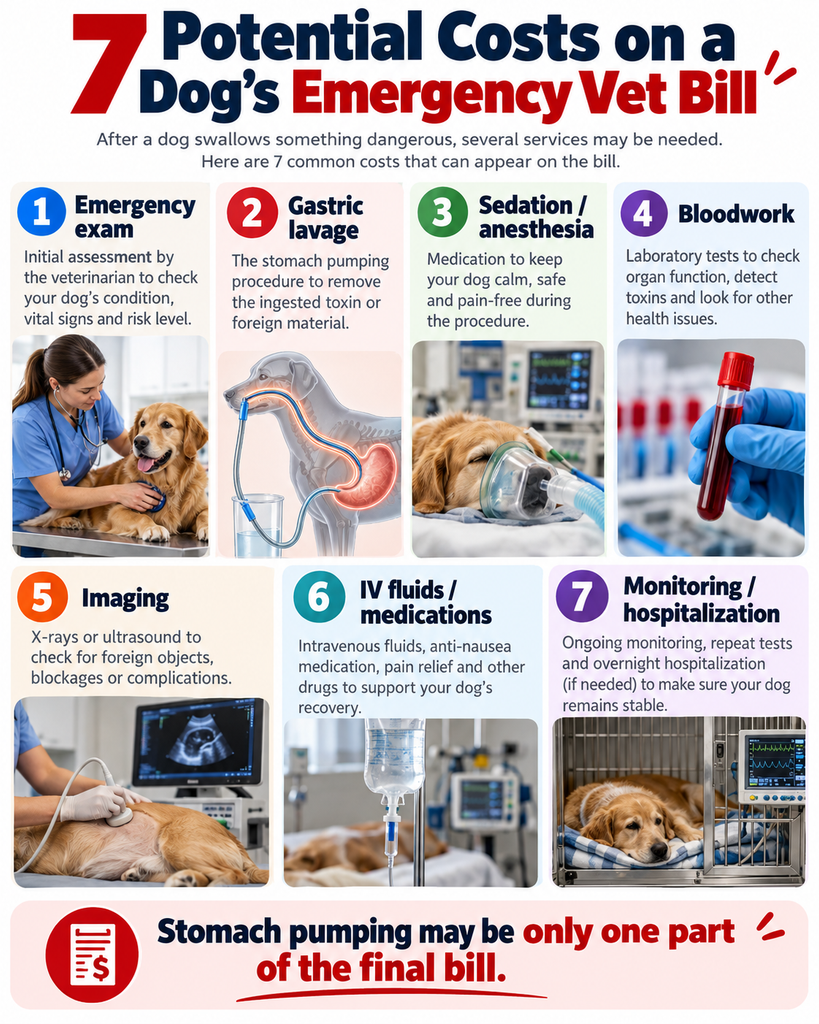
The 7 Costs That Can Make Your Dog’s Emergency Bill More Expensive
| Possible Cost | Typical US Range | Why It May Be Charged |
|---|---|---|
| Emergency exam | $100–$250 | Initial assessment and triage |
| Gastric lavage | $200–$1,500 | Stomach decontamination, when needed |
| Sedation/anesthesia | Often bundled with lavage; $100–$300 if separate | Required for the procedure to be done safely |
| Bloodwork | $100–$300 | Assesses organ function and toxin effects |
| X-rays/ultrasound | $150–$450 | Checks for swallowed material or complications |
| Medications/IV fluids | $100–$400+ | Supportive treatment, activated charcoal |
| Monitoring/hospitalization | $200–$1,000+/day | Observation, especially in serious cases |
1. Emergency Vet Exam Fee
This is the cost of simply being seen and assessed, often $100–$250 at an emergency hospital, before any treatment decision is even made. A common misconception is thinking “if lavage costs $500, my bill is $500” — the exam fee is a separate charge that happens regardless of what treatment follows.
2. Gastric Lavage or Stomach Pumping
This is the core procedure charge, covering the tube placement and flushing itself. Whether anesthesia is included in this number or billed separately depends entirely on the facility — ask directly. Not every ingestion results in lavage; timing and the specific substance both factor into whether your vet recommends it.
3. Sedation or Anesthesia
Gastric lavage isn’t simply tube-plus-water — veterinary guidance calls for appropriate sedation or general anesthesia with airway protection specifically because of aspiration risk. This is one of the main reasons published cost estimates for “stomach pumping” differ so much — some include this, some don’t.
4. Bloodwork and Other Diagnostic Tests
Treating an ingestion isn’t only about removing what’s still in the stomach — your vet may recommend a CBC and chemistry panel to assess organ function and monitor for toxin-related effects that have already entered the bloodstream.
Read Related Article… Dog Blood Test Cost in the USA (2026): Real Prices, What Each Panel Tests, and How to Pay Less
5. X-Rays or Other Imaging
Particularly relevant if there’s any possibility your dog swallowed an object rather than (or in addition to) a toxic substance — a sock, toy, bone, or piece of plastic. Swallowed objects can cause obstruction or injury, and prompt assessment matters. If imaging reveals an object rather than a dissolved substance, the entire treatment pathway — and cost — shifts; see our dedicated dog foreign body surgery cost guide for that scenario.
6. IV Fluids, Activated Charcoal, and Medications
Depending on what was swallowed and your dog’s condition, your vet may recommend activated charcoal to limit further absorption, IV fluids for support, or anti-nausea medication. Not every dog needs every one of these — your vet tailors this to the specific substance and your dog’s presentation.
7. Hospitalization and Monitoring
This is where the bill can grow substantially. Ongoing monitoring, repeated bloodwork, IV therapy, and overnight hospitalization — or ICU-level care in severe cases — can add hundreds to thousands of dollars depending on duration and severity.
Why Your Dog May Not Need Stomach Pumping
“My dog ate something dangerous” does not automatically mean “the vet will pump the stomach.” In fact, induced vomiting — a simple injection, not a procedure requiring anesthesia — is used far more often than gastric lavage, because it’s faster, doesn’t require anesthesia, and is effective for many common ingestions.
When a Vet May Consider Gastric Lavage
Lavage is typically considered in more specific circumstances — when inducing vomiting isn’t appropriate for the substance involved, or when vomiting was attempted but wasn’t successful.
When Gastric Lavage May Be Unsafe
Certain substances make both vomiting and lavage riskier rather than helpful — corrosive or caustic substances and some hydrocarbons are examples where these procedures can cause additional injury or raise aspiration risk. This is a decision for your veterinary team to make based on exactly what was ingested, never something to attempt or decide at home.
How Much Does It Cost to Induce Vomiting at the Vet?
If your dog recently swallowed something potentially dangerous, inducing vomiting at a veterinary clinic is often less expensive than gastric lavage when it is safe and appropriate. In the U.S., the induced-vomiting treatment itself may cost roughly $75–$300, while the total visit can be higher once the veterinary exam, medication, monitoring, and any additional treatment are included. Recent veterinary cost data puts the emesis medication itself at about $63–$88 per invoice, with the surrounding exam and other charges bringing some visits into the $150–$400 range.
At an emergency hospital, the exam alone may add around $100–$250, particularly for after-hours care. If your dog also needs activated charcoal, IV fluids, bloodwork, imaging, or hospitalization, the final bill can quickly move beyond the cost of inducing vomiting itself.
The important distinction is that inducing vomiting and stomach pumping are not interchangeable treatments. A veterinarian chooses between them based on what your dog swallowed, how long ago it happened, and whether making the dog vomit could cause additional harm. For some substances or objects, vomiting can be unsafe, so the veterinary team may recommend another approach instead.
Does Timing Affect Whether a Dog Needs Stomach Pumping?
Yes. How long ago your dog swallowed something can affect which treatment a veterinarian considers, but there is no single cutoff that applies to every ingestion. For some toxins, inducing vomiting is most useful when done within a few hours, while the appropriate timing can vary significantly depending on the substance, amount swallowed, and your dog’s condition.
Gastric lavage may be considered when vomiting is not appropriate or was unsuccessful, but veterinarians also have to consider whether the material is still likely to be in the stomach and whether the procedure’s risks outweigh its benefits. Merck Veterinary Manual notes that lavage is generally reserved for selected or extreme cases and requires appropriate sedation or anesthesia with airway protection.
The substance matters just as much as the clock. Some poisons can be absorbed quickly, while corrosive substances and certain hydrocarbons can make vomiting or gastric lavage unsafe regardless of when the ingestion occurred.
So if your dog has just swallowed something potentially dangerous, don’t wait for a specific number of hours before contacting a veterinarian. Tell them what was swallowed, approximately how much, when it happened, and your dog’s weight so they can determine the safest treatment.
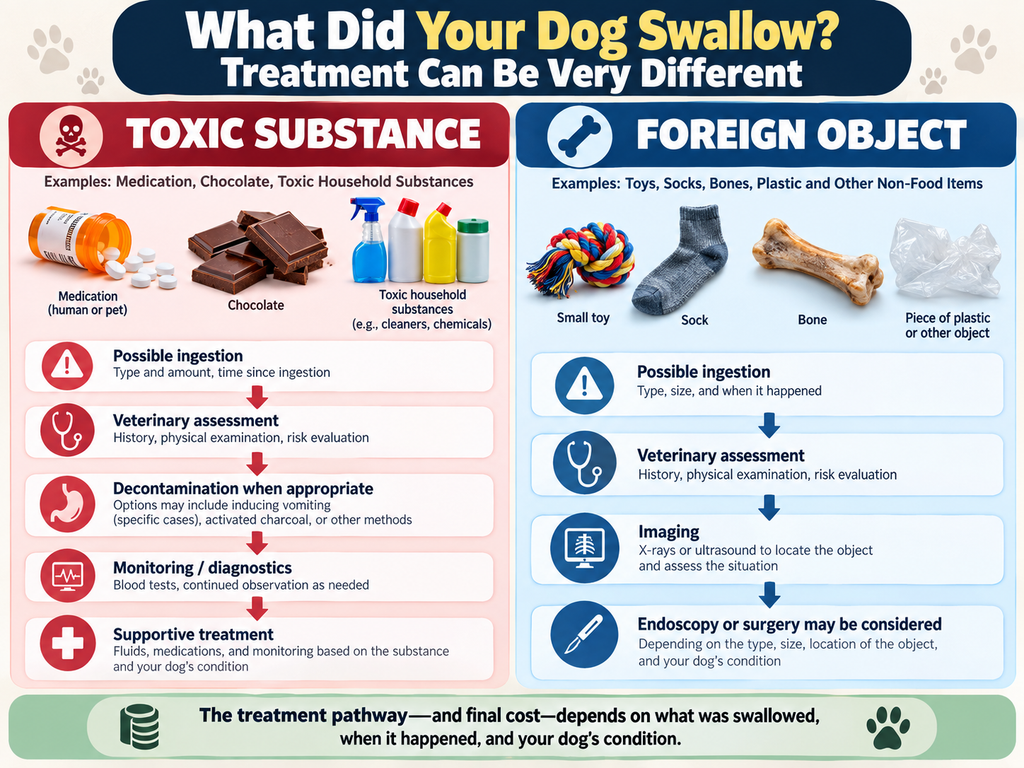
Toxic Substance vs. Foreign Object: Why It Changes Everything
| Situation | Possible Vet Approach | Potential Cost Impact |
|---|---|---|
| Toxic substance (chocolate, medication, etc.) | Decontamination + monitoring | Moderate–high |
| Medication ingestion | Decontamination + diagnostics | Moderate–high |
| Foreign object (toy, sock, bone) | Imaging/possible surgery | Potentially very high |
| Severe poisoning | ICU/supportive treatment | High |
| Corrosive substance | Supportive care, lavage avoided | Can become high |
What your dog actually swallowed changes the entire treatment pathway — and the bill — far more than the generic question “how much is stomach pumping.” A toxic substance that can be decontaminated and monitored is a very different financial situation from a solid object requiring imaging and possibly surgery to remove.
Read Related Article… Dog Surgery Cost in the USA: Real Prices for 2026
How Much Could the Total Emergency Vet Bill Be?
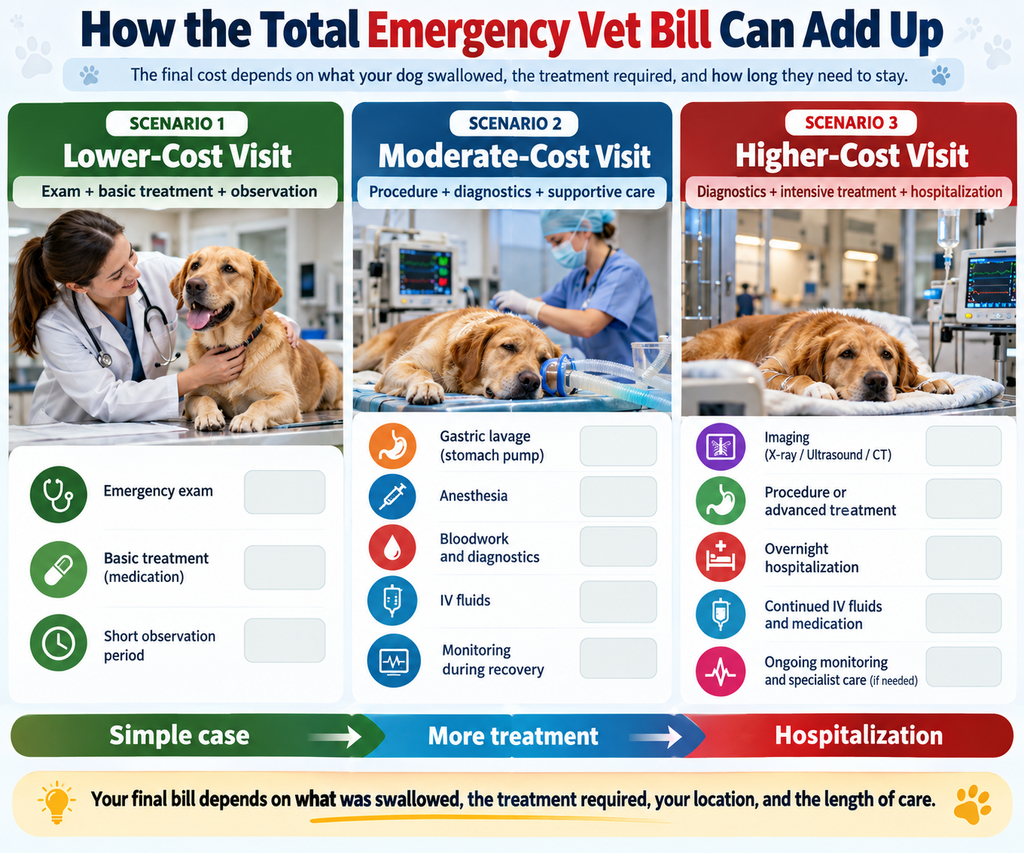
Lower-Cost Scenario
An emergency exam plus basic treatment — induced vomiting (not lavage), a dose of activated charcoal, and a few hours of observation. Illustrative total: roughly $300–$700.
Moderate-Cost Scenario
Emergency exam, gastric lavage with anesthesia, bloodwork, and IV fluids with a few hours of monitoring before discharge. Illustrative total: roughly $800–$2,000.
High-Cost Scenario
Emergency exam, lavage or other decontamination, extensive diagnostics (bloodwork plus imaging), overnight hospitalization, and monitoring for complications. Illustrative total: roughly $2,000–$4,000+.
These are illustrative scenarios built from published cost ranges, not guaranteed prices — your vet’s actual itemized estimate depends on your dog’s specific case.
Does Dog Stomach Pumping Cost More at an Emergency Vet?
Generally yes. Emergency animal hospitals typically charge more across every line item than a regular daytime veterinary clinic — the exam fee, the procedure itself, and diagnostics all tend to run higher, reflecting 24/7 staffing and higher facility overhead. After-hours timing (nights, weekends, holidays) can add its own surcharge on top of standard emergency pricing at some facilities.
Read Related Article… Does Dog Stomach Pumping Cost More at an Emergency Vet?
Does Cost Vary Depending on Where You Live?
Yes, meaningfully, though not in a way we can responsibly reduce to a state-by-state price list without reliable data to back it. Urban areas with higher costs of living generally run toward the higher end of every range in this article. Rural areas may see lower baseline pricing but often have fewer emergency hospital options, meaning less ability to shop around during an actual emergency. Local veterinary labor costs and the availability of 24-hour or specialty facilities in your area both factor in as well.
Does Pet Insurance Cover Dog Stomach Pumping?
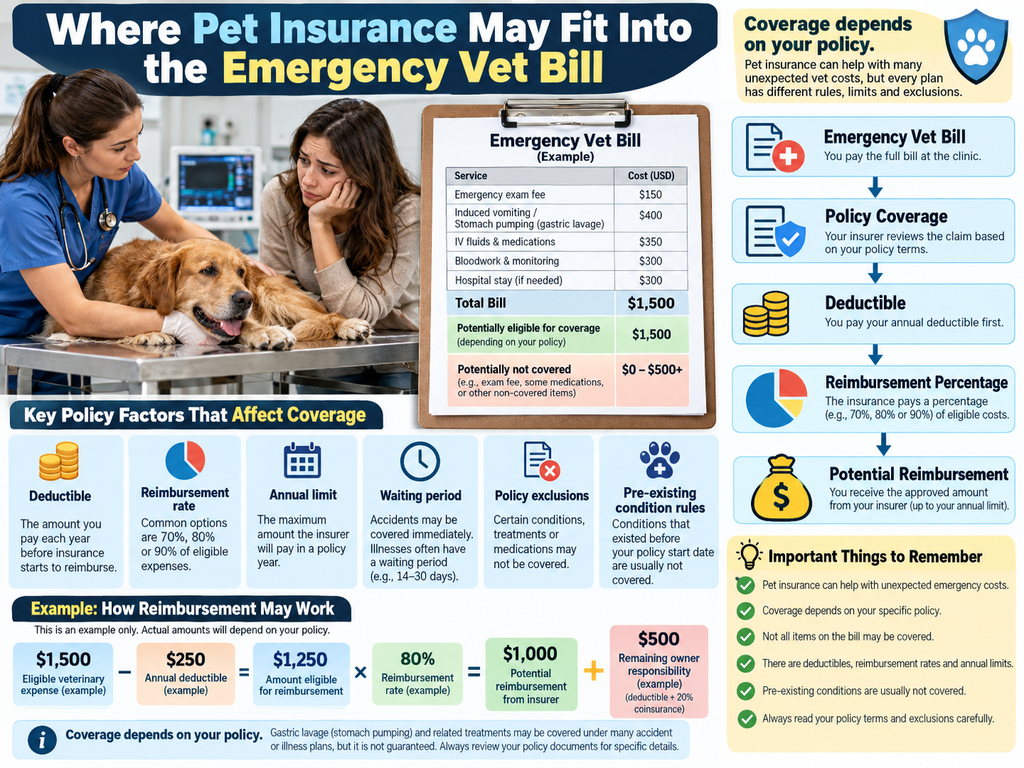
Many accident-and-illness pet insurance plans cover gastric lavage and related emergency treatment as part of a covered accidental ingestion, but coverage depends entirely on your specific policy — this isn’t something to assume universally.
Your deductible applies first, then your reimbursement percentage (commonly 70–90%) applies to the remaining eligible costs, up to your annual limit. Your waiting period matters — most policies have a shorter waiting period for accidents than illnesses, but this varies by insurer. Pre-existing conditions generally don’t apply to a one-time accidental ingestion the way they might to a chronic illness, but always confirm your specific policy’s language.
What If You Can’t Afford the Emergency Vet Bill?
If the estimate is more than you can cover right now, say so directly to the vet team immediately — ingestion cases are often time-sensitive, so speed in this conversation matters.
Ask for a written, itemized estimate covering all seven potential cost categories above. Ask specifically which treatments are immediately necessary versus what could reasonably be discussed after initial stabilization. Ask about payment options or financing — CareCredit or Scratchpay can often approve within minutes and pay the clinic directly. Ask whether lower-cost appropriate alternatives exist for your dog’s specific situation. If you’re insured, ask about pet insurance reimbursement timing. For the complete breakdown of every financing and assistance option.
Read Related Article… Can’t Pay a Vet Bill in the USA? 15 Real Ways to Get Help in 2026
How to Prepare for the Vet After Your Dog Eats Something Dangerous
Know and be ready to share: what your dog may have swallowed, the approximate amount, the approximate time it happened, the packaging or container if you have it, your dog’s weight, and any medications or existing conditions your dog has. Having this information ready helps your vet make faster, more accurate decisions — but never delay calling or heading to the vet just to gather more detail first.
Frequently Asked Questions
How much does it cost to pump a dog’s stomach?
A dog’s stomach pumping (gastric lavage) may cost around $200–$500 as a standalone procedure, while an emergency-hospital case can reach $500–$1,500 or more when anesthesia, monitoring, and recovery are included. More complicated cases can cost substantially more.
How much does it cost to pump a dog’s stomach at an emergency vet?
Emergency hospitals generally cost more because the bill may include an emergency exam, anesthesia, monitoring, and other treatment. A realistic lavage-related cost can be $500–$1,500, but your total bill may be higher if diagnostics, medication, or hospitalization are needed.
How much does gastric lavage cost for a dog?
Gastric lavage is the veterinary term for what people commonly call stomach pumping. The procedure itself may cost roughly $200–$500, while the total charge can be higher when anesthesia, emergency care, monitoring, and other services are included.
Will my dog always need its stomach pumped after eating something dangerous?
No. Gastric lavage is not automatically needed after an ingestion. Depending on what was swallowed, how much was consumed, and how recently it happened, a veterinarian may consider another approach, such as induced vomiting or supportive treatment. Some substances also make vomiting or lavage unsafe.
Does pet insurance cover stomach pumping?
Some accident-and-illness pet insurance policies may cover gastric lavage when it is medically necessary for a covered accident, but coverage varies by policy. Your deductible, reimbursement percentage, waiting period, exclusions, and annual limit can affect what you receive back. Check your policy before assuming the procedure is covered.
How much is an emergency vet visit for a dog that ate something toxic?
The total can vary widely depending on the substance, diagnostics, treatment, and whether hospitalization is required. A relatively straightforward ingestion may cost hundreds of dollars, while serious poisoning or complications can push the bill into the thousands.
What makes dog poisoning treatment more expensive?
The biggest cost drivers are usually the severity of the ingestion, emergency-hospital fees, bloodwork or imaging, IV treatment, medications, repeated monitoring, and hospitalization. If complications develop or intensive care is required, the final bill can increase substantially.
What should I do if I can’t afford the emergency vet bill?
Tell the veterinary team immediately rather than waiting until treatment is underway. Ask for an itemized estimate, which treatments are immediately necessary, and whether the clinic offers financing or payment options. You can also ask about appropriate lower-cost alternatives while prioritizing your dog’s immediate medical needs.
External Authority Sources
- Merck Veterinary Manual — Principles of Toxicosis Treatment in Animals
- Merck Veterinary Manual — Toxicoses from Corrosive Agents in Animals
- PetMD — Swallowed Objects in Dogs
- WagWalking — Gastric Lavage in Dogs
- AVMA (American Veterinary Medical Association)
Disclaimer: This article is for informational and educational purposes only and is not a substitute for veterinary or poison control guidance. If you suspect your dog has ingested something dangerous, contact your veterinarian or a poison control hotline immediately rather than attempting treatment at home. Cost data reflects 2026 figures from multiple veterinary industry sources and will vary based on your dog’s size, the substance or object involved, location, and treatment timing. PetInsurePrime does not sell pet insurance and receives no compensation from any veterinary facility or insurance provider.
PetInsurePrime | Independent • Research-Based | Helping US dog owners understand real vet costs and coverage options — without the sales pressure.