
Updated: June 2026 | Reading Time: 18 Minutes | Reviewed Sources: American Veterinary Medical Association (AVMA) PetMD
One day your dog is fine. The next they’re dragging their back legs, crying in pain, or suddenly unable to stand. The vet says the words — slipped disc, IVDD, spinal compression — and then comes an estimate that stops you cold.
Dog spinal surgery is one of the most expensive veterinary procedures in the US, and the quote you receive is almost never the full story. The surgery itself is one line item. The MRI that has to happen before the surgeon can even pick up a scalpel? That’s often the single largest charge on the bill.
Read more Related… average dog surgery cost
Quick answer Dog Spinal Surgery Cost in the USA:
Dog spinal surgery in the USA costs $2,000–$4,000 for the surgical procedure alone. Add mandatory pre-surgical imaging ($1,500–$5,000 for MRI), extended anesthesia ($800–$1,200), specialist neurologist fees, and 2–5 nights of post-surgical hospitalization, and the all-in total typically lands between $5,000 and $12,000 for most cases. Complex or emergency cases at specialty neurology hospitals can reach $10,000–$15,000.
What you’re dealing with, what grade of severity your dog has, and where you have the surgery done all affect that number significantly. This article breaks down every part of it.
Dog Spinal Surgery Cost at a Glance
| Expense | Typical Cost |
|---|---|
| MRI | $1,500–$3,500 |
| Surgery | $2,000–$7,000 |
| Hospitalization | $400–$3,000 |
| Rehab | $400–$1,200 |
| Total Cost | $5,000–$12,000 |
| Emergency Cases | Up to $15,000+ |
What Is Dog Spinal Surgery? (The Conditions That Require It)
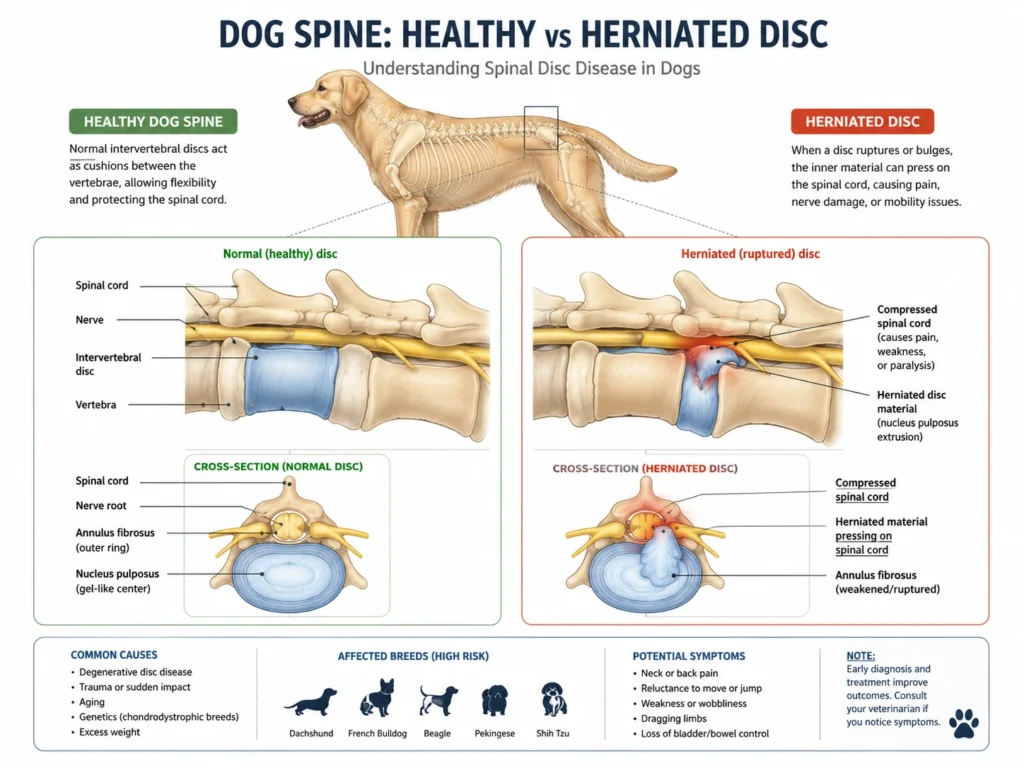
Most dog spinal surgeries in the US are performed to treat Intervertebral Disc Disease (IVDD) — also called a slipped disc, herniated disc, ruptured disc, or bulging disc. It’s the same family of conditions, different stages.
IVDD occurs when the cushioning discs between the vertebrae of the spine degenerate and either bulge or rupture, pressing on the spinal cord. The resulting compression causes pain ranging from mild stiffness to complete paralysis of the hind legs.
There are two types:
Hansen Type I — Sudden, acute rupture. Common in chondrodystrophic (short-legged) breeds. A dog jumping off the couch can trigger it.
Hansen Type II — A slower, progressive form of disc disease most commonly seen in larger dog breeds. The disc gradually bulges and compresses the spinal cord over time, often causing worsening mobility issues.
A separate condition worth knowing: Fibrocartilaginous Embolism (FCE) — sometimes called a spinal stroke. FCE occurs when a small piece of material from an intervertebral disc enters the bloodstream and blocks the blood vessels supplying the spinal cord, depriving the spinal cord tissue of oxygen and nutrients. Critically: there is no surgery or medication for FCE. Instead, treatment is focused on supporting the dog while they heal, encouraging limb use, and preventing muscle atrophy. FCE is diagnosed and managed differently — and costs significantly less than surgical IVDD treatment, because hospitalization and rehabilitation are the primary costs rather than surgery.
How Much Does Dog Spinal Surgery Cost in the USA?
Dog spinal surgery in the USA typically costs between $5,000 and $12,000 when MRI, anesthesia, hospitalization, and recovery expenses are included. Emergency spinal surgeries and complex neurological cases can exceed $15,000, especially at specialty hospitals in major metropolitan areas.
The IVDD Grading System — Why Grade Determines Cost
Vets grade IVDD from 1 to 5. That grade isn’t just a description of severity — it determines whether surgery is recommended, how urgent it is, and what the success rate is. It also directly affects the bill.
| IVDD Grade | Symptoms | Treatment Typically Recommended | Surgery Success Rate |
|---|---|---|---|
| Grade 1 | Pain only, normal walking | Conservative management | Surgery rarely needed |
| Grade 2 | Weakness, wobbly walking (ambulatory) | Conservative or surgical | ~95% with surgery |
| Grade 3 | Significant weakness, difficulty walking | Surgery recommended | ~95% with surgery |
| Grade 4 | Cannot walk, but has deep pain sensation | Surgery — urgent | ~95% if deep pain present |
| Grade 5 | Complete paralysis, no deep pain sensation | Surgery — emergency | ~50% if treated within 24–48 hours |
A Grade 2 dog that has surgery on day one often has a significantly better outcome than a Grade 5 dog who waited several days. Delayed treatment can reduce recovery chances and increase overall treatment costs.
The Three Types of Dog Spinal Surgery — And What Each Costs
The specific procedure your dog needs depends on where the disc problem is located on the spine.
Hemilaminectomy (Most Common — Thoracolumbar Spine)
The most frequently performed dog spinal surgery. Used when the disc problem is in the mid-to-lower back region (thoracolumbar spine). The surgeon removes a small section of vertebral bone to access and remove the herniated disc material pressing on the spinal cord.
This procedure involves approaching the ruptured disc from the tissue over your dog’s back to remove disc material pressing on the spinal cord.
- Surgery cost alone: $2,000–$5,000
- All-in total (including imaging and hospitalization): $5,000–$12,000
- Duration: 1–3 hours under general anesthesia
- Most common in: Dachshunds, Corgis, Beagles, French Bulldogs, Basset Hounds
Ventral Slot Procedure (Cervical — Neck Region)
Used when the disc problem is in the neck (cervical spine). The approach is from the underside of the neck rather than the back.
This surgery involves approaching a ruptured disc in the neck area from the tissue under the neck.
Cervical surgery tends to be more technically demanding than thoracolumbar surgery and is generally performed by a board-certified veterinary neurologist.
- Surgery cost alone: $3,000–$6,000
- All-in total: $6,000–$14,000
- Specialty neurologist required: Yes, in most cases
Dorsal Laminectomy (Less Common — Multiple Sites or Complex Cases)
Used for more complex presentations, including large breeds with multiple disc involvement or cases requiring decompression across a broader spinal region.
- Surgery cost alone: $3,500–$7,000+
- All-in total: $8,000–$15,000+
- Most common in: Large and giant breeds — German Shepherds, Labrador Retrievers, Dobermans
The Real All-In Cost — Line by Line
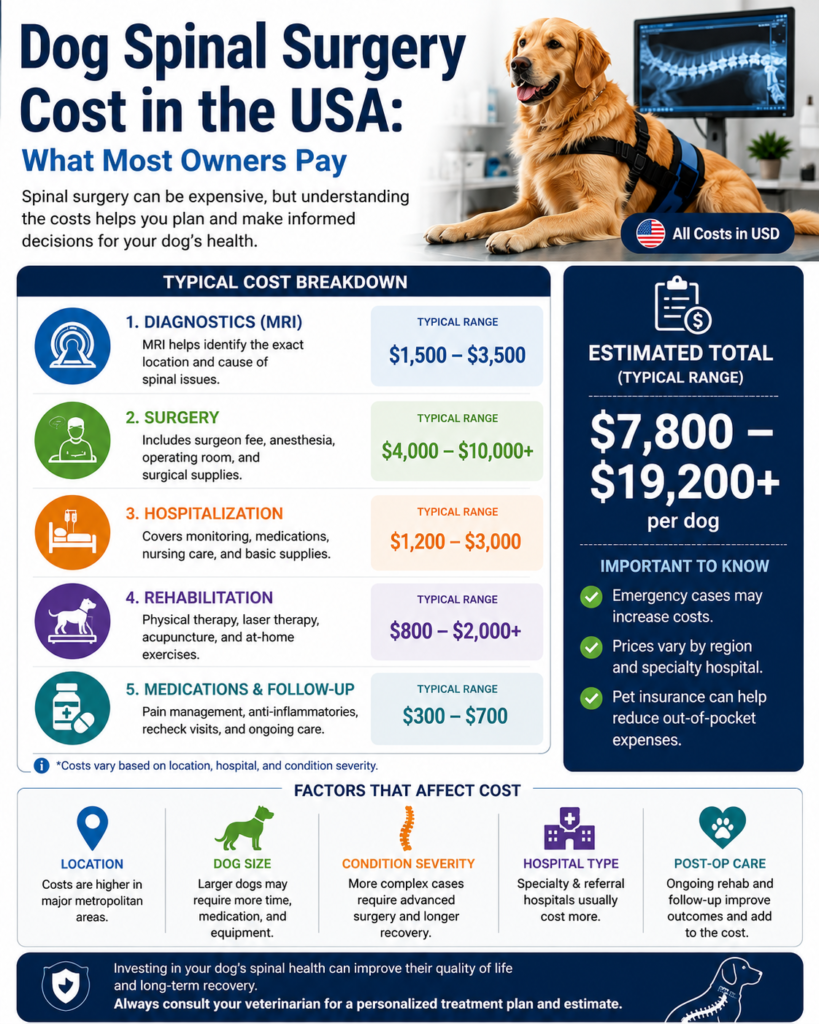
The surgery quote you receive covers the operating room time. It rarely covers everything else — and “everything else” is where the bill actually lives.
| Line Item | Typical Cost (2026) |
|---|---|
| Neurological exam (specialist evaluation, IVDD grading) | $100–$300 |
| Pre-surgical bloodwork (CBC + chemistry panel) | $75–$200 |
| MRI — the biggest single cost driver | $1,500–$3,500 |
| CT scan (alternative to MRI, less common) | $1,000–$2,500 |
| Myelogram (contrast imaging, older technique) | $800–$1,500 |
| Extended general anesthesia (2–4 hours) | $800–$1,200 |
| Surgical procedure (hemilaminectomy) | $2,000–$5,000 |
| Surgical procedure (ventral slot — cervical) | $3,000–$6,000 |
| Post-surgical hospitalization (per night, 2–5 nights) | $200–$600/night |
| IV fluids + catheter | $100–$300 |
| Injectable pain management (in-hospital) | $50–$200 |
| Take-home medications (gabapentin, anti-inflammatories) | $30–$80 |
| Follow-up neurological recheck (10–14 days) | $100–$300 |
| Physical rehabilitation (per session, 4–8 weeks) | $50–$150/session |
| Total all-in (typical mid-range case) | $5,000–$12,000 |
| Total all-in (complex/specialty/emergency case) | $10,000–$15,000 |
The biggest cost driver is usually diagnostics. Advanced imaging such as MRI or myelogram is required for a definitive diagnosis before surgery. That means two dogs with similar symptoms can receive very different estimates depending on whether imaging is done at a specialty center during regular hours or through an emergency hospital overnight.
Real Example Bill: Grade 4 IVDD, Medium-Sized Dog, Private Specialty Hospital
| Line Item | Amount |
|---|---|
| Neurological specialist exam + IVDD grading | $250 |
| Pre-surgical bloodwork | $180 |
| MRI (thoracolumbar spine) | $2,800 |
| General anesthesia (3 hours) | $950 |
| Hemilaminectomy surgery | $3,800 |
| 3-night hospitalization + monitoring | $1,350 |
| IV fluids | $185 |
| In-hospital pain management | $140 |
| Take-home medications (2-week supply) | $65 |
| Follow-up recheck appointment | $185 |
| Total | $9,905 |
This is a realistic mid-range bill for a grade 4 IVDD case in a medium-sized dog at a private specialty hospital in a mid-cost US city. Urban specialty centers in California, New York, and the Pacific Northwest would push this $2,000–$4,000 higher.
Surgery vs Conservative Management: The Real Cost Comparison
Not every dog needs surgery. For grades 1 and 2 — dogs who are in pain but still ambulatory — conservative management is often tried first.
Conservative treatment typically costs $500 to $2,500 total for crate rest, medications, follow-up exams, and basic rehabilitation over 4 to 8 weeks.
What conservative management involves:
- Strict crate rest: 4–8 weeks of severely restricted movement to allow inflammation to reduce
- Pain medication + anti-inflammatories: Gabapentin, methocarbamol, prednisone or NSAIDs
- Physical rehabilitation: Gentle exercises, hydrotherapy if available
- Serial follow-up exams: To monitor whether improvement is occurring or surgery becomes necessary
A recent systematic review estimated that 86% of deep pain-positive dogs recover ambulation after conservative management. For grades 1 and 2, conservative management has legitimate success rates — particularly in dogs who still have full deep pain sensation.
The complication: conservative management sometimes fails. And when it fails — especially when a dog deteriorates from grade 2 to grade 4 or 5 during conservative care — surgery becomes both urgent and more expensive than it would have been if done early. Some owners spend $1,500–$2,500 on conservative care, then still pay $8,000–$12,000 for emergency surgery when the dog’s condition worsens.
Read more article… emergency vet costs
| Approach | Upfront Cost | Success Rate (Grade 1–2) | Risk |
|---|---|---|---|
| Conservative management | $500–$2,500 | ~86% for ambulatory dogs | Possible deterioration requiring surgery |
| Early surgery (Grade 3–4) | $5,000–$12,000 | ~95% | Surgical and anesthesia risks |
| Emergency surgery (Grade 5) | $8,000–$15,000 | ~50% | Lower success, higher cost |
The conversation with your veterinary neurologist should include your dog’s current grade, how rapidly symptoms progressed, and whether the window for high-success surgery is still open.
Which Breeds Face the Highest Risk (and Highest Bills)
IVDD doesn’t affect all dogs equally. Certain breeds carry genetic predispositions that make spinal problems significantly more likely — and for owners of these breeds, understanding the cost landscape matters before an emergency happens.
Highest risk — chondrodystrophic breeds (Hansen Type I): Nearly 1 in 4 dachshunds will experience IVDD in their lifetime. Other high-risk breeds include Corgis, Beagles, Shih Tzus, Basset Hounds, French Bulldogs, and Pekingese. These breeds have the genetic profile that causes disc degeneration at younger ages — many experience first episodes between ages 3 and 6.
Moderate-to-high risk — larger breeds (Hansen Type II): German Shepherds, Labrador Retrievers, Doberman Pinschers, and Dalmatians develop the slower progressive form. Surgery for large breeds is typically more expensive — larger body means more anesthesia, longer surgical time, and higher ICU costs.
If you own a Dachshund, Corgi, or French Bulldog and don’t currently have pet insurance, the actuarial case for buying a policy before any back symptoms appear is strong. The breed-specific spinal risk is predictable in a way that random accidents are not.
When Should You See a Veterinary Neurologist?
If your dog suddenly loses the ability to walk, drags its rear legs, shows signs of severe neck or back pain, or becomes incontinent, immediate veterinary attention is recommended. A board-certified veterinary neurologist can determine whether advanced imaging such as MRI is necessary and whether surgery is likely to improve outcomes.
How Location Changes the Bill
The same hemilaminectomy surgery performed on the same dog has a dramatically different price tag depending on where in the US the surgery is done.
| Region | Cost Modifier vs National Median |
|---|---|
| California (Bay Area, LA, San Diego) | +35–55% above median |
| New York / Northeast metro | +30–45% above median |
| Pacific Northwest (Seattle, Portland) | +25–40% above median |
| Texas (Houston, Dallas, Austin) | Near median or slightly above |
| Midwest (Chicago, Minneapolis, Columbus) | Near median |
| Southeast / South | Near median to 10% below |
| Rural areas | 10–20% below median, fewer specialist options |
A hemilaminectomy that costs $3,800 in Columbus, Ohio might run $5,500–$6,000 at a comparable specialty hospital in Los Angeles. The surgery is identical. The cost difference reflects local facility overhead, staff compensation, and cost of living.
University teaching hospitals are the most reliable way to access the same quality of spinal surgery at meaningfully lower cost. AVMA-accredited veterinary teaching hospitals, including Cornell, UC Davis, Colorado State, Purdue, and Texas A&M, often perform spinal surgeries under board-certified neurologist supervision. Treatment costs are frequently 30–50% lower than those charged by private specialty hospitals.
If your dog’s condition allows a 12–24 hour window to arrange transport, calling the nearest veterinary college is worth every minute it takes.
Does Pet Insurance Cover Dog Spinal Surgery?
Yes — this is exactly the type of procedure accident and illness pet insurance is designed for.
A comprehensive accident and illness policy covers: the neurological specialist exam, pre-surgical bloodwork, MRI or CT scan, the surgical procedure itself, anesthesia, hospitalization, post-op medications, and follow-up rechecks.
What’s typically not covered:
Read more Article…. accident and illness pet insurance
- Pre-existing conditions: If your dog had documented back pain, stiffness, or disc problems before the policy start date, IVDD-related claims may be denied or partially denied
- Breed-specific exclusions: A small number of policies exclude IVDD entirely for high-risk breeds like Dachshunds — read the exclusions section carefully before purchasing
- The deductible: Your out-of-pocket responsibility before reimbursement begins
What reimbursement looks like on a $9,900 bill:
| Amount | |
|---|---|
| Total bill | $9,905 |
| Annual deductible (example: $500) | −$500 |
| Reimbursable amount | $9,405 |
| Insurance reimburses at 80% | $7,524 |
| Your out-of-pocket | $2,381 |
Without insurance: $9,905. With insurance: $2,381. The difference — $7,524 — is approximately 8–10 years of monthly premiums on a typical policy.
Two critical things about pet insurance and spinal surgeries:
You pay the hospital upfront. Pet insurance is reimbursement-based. The specialty hospital will not wait for insurance authorization. You need a way to cover the bill at the time of service — CareCredit, Scratchpay, or a personal loan — and then submit for reimbursement afterward.
Buy before symptoms appear. A dog that has already been diagnosed with IVDD, or who has documented back pain or stiffness in their records, may find the condition excluded as pre-existing on a new policy. For Dachshund and Corgi owners especially, purchasing pet insurance before any symptoms appear can make the difference between receiving reimbursement and having the claim denied as a pre-existing condition.
What If You Can’t Afford Spinal Surgery?
A $9,000 bill is genuinely unaffordable for many households. If you’re in that position right now, these are the most realistic options:
Read more Article…. monthly payments to a vet
On-site financing: CareCredit and Scratchpay applications take two minutes and return instant decisions at most specialty hospitals. CareCredit offers 0% interest for 6–24 months on qualifying amounts. Scratchpay has higher approval rates for lower credit scores.
University teaching hospital: If your dog’s grade allows a short window, the same surgery at a veterinary school costs $3,000–$6,000 all-in rather than $8,000–$12,000. The care quality is legitimate — board-certified neurologists supervise all procedures.
Read more… organizations that help pay vet bills
Emergency grants: RedRover Relief (up to $250, responds within 2 business days), Frankie’s Friends (up to $2,000 for dogs with good prognosis), and Bow Wow Buddies Foundation (up to $2,500, dogs only) can be applied for simultaneously.
Conservative management as a starting point: If your dog is still ambulatory (Grade 1 or 2), asking your neurologist whether conservative management is a reasonable first attempt — with clear criteria for when surgery becomes necessary — is a legitimate question. For grades 3–5, surgery is almost always the recommendation, and delaying for financial reasons tends to worsen outcomes.
Honest conversation with the specialty hospital: “I want to treat my dog. I can’t cover $10,000 today. What can we work out?” — said at the start, not after the estimate. Most specialty hospitals have seen this conversation and have options they won’t volunteer unprompted.
Recovery: What Comes After Surgery (And What It Costs)
Recovery Cost Snapshot
| Recovery Expense | Typical Cost |
|---|---|
| Follow-up Exams | $100–$300 |
| Rehab Sessions | $400–$1,200 |
| Wheelchair | $250–$600 |
| Support Harness | $30–$80 |
Recovery often lasts 6–8 weeks and can add several hundred to several thousand dollars in rehabilitation and follow-up costs.
Week 1–2: Strict crate rest, pain medications, monitoring for complications. Bladder management may be needed for dogs with Grade 4–5 IVDD.
Week 2–4: Gentle rehabilitation begins — guided standing exercises, short leash walks. Many specialist practices recommend working with a certified canine rehabilitation therapist.
Week 4–8: Hydrotherapy (underwater treadmill) is commonly recommended. Sessions run $50–$150 each. A typical 8-week rehabilitation program costs $400–$1,200 in total.
Week 8+: Most dogs who recover well are ready to resume normal home life by around 8 weeks, though some dogs still need help walking or keeping their balance. Even if walking returns, some dogs never regain full control over urination or bowel movements.
For Grade 5 dogs that don’t fully recover mobility: rear-support harnesses ($30–$80) and dog wheelchairs ($250–$600) can significantly improve quality of life and are worth knowing about as options, not as failures.
Medical Review Note
This article is for educational purposes only and should not replace professional veterinary advice. Cost estimates are based on publicly available veterinary pricing data, specialty hospital pricing trends, and reported owner experiences. Actual costs vary by location, hospital, severity, and treatment plan.
Actionable Next Steps
If your dog is showing spinal symptoms right now:
- Get to a veterinary neurologist or emergency hospital immediately — do not wait
- Grade 5 symptoms (paralysis, no pain response) make this a same-day emergency
- Ask specifically for a neurologist consult and IVDD grading at the first evaluation
Before agreeing to the estimate:
- Ask for an itemized breakdown — surgery, MRI, anesthesia, and hospitalization should be listed separately
- Ask whether imaging can be done at a lower-cost facility and results transferred to the surgeon
- If you’re near a university veterinary hospital, call them before committing to a private specialty center
If the estimate is more than you can pay:
- Apply for CareCredit or Scratchpay on-site immediately (instant decisions)
- Apply to RedRover Relief, Frankie’s Friends, and Bow Wow Buddies Foundation the same day
- Ask the hospital directly: “What options do we have if I can’t cover the full estimate today?”
If your dog is a high-risk breed and hasn’t had spinal symptoms yet:
- Research pet insurance now, while your dog is healthy and symptom-free
- Ask your vet about prophylactic measures — ramps instead of stairs, no jumping, weight management
- Know where your nearest university veterinary hospital is before you need it
Frequently Asked Questions
How much does dog spinal surgery cost in the USA?
Dog spinal surgery typically costs $5,000–$12,000 when MRI, anesthesia, hospitalization, and recovery expenses are included. Complex emergency cases at specialty hospitals can exceed $15,000.
What is the most expensive part of dog spinal surgery?
For most dogs, the MRI is the largest non-surgical expense, typically costing $1,500–$3,500. Advanced imaging is usually required before surgery to identify the exact location of spinal cord compression.
What is the success rate of dog spinal surgery?
Success rates are approximately 90–95% for dogs that still have deep pain sensation. For Grade 5 IVDD cases with complete paralysis, success rates may drop to around 50%, especially if treatment is delayed.
Can a dog recover from IVDD without surgery?
Some Grade 1 and Grade 2 IVDD cases can recover with strict crate rest, medications, and rehabilitation. However, dogs with severe mobility loss or paralysis usually have better outcomes with surgery.
Which breeds are most at risk for dog spinal surgery?
Dachshunds have the highest risk of IVDD. Other commonly affected breeds include Corgis, French Bulldogs, Beagles, Basset Hounds, Shih Tzus, German Shepherds, Labrador Retrievers, and Dobermans.
Does pet insurance cover IVDD surgery for dogs?
Yes. Most accident-and-illness pet insurance plans cover IVDD surgery, MRI scans, hospitalization, and medications if the condition is not considered pre-existing.
How can I reduce the cost of dog spinal surgery?
University veterinary teaching hospitals often charge 30–50% less than private specialty hospitals. Purchasing pet insurance before symptoms appear can also significantly reduce out-of-pocket expenses.
Can a dog live a normal life after spinal surgery?
Many dogs return to a normal or near-normal quality of life after successful spinal surgery. Recovery depends on the severity of spinal cord damage, the dog’s age, and how quickly treatment is provided.
How long does recovery take after dog spinal surgery?
Most dogs require 6–8 weeks of recovery, including restricted activity, medications, follow-up visits, and physical rehabilitation. Severe cases may require longer recovery periods.
Is dog spinal surgery worth it?
For many dogs with moderate to severe IVDD, spinal surgery offers the highest chance of restoring mobility and reducing long-term pain. Early treatment generally produces the best outcomes.
Disclaimer
Disclaimer: This article is for informational and educational purposes only. Cost data reflects 2026 national averages compiled from Southeast Veterinary Neurology, Vety, SpectrumCare, VetReceipt, Pawlicy Advisor, and real veterinary claim data. Costs will vary based on your dog’s size, breed, IVDD grade, geographic location, and the specific facility performing the procedure. PetInsurePrime does not sell pet insurance and receives no compensation from any insurance provider. Always obtain an itemized estimate from your veterinary neurologist and consult a licensed veterinarian for diagnosis and treatment decisions specific to your dog.
PetInsurePrime | Independent • Research-Based | Helping US dog owners understand real vet costs and coverage options — without the sales pressure.