
Yes, pet insurance can cover endoscopy, but not simply because the procedure is called an endoscopy. What matters is why it’s being done. Insurers look at whether the underlying condition is covered, whether it’s pre-existing, whether your waiting period has passed, and what your policy says about diagnostics, anesthesia, biopsy, and pathology. Your deductible, reimbursement rate, and annual limit then decide how much comes back.
Quick Answer : Does Pet Insurance Cover Endoscopy
Often yes, but not just because the procedure is called an endoscopy. Pet insurance can cover endoscopy when it’s medically necessary and tied to a covered condition, such as a new illness or a swallowed foreign object after a covered accident. What matters is why the endoscopy is being done, whether the condition is pre-existing, and whether your waiting period has ended.
Coverage isn’t automatic. Symptoms that started before your policy or during the waiting period are commonly excluded, and anesthesia, biopsy, and pathology fees can be reviewed line by line. Even when a claim is approved, your deductible, reimbursement rate, and annual limit decide your share. On a $2,500 eligible bill with a $500 deductible and 80% reimbursement, you’d get $1,600 back and pay about $900 (illustrative example, not a guaranteed payout).
Table of Contents
- Quick Answer : Does Pet Insurance Cover Endoscopy
- What Type of Pet Insurance Covers Endoscopy?
- 7 Critical Things to Know Before You Pay
- Does Pet Insurance Cover Endoscopy for a Foreign Body?
- Can You Get Pet Insurance After Your Vet Recommends an Endoscopy?
- Can Pet Insurance Deny an Endoscopy Claim?
- What to Ask Your Insurer Before the Endoscopy
- Is Endoscopy Considered a Diagnostic Test or Surgery for Pet Insurance?
- What to Ask Your Vet Before You Approve the Procedure
- What If You Can’t Afford the Endoscopy?
- Check These 5 Things Before You Pay
- FAQ
What Type of Pet Insurance Covers Endoscopy?
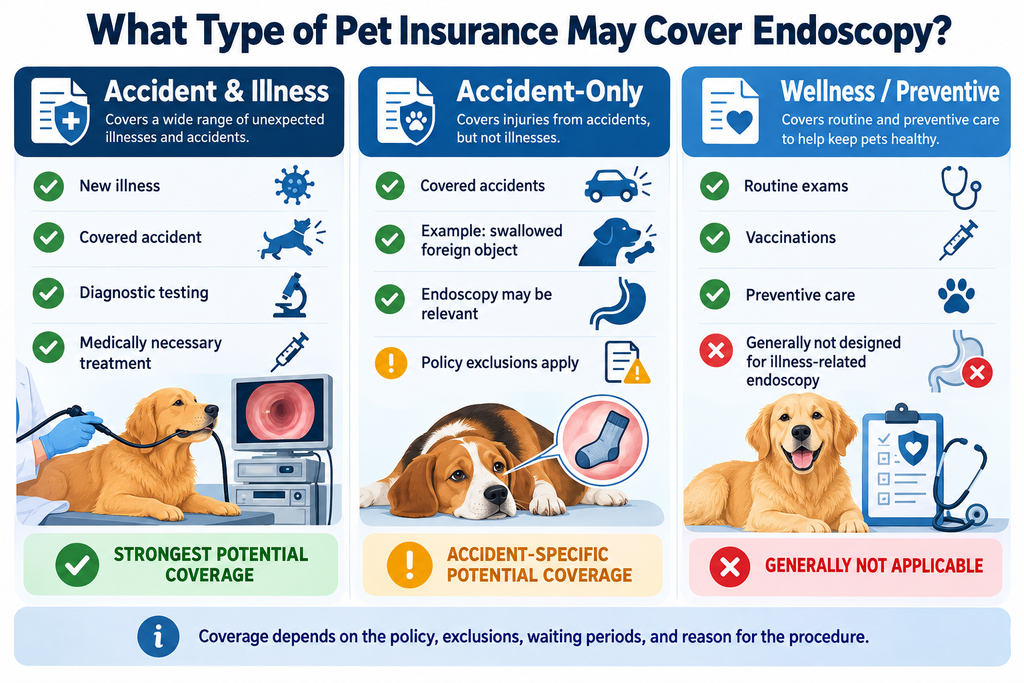
For most pet owners, an accident-and-illness pet insurance plan is the type most likely to cover a medically necessary endoscopy. These plans can cover diagnostic testing and treatment for eligible accidents and illnesses, although the exact coverage depends on your policy, exclusions, waiting periods, and the reason for the procedure.
Accident-only plans may help when an endoscopy is needed because of a covered accident, such as a pet swallowing a foreign object. However, coverage varies by insurer, so don’t assume every foreign-body endoscopy will be covered.
Wellness plans generally aren’t designed to pay for an endoscopy because they focus on routine and preventive care, not treatment for an illness or injury.
The key is that insurers usually look at why your pet needs the endoscopy, not just the name of the procedure. An endoscopy investigating a covered digestive illness may be handled differently from one related to a pre-existing condition.
Before approving the procedure, check your policy for diagnostic coverage, pre-existing-condition exclusions, waiting periods, and any limits or deductibles that could affect your reimbursement.
7 Critical Things to Know Before You Pay
1. Why Your Pet Needs an Endoscopy Matters More Than the Procedure
Insurance generally evaluates the underlying condition or event, not the word “endoscopy” on the invoice.
Endoscopy for an illness. Examples include chronic vomiting, unexplained weight loss, gastrointestinal disease, suspected inflammatory bowel disease, or a digestive tract abnormality. These need an accident-and-illness plan, and the condition must be new.
Endoscopy for an accident. Your dog swallowed a foreign object. A scope can sometimes retrieve an object from the esophagus or stomach and potentially avoid open surgery. Many insurers treat swallowing an object as an accident, so it can qualify even under some accident-only plans. Check your wording.
2. Pre-Existing Conditions Can Get an Endoscopy Claim Denied
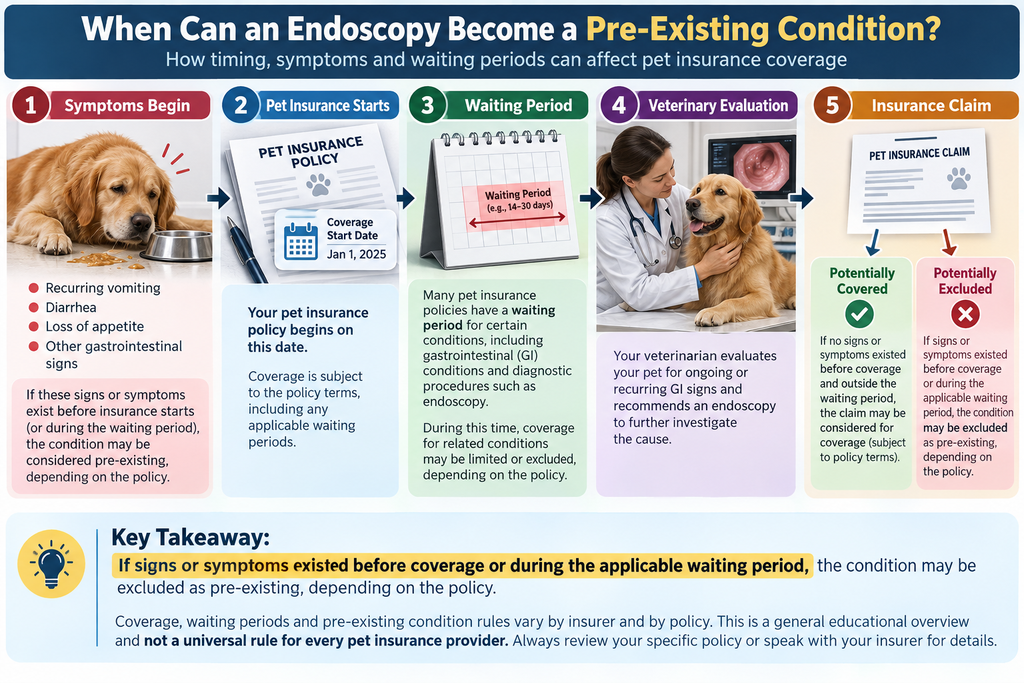
Your pet doesn’t need a formal diagnosis for an insurer to call a condition pre-existing. Insurers commonly define it to include signs, symptoms, or treatment before coverage began, not only a diagnosis.
An example: Before the policy starts, your dog has recurring vomiting. You enroll. Two months later your vet recommends an endoscopy for chronic vomiting. The insurer may check whether those symptoms existed before coverage, and if they did, the claim can be excluded even though the scope happens after enrollment.
| Situation | Coverage Risk |
|---|---|
| Endoscopy for a new covered illness | Lower |
| Endoscopy after a new accident | Potentially covered |
| Symptoms existed before the policy | High |
| Condition appeared during the waiting period | High |
| Previously diagnosed GI disease | High |
General examples, not guaranteed outcomes. A few insurers have exceptions for curable conditions after a symptom-free period, but chronic conditions generally can’t be added back. Read your policy’s definition.
3. Did the Waiting Period End Before Your Pet Needed the Endoscopy?
Waiting periods are separate from pre-existing conditions, and both can block a claim. A waiting period is the gap between your start date and when coverage begins. Accident waiting periods are often shorter than illness ones. One insurer, for example, lists a 0-day wait for accidents and 14 days for illnesses, but yours may differ.
Anything that happens during the waiting period is generally treated as pre-existing. A scope ordered months later for a problem that began inside that window can still be excluded.
Many owners ask, “My vet just recommended an endoscopy. Can I buy insurance today?” You can buy a policy, but it generally won’t solve the current bill, since the problem was already showing before coverage began. More on that below.
4. What Parts of an Endoscopy Does Pet Insurance Actually Pay For?
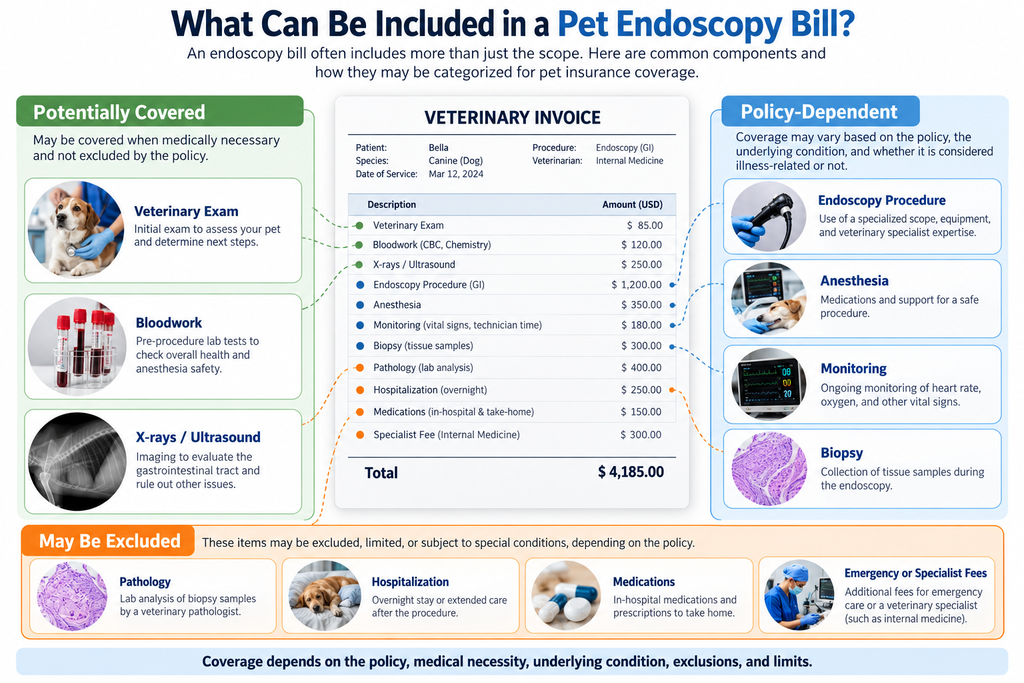
“Does insurance cover endoscopy?” really means “which parts of this estimate will insurance pay?” An endoscopy bill often includes consultation, bloodwork, imaging, anesthesia, monitoring, biopsies, pathology, and hospitalization, not only the scope.
Read Related Article… Dog Biopsy Cost in the USA (2026): Real Prices by Type, Hidden Lab Fees & What the Results Mean
| Expense | May Be Covered? | What Determines It |
|---|---|---|
| Veterinary exam | Potentially | Covered condition and policy |
| Bloodwork | Potentially | Medical necessity |
| X-rays / ultrasound | Potentially | Diagnostic coverage |
| Anesthesia | Potentially | Policy terms |
| Endoscopy | Potentially | Underlying condition |
| Foreign-body removal | Potentially | Accident coverage |
| Biopsy | Potentially | Covered diagnostic work |
| Pathology | Policy-dependent | Check wording |
| Hospitalization | Potentially | Covered treatment |
| Medications | Policy-dependent | Plan terms |
| Emergency fees | Policy-dependent | Policy and exclusions |
5. How Much Does Pet Endoscopy Cost Without Insurance?
Published ranges vary widely. One 2026 source puts dog endoscopy at roughly $1,200–$4,500, and another compiled source puts cat endoscopy at roughly $1,000–$3,700. These are published ranges, not national prices, and they depend on location, hospital, emergency status, procedure type, and what’s included.
What pushes the bill up:
- Emergency or specialty hospitals
- Anesthesia and monitoring
- Biopsies and pathology
- Foreign-body retrieval
- Hospitalization
- A failed endoscopy that becomes surgery
For the detailed breakdown, see our dedicated dog endoscopy cost guide.
6. How Much Will Pet Insurance Pay for an Endoscopy?
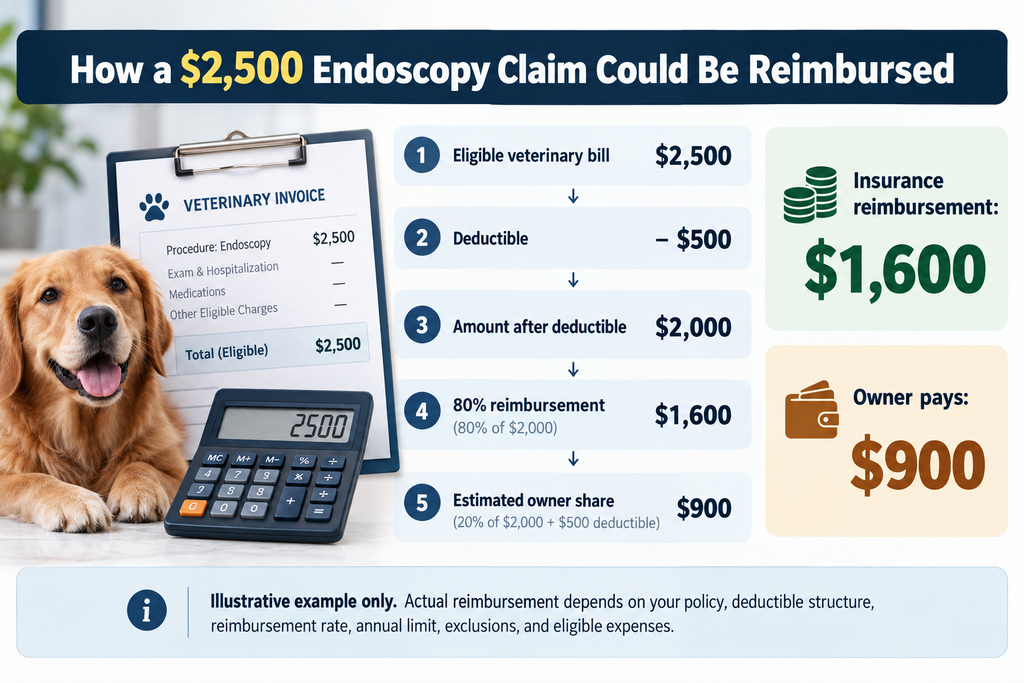
Here’s an illustrative example, assuming a $500 deductible not yet met and 80% reimbursement.
| Item | Amount |
|---|---|
| Eligible bill | $2,500 |
| Minus deductible | −$500 |
| Amount after deductible | $2,000 |
| Reimbursement (80%) | $1,600 |
| Your share | $900 |
This is an example, not a guaranteed payout. Annual limits, deductible structure, reimbursement percentage, and exclusions can change the result. Most insurers also reimburse after you pay the clinic, so expect to cover the bill first and file a claim.
7. What If the Endoscopy Finds Something or Doesn’t Work?
Most basic articles stop at “insurance covers endoscopy.” The next financial problem is what happens after the scope.
Read Related Article… Dog Surgery Cost in the USA: Real Prices for 2026
If your vet takes a biopsy: expect possible add-ons for biopsy collection, pathology or lab analysis, and a follow-up consultation. Confirm pathology coverage in advance.
If a foreign body is removed: endoscopy may remove the object without abdominal surgery, which can keep the total lower.
If the object can’t be removed: your pet may need surgery, and the final bill can become substantially larger. Here’s an illustrative example on the same policy:
| Item | Amount |
|---|---|
| Endoscopy attempt | $2,500 |
| Conversion to surgery, added | $3,500 |
| Total bill | $6,000 |
| After $500 deductible | $5,500 |
| Reimbursement (80%) | $4,400 |
| Your share | $1,600 |
Illustrative only. A surgery that follows a failed retrieval for the same covered event is often handled within the same claim, but ask your insurer to confirm, and watch your annual limit.
Does Pet Insurance Cover Endoscopy for a Foreign Body?
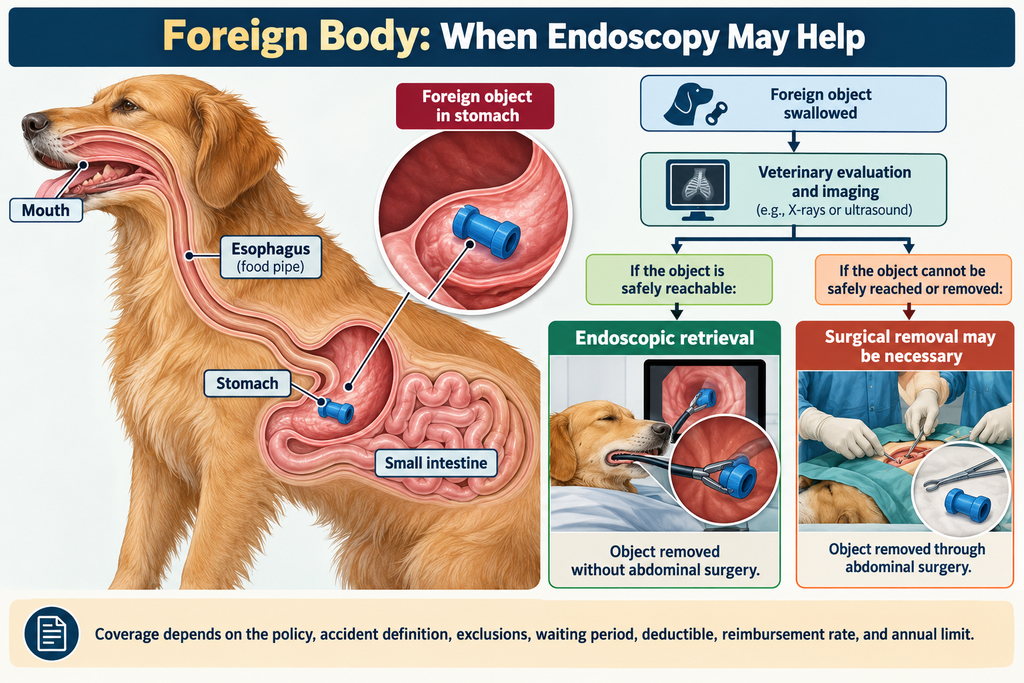
Often, yes—but it depends on your policy and when the foreign-body incident happened. Many pet insurance plans treat swallowing a non-food object as an accident, and accident coverage may include the veterinary treatment needed to remove it. Some insurers specifically list foreign-body ingestion as a covered accident.
If the object is still in the stomach or esophagus, your veterinarian may be able to remove it using an endoscope instead of surgery. If the object has moved into the intestine or cannot be safely retrieved, abdominal surgery may be necessary.
Before assuming insurance will pay, check three things: whether foreign-body ingestion is covered under your plan, whether the incident happened after your policy’s waiting period, and whether the condition could be considered pre-existing. Your deductible, reimbursement percentage, annual limit, and policy exclusions can also affect what you actually receive.
For example, Nationwide currently shows foreign-body ingestion as an accident covered under some accident plans and provides a claim example involving a $3,158 veterinary bill. That is an insurer-specific example—not a guarantee that every plan will cover your pet’s endoscopy.
If your pet may have swallowed a foreign object, contact your veterinarian promptly rather than waiting to see whether insurance approves the claim.
Read Related Article… Dog Foreign Body Surgery Cost: What You’ll Actually Pay in 2026
Endoscopy vs. Surgery: Which Costs More?
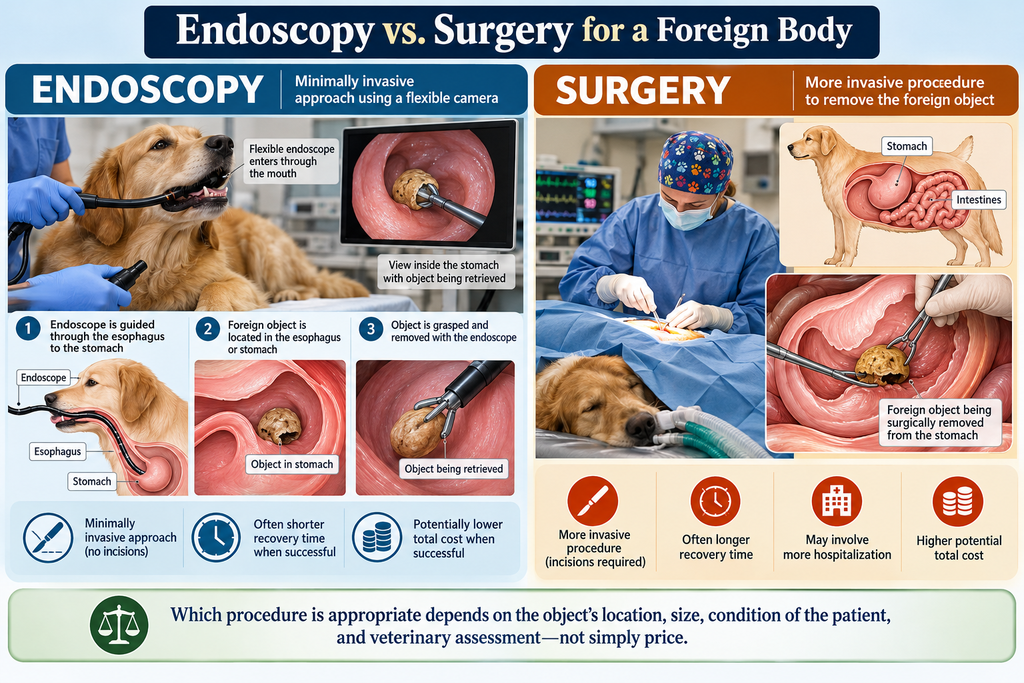
| Endoscopy | Surgery | |
|---|---|---|
| Invasiveness | Minimally invasive, no large abdominal incision in many GI cases | More invasive |
| When it’s used | Objects within reach in the esophagus or stomach; some diagnostics | Intestinal obstructions; objects the scope can’t reach or reme |
| Typical cost | $1,500–$2,800 for endoscopic retrieval | $2,000–$8,500+, depending on whether it’s stomach, intestine, or resection |
| Recovery | Often shorter | Often longer, with more hospitalization |
Prices above come from our foreign body cost guide. Don’t pick a procedure by price. Your veterinarian decides what’s medically appropriate for your pet. See our dog foreign body surgery cost and intestinal blockage surgery cost guides for the surgical breakdown.
Read Related Article… Dog Intestinal Blockage Surgery Cost: $2,000–$10,000 (2026)
Can You Get Pet Insurance After Your Vet Recommends an Endoscopy?
Usually, don’t expect a newly purchased policy to cover an endoscopy for a problem that was already showing symptoms or being investigated before coverage began. The condition would likely be considered pre-existing, and the waiting period adds another barrier. Medical records and symptom history are what insurers review.
Buying a policy can still make sense for future, unrelated accidents and illnesses. It just isn’t a fix for the current bill.
Can Pet Insurance Deny an Endoscopy Claim?
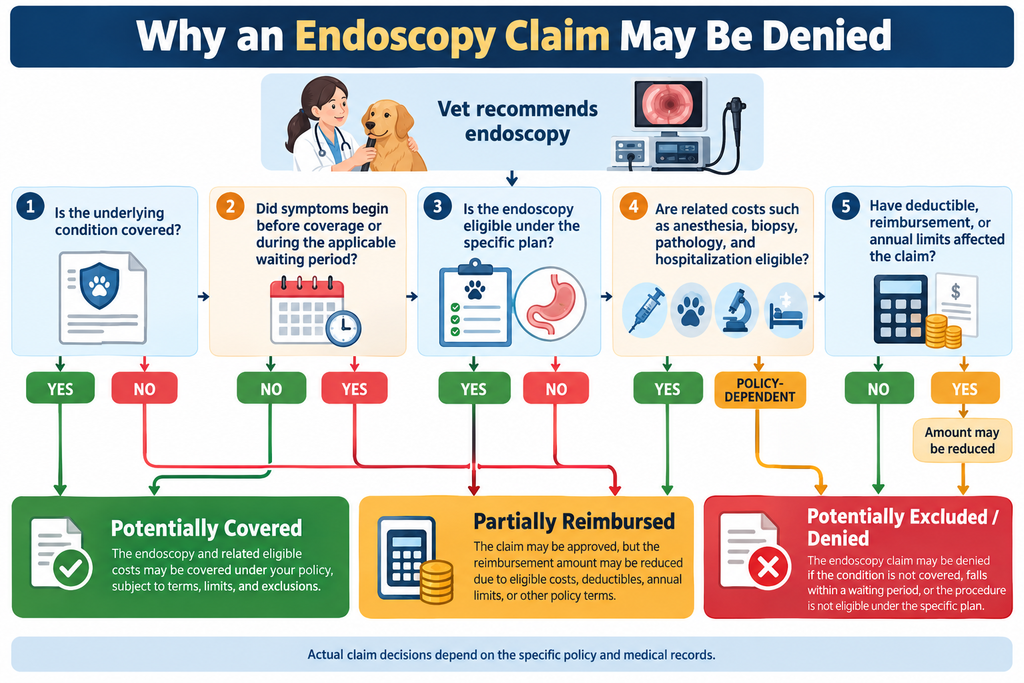
Yes. An endoscopy claim can be denied or only partly reimbursed even if endoscopy itself is a covered procedure. The biggest issue is usually why your pet needs the endoscopy and whether that underlying condition is covered under your policy.
A claim may be denied if:
- your pet had signs or symptoms of the condition before coverage started;
- the problem began during the policy’s waiting period;
- the condition or procedure is specifically excluded;
- the endoscopy isn’t eligible under your particular plan; or
- your policy limits, deductible, or reimbursement rules reduce the amount payable.
For example, if your dog had recurring vomiting before you bought insurance and later needs an endoscopy to investigate it, the insurer may review the medical records and consider the condition pre-existing.
Before approving the procedure, ask your insurer whether the specific condition, endoscopy, anesthesia, biopsy, and any possible follow-up surgery are covered. Coverage ultimately depends on your policy terms, not simply on the name of the procedure.
What to Ask Your Insurer Before the Endoscopy
- Is medically necessary endoscopy covered under my plan?
- Is my pet’s specific diagnosis or event eligible?
- Is this condition considered pre-existing?
- Has the applicable waiting period ended?
- Are anesthesia and monitoring covered?
- Are biopsy and pathology fees covered?
- If the endoscopy fails and surgery is required, is the surgery covered?
- Do I need pre-authorization or a medical records review?
Save the answers in writing. Many insurers won’t guarantee payment in advance, but a written explanation of how they’d treat the condition is still useful.
Is Endoscopy Considered a Diagnostic Test or Surgery for Pet Insurance?
For pet insurance purposes, endoscopy is generally best thought of as a medical procedure that can be used for both diagnosis and treatment—not automatically as surgery. A veterinarian may use an endoscope to look inside the digestive tract, investigate unexplained vomiting or other symptoms, take a biopsy, or sometimes remove a foreign object.
That distinction matters because pet insurance usually looks at why the procedure is being performed and whether the underlying condition is covered, rather than simply labeling the procedure “endoscopy.” Some insurers specifically include endoscopy among covered diagnostic or special procedures, while others determine coverage based on the policy, diagnosis, exclusions, and plan type.
For example, an endoscopy used to investigate a new, covered illness may be eligible for reimbursement. An endoscopy used to remove a swallowed object may also qualify when the accident and related treatment are covered. But if the underlying condition is pre-existing, excluded, or began during a waiting period, the endoscopy may not be covered—even if the procedure itself is normally eligible.
What to Ask Your Vet Before You Approve the Procedure
- What exactly are you looking for?
- Is the endoscopy diagnostic, therapeutic, or both?
- Could the problem require surgery instead?
- Does the estimate include anesthesia?
- Does it include biopsy and pathology?
- What happens if the scope can’t remove the object?
- What’s the expected total cost range?
What If You Can’t Afford the Endoscopy?
If the estimate is more than you can cover, say so early. Ask for an itemized estimate, ask whether payment plans are available, and ask whether a lower-cost diagnostic path is medically reasonable. Ask about veterinary financing like CareCredit or Scratchpay, and about nonprofit or local assistance where applicable. A referral to another appropriate facility can also change the cost.
Don’t delay emergency veterinary care just because you’re waiting for an insurance decision.
Read Related Article… Best Vet Payment Plans in the USA (2026): CareCredit vs Scratchpay
Read Related Article… 15 Organizations That Help Pay Vet Bills When You Can’t Afford Care (2026)
Check These 5 Things Before You Pay
- Why does your pet need the endoscopy? The reason decides eligibility.
- Did symptoms begin before coverage? If so, expect a pre-existing question.
- Has the waiting period ended? Dates matter more than the procedure.
- What’s included in the estimate? Anesthesia, biopsy, and pathology are separate lines.
- What happens if surgery is needed? Ask both your vet and your insurer before you approve.
Frequently Asked Question
Does pet insurance cover dog endoscopy?
Often, yes, if the endoscopy is medically necessary for a covered accident or illness and the applicable waiting period has passed. Pre-existing conditions are generally excluded, and your deductible, reimbursement rate, annual limit, and policy exclusions can affect what you actually receive.
Does pet insurance cover cat endoscopy?
Potentially, yes. The same basic rules apply to cats: the procedure must relate to a covered condition or accident, and applicable waiting periods and exclusions must be satisfied. Check your policy for specific limits, deductibles, and exclusions before approving the procedure.
Does pet insurance cover endoscopy for a swallowed foreign object?
It can, particularly when the swallowed object is treated as a covered accident. However, coverage depends on your specific policy and exclusions. Ask your insurer whether the endoscopy, foreign-body removal, anesthesia, and any follow-up surgery would be covered before treatment.
Does pet insurance cover an endoscopy biopsy?
A medically necessary biopsy may be covered when it is related to a covered condition, but coverage can vary by policy. Ask whether both the biopsy procedure and the laboratory or pathology charges are eligible for reimbursement.
Does pet insurance cover anesthesia for endoscopy?
Anesthesia may be covered when it is medically necessary for a covered endoscopy, but don’t assume every related charge is automatically eligible. Ask your insurer specifically about anesthesia, monitoring, and other procedure-related fees before treatment.
Is endoscopy covered if my pet has a pre-existing condition?
Usually, treatment related to a pre-existing condition isn’t covered. Insurers may consider symptoms or signs that existed before enrollment or before the waiting period, even if the condition wasn’t formally diagnosed yet. Some insurers have limited exceptions, so check your policy.
Can I buy pet insurance after my vet recommends an endoscopy?
You can still purchase pet insurance for future eligible accidents and illnesses, but don’t expect a new policy to cover the problem that already caused the endoscopy recommendation. If symptoms existed before coverage or during the waiting period, the condition may be excluded as pre-existing.
How much does pet endoscopy cost without insurance?
The cost can vary substantially depending on your location, hospital, procedure, anesthesia, biopsies, pathology, and whether additional treatment is needed. Rather than relying on a single national figure, ask your veterinarian for an itemized estimate showing exactly what is included.
What happens if endoscopy turns into surgery?
If an endoscopy cannot resolve the problem, surgery may be necessary and can significantly increase the bill. Whether that surgery is covered depends on the underlying condition, policy terms, exclusions, and remaining coverage limits. Ask your insurer before treatment when possible.
External Authority Sources
- MetLife Pet Individual insurer policy pages and pre-existing condition definitions
- ASPCA Individual insurer policy pages and pre-existing condition definitions
- PetPlace biopsy coverage explainer
- NAPHIA (waiting periods and pre-existing conditions)
- State insurance department / NAIC consumer resources
- AVMA (medical-necessity framing, kept minimal)
Disclaimer: This article is for informational and educational purposes only. Coverage varies by insurer, plan, state, and the specific wording of your policy, and nothing here guarantees a claim outcome. Cost figures are 2026 planning ranges and will vary by clinic, location, and what’s included. PetInsurePrime does not sell pet insurance and receives no compensation from any insurance provider. Always read your policy documents carefully and confirm coverage with your insurer when possible.
PetInsurePrime | Independent • Research-Based | Helping US dog owners understand real vet costs and coverage options — without the sales pressure.