Updated: July 2026 | Reading Time: 24 Minutes
A simple dog X-ray can cost anywhere from under $200 to well over $800 depending on what your dog needs. Knowing what’s included before you approve the test can save you from an expensive surprise.
The number you’ll find most often online — $150 to $250 — is real, but incomplete. It reflects the imaging fee for a standard two-view study. What it typically doesn’t include is the exam fee you already paid to walk in the door, any sedation your dog might need to stay still, additional views if the first set isn’t definitive, or the processing and interpretation fees some clinics charge separately.
Quick Answer Dog X-Ray Cost in the USA
The national average cost of a dog X-ray is $213, with typical prices ranging from $169 to $388, depending on location, sedation needs, and how many images are required. That average reflects a standard two-view study at a regular vet clinic during normal business hours. Emergency clinic X-rays run higher — $150 to $600 — due to facility premiums and after-hours staffing costs. Dental X-rays are significantly more expensive because they require general anesthesia. Sedation, when needed, adds $40–$400 depending on dog size and sedation type.
At a Glance: 2026 Dog X-Ray Cost Summary
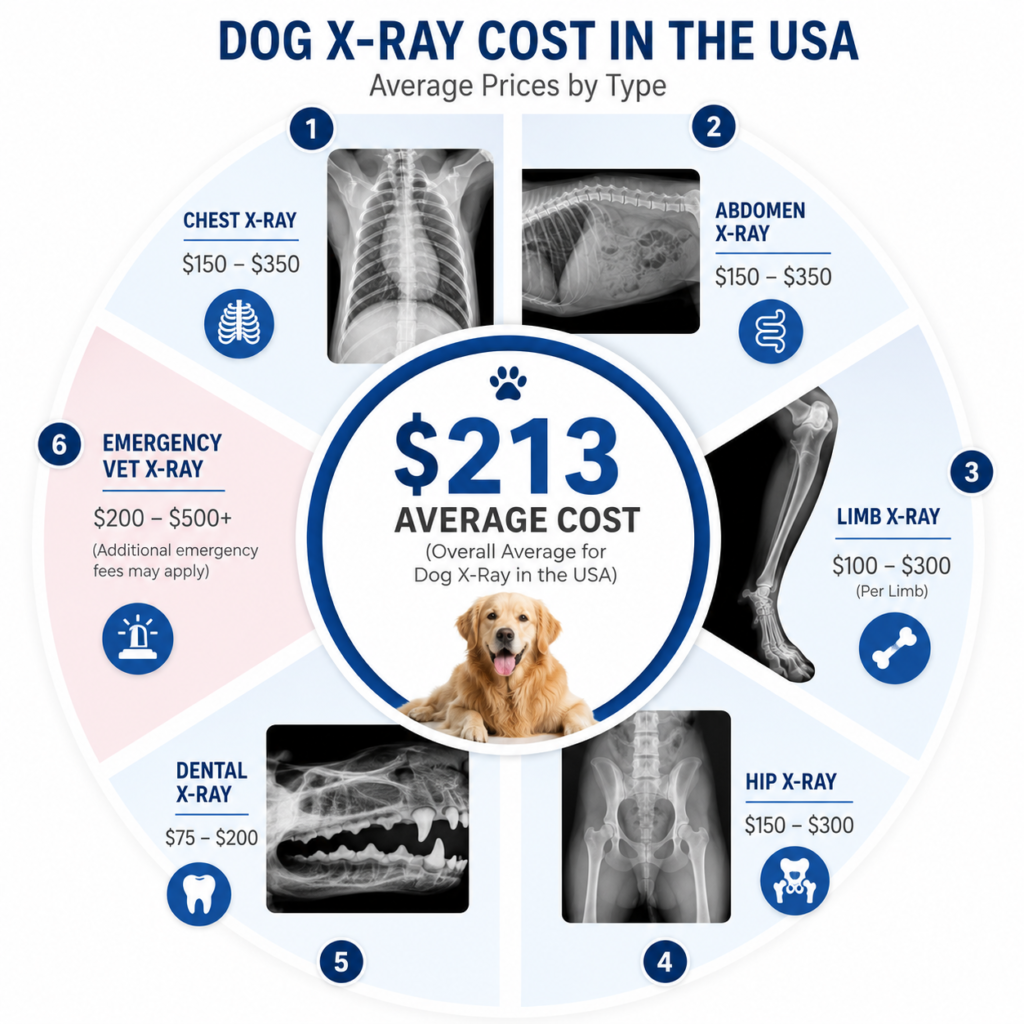
| X-Ray Type | Cost Per Session | Sedation Usually Needed? |
|---|---|---|
| Chest (thorax) — 2 views | $150 – $300 | ❌ Rarely |
| Abdomen — 2–3 views | $175 – $350 | ❌ Sometimes |
| Limbs / paws — 2 views | $100 – $250 | ❌ Rarely |
| Hip / pelvis | $150 – $350 | ⚠️ Sometimes |
| Spine / vertebrae | $200 – $450 | ✅ Often |
| Skull / head | $200 – $450 | ✅ Often |
| Dental (full mouth) | $150 – $500+ | ✅ Always (general anesthesia) |
| Whole-body / multi-area | $350 – $650+ | ⚠️ Depends on dog |
| Emergency vet X-ray (any type) | $150 – $600 | ⚠️ Depends |
These are imaging fees only. Exam fee, sedation, and interpretation charges are typically billed separately.
Table of Contents
- What Does a Dog X-Ray Actually Cost at a Regular Vet?
- Dog X-Ray Cost by Body Part — Real Ranges for Each Area
- The Sedation Variable: When It’s Needed and What It Adds
- Dog Dental X-Ray Cost — Why It’s in a Different Price Category
- Emergency Vet X-Ray Cost vs Regular Vet
- What’s Hidden in the Quote — Charges That Show Up Separately
- How Dog Size Affects X-Ray Cost
- Does Pet Insurance Cover Dog X-Rays?
- How To Reduce Your Dog’s X-Ray Cost
- When an X-Ray Isn’t Enough — What Comes Next
- Action Checklist
- FAQ
What Does a Dog X-Ray Actually Cost at a Regular Vet?
A 2025 survey conducted across all 50 states and Washington, D.C. found the national average cost for dog X-rays is $213, ranging from $169 to $237. That number represents the imaging fee for a standard two-view study — two images taken from different angles of the same body area — at a regular daytime veterinary clinic.
That average typically reflects a standard two-view study. Your vet almost always needs at least two views to get a useful picture of what’s going on inside your pet. If the problem area is complex, or if your vet needs to image multiple body parts, expect the cost to climb because each additional set of views adds to the bill.
Cost by facility type:
| Facility Type | X-Ray Cost Range | Notes |
|---|---|---|
| Regular vet clinic (daytime) | $100 – $300 | Most affordable option |
| Urgent care vet clinic | $150 – $400 | Moderate premium, no overnight surcharge |
| Emergency / 24-hour animal hospital | $150 – $600 | Highest due to staffing and overnight premium |
| Specialty / referral hospital | $200 – $500 | Specialist interpretation on-site |
| University teaching hospital | $100 – $250 | Often lowest; volume-based pricing |
When possible, scheduling X-rays through your regular vet during normal business hours is the most affordable route. But if your pet is in acute distress, limping badly after a fall, or showing signs of a serious problem like a bloated abdomen, the emergency clinic is the right call regardless of cost.
Geographic variation:
Where you live changes the number significantly. A vet practicing in New York City or San Francisco will likely charge significantly more than a Midwestern small town vet. Urban metro areas typically run 25–40% above the national average. Rural clinics and smaller cities tend to sit at or below the $213 average.
Dog X-Ray Cost by Body Part — Real Ranges for Each Area
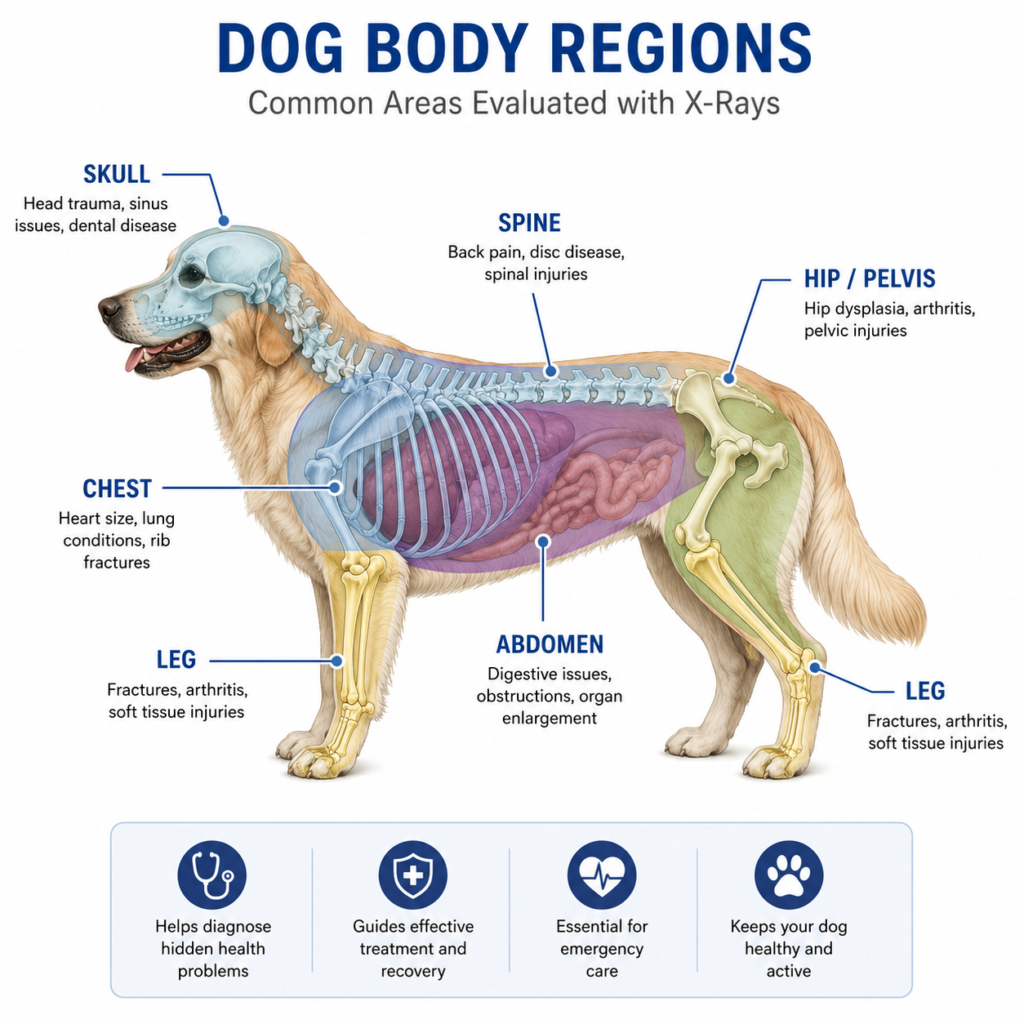
Not all X-rays cost the same. The body part being imaged affects how many views are needed, how difficult it is to position the dog, and whether sedation is required — all of which affect the total cost.
Chest (thorax) X-ray: One of the most common veterinary X-rays. Used to evaluate the lungs, heart size, trachea, ribs, and surrounding structures. If your dog is coughing or having breathing problems, a chest X-ray can help identify conditions such as fungal infection, bronchitis, pneumonia, a mass, or heart problems. Chest X-rays are also part of cancer staging workups to check for lung spread.
Cost: $150 – $300. Two views (lateral and ventrodorsal) are standard. Sedation is rarely needed for chest films — most dogs tolerate the positioning without chemical restraint.
Abdominal X-ray: Used for suspected foreign body ingestion, bladder stones, organ enlargement, intestinal obstruction, and pregnancy confirmation. Many vets X-ray pregnant dogs to see how many puppies the mother is carrying and to compare fetus size to the pelvic canal.
Cost: $175 – $350. Two to three views are standard. Sedation occasionally needed for anxious dogs or those in significant pain.
Limb and paw X-rays: The most straightforward X-rays to perform. Used for fractures, joint disease, bone tumors, and soft tissue swelling assessment. A dog paw X-ray is much easier than an X-ray of the head or tail — positioning is simpler and dogs typically tolerate it without sedation.
Cost: $100 – $250 per limb/area. Two views standard. Sedation rarely needed unless the dog is in significant pain.
Hip and pelvis X-rays: Hip X-rays are commonly used for hip dysplasia evaluation — a procedure often required for breeding clearances through the Orthopedic Foundation for Animals (OFA). OFA-standard hip views require specific positioning that is difficult or impossible to achieve without full muscle relaxation. In instances such as assessing a dog for hip dysplasia, a pet may be too uncomfortable to stay still during an X-ray without anesthetic.
Cost: $150 – $350 for standard hip views. OFA evaluation films may run higher ($200–$450) due to positioning requirements and submission fees. Sedation or light anesthesia frequently required.
Spine X-rays: Used for intervertebral disc disease, spinal arthritis, vertebral fractures, and neurological symptom investigation. Spinal X-rays require precise positioning — the dog must be perfectly straight — which is very difficult without sedation.
Cost: $200 – $450. Multiple views often needed. Sedation almost always required. For suspected disc herniation, a CT or MRI typically follows if X-rays show abnormalities.
Skull and head X-rays: Less commonly performed since CT scanning provides far superior detail of the skull and surrounding structures. When used, skull X-rays assess facial fractures, nasal structures, and the bony components of the ear canal.
Cost: $200 – $450. Sedation almost always required due to positioning demands.
| Body Area | Cost Range | Sedation Typical? | Common Indications |
|---|---|---|---|
| Chest / thorax | $150 – $300 | ❌ Rarely | Cough, breathing issues, heart disease, cancer staging |
| Abdomen | $175 – $350 | ❌ Sometimes | Foreign body, stones, organ size, pregnancy |
| Limbs / paw | $100 – $250 | ❌ Rarely | Fractures, joint disease, lameness |
| Hip / pelvis | $150 – $350 | ⚠️ Frequently | Hip dysplasia, OFA evaluation, trauma |
| Spine | $200 – $450 | ✅ Usually | IVDD, disc disease, back pain, neurological signs |
| Skull / head | $200 – $450 | ✅ Usually | Facial trauma, ear canal, nasal disease |
| Multiple areas | $300 – $650+ | ⚠️ Depends | Trauma survey, cancer staging, full orthopedic eval |
The Sedation Variable: When It’s Needed and What It Adds
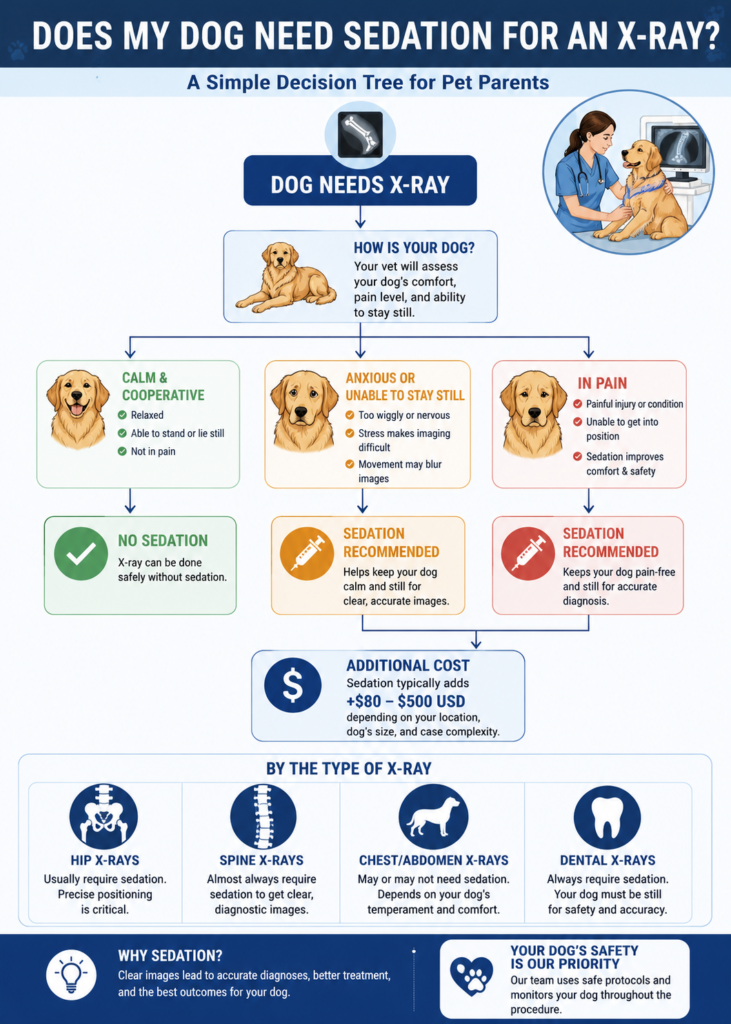
Sedation is the single most misunderstood cost variable in dog X-ray pricing. Whether your dog needs it — and how much it adds — depends on the body area, the dog’s temperament, and the level of pain involved.
Not all X-rays require sedation. A standard X-ray or ultrasound does not require sedation. Some vets may hold a dog in place with special padded devices for standard X-rays.
Big, excitable, or painful dogs may need sedation to lie still, especially for hip, spine, or elbow films. Sedation rarely comes as part of the basic X-ray fee.
When sedation is and isn’t required:
| Situation | Sedation Needed? |
|---|---|
| Calm dog, simple limb or chest X-ray | ❌ Rarely |
| Anxious or excitable dog, any X-ray | ⚠️ Often |
| Dog in significant pain | ⚠️ Frequently |
| Hip dysplasia / OFA evaluation films | ✅ Almost always |
| Spine or skull X-rays | ✅ Almost always |
| Dental X-rays | ✅ Always (general anesthesia) |
| Emergency trauma patient in shock | ❌ Often skipped — urgency overrides |
What sedation actually costs:
Sedation for these procedures can run between $31 and $444, depending on the size of the dog and the type of sedation used.
| Sedation Type | Cost Range | Used For |
|---|---|---|
| Light oral sedation (trazodone/gabapentin pre-visit) | $20 – $60 | Anxious dogs; prescribed in advance |
| Injectable mild sedation (dexmedetomidine) | $50 – $150 | Most standard X-ray sedation needs |
| Full general anesthesia with monitoring | $200 – $500 | Hip OFA films, spine, skull, dental |
| Anesthesia for large dogs (70+ lbs) | $300 – $500+ | Weight-based drug dosing increases cost |
Standard sedation for a larger dog costs around $250. A full general anesthetic can cost from $200–$400. Prices vary depending on the local area.
Read Related Article… Dog Surgery Cost in the USA: Real Prices for 2026
The pre-sedation bloodwork question:
If sedation is needed, a vet may check your dog’s health with a blood test first to confirm organ function is adequate for sedation. This pre-anesthetic bloodwork runs $75–$200 and is an additional charge not included in the X-ray or sedation fee. For older dogs or those with known health conditions, this screening is genuinely important — but it’s worth knowing it will appear as a separate line item.
Dog Dental X-Ray Cost — Why It’s in a Different Price Category
Dental X-rays are genuinely different from body X-rays in both procedure and cost structure. Dental X-rays use different, smaller equipment designed to capture individual teeth and jaw structures and are almost always performed under general anesthesia because your pet needs to be completely still with their mouth held open.
The anesthesia alone is a significant portion of the dental bill, often $200 to $500 or more depending on your pet’s size and health. The dental X-rays themselves are then layered on top of that cost.
Dental X-ray cost breakdown:
| Component | Cost Range |
|---|---|
| Dental exam (separate from general exam) | $50 – $150 |
| Pre-anesthetic bloodwork | $75 – $200 |
| General anesthesia (weight-based) | $200 – $500 |
| Dental X-rays (full mouth series) | $150 – $300 |
| Dental cleaning (often done simultaneously) | $150 – $400 |
| Total dental X-ray visit (all-in) | $500 – $1,200+ |
Dental X-rays for dogs cost $40 to $125 per image, but a full-mouth series requires 8–12 individual images to capture the complete dentition. The imaging fee alone for a full series runs $150–$500.
The reason dental X-rays require general anesthesia — not just sedation — is that a cooperative, still patient with an open mouth and a small sensor precisely positioned between the teeth is simply not achievable any other way. If your dog has a serious dental problem, X-rays may be the only way for your veterinarian to know exactly what’s going on under the gums.
The practical implication: dental X-rays are almost never a standalone visit. They’re typically performed during a scheduled dental cleaning under the same anesthetic event, which is why the all-in cost for a “dental X-ray visit” includes cleaning, anesthesia, bloodwork, and imaging together.
Emergency Vet X-Ray Cost vs Regular Vet
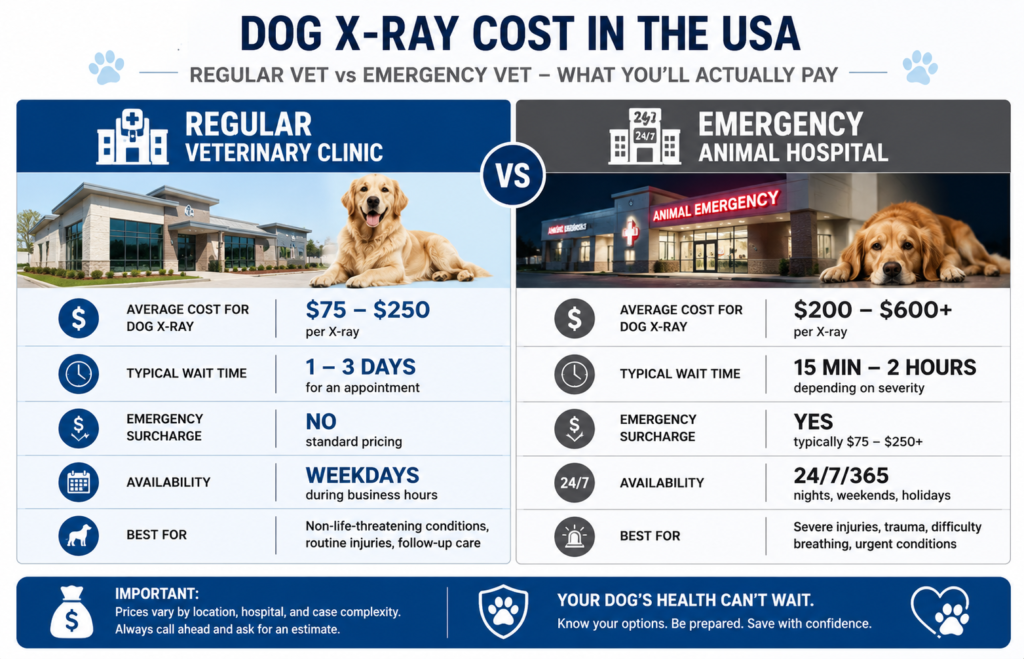
The same two-view chest X-ray that costs $175 at your regular vet on a Tuesday morning can cost $350–$500 at a 24-hour emergency hospital at 10 PM on a Saturday. The imaging quality is the same. The cost difference comes from overhead.
Emergency facilities charge more across the board because they operate around the clock with specialized staffing. Basic imaging at an emergency vet typically runs $150 to $600, a range that reflects both the urgency surcharge and the fact that emergency cases often require more views or additional diagnostics like ultrasound.
Cost comparison for common X-ray scenarios:
| Scenario | Regular Vet | Emergency Vet |
|---|---|---|
| Single limb X-ray (fracture suspected) | $100 – $200 | $200 – $400 |
| Chest X-ray (cough, breathing issue) | $150 – $300 | $250 – $500 |
| Abdominal X-ray (foreign body) | $175 – $350 | $250 – $550 |
| Multi-view trauma survey (hit by car) | $250 – $450 | $400 – $700 |
The after-hours surcharge at most emergency clinics ($50–$200) applies to every service, not just the exam. That means the X-ray fee, the bloodwork, and any treatments all carry the same premium.
When the emergency premium is unavoidable:
A dog hit by a car, showing respiratory distress, or with a distended abdomen cannot safely wait for morning. In those situations, the cost difference is irrelevant — immediate care is the priority.
When you can avoid the emergency premium:
A dog limping mildly with no history of trauma, who is weight-bearing and otherwise alert, can often wait for a same-day appointment at your regular vet or an urgent care clinic that opens at 7–8 AM. That decision can save $150–$300 on the imaging alone.
What’s Hidden in the Quote — Charges That Show Up Separately
The X-ray fee your vet quotes over the phone is usually just the imaging cost. Several additional charges appear on the final invoice that owners don’t anticipate.
Exam fee: Most clinics charge an exam fee before any imaging is authorized. A standard vet exam runs $50 to $150, and a sick visit exam can cost $75 to $300 depending on how involved the evaluation is. This fee is charged regardless of how straightforward the X-ray turns out to be.
Multiple views: The body part being scanned can affect the cost. More complex areas, such as joints, teeth, and the spine, often need to be looked at from multiple angles. A two-view study is standard. If the images aren’t diagnostic — the dog moved, the positioning wasn’t ideal, or the vet needs another angle — additional views are taken at additional cost ($50–$150 per extra view).
Read Related Article… Emergency Vet Costs in the USA (2026): What You’ll Really Pay by State
Image interpretation / radiologist fee: Some clinics — particularly general practices that don’t have a radiologist on staff — send images to an external veterinary radiologist for interpretation. This adds a separate fee of $75–$200 to the invoice. Specialty hospitals with in-house radiologists typically bundle this into the imaging price.
Sedation (when needed): Rarely included in the quoted X-ray price. Adds $50–$500 depending on type and dog size.
Pre-sedation bloodwork: Required before anesthesia in most clinics for dogs over a certain age or with known health conditions. Adds $75–$200.
Supplies and handling fees: IV catheter placement ($40–$75), biohazard disposal ($5–$15), and processing fees ($10–$30) sometimes appear as separate line items on emergency clinic invoices.
Full realistic cost of a dog X-ray visit:
| Scenario | Line Items | Realistic Total |
|---|---|---|
| Calm dog, limb X-ray, no sedation | Exam + 2-view X-ray | $175 – $380 |
| Anxious dog, chest X-ray, mild sedation | Exam + X-ray + sedation | $300 – $550 |
| Hip dysplasia OFA films (anesthesia needed) | Exam + bloodwork + anesthesia + X-ray | $450 – $900 |
| Emergency trauma survey (no sedation) | Emergency exam + surcharge + 4-view survey | $500 – $900 |
| Dental X-ray with cleaning | Exam + bloodwork + anesthesia + imaging + cleaning | $600 – $1,200+ |
How Dog Size Affects X-Ray Cost
Dog size affects X-ray cost in two distinct ways — imaging coverage and sedation dosing.
Imaging coverage: Larger dogs might need additional X-rays to cover a full area. A single chest X-ray captures the full thorax of a 20-pound Beagle in two views. A 100-pound Great Dane’s chest may require additional exposures to image completely, particularly for the lateral (side) view. Each additional image adds to the total.
Sedation dosing: Sedation drugs are dosed by body weight. If anesthesia is needed, large dogs require more, which can increase costs. A 25-pound dog sedated with dexmedetomidine and butorphanol may require $60–$80 in drugs. The same protocol for a 100-pound dog runs $150–$250 in drug costs alone — before the monitoring and administration fees.
Size-based cost comparison (same X-ray type):
| Dog Size | Imaging Cost | Sedation Cost (if needed) | Typical Total |
|---|---|---|---|
| Small (under 25 lbs) | $100 – $200 | $40 – $100 | $140 – $300 |
| Medium (25–60 lbs) | $150 – $280 | $80 – $200 | $230 – $480 |
| Large (60–100 lbs) | $175 – $350 | $150 – $350 | $325 – $700 |
| Giant (over 100 lbs) | $200 – $400 | $200 – $500 | $400 – $900 |
For routine chest or limb X-rays without sedation, size matters less — the imaging fee variation is modest. For procedures requiring anesthesia (dental X-rays, OFA hip films, spinal series), size becomes the most significant cost variable.
Does Pet Insurance Cover Dog X-Rays?
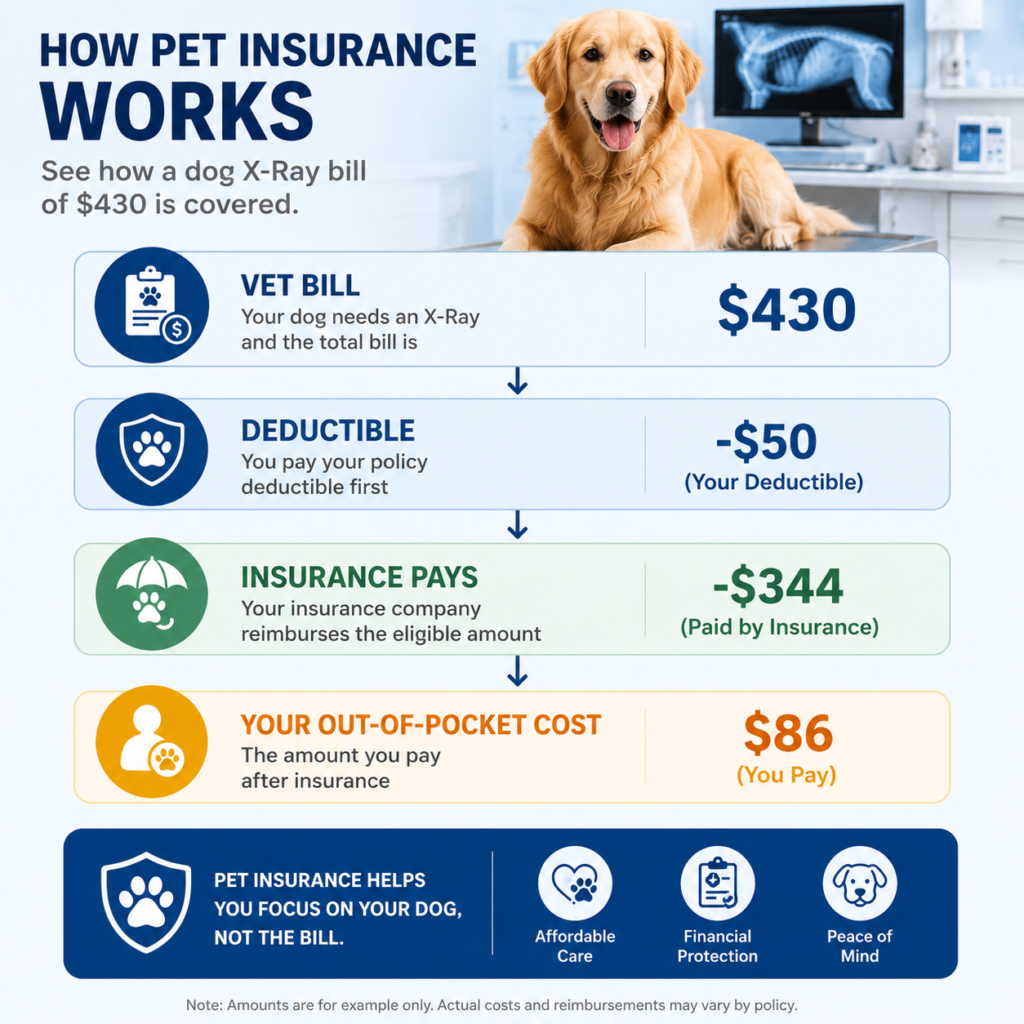
Yes — most comprehensive accident-and-illness pet insurance plans cover X-rays as diagnostic imaging when the X-ray is medically necessary to diagnose or treat a covered condition.
Coverage by plan type:
| Plan Type | X-Ray Coverage |
|---|---|
| Accident & Illness (comprehensive) | ✅ Covers X-rays for both injuries and illnesses |
| Accident-only | ✅ Covers X-rays for injuries; not illness-related |
| Wellness / preventive add-on | ⚠️ May cover routine dental X-rays only |
| Routine care plan | ❌ Typically covers wellness only |
What’s typically included in a covered X-ray claim:
- The X-ray imaging fee
- Sedation or anesthesia required for the imaging (at most insurers)
- Exam fee associated with the visit (varies by insurer — some exclude exam fees)
- Additional views taken during the same visit
- Radiologist interpretation fee
Reimbursement math on a real visit:
Dog with suspected leg fracture: exam fee ($120) + two-view X-ray ($220) + mild sedation ($90) = $430 total.
- Annual deductible: $250 (first claim of the year, so full deductible applies)
- Eligible after deductible: $180
- At 80% reimbursement: $144 back
- Your out-of-pocket: $286
Same visit, later in the policy year after deductible is already met:
- Eligible: $430
- At 80% reimbursement: $344 back
- Your out-of-pocket: $86
The deductible timing matters significantly for smaller bills like X-rays. An X-ray early in the policy year — before the deductible is met — may see little to no reimbursement on a moderate bill. The same X-ray later in the year, with deductible already satisfied from a prior visit, returns most of the cost.
What pet insurance won’t cover for X-rays:
- X-rays for pre-existing conditions
- Routine dental X-rays under standard plans (wellness add-on required)
- X-rays taken during the waiting period
- Purely preventive screening X-rays without clinical signs
How To Reduce Your Dog’s X-Ray Cost
1. Schedule with your regular vet, not the emergency clinic, when the situation allows. When possible, scheduling X-rays through your regular vet during normal business hours is the most affordable route. The imaging quality is identical. The cost difference for the same two-view study can be $100–$300.
2. Ask whether sedation is likely before the appointment. If sedation is probable, ask your vet whether a mild oral pre-visit sedative (trazodone or gabapentin, prescribed in advance) could substitute for injectable sedation at the clinic. Pre-visit oral sedation costs $20–$40 in medications and can sometimes replace $100–$200 in injectable sedation fees.
3. Ask what the all-in cost will be — not just the X-ray fee. Get a specific estimate covering exam fee, imaging, sedation if expected, any bloodwork required, and interpretation. The difference between the quoted imaging fee and the actual invoice can be $100–$300.
4. Ask whether the X-ray is truly necessary as the first step. For some presentations — a lump on the skin, for example — an X-ray may be less useful than a fine needle aspirate ($50–$150). For a dog limping mildly after a known minor incident, a physical orthopedic exam may be diagnostic without imaging. Your vet will be honest if you ask directly: “Would it be reasonable to start with a physical exam alone and add imaging only if needed?”
5. Ask about OFA submission if hip X-rays are for breeding evaluation. If you’re paying for OFA hip evaluation films, confirm whether your vet submits the X-rays to OFA directly or whether you need to handle submission separately. OFA submission fees ($35–$45 per evaluation) are not included in the clinic’s imaging fee.
6. Check whether the pre-anesthetic bloodwork can use results from a recent visit. If your dog had bloodwork at a wellness visit in the past 2–4 weeks, some clinics will accept recent results rather than requiring a repeat panel. Ask specifically — this saves $75–$200 on sedation-required X-ray visits.
7. Apply for CareCredit before large planned X-ray visits. For dental X-rays or OFA evaluation films where the total visit cost is predictably high ($500–$1,200), having CareCredit already in place eliminates the at-desk financing scramble. Apply online before the appointment.
When an X-Ray Isn’t Enough — What Comes Next
X-rays answer a lot of questions, but not all of them. Knowing when your vet is likely to recommend additional imaging after an X-ray helps you mentally and financially prepare for what the full diagnostic journey might cost.
When X-rays typically settle the question:
- Obvious fractures — a clean bone break is usually definitive on X-ray
- Foreign body confirmation — most swallowed objects (metal, dense plastic, bone) show clearly
- Bladder or kidney stones — most mineral-based stones are visible on abdominal X-ray
- Pregnancy litter count — fetal skeletons are visible after day 45 of gestation
- Lung patterns — pneumonia, mass lesions, and heart enlargement are usually visible
When X-rays frequently lead to additional imaging:
- Soft tissue masses — an X-ray shows a mass exists but not what it is; ultrasound or CT follows
- Spinal disease — X-rays show vertebrae but not disc material or spinal cord; CT or MRI typically needed for surgical planning
- Abdominal organ detail — X-ray shows organ size but not internal structure; ultrasound added for detail
- Nasal disease — X-rays are inadequate for nasal tumor detail; CT is the standard next step
- Small or subtle fractures — hairline fractures and chip fractures sometimes not visible on X-ray; CT confirms
Cost escalation to expect:
| Follow-Up Test | Cost Range | When Added After X-Ray |
|---|---|---|
| Ultrasound | $250 – $600 | Soft tissue, organ detail, abdominal mass |
| CT scan (all-in) | $750 – $2,500 | Surgical planning, nasal, spinal, cancer staging |
| MRI (all-in) | $1,800 – $4,500 | Brain, spinal cord, neurological conditions |
| Biopsy / FNA | $50 – $500 | Confirm mass type after imaging identifies it |
If your vet says “let’s start with X-rays and see what we find,” it’s reasonable to ask: “If the X-ray shows something, what’s the next step likely to be, and what would that cost?” Getting that answer before the first imaging step helps you plan financially for the full diagnostic journey rather than absorbing each new cost as a surprise.
Action Checklist

Before the X-ray appointment:
- Ask your vet: “What is the all-in cost including exam, imaging, any sedation, and interpretation?”
- Ask: “Is sedation likely for this type of X-ray with my dog?”
- Ask: “If the X-ray shows something, what is the likely next step and its cost?”
- If sedation is expected, ask whether oral pre-visit sedation could substitute for injectable sedation
- Check whether recent bloodwork (within 2–4 weeks) can be used instead of a new pre-sedation panel
- Confirm your pet insurance deductible status — have you met your annual deductible yet this year?
- Apply for CareCredit before planned high-cost visits (dental X-ray, OFA films)
At the appointment:
- Confirm the all-in estimate at check-in before authorizing the procedure
- Ask the vet to document why the X-ray is medically necessary — this supports your insurance claim
- Request copies of all images and the written report for your records
After the appointment:
- Request an itemized invoice — not just a total
- Submit your insurance claim promptly with complete documentation
- If additional imaging was recommended, research whether a university veterinary hospital offers it at lower cost
Frequently Asked Questions
How much does a dog X-ray cost in the USA?
The average dog X-ray costs about $213 in the USA, with most standard X-rays ranging from $169–$388. Emergency clinics may charge $150–$600, while the total visit—including the exam, sedation (if needed), and interpretation—often costs $300–$600.
Does my dog need sedation?
Not always. Most chest, limb, and abdominal X-rays don’t require sedation if your dog stays still. Sedation is more common for hip, spine, skull, dental X-rays, or dogs that are anxious, painful, or unable to remain still.
Can a dog eat or drink before an X-ray?
If sedation or anesthesia is planned, your vet may ask you to withhold food for 8–12 hours beforehand. Water is usually allowed unless instructed otherwise. For X-rays without sedation, fasting is often unnecessary.
Are dog X-rays safe?
Yes. Modern veterinary X-rays use very low levels of radiation and are considered safe when performed only when medically necessary. The benefits of diagnosing injuries or disease usually outweigh the minimal radiation exposure.
How much does sedation add to a dog X-ray cost?
Sedation for these procedures can run between $31 and $444, depending on the size of the dog and the type of sedation used. Light injectable sedation for an average-sized dog typically adds $80–$150. Full general anesthesia for large dogs or dental/hip X-rays adds $200–$500.
Why does my dog need multiple X-ray views?
Your vet almost always needs at least two views to get a useful picture of what’s going on inside your pet. A single flat image cannot reliably determine depth, exact location, or three-dimensional relationship of structures. Two or three views from different angles give the vet a complete picture — and each additional view is billed separately.
What You Should Do Next
If your vet just recommended an X-ray — ask the all-in question before you leave the room: “What will this visit cost in total, including the exam, imaging, any sedation that might be needed, and interpretation?” That one question eliminates the most common billing surprise.
If the X-ray is planned and non-urgent — check whether your regular vet can perform it during normal business hours before assuming you need to go to a specialty or emergency clinic. For the same diagnostic result, you’ll pay meaningfully less.
And if you don’t have pet insurance yet — a dog X-ray visit running $400–$900 after exam, sedation, and interpretation is a reasonable demonstration of why it matters. A comprehensive plan at $40–$70/month covers X-rays, bloodwork, diagnostics, and everything that follows. The time to set that up is before the next limping episode or accidental ingestion — not during one.
External Authority Sources
- CareCredit Dog X-Ray Cost Guide
- PetMD — X-Rays for Dogs
- GoodRx Pet Health — How Much Does a Dog X-Ray Cost
- Orthopedic Foundation for Animals (OFA)
- AVMA (American Veterinary Medical Association)
Disclaimer: This article is for informational and educational purposes only. Cost data reflects 2026 national averages from NAPHIA, Insurify, and MetLife Pet Insurance and will vary based on your dog’s age, breed, location, and the specific plan you choose. PetInsurePrime does not sell pet insurance and receives no compensation from any insurance provider. Always compare multiple quotes and read your policy documents carefully before enrolling.
PetInsurePrime | Independent • Research-Based | Helping US dog owners understand real vet costs and coverage options — without the sales pressure.